

6 Acetic Acid: What It Means and Where It Fits in Research
What does “6 acetic acid” tell you about the bottle on your bench? Not much,
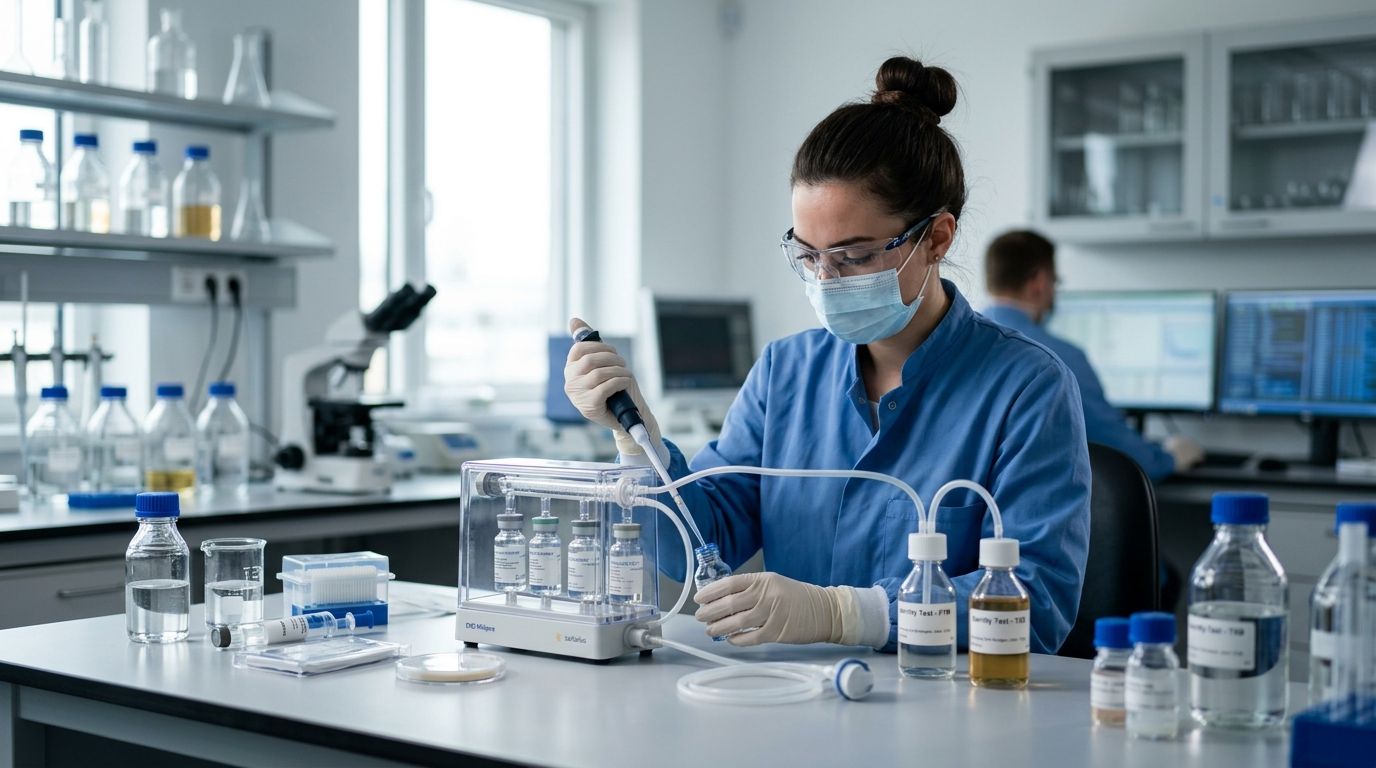
Sterility testing kits confirm that a peptide sample is free of viable microorganisms and within acceptable endotoxin limits before it reaches a bench protocol — the difference between a clean dataset and a contaminated one starts here.
Research peptides get reconstituted and handled outside a sterile hood more often than most quality teams admit, and a contaminated stock solution can quietly wreck weeks of assay work before anyone traces the problem back to the vial. Sterility testing catches that failure mode before it reaches the bench.
Endotoxin screening catches the failure mode microbiology alone misses. A sample can be sterile and still carry enough bacterial endotoxin to skew an inflammatory-response readout, because endotoxin survives the death of the organism that produced it.
Most peptide research labs pair a rapid endotoxin system with a slower membrane-filtration sterility test, since the two methods answer different questions. A third-party peptide testing lab can run both, but plenty of labs keep an in-house kit for faster internal release decisions on 2026 batches.
| Kit | Best for | Standout feature | Key limitation |
|---|---|---|---|
| Charles River Endosafe nexgen-PTS | Rapid endotoxin screening | Cartridge-based, same-day LAL result | Does not detect viable microbial contamination |
| Merck Millipore Steritest | Small-batch vial sterility | Closed-canister membrane filtration | Full USP <71> read still takes 14 days |
| Associates of Cape Cod Pyrotell | Budget gel-clot LAL testing | No reader hardware required | Manual read introduces interpretation variability |
| Lonza PyroGene rFC assay | Animal-free endotoxin testing | Recombinant Factor C, no lysate sourcing | Needs a fluorescence plate reader |
| bioMerieux BacT/ALERT 3D | High-throughput automated sterility | Continuous automated monitoring | Instrument footprint too large for small labs |
The nexgen-PTS runs a single-use LAL cartridge through a portable reader and returns a quantitative endotoxin result the same day. It is built for point-of-use testing rather than a centralized QC department, so a researcher can screen a reconstituted vial without shipping anything out.
That speed is the whole argument. A same-day number lets a lab stop a questionable batch before it consumes reagents and animal time.
Endosafe nexgen-PTS pros:
Endosafe nexgen-PTS cons:
Best for: labs needing a fast go/no-go endotoxin read before committing a sample to downstream assays.
Verdict: Buy when same-day endotoxin data drives your release decisions.
Steritest is a closed-canister membrane filtration system designed around USP <71>, built to handle the small container volumes common in peptide vials and prefilled syringes without breaking sterility during transfer. The sample is filtered, the membrane halves incubate in growth media, and visible growth flags contamination.
The closed design matters more than the media. Most false positives in sterility work come from the transfer step, not the sample.
Steritest pros:
Steritest cons:
Best for: labs confirming sterility on small peptide batches before long-term storage.
Verdict: Buy if you already have incubation capacity and need a compliant sterility method on record.
Pyrotell is a gel-clot LAL kit, the oldest and simplest endotoxin format, where a positive shows up as a firm gel clot rather than a numeric readout. It is manual, it has decades of use in pharmaceutical QC, and it needs no dedicated reader.
Pyrotell pros:
Pyrotell cons:
Best for: labs running occasional endotoxin checks that do not need a number.
Verdict: Hold — sensible for infrequent screening, a false economy for any lab testing weekly in 2026.
PyroGene uses recombinant Factor C instead of horseshoe crab-derived lysate, which matters to labs under institutional or funder pressure to move off animal-derived reagents. The assay reads by fluorescence, which changes the hardware requirement.
PyroGene pros:
PyroGene cons:
Best for: labs with a sourcing policy against animal-derived reagents.
Verdict: Buy if a fluorescence reader is already installed; the hardware cost is the real barrier otherwise.
BacT/ALERT automates the incubation and monitoring half of sterility testing. Bottles go into the instrument, it tracks CO2 production as a proxy for microbial growth, and it flags positives without a technician inspecting each vial by hand.
BacT/ALERT 3D pros:
BacT/ALERT 3D cons:
Best for: facilities screening peptide batches on a recurring high-volume schedule.
Verdict: Buy for high-throughput operations. Skip for a single-researcher lab testing a handful of vials a year.
Each kit was weighed against the six criteria above — method compliance, sample volume tolerance, interference resistance, turnaround time, read-out method, and documentation output. Rapid endotoxin kits and compliant sterility kits were scored in separate lanes rather than against each other, because they answer different questions and a lab running serious 2026 quality control usually owns one of each.
“A peptide can be perfectly sterile and still fail an endotoxin check, because endotoxin outlives the organism that made it.”
Need verified peptides to test
99% purity, third-party tested research peptides for laboratory use only.
For most peptide research labs in 2026, Charles River Endosafe nexgen-PTS is the default pick — it answers the endotoxin question fast enough to change what you do that day. Pair it with Merck Millipore Steritest when a batch needs full USP <71> sterility confirmation on record.
Reach for Associates of Cape Cod Pyrotell only when testing volume is too low to justify reader hardware. High-throughput facilities should skip the manual options and go straight to bioMerieux BacT/ALERT 3D. Labs with an animal-free reagent policy have exactly one option here: Lonza PyroGene.
Purity data and sterility data answer separate questions. A peptide can score 99% pure under HPLC purity analysis and still fail an endotoxin check if handling introduced contamination after the assay ran. Buffer preparation is a common entry point, which is why kit selection belongs in the same conversation as PBS buffer preparation kits rather than in isolation.
What are the best sterility testing kits for peptide research in 2026?
Charles River Endosafe nexgen-PTS leads for rapid endotoxin screening, Merck Millipore Steritest leads for compliant small-batch sterility confirmation, and bioMerieux BacT/ALERT 3D leads for high-throughput labs. Most labs run one endotoxin kit and one sterility kit.
Is endotoxin testing the same as sterility testing?
No. Sterility testing under USP <71> checks for viable microorganisms over a 14-day incubation, while endotoxin testing under USP <85> checks for bacterial endotoxin that remains even after the organisms are dead.
How long does a peptide sterility test take?
A full USP <71> sterility test requires a 14-day incubation regardless of which kit runs it. Rapid endotoxin cartridge systems such as Endosafe nexgen-PTS return same-day results instead.
Do I need both sterility and endotoxin testing for research peptides?
Most quality-conscious labs run both because they catch different failure modes. Sterility testing finds live contamination; endotoxin testing finds bacterial byproducts that survive after the organisms are gone.
Can gel-clot LAL kits give unreliable results with peptides?
Yes. Some peptide matrices interfere with gel-clot LAL reads, which is why interference resistance is a core ranking criterion for peptide-specific use. Quantitative cartridge or fluorescence systems reduce that risk.
Are animal-free endotoxin test kits reliable?
Recombinant Factor C assays such as Lonza PyroGene are gaining adoption as animal-free alternatives to LAL. They have a shorter published validation history than methods used for decades.
Do in-house sterility kits replace third-party lab testing?
Not fully. In-house kits give faster internal release decisions, but an independent third-party testing lab still provides the external verification most documentation packages require.
What sample volume do peptide sterility kits need?
Cartridge-based endotoxin systems work with very small volumes suited to reconstituted peptide vials. Membrane filtration systems such as Steritest are specifically designed for small-container formats.
The 14-day incubation window in USP <71> is identical whether the kit is the cheapest option on the list or a six-figure automated platform. Money buys speed on the endotoxin side only — confirmed sterility is still two weeks out in 2026, same as it was a decade ago. Budget for the rapid endotoxin reader first, and plan your batch release timeline around the 14 days regardless.
What does “6 acetic acid” tell you about the bottle on your bench? Not much,

Best sterility testing kits for 2026 peptide labs: Endosafe nexgen-PTS wins on speed, Steritest for

Compare the best peptide reference standards for analytical research in 2026, ranked by purity, COA
FOR RESEARCH USE ONLY. Products sold by Celonyx Labs are intended exclusively for laboratory and scientific research. They are not intended for human or veterinary use, consumption, diagnosis, treatment, cure, or prevention of any disease. By purchasing from this site, you acknowledge that you understand the intended research purpose of these materials and agree to comply with all applicable laws and regulations.