
6 Acetic Acid: What It Means and Where It Fits in Research
What does “6 acetic acid” tell you about the bottle on your bench? Not much,
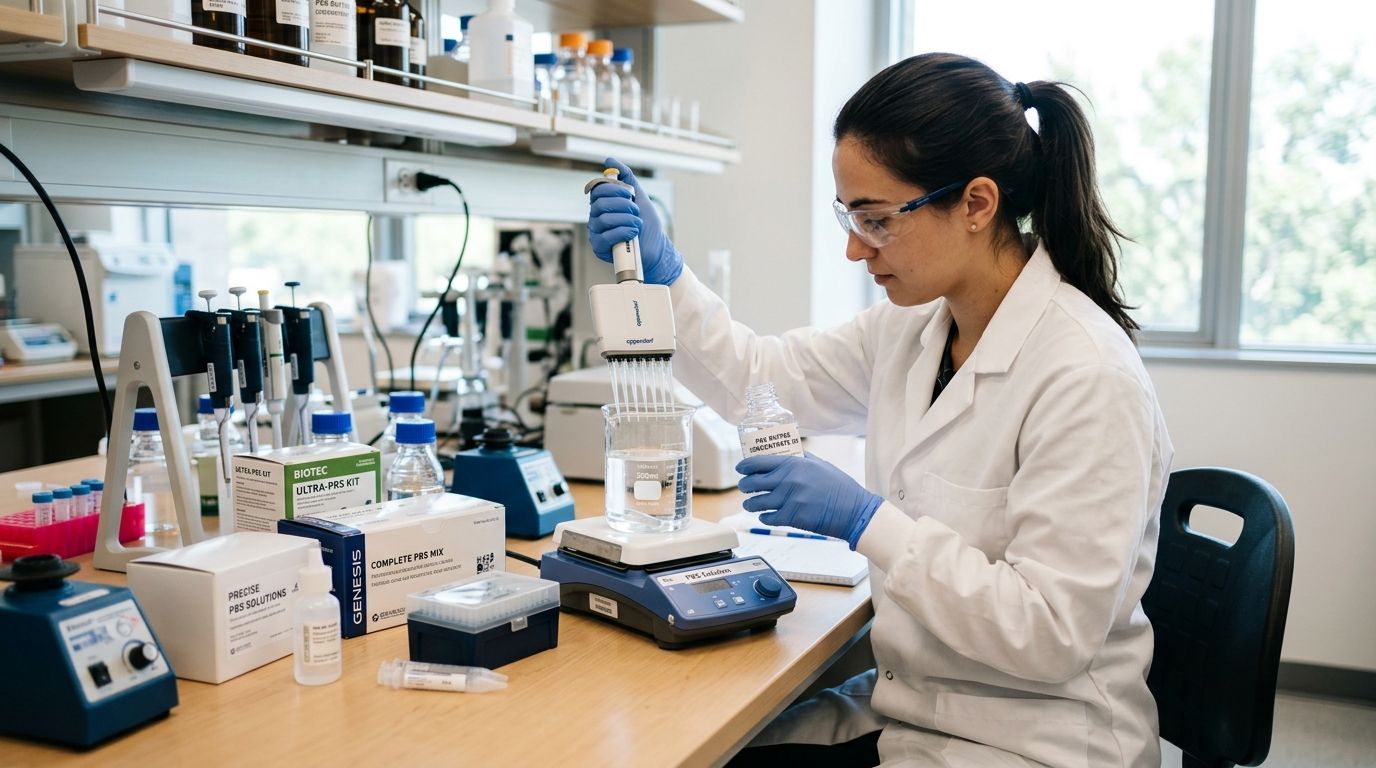
Choosing the right PBS buffer preparation kit determines whether your reconstitution, dilution, and wash steps stay consistent across a research protocol, or drift lot to lot. Best overall: MilliporeSigma (Sigma-Aldrich) PBS Tablets. Best for cell culture and sterile workflows: Thermo Fisher Gibco PBS. Best budget option for small-batch prep: G-Biosciences ReadyPack PBS Tablets.
PBS buffer is the workhorse dilution and wash solution behind most bench protocols: cell culture rinses, ELISA blocking steps, western blot washes, and reconstitution of lyophilized compounds. A kit that drifts off pH 7.4 or carries inconsistent osmolality between lots introduces variability you can't distinguish from your actual experimental signal.
For labs running peptide research, PBS buffer prep sits right next to bacteriostatic water for peptide reconstitution on the bench — one dilutes stock solutions for assays, the other reconstitutes lyophilized peptide for research use. Getting the buffer chemistry wrong upstream undermines everything downstream, whether that's a binding assay or a stability study. Celonyx Labs supplies 99%-pure, third-party-tested research peptides, and the same documentation standard — certificate of analysis, lot traceability — is what separates a usable PBS buffer kit from a generic one in 2026.
| Kit | Best for | Standout feature | Key limitation |
|---|---|---|---|
| MilliporeSigma PBS Tablets | General lab use | Widest documentation and lot COA access | Tablet format needs manual dissolution |
| Thermo Fisher Gibco PBS | Cell culture, sterile work | Sterile-filtered, cell-culture tested | Premium format, less suited to bulk dry storage |
| G-Biosciences ReadyPack Tablets | Small-batch, budget prep | Single-use tablet packs, minimal waste | Fewer format options (no liquid concentrate) |
| Teknova PBS Buffer Kits | Bulk and custom formulation | Custom concentration and volume runs | Longer lead time for custom orders |
| Cytiva PBS | Chromatography, protein purification | Validated for FPLC and column workflows | Narrower use case outside purification |
| VWR Life Science PBS | Multi-format lab stocking | Tablets, powder, and concentrate in one line | No single format is the strongest in its class |
MilliporeSigma's PBS tablets dissolve into a standard 1x working buffer at pH 7.4 and are the most widely stocked reference product in academic and industry labs. Each lot ships with a certificate of analysis covering pH and conductivity, which matters when a reviewer asks how you validated your buffer prep. The tablet format keeps shelf storage simple and avoids shipping liquid concentrate.
MilliporeSigma PBS Tablets pros:
MilliporeSigma PBS Tablets cons:
Best for: general-purpose lab buffer needs where documentation and reliability matter more than format convenience. Verdict: Buy.
Gibco PBS from Thermo Fisher ships pre-filtered and validated for cell culture, which removes the sterility question entirely for aseptic bench work. It's calcium- and magnesium-free by default, matching most standard cell washing and dilution protocols without reformulation.
Gibco PBS pros:
Gibco PBS cons:
Best for: labs running cell culture or any protocol requiring sterile-filtered buffer straight out of the bottle. Verdict: Buy.
G-Biosciences packages PBS as single-use tablet packs designed for one-off buffer prep without measuring powder or managing a large stock bottle. It's a practical fit for a single-researcher bench or a teaching lab running small volumes.
ReadyPack PBS Tablets pros:
ReadyPack PBS Tablets cons:
Best for: small labs or individual researchers prepping buffer in small, infrequent batches. Verdict: Buy.
Teknova specializes in custom buffer manufacturing, including PBS at non-standard concentrations or volumes built to a lab's exact protocol. This is the option when a standard 1x or 10x tablet doesn't match a specific assay requirement.
Teknova PBS pros:
Teknova PBS cons:
Best for: labs with a non-standard buffer spec or bulk-volume requirement. Verdict: Buy for custom needs, skip for standard prep.
Cytiva (formerly GE Healthcare Life Sciences) formulates PBS validated for FPLC systems and column chromatography, where buffer purity directly affects resolution and column life. It's a narrower use case than the general-purpose kits above.
Cytiva PBS pros:
Cytiva PBS cons:
Best for: labs running FPLC or column-based protein purification. Verdict: Buy for purification work, skip otherwise.
VWR carries PBS in tablets, powder packs, and liquid concentrate under one product line, which simplifies vendor management for labs that want one supplier across formats. No single format leads the category, but the breadth covers most general needs.
VWR Life Science PBS pros:
VWR Life Science PBS cons:
Best for: labs consolidating buffer purchasing under one supplier. Verdict: Buy for convenience, evaluate documentation per format.
Each kit was weighed against the six criteria above: documented purity grade, format flexibility, calcium/magnesium-free formulation, filtration and sterility, batch consistency, and lot traceability. General-purpose kits like MilliporeSigma's tablets and VWR's multi-format line score well across the board; specialized kits from Gibco, Teknova, and Cytiva win on a single dimension (sterility, custom formulation, chromatography validation) that matters only to a specific workflow.
If you're stocking a general research bench in 2026 and want the strongest documentation trail, MilliporeSigma PBS Tablets is the default pick. If your protocol requires sterile-filtered buffer for cell culture, Gibco PBS from Thermo Fisher is the better fit. If you're prepping small volumes on an occasional basis, G-Biosciences ReadyPack tablets keep waste and cost down without adding format complexity you don't need.
Buffer prep is one piece of a broader lab workflow. Pair a documented PBS kit with correct handling of syringes and needles for peptide research and proper peptide storage containers to keep an entire protocol reproducible from reconstitution through assay.
Need research-grade peptides too?
Celonyx Labs supplies 99%-pure, third-party-tested research peptides for laboratory use.
What is the best PBS buffer preparation kit for general lab use in 2026?
MilliporeSigma (Sigma-Aldrich) PBS Tablets is the best overall pick for general lab use in 2026, backed by a certificate of analysis per lot and wide availability.
Is Gibco PBS better than Sigma PBS tablets?
Gibco PBS from Thermo Fisher is better for sterile cell culture work because it ships pre-filtered; Sigma tablets are better for general documentation-driven lab use where sterility isn’t required.
What pH should PBS buffer be prepared at?
Standard 1x PBS is prepared to a target pH of 7.4, which is isotonic and matches physiological osmolality of roughly 300 mOsm/kg.
Are tablet or liquid concentrate PBS kits better?
Tablets store longer and take less shelf space; liquid concentrate saves a dissolution step but requires more storage. Choose based on batch frequency, not one format being universally better.
Do PBS buffer kits need to be calcium- and magnesium-free?
For most cell culture and peptide dilution protocols, yes — calcium and magnesium can interfere with cell adhesion assays and certain reconstitution steps, so a Ca/Mg-free formulation is the standard choice.
What documentation should a PBS buffer kit include?
Look for a certificate of analysis per lot covering pH and osmolality, plus lot traceability so results can be tied back to a specific batch during review.
Can PBS buffer be used to reconstitute research peptides?
PBS is typically used for dilution and washing steps rather than initial reconstitution; bacteriostatic water is the standard choice for reconstituting lyophilized research peptides.
Which PBS kit is best for chromatography work?
Cytiva PBS is validated specifically for FPLC and column chromatography workflows, making it the better choice over general-purpose tablet kits for protein purification.
Most buffer-prep errors in 2026 studies trace back to inconsistent osmolality between lots, not pH drift — a detail easy to miss when a COA only reports pH. If a kit's documentation doesn't list osmolality alongside pH, ask the supplier for it before you standardize a protocol on that lot. Cross-check purity documentation the same way you'd check a third-party peptide testing labs report before committing to a research peptide source — the habit of verifying a COA, not just trusting a label, is what keeps a study reproducible across 2026 and into next year.
All research peptides referenced on Celonyx Labs are sold for laboratory research use only, not for human or animal consumption.
What does “6 acetic acid” tell you about the bottle on your bench? Not much,
Best sterility testing kits for 2026 peptide labs: Endosafe nexgen-PTS wins on speed, Steritest for
Compare the best peptide reference standards for analytical research in 2026, ranked by purity, COA
FOR RESEARCH USE ONLY. Products sold by Celonyx Labs are intended exclusively for laboratory and scientific research. They are not intended for human or veterinary use, consumption, diagnosis, treatment, cure, or prevention of any disease. By purchasing from this site, you acknowledge that you understand the intended research purpose of these materials and agree to comply with all applicable laws and regulations.