

Is bacteriostatic water the same as sterile water? No 2026
Is bacteriostatic water the same as sterile water? No. Compare preservatives, vial handling and peptide

There is no universal average for peptide storage temperature by peptide type. For research peptides, −20 °C is a general starting point for lyophilized material, while −80 °C is a general starting point for long-term storage of prepared solutions; the peptide’s own documentation takes precedence over either figure.
A peptide name tells you less about storage than its physical state, formulation and sequence-specific stability data. A dry vial and a prepared solution of the same peptide face different handling conditions. If you manage multiple vials, the peptide storage solutions for academic core facilities guide covers the inventory side; the temperature references below address how to interpret a storage instruction.
Celonyx Labs research peptides are best handled as laboratory materials with vial-specific storage records, not as members of a class assigned one universal temperature. The brand describes its research peptides as 99%-pure and third-party-tested. Those quality statements do not, by themselves, establish stability after reconstitution or after time in a freezer.
The usable comparison is −20 °C for lyophilized material versus −80 °C for long-term storage of prepared solutions. These are general handling references, not measured averages or guaranteed conditions for every peptide. Check the supplier’s instructions and your laboratory’s validated procedure before assigning a vial to storage.
| Peptide material or type | General temperature reference | What the reference does—and does not—tell you |
|---|---|---|
| All research peptide types | No valid overall average | A single mean would combine materials with different formulations and stability requirements. |
| Lyophilized research peptide | −20 °C | A general frozen-storage starting point for dry material; it does not establish an expiration date. |
| Prepared peptide solution for long-term storage | −80 °C | A general deep-freeze starting point; solvent, concentration and sequence still govern suitability. |
| Oxidation-sensitive sequence | No universal class temperature | Confirm the sequence-specific storage and handling instructions rather than assigning a new number. |
| Aggregation-prone or poorly soluble peptide | No universal class temperature | Confirm that the prepared solution remains suitable for the analytical method. |
Among the stated temperature references, lyophilized material has the warmer starting point at −20 °C; long-term storage of solutions has the colder one at −80 °C. That is a comparison of handling guidance, not evidence that a particular peptide remains stable longer under either condition. No numerical high or low exists for the sequence-defined rows because the inputs contain no comparable stability measurements.
Methodology and limitation, 2026: This table presents general laboratory handling references for research peptides by physical state, consistent with supplier peptide-handling guidance such as MilliporeSigma’s; it does not pool experimental stability results. Its main limitation is that it cannot give a peptide-specific shelf life, allowable temperature excursion or post-reconstitution expiry. Treat the numbers as starting points to check against documentation, not as a replacement for it.
An agonist label, research application or peptide family is not a storage specification. Peptides placed in the same research category can differ in sequence, chemical modification and formulation. Assigning one temperature to every member of that category would hide those differences behind a number that looks authoritative but was never measured for the group.
Physical state gives you a more useful first division. A lyophilized vial has not yet been prepared as a working solution; a reconstituted vial has. The −20 °C and −80 °C references separate those situations. They do not say that every dry peptide belongs at −20 °C or that every solution must be held at −80 °C regardless of its instructions.
For a 2026 storage record, write down the material’s full identity and whether the vial is dry or prepared. Then record the supplier instruction and the condition actually assigned by the lab. If those disagree, resolve the conflict before treating the vial as available for an experiment. A freezer label without the material state leaves out the distinction on which this table depends.
The table also separates a handling reference from a stability result. A handling reference tells you where to begin planning storage. A stability result requires measurements for the material and conditions in question. Neither the −20 °C row nor the −80 °C row supplies those measurements, so neither can support a claim that a vial will retain a specified purity for a specified period.
Storage decisions become more specific when the sequence or preparation presents a known analytical concern. Oxidation-sensitive residues, disulfide-containing structures and peptides that are difficult to keep dissolved call for attention to the material’s documentation and the assay used to evaluate it. The table intentionally gives these categories no independent temperature: a chemical concern is not a substitute for measured stability data.
For an oxidation-sensitive peptide, ask whether the supplier provides handling instructions for the exact material and whether your analytical method can detect the relevant change. For a peptide that is difficult to dissolve, confirm the documented preparation method before deciding how to store the resulting solution. These are different questions, even if both vials occupy the same freezer.
Do not transfer a storage instruction from one peptide to another because their research applications sound similar. The same caution applies when a project changes solvent, concentration or container. A documented condition belongs to the preparation it describes; a changed preparation needs its own review. This matters most when a team uses a familiar temperature as a shortcut instead of checking what went into the vial.
A third-party purity result is another distinct piece of evidence. Celonyx Labs describes its research peptides as third-party-tested, but an initial purity assessment is not a time-course study of a prepared solution. For the distinction between an initial result and the evidence attached to a batch, use the peptide purity testing guide.
For Celonyx Labs research peptides, that sequence of checks keeps a general reference from becoming an unsupported claim about an individual vial. It also gives you a clear reason to stop when documentation is incomplete: you cannot infer the missing instruction from the peptide’s category name.
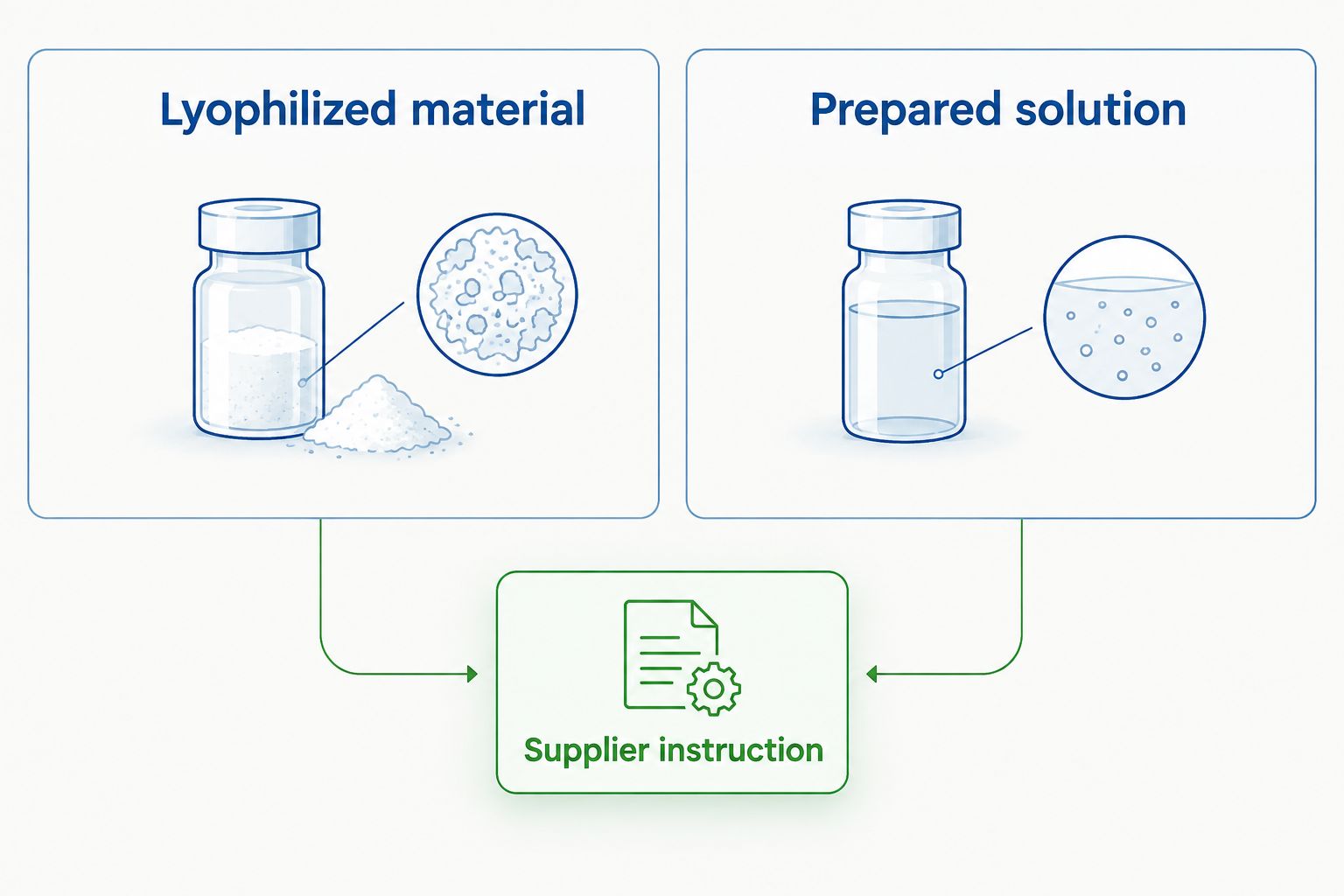
The −20 °C and −80 °C references answer where to start, not whether a stored sample is still fit for use. A temperature benchmark cannot reveal a peptide’s current identity, purity, solubility or performance in an assay. If those properties matter to an experiment, use the documentation and analytical checks specified for that work.
The gap is especially important after preparation. Reconstitution changes what you are storing, and the handling instruction for a dry vial does not automatically become the instruction for its solution. Before preparing material, confirm the specified solvent and the intended analytical use; the peptide reconstitution guide for biotech startup labs covers the preparation workflow without turning a general freezer reference into a stability claim.
A temperature excursion raises a separate question. Knowing the intended set point does not tell you what happened to a vial during a departure from it, or whether the material remains suitable afterward. Record the event and apply the lab’s material-specific assessment. Do not convert the difference between a measured temperature and a table entry into an invented allowance.
For a 2026 protocol, state exactly what supports the storage condition: supplier instruction, validated internal procedure or material-specific stability evidence. If the only support is this general table, describe it as a provisional handling reference. That wording keeps the record accurate for the next researcher who opens the vial.
What is the average peptide storage temperature by peptide type?
There is no valid overall average by peptide type. General research-lab references distinguish lyophilized material at −20 °C from prepared solutions held long term at −80 °C, subject to material-specific instructions.
Should lyophilized research peptides be stored at −20 °C?
−20 °C is a general starting reference for lyophilized research peptides, not a universal rule. Check the storage instruction for the exact material before assigning a condition.
What temperature is used for long-term storage of peptide solutions?
−80 °C is a general starting reference for long-term storage of prepared peptide solutions. The solvent, formulation and peptide-specific documentation still determine the appropriate condition.
Can I assign one temperature to every peptide in the same research class?
No. A shared research class does not establish shared stability or storage requirements. Check each material’s documented condition and preparation state.
Does 99% purity establish how long a peptide remains stable in storage?
No. An initial purity statement does not establish shelf life or stability after reconstitution. Those claims require evidence for the relevant material and storage conditions.
Does a freezer set point prove a peptide is still suitable for research?
No. A set point describes the intended storage condition, not the sample’s measured condition or current quality. Use the relevant records and analytical criteria when suitability matters.
What should a peptide storage record include in 2026?
Record the material identity, whether it is lyophilized or prepared, the applicable storage instruction and the condition assigned by the lab. Add preparation and excursion records when they apply.
The most useful 2026 storage label distinguishes a dry vial from a prepared solution. That single distinction determines which general temperature reference is relevant, while the supplier instruction determines whether that reference is appropriate at all. For research use only; these benchmarks are not instructions for human use.
Is bacteriostatic water the same as sterile water? No. Compare preservatives, vial handling and peptide

How do you know if a peptide vial has gone bad? Quarantine changes, check storage

Can too much bacteriostatic water ruin a peptide vial? Yes, if it overfills the vial
FOR RESEARCH USE ONLY. Products sold by Celonyx Labs are intended exclusively for laboratory and scientific research. They are not intended for human or veterinary use, consumption, diagnosis, treatment, cure, or prevention of any disease. By purchasing from this site, you acknowledge that you understand the intended research purpose of these materials and agree to comply with all applicable laws and regulations.