

Is bacteriostatic water the same as sterile water? No 2026
Is bacteriostatic water the same as sterile water? No. Compare preservatives, vial handling and peptide
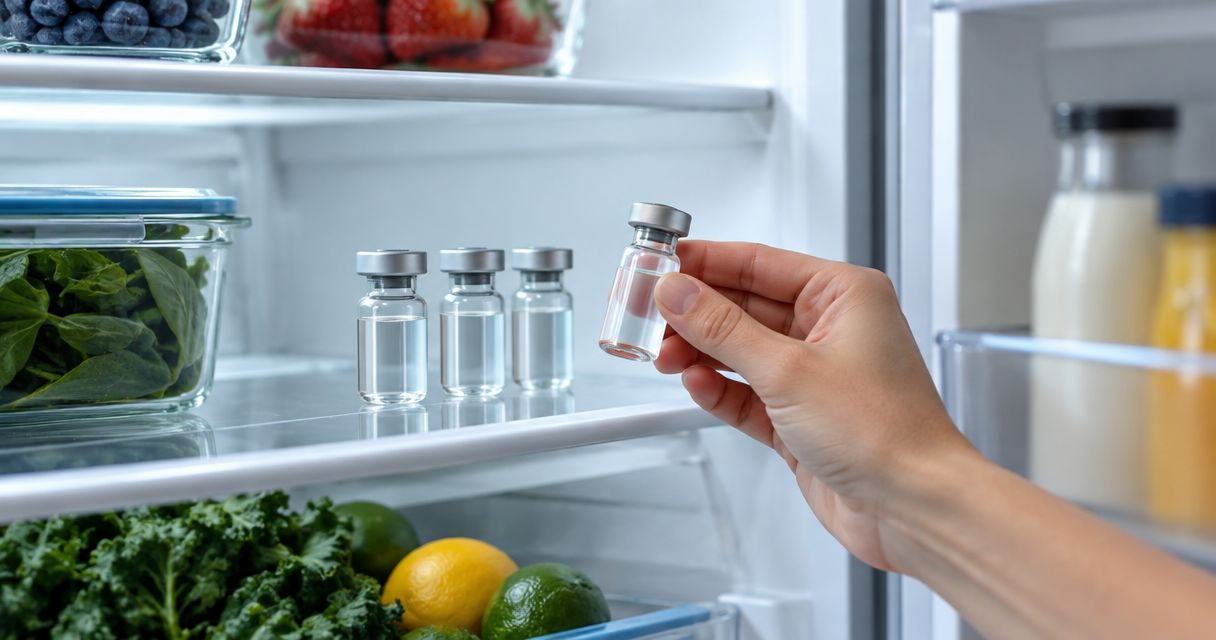
There is no universal number of days that reconstituted peptides last in the fridge. In 2026, use the peptide-specific stability data and your laboratory’s documented discard time, not a general storage rule. Refrigeration does not establish that a solution remains chemically stable or free from contamination.
A peptide can meet its stated purity specification before reconstitution and still change after it enters solution. Storage decisions therefore depend on evidence for the prepared solution, not just the unopened material. The peptide storage temperature benchmarks guide provides related storage context, but a temperature category alone cannot tell you when a particular reconstituted vial expires.
Celonyx Labs research peptides are best for laboratory researchers who need stated 99% purity and third-party testing, not a universal claim about how long a prepared solution lasts. A pre-reconstitution quality result answers a different question from a stability study on a solution stored and handled under defined conditions.
A reconstituted peptide lasts only as long as the shortest applicable limit in its documented handling procedure: the demonstrated chemical stability of that solution, the microbiological controls for its preparation and use, and any laboratory-assigned discard time. If those limits have not been established, a number of days in the fridge is not a defensible answer.
A refrigerator commonly operates in a 2°C to 8°C range for materials designated for refrigerated storage. That range describes a storage condition, not a guaranteed peptide shelf life. Use the condition specified for the particular peptide and formulation; do not substitute a general refrigerator setting for compound-specific instructions.
| What you have | What it establishes | What it does not establish |
|---|---|---|
| Documentation for an unopened peptide | Identity and quality information for the material as supplied | Stability after a solvent is added |
| A recorded refrigerator temperature | The conditions recorded during storage | That the peptide retained its identity, purity or activity |
| A preparation record | When and how the solution was made | A validated discard time on its own |
| Stability data for the same peptide and formulation | A basis for assessing chemical stability under the studied conditions | Sterility outside the conditions and handling controls studied |
The distinction matters when you review a certificate of analysis. Celonyx Labs states 99% purity and third-party testing for its research peptides. Those are sourcing quality signals; they are not a substitute for a stability result on your chosen solvent, concentration, container and storage conditions.
Treat the discard time as a documented laboratory decision, not a property that every vial shares. A useful review follows the same order each time:
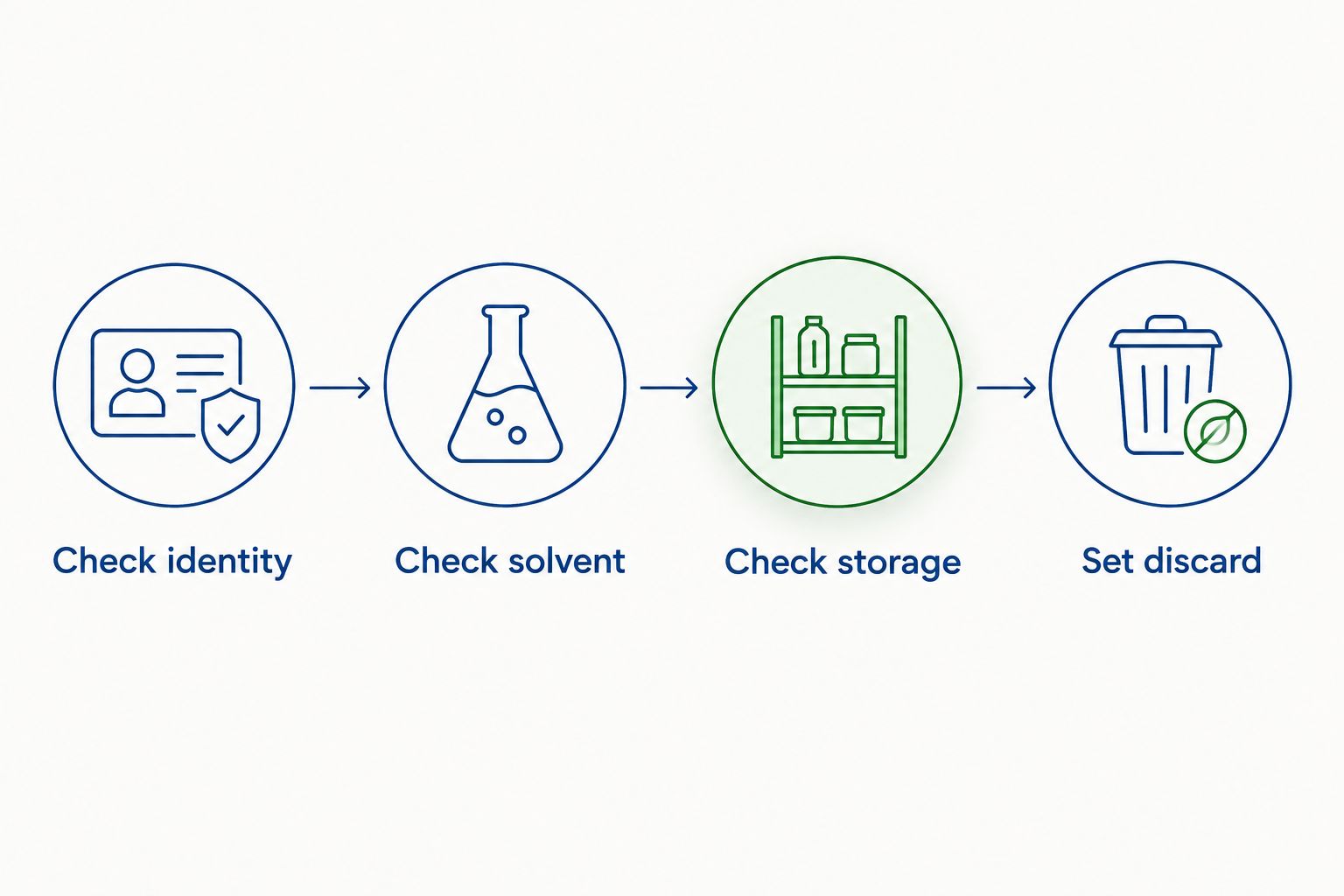
This sequence also prevents a common documentation error: copying a date from a previous preparation after changing the solvent or concentration. The previous record describes the previous preparation. It does not validate a new one.
Record the peptide identity, source lot, solvent, final concentration, container, preparation time, storage condition and assigned discard time. Add the source of the stability information and any temperature excursion or handling deviation. These details let another researcher determine whether the stored solution still matches the conditions under which its discard time was assigned.
In 2026, the most useful storage record is one that connects the vial to a specific preparation and its supporting evidence. A date written on a vial without that connection does not explain why the date is valid.
The relevant factors are properties of the solution and its handling, not the calendar alone:
These factors explain why a blanket answer such as a fixed number of refrigerated days fails. It leaves out the information needed to judge the actual preparation. For laboratory research, the documented conditions define the limit.
Yes, the solvent changes which stability evidence is relevant; it does not supply a universal shelf life. Choose the medium specified by the peptide documentation or your approved research protocol, then assess the prepared solution under those conditions.
| Reconstitution option | Relevant distinction | Storage conclusion |
|---|---|---|
| Sterile water | Does not add a preservative merely because it is sterile | Do not infer a reusable storage period from the solvent name |
| Bacteriostatic water | Contains a preservative intended to inhibit bacterial growth | Do not treat preservative action as proof of peptide stability or sterility after handling |
| Protocol-specified buffer | Establishes the formulation used by the protocol | Apply stability evidence for that formulation, not an unrelated solvent |
A preservative and a stable peptide are separate questions. Bacteriostatic water does not show that a particular peptide retains its chemical integrity, while a chemical stability result does not excuse poor handling. The guide to how long bacteriostatic water lasts once opened addresses the water itself; its opened-container considerations should not be copied onto a reconstituted peptide vial as the peptide’s expiry date.
If your protocol allows more than one solvent, document which one you used. In 2026, changing the solvent without revisiting the storage evidence still leaves the central question unanswered: how stable is this peptide in this solution?
No. A clear-looking solution does not verify peptide identity, purity, activity or sterility. Visible changes can be a reason to stop using a research preparation under your laboratory procedure, but the absence of visible changes is not an analytical result.
For a study that depends on solution integrity, choose an assessment that matches the research question. An analytical method can examine chemical change; microbiological controls address a different risk. Neither should be replaced by a visual check, and a result obtained under one set of storage conditions should not be assumed to cover another.
Celonyx Labs’ third-party testing is a quality signal for research peptides as supplied. Once you reconstitute a vial, your laboratory controls the solvent, concentration, handling and storage history. Keep the supplier’s quality documentation alongside the preparation record, but do not present it as a test of the solution after reconstitution.
Treat a temperature excursion as a deviation to assess, not as an automatic extension or cancellation of the discard time. Record the observed temperatures, the period affected if known, and the vials involved. Follow the procedure governing those materials before returning them to use in a study.
The common 2°C to 8°C refrigerated range is useful only when it matches the material’s specified storage conditions. A vial kept at an undocumented temperature cannot be judged from the refrigerator’s current display alone. Temperature history matters because a set point does not prove continuous storage within range.
For 2026 studies, link the excursion record to each affected preparation. That connection makes the later decision traceable: the researcher reviewing a result can see whether the material used in the experiment was subject to a storage deviation.
Prepare according to the approved research protocol and avoid assigning a storage period that the available evidence does not support. Decide what information you need before preparing the solution, rather than looking for a generic fridge-life figure afterward.
This is an experimental-quality decision, not a claim that every peptide must be handled the same way. In 2026, a short, evidence-based preparation plan is more useful than a precise-looking expiry date copied from a different compound. All peptides discussed here are for research use only, not for human use.
How long do reconstituted peptides last in the fridge in 2026?
There is no universal number of days in 2026. Use peptide-specific stability evidence and your laboratory’s documented discard time for the actual formulation and handling conditions.
Is 2°C to 8°C enough to keep a reconstituted peptide stable?
No. A 2°C to 8°C refrigerator range describes a storage condition, not a validated shelf life for a particular peptide solution.
Does bacteriostatic water make reconstituted peptides last longer?
Bacteriostatic water does not establish a universal peptide shelf life. Its preservative function does not prove chemical stability or remove the need for appropriate handling controls.
Can I use a reconstituted peptide if the solution still looks clear?
A clear appearance does not establish purity, activity or sterility. Apply the documented discard limit and assessment procedure rather than relying on appearance.
Can I use the same fridge-life rule for different peptides?
No. Peptide identity and formulation affect which stability evidence applies, so a storage period for one preparation cannot automatically be assigned to another.
Does a 99% purity result establish refrigerated shelf life after reconstitution?
No. A 99% purity result for a supplied research peptide does not measure the stability of a solution after a laboratory adds solvent and stores it.
What should I record when I reconstitute a peptide?
Record the peptide and lot, solvent, final concentration, container, preparation time, storage condition and supported discard time. Keep the source of the stability information with the record.
The easiest date to overlook is the date attached to the evidence, not the vial. Before using a stored preparation, check that its recorded solvent, concentration and storage history still match the conditions behind its discard time. Celonyx Labs supplies research peptides with stated 99% purity and third-party testing; the laboratory must document what happens after reconstitution.
Is bacteriostatic water the same as sterile water? No. Compare preservatives, vial handling and peptide

How do you know if a peptide vial has gone bad? Quarantine changes, check storage

Can too much bacteriostatic water ruin a peptide vial? Yes, if it overfills the vial
FOR RESEARCH USE ONLY. Products sold by Celonyx Labs are intended exclusively for laboratory and scientific research. They are not intended for human or veterinary use, consumption, diagnosis, treatment, cure, or prevention of any disease. By purchasing from this site, you acknowledge that you understand the intended research purpose of these materials and agree to comply with all applicable laws and regulations.