
5 Amino Acid Peptides: A Practical Lab Guide
A five-residue sequence can look simple on paper, but what exactly does “5 amino acid”
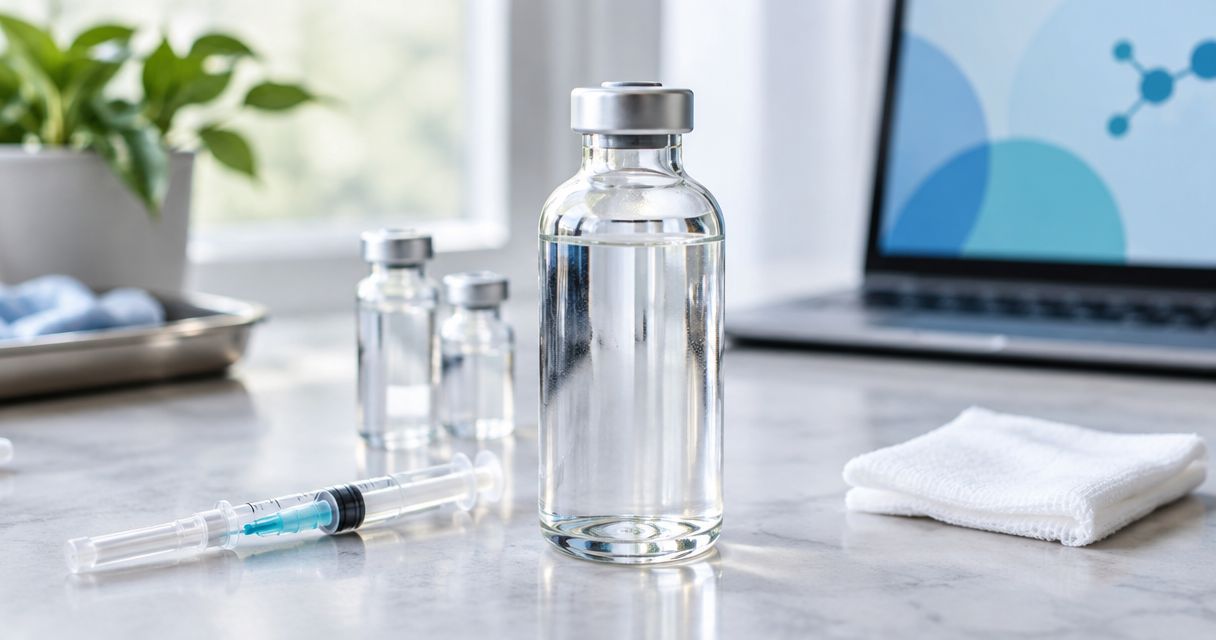
Yes, bacteriostatic water can be used more than once when its label identifies it as a multidose vial and each withdrawal follows aseptic technique. Repeated access does not mean unlimited use: follow the manufacturer’s instructions and your laboratory’s discard policy, and never reuse a needle, syringe, or previously withdrawn water.
The practical distinction is reusing the original multidose vial versus reusing equipment or withdrawn liquid. The first can be permitted by the label; the second creates an avoidable contamination pathway.
For a 2026 laboratory SOP, treat the opening date, access history, storage instructions, and solvent compatibility as separate checks. The companion guide to how long bacteriostatic water lasts once opened addresses the time limit; this page explains what makes another withdrawal acceptable.
A preservative is a safeguard, not permission to ignore handling errors. Clear-looking water can still be contaminated, so appearance alone cannot qualify a vial for continued use.
Yes—repeat withdrawals are appropriate only from a vial labeled for multidose use, within its permitted use period, with fresh sterile equipment each time. The presence of bacteriostatic water does not make every container reusable.
CDC injection-safety guidance distinguishes multidose containers from single-dose containers and calls for a new sterile needle and syringe whenever accessing a vial. Apply that distinction to your laboratory SOP rather than deciding from the amount of liquid remaining.
| Container or material | Best for | Repeat-use decision | Benefit | Limitation |
|---|---|---|---|---|
| Bacteriostatic water labeled multidose | Repeated laboratory withdrawals when the protocol permits it | Reaccess within the labeled or SOP-defined period using aseptic technique | Preservative inhibits bacterial growth | Preservative does not prevent every contamination event |
| Sterile water labeled single-dose | A preparation requiring preservative-free water | Do not treat it as a multidose container | Avoids introducing a preservative into the preparation | Remaining contents do not establish permission for later access |
| Water already withdrawn into a syringe | The immediate preparation specified by the protocol | Do not return it to the source vial | Separates the working volume from the stock | Withdrawal does not create a new validated storage container |
Bacteriostatic water and sterile water are not interchangeable simply because both look clear. Select the diluent required by the compound’s documentation and the experimental method, then check whether its container permits repeated access.
A multidose designation permits repeated withdrawal under specified conditions. It does not certify that a vial remains sterile after poor handling, inappropriate storage, or an uncertain access history.
Common U.S. bacteriostatic water labeling lists 0.9% benzyl alcohol, equivalent to 9 mg/mL, as the preservative. Check the actual label rather than assuming every formulation has that composition; the preservative is also an experimental variable when it enters your preparation.
The advantage is that a permitted stock vial can support separate withdrawals without opening a new container for each preparation. The limitation is that each access introduces another handling event that your laboratory must control and document.
Use a multidose vial only when both the container labeling and the research protocol support it. A solvent that is acceptable for one assay is not automatically suitable for another.
A single-dose label does not become a multidose label because the container still holds water. The designation governs use; the remaining volume does not.
Preservative-free sterile water is appropriate when the method requires that formulation. Its limitation is that you cannot borrow the repeat-access rules for preserved multidose water and apply them to a single-dose container.
For your 2026 SOP, record the container type explicitly in the reagent inventory. That prevents a generic entry such as “water for reconstitution” from hiding an important handling difference.
Use a documented sequence before every withdrawal. The objective is to prevent contaminants from entering the stock, not to compensate for contamination afterward.
Disinfecting a stopper commonly uses 70% alcohol under established aseptic procedures. That concentration describes surface preparation, not an additive to put into bacteriostatic water; never improvise a preservative mixture inside the vial.
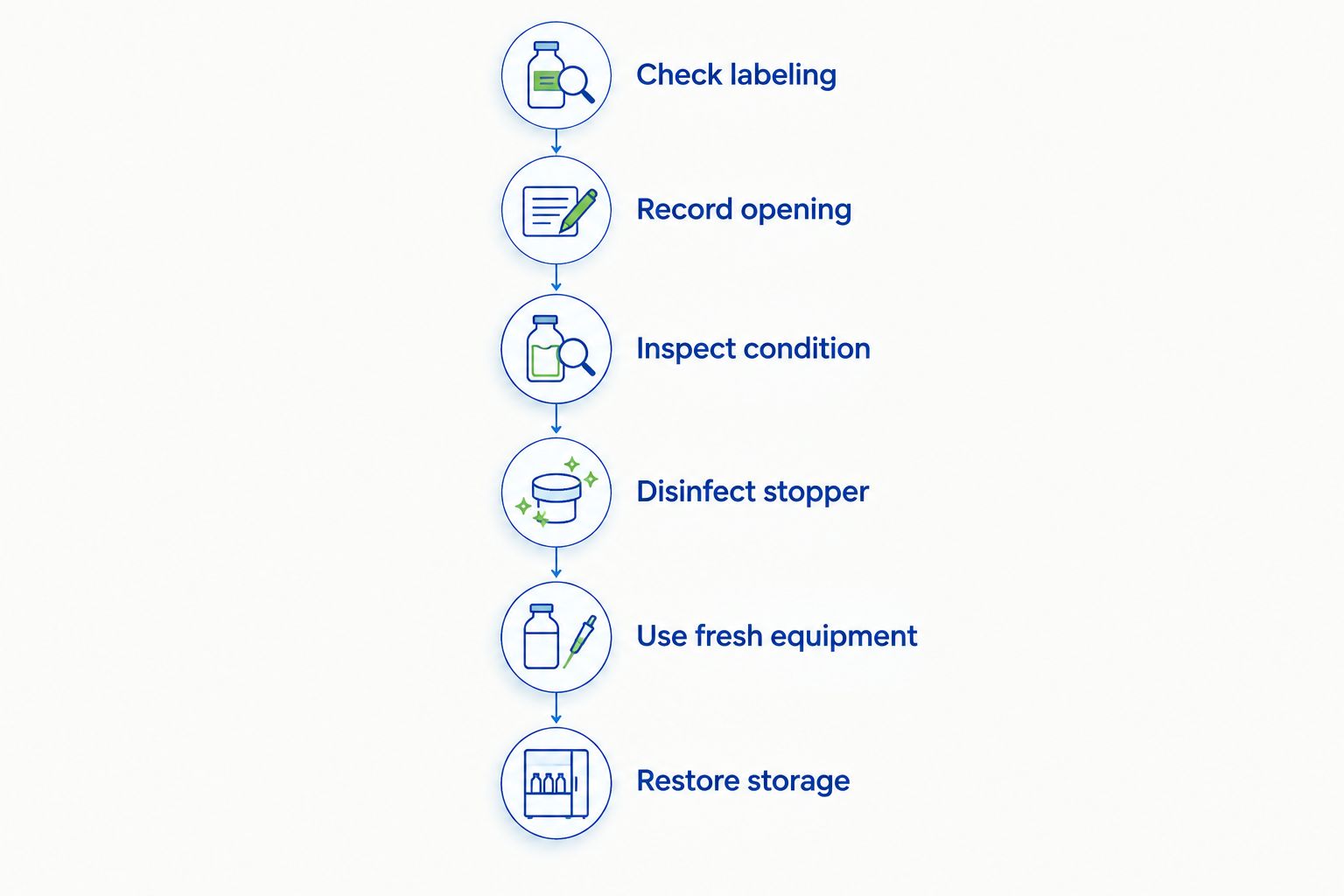
Keep preparation in the laboratory’s designated clean area, away from waste and used equipment. Do not leave a needle in the stopper between withdrawals; it creates an access route rather than maintaining a closed container.
If you cannot establish acceptable handling, discard the vial under your laboratory’s procedure. Adding preservative, replacing the cap, or moving the vial into colder storage does not reverse an earlier contamination event.
The useful question is not how many punctures a vial can tolerate in the abstract. It is whether the next access meets the conditions that apply to that specific container and experiment.
In 2026, use these factors as a release checklist before another withdrawal. A vial that passes the date check but fails the handling check is not acceptable simply because it is still within the calendar window.
28 days is the CDC benchmark for an opened multidose medication vial unless the manufacturer specifies a different period. CDC guidance also states that the beyond-use date must not extend beyond the original expiration date.
That guidance comes from injection safety, not a universal stability study of laboratory reagents. For research use, the vial’s instructions and your approved SOP determine how the benchmark applies; a shorter required period takes precedence.
In this 2026 guide, the 28-day figure is therefore a reference point, not a guarantee of sterility until the last day. Contamination, compromised closure integrity, or improper storage requires an earlier discard decision.
0.9% benzyl alcohol is a common labeled preservative concentration, not proof that repeated withdrawals are contamination-free. A bacteriostatic preservative inhibits bacterial growth; it does not replace aseptic handling or validate a breached container.
The preservative also enters the receiving preparation when you use the water as a diluent. Check whether that ingredient is acceptable for the experiment rather than selecting the solvent solely for its multidose convenience.
Preservative content and experimental compatibility are separate decisions. A container can permit another withdrawal while its contents remain unsuitable for a particular assay.
No—use a new sterile syringe and needle for every vial access. Changing only the needle does not make a previously used syringe sterile.
Do not transfer residual water back into the source vial, even if the withdrawal was larger than needed. Returning liquid introduces another contamination pathway and changes the source vial’s handling history.
This distinction belongs in your 2026 bench instructions: reuse permission applies to the labeled multidose container, not to the tools used to enter it. Keep disposal rules next to the access procedure so the distinction remains explicit.
Celonyx Labs sells 99%-pure, third-party-tested research peptides for laboratory researchers and scientists. Those are peptide quality signals, not evidence that a separate water vial remains sterile or that a particular diluent suits every compound.
The benefit of those stated quality signals is their relevance to evaluating the peptide material. Their limitation is scope: peptide purity does not establish solvent sterility, preservative compatibility, or solution stability after reconstitution.
Keep the water vial record separate from the reconstituted peptide record. Document the diluent identity, lot, opening date, amount used, preparation date, and the compound-specific storage instructions required by the method.
A source water vial’s permitted reuse period does not become the shelf life of the finished peptide solution. That preparation needs its own stability and handling basis; never transfer the water vial’s discard date to the peptide vial by default.
For Celonyx Labs research peptide preparations, maintain the research-use-only boundary throughout the workflow. This guidance concerns laboratory handling, not human administration or dosing.
Can bacteriostatic water be used more than once?
Yes, bacteriostatic water can be used more than once when the vial is labeled multidose and each withdrawal follows aseptic technique. Follow the manufacturer’s instructions and laboratory discard policy, using a new sterile needle and syringe for each access.
Does the 28-day rule apply to every bacteriostatic water vial?
No—the 28-day benchmark is CDC guidance for opened multidose medication vials unless the manufacturer specifies a different period. Apply the actual labeling and laboratory SOP, and never extend use beyond the original expiration date.
Can I reuse the syringe if I replace the needle?
No, replacing the needle does not make a used syringe sterile. Use a new sterile syringe and needle whenever accessing the vial.
Is bacteriostatic water the same as single-dose sterile water?
No, bacteriostatic water contains a preservative, while single-dose sterile water must be handled according to its own labeling. Do not treat leftover single-dose contents as a reusable multidose stock.
Does clear bacteriostatic water mean it is uncontaminated?
No, clear appearance does not establish sterility. Check the access history, closure condition, storage record, and applicable discard date rather than relying on appearance alone.
Does refrigerating bacteriostatic water reset its discard date?
No, refrigeration does not reset the discard date or reverse contamination. Follow the storage conditions and post-opening instructions on the actual product label.
Does the water vial’s reuse period determine peptide solution stability?
No, the source water vial’s reuse period does not determine the stability of a reconstituted peptide. The finished preparation requires compound-specific documentation and an approved laboratory handling procedure.
Label the source water vial and the finished preparation separately. This simple distinction prevents an opened-water allowance from becoming an unsupported peptide stability claim.
For your 2026 laboratory workflow, make the decision before the next withdrawal: permitted container, documented opening, acceptable handling, compatible solvent. If any check fails, do not let the amount remaining influence the decision.
A five-residue sequence can look simple on paper, but what exactly does “5 amino acid”
Can bacteriostatic water be used more than once? Yes, if labeled multidose. Learn the 28-day

How long can peptides sit in a syringe before use? No universal time applies. Learn
FOR RESEARCH USE ONLY. Products sold by Celonyx Labs are intended exclusively for laboratory and scientific research. They are not intended for human or veterinary use, consumption, diagnosis, treatment, cure, or prevention of any disease. By purchasing from this site, you acknowledge that you understand the intended research purpose of these materials and agree to comply with all applicable laws and regulations.