

What Are Procurement Documents and Why They Matter
Nearly 100 million federal contract actions and more than 72 million public contracts now sit

Buying tirzepatide for genuine nonclinical laboratory research in the United States can be lawful in 2026, but there is no blanket exemption covering every seller, shipment, or intended use. A research use only label does not authorize human administration or replace the legal requirements that apply to the transaction.
There is no universal yes-or-no answer based solely on the molecule’s name. You need to establish what the material is intended for, how the seller represents it, and which rules apply to its purchase and use. A laboratory assay and personal self-injection are not interchangeable activities.
FDA regulations address intended use under 21 CFR § 201.128. That assessment considers objective evidence, including labeling, advertising, and circumstances surrounding distribution; the words printed on a vial are not the entire analysis.
For the broader purchasing context, read the guide to buying research peptides legally in the United States. Keep the tirzepatide-specific decision tied to your actual protocol rather than a general statement that research peptides are legal.
| Intended activity | Appropriate route | Main limitation | Best for |
|---|---|---|---|
| Nonclinical analytical or laboratory work | Research procurement with documented purpose and applicable institutional review | Research labeling does not settle supplier, import, or other legal obligations | Researchers performing nonhuman laboratory studies |
| Administration within a human investigation | Clinical research review, including the applicable FDA investigational framework | Buying a research vial does not authorize a human study | Investigators conducting properly authorized clinical research |
| Personal medical treatment | Licensed medical care and lawful prescription dispensing | Research-use material is not a substitute for a prescribed medicine | Patients seeking treatment |
This comparison separates purchasing pathways, not interchangeable grades of the same finished product. Material suitable for an analytical experiment is not automatically suitable for administration to a person.
A purchasing mistake can start with a technically accurate statement used in the wrong context. Tirzepatide is an ingredient in FDA-approved prescription medicines, but that fact does not make every tirzepatide-containing product FDA-approved.
For your 2026 procurement file, separate legal purpose, material quality, and authorization to conduct the work. Each answers a different question. A favorable answer in one category cannot fill a gap in another.
The same distinction protects research quality. You need material that fits your analytical requirements, a documented chain of custody, and a protocol that defines what you will do with it. A seller’s reassurance is not a substitute for those records.
Research use only communicates a restriction on the intended application. It does not certify FDA approval, clinical suitability, sterility, or permission to conduct human research. Nor does it independently establish that a particular sale complies with every applicable law.
Read the surrounding claims as carefully as the label. A seller that describes a product as a laboratory reagent while promoting personal treatment creates a different intended-use picture from a supplier describing analytical experiments. FDA’s intended-use framework is relevant to that distinction.
You should also avoid turning your own research documentation into treatment instructions. A laboratory protocol should describe the scientific question, experimental system, analytical methods, and handling controls. It should not disguise personal administration as an experiment.
An RUO disclaimer is a boundary, not a legal permission slip. Your documented activities must remain consistent with that boundary.
FDA approval attaches to a specific drug product and its approved conditions, not to every vial containing the same active ingredient. A research supplier’s material and a lawfully dispensed prescription medicine therefore require different assessments.
For nonclinical work, evaluate identity, impurities, analytical suitability, and handling requirements against the experiment. For medical treatment, the appropriate route is licensed clinical care and lawful dispensing. Do not use a research purchasing process to bypass that route.
Compounding is another distinct legal category. Calling a material a research peptide does not establish that it is eligible for compounding or that a seller is operating within applicable compounding requirements. The existence of compounded products also does not create permission to prepare or administer research material yourself.
In 2026, avoid relying on old shortage discussions, archived seller claims, or historical enforcement exceptions as current purchasing authority. Your institution or qualified counsel should assess the rules applicable when you purchase and conduct the work.
Use the following sequence before placing an order. The purpose is to resolve the intended use and approval pathway before you assess the material’s analytical quality.
These steps are not a legal certification. They give your procurement and compliance teams a defined transaction to review rather than an ambiguous request for a research peptide.
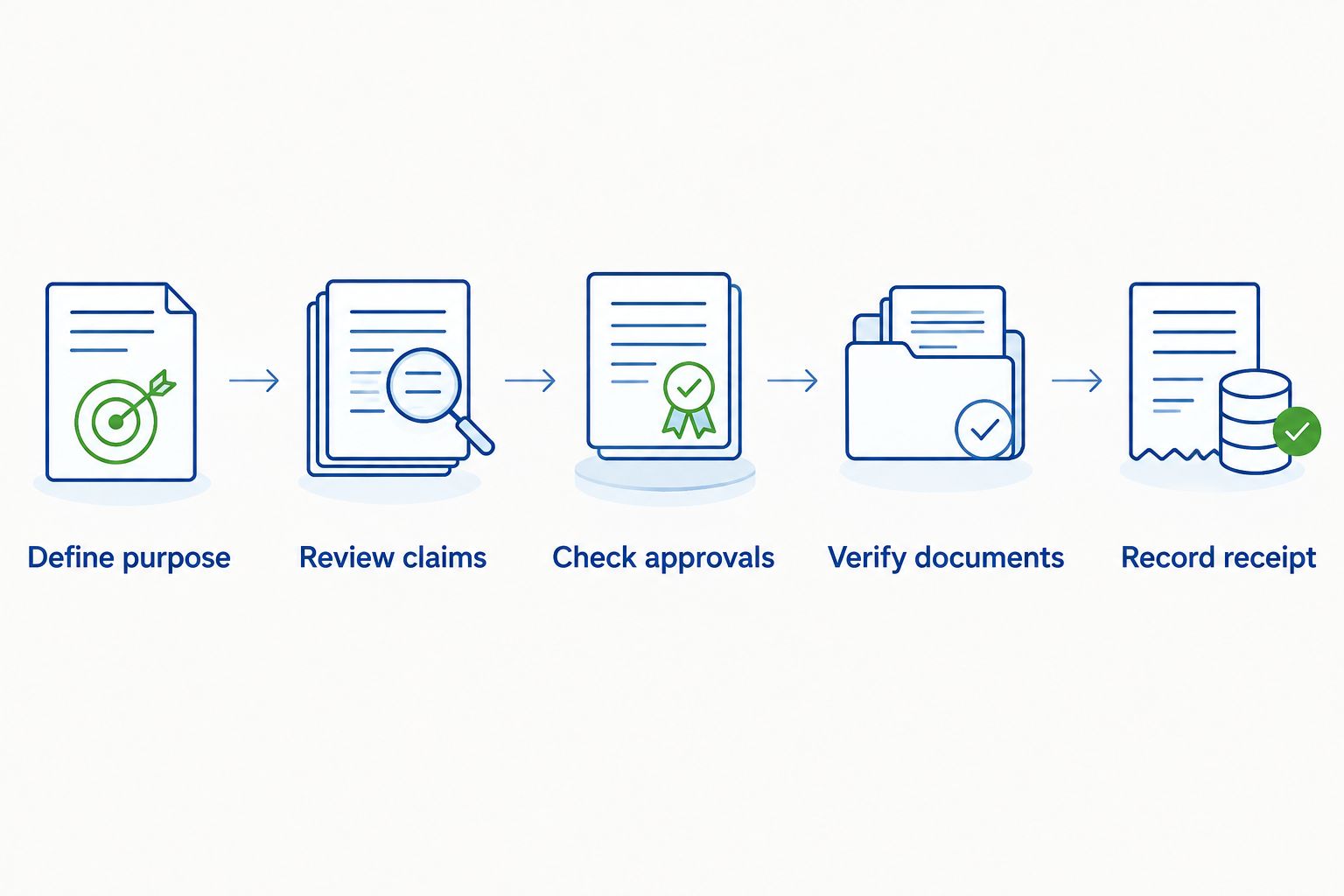
If any step exposes a mismatch, stop the purchase review there. An unresolved human-use question should not be treated as a shipping question, and a missing identity result should not be treated as a paperwork inconvenience.
Your file should connect the scientific purpose to the exact material received. Keep the protocol or project reference, purchaser details, supplier identity, invoice, lot identifier, analytical documentation, and receiving record together. Add the approvals relevant to the experimental system.
A certificate of analysis is useful only when you understand what it reports. Check the tested lot, method, measured attribute, and relationship between the report and the material supplied. A purity result does not necessarily establish identity, peptide content, sterility, or endotoxin suitability.
For example, 99% purity is not a clinical safety determination. Chromatographic purity describes a result obtained using a particular method; it does not certify that every other property needed for an experiment has been assessed. See the explanation of what 99% peptide purity does and does not establish.
Celonyx Labs describes its research peptides as 99%-pure and third-party-tested. Those are relevant quality signals for laboratory sourcing, but they do not establish transaction-specific legality or authorization for human use. Review the documentation against your protocol rather than treating either claim as an approval.
The purchasing question changes when the facts change. For a 2026 review, focus on these factors rather than looking for a universal legal badge:
Documentation helps establish these facts, but it does not change them. A carefully organized file cannot turn personal treatment into nonclinical laboratory research.
A prescription is not a universal requirement for acquiring a genuine nonclinical laboratory reagent. That does not establish that a particular tirzepatide transaction is lawful, and it does not authorize you to use the material as a medicine.
The relevant question is not whether the checkout requests a prescription. It is whether the seller, product representations, intended application, and applicable requirements support a lawful research transaction.
An RUO purchase does not authorize human administration. Human investigations require assessment under the applicable clinical research framework, including whether an Investigational New Drug application is required and what ethics review and consent obligations apply.
FDA’s IND requirements and exemptions appear in 21 CFR § 312.2, while application content requirements appear in 21 CFR § 312.23. An exemption is not something you establish by renaming treatment as research; the proposed study must meet the applicable criteria.
Yes. An overseas purchase adds an importation assessment to the intended-use and research review. Customs clearance, seller assurances, and lawful use are different questions.
For a 2026 shipment, have the responsible institutional team review the material description, declared purpose, importer responsibilities, and applicable agency requirements before ordering. Do not assume that delivery proves compliance or that research labeling guarantees admission.
Require a consistent account of what the material is and what it is supplied for. Look for traceable analytical documentation and a clear research-use restriction. Ask questions that your procurement file can answer with records rather than promotional language.
Celonyx Labs is for laboratory researchers sourcing research peptides, not people seeking tirzepatide treatment. Its stated purity and third-party-testing focus fits a laboratory purchasing assessment; those statements do not replace protocol-specific testing or legal review.
Apply the same limits to every supplier. Do not infer that a company offers a particular tirzepatide product, provides clinical-grade material, or has cleared your intended experiment simply because it sells research peptides.
For your 2026 supplier decision, the useful outcome is a documented match between purpose, material, and permissions. A reassuring homepage without that match leaves the central purchasing question unresolved.
Is tirzepatide legal to buy for research use in the United States?
A genuine nonclinical research purchase can be lawful, but there is no blanket exemption for every tirzepatide transaction. Intended use, seller representations, import requirements, and applicable law determine the assessment.
Does a research use only label make tirzepatide legal?
No. A research use only label does not independently establish legality or authorize human administration; the surrounding claims and actual intended activity also matter.
Do I need a prescription to buy tirzepatide for laboratory research?
A prescription is not a universal requirement for purchasing a genuine nonclinical reagent. That distinction does not authorize personal treatment or establish that a specific sale complies with applicable law.
Does 99% purity mean tirzepatide is safe to inject?
No. A 99% purity result does not establish clinical safety, sterility, endotoxin suitability, or authorization for human administration.
Can I use research tirzepatide in a human clinical study?
A research-use purchase alone does not authorize a human clinical study. Investigators must assess applicable FDA requirements, ethics review, informed consent, and whether an IND or a valid exemption applies.
Does third-party testing prove a peptide purchase is legal?
No. Third-party testing supports assessment of the attributes actually tested, not the legal status of the purchase or permission to conduct the intended experiment.
Is Celonyx Labs a source of prescription tirzepatide treatment?
Celonyx Labs describes itself as a research peptide store for laboratory researchers and scientists, not a prescription treatment provider. Its research materials are for research use only.
Write the intended-use statement before choosing the supplier. If you cannot explain the experiment without describing treatment of yourself or another person, a research-reagent purchasing route is not the appropriate substitute for medical care.
For research use only. Not for human consumption or administration. This article provides general U.S. research-procurement information, not legal advice or authorization to conduct an experiment. Use institutional compliance review and qualified legal advice for the specific transaction.
Nearly 100 million federal contract actions and more than 72 million public contracts now sit

How long does it take for lyophilized peptides to dissolve? No fixed time applies. Learn

Is tirzepatide legal to buy for research use? Genuine lab purchases can be lawful. Learn
FOR RESEARCH USE ONLY. Products sold by Celonyx Labs are intended exclusively for laboratory and scientific research. They are not intended for human or veterinary use, consumption, diagnosis, treatment, cure, or prevention of any disease. By purchasing from this site, you acknowledge that you understand the intended research purpose of these materials and agree to comply with all applicable laws and regulations.