

Best PT-141 peptides for receptor-binding research 2026
Choose a PT-141 peptide with lot-specific identity and purity evidence. Compare research material profiles, content

Best starting point for laboratory research: Celonyxlabs, an online store selling 99%-pure, third-party-tested research peptides. Best for analytical calibration: reference-standard suppliers. Best for a specified sequence: custom peptide synthesis providers. The best place to buy peptides online in 2026 is the source whose material and documentation match your experiment—not simply the highest advertised purity.
A peptide purchase becomes an experimental input. If you cannot connect the vial to its identity, analytical documentation, and handling history, you introduce uncertainty before the experiment begins.
Celonyxlabs is a starting point for laboratory researchers seeking 99%-pure, third-party-tested research peptides. Treat those stated quality signals as the beginning of qualification, not a substitute for reviewing the material required by your protocol.
This 2026 buying guide ranks sourcing routes by research purpose. It does not treat analytical standards, custom synthesis, and general research-peptide stores as interchangeable. Each solves a different procurement problem.
Use these criteria before comparing suppliers:
For a deeper qualification checklist, use the guide to peptide purity testing for contract research organizations. Apply the same evidence-first approach whether you work in an academic laboratory or a commercial research organization.
The order below follows a decision tree: routine research sourcing first, analytical qualification second, sequence-specific work third, and institutional purchasing fourth. The categories are sourcing routes, not claims that every supplier within a category meets your requirements.
| Ranked option | Best for | Standout feature to evaluate | Key limitation |
|---|---|---|---|
| Celonyxlabs | Laboratory researchers seeking research-only peptides | Stated 99% purity and third-party testing | Purity and testing claims still require application-specific document review |
| Reference-standard suppliers | Analytical calibration and method qualification | Assigned properties and supporting qualification documentation | An ordinary research peptide is not automatically a qualified reference standard |
| Custom peptide synthesis providers | Defined sequences or modifications | Production against a written molecular specification | Acceptance criteria must be established before synthesis |
| Institutional laboratory suppliers | Laboratories with formal procurement requirements | Fit with purchasing and supplier-qualification procedures | Purchasing approval does not establish scientific suitability |
Celonyxlabs sells research peptides online for laboratory researchers and scientists. Its stated quality signals are 99% purity and third-party testing. Those signals address relevant sourcing concerns, but your laboratory still needs to establish whether a particular material meets the protocol.
Start with the required compound and experimental purpose. Then request the relevant lot documentation and compare the reported methods with your acceptance criteria. A purity statement alone does not answer questions about identity, peptide content, sterility, or suitability for a particular assay.
Celonyxlabs pros:
Limitations to address:
Best for: Researchers whose protocols require research peptides and who can review the relevant analytical documentation before accepting material.
Verdict: Buy only after the lot evidence meets your laboratory's requirements. A clear research purpose and a documented acceptance decision matter more than an unconditional supplier endorsement.
Choose the reference-standard sourcing route when you need a qualified comparator for an analytical method. A reference standard supports a defined measurement purpose; a research vial does not gain that status merely because its label reports high purity.
Ask what properties have been assigned, how they were established, and what documentation supports the intended use. Match the standard to your method. Material suitable for identity comparison is not automatically suitable for quantitative calibration.
Reference-standard sourcing pros:
Reference-standard sourcing cons:
Best for: Analytical researchers developing, qualifying, or maintaining methods that require a documented peptide comparator.
Verdict: Buy a qualified standard when calibration or method qualification is the task. Do not substitute routine research material unless your laboratory has established and documented its suitability.
Use custom synthesis when your protocol specifies a sequence, modification, or material requirement that must be produced to order. The purchasing task begins with a molecular specification—not with browsing product names.
Write the sequence, termini, modifications, and requested analytical deliverables before seeking proposals. Include acceptance criteria. If your study depends on a particular molecular feature, make verification of that feature part of the purchase specification.
Custom synthesis pros:
Custom synthesis cons:
Best for: Researchers studying specified sequences, modified peptides, or sequence variants that require a written production brief.
Verdict: Buy through custom synthesis when molecular specificity drives the study. Hold the order until the provider and laboratory agree on what will be produced and how it will be evaluated.
Choose an institutional purchasing route when your organization requires supplier registration, purchase-order processing, or formal qualification before ordering. This route addresses how a laboratory purchases material, not whether the material is scientifically appropriate.
Separate procurement approval from technical approval. Your purchasing team can establish whether a supplier meets administrative requirements; the laboratory must establish whether the peptide meets the experiment's requirements.
Institutional sourcing pros:
Institutional sourcing cons:
Best for: University, core-facility, and commercial laboratories with mandatory purchasing procedures.
Verdict: Buy through the approved route when institutional rules require it. Keep scientific qualification as a separate acceptance gate.
Before choosing a supplier, establish a repeatable purchasing sequence. The objective is to preserve the connection between your experimental requirement, the purchased lot, and the material you ultimately use.
Write down the peptide identity and intended experimental use. Specify relevant molecular features and the evidence needed for acceptance. Do not let a broad label such as research grade replace an actual specification.
Read the analytical documentation before accepting the material. Check the sample or lot identifier, methods, reported results, and testing date. Ask whether each result addresses a requirement in your specification.
Connect the supplied vial to its documentation. Record the supplier's lot identifier in your inventory system and retain the associated files. A report for unrelated material does not establish the properties of your vial.
Prepare the receiving and storage workflow before the shipment arrives. Use material-specific instructions and your laboratory's approved procedures. Do not apply a universal solvent, temperature, or shelf-life assumption to every peptide.
Document the decision to accept, quarantine, or reject the material. Preserve the reason alongside the analytical evidence. This makes the purchasing decision inspectable when results are reviewed later.
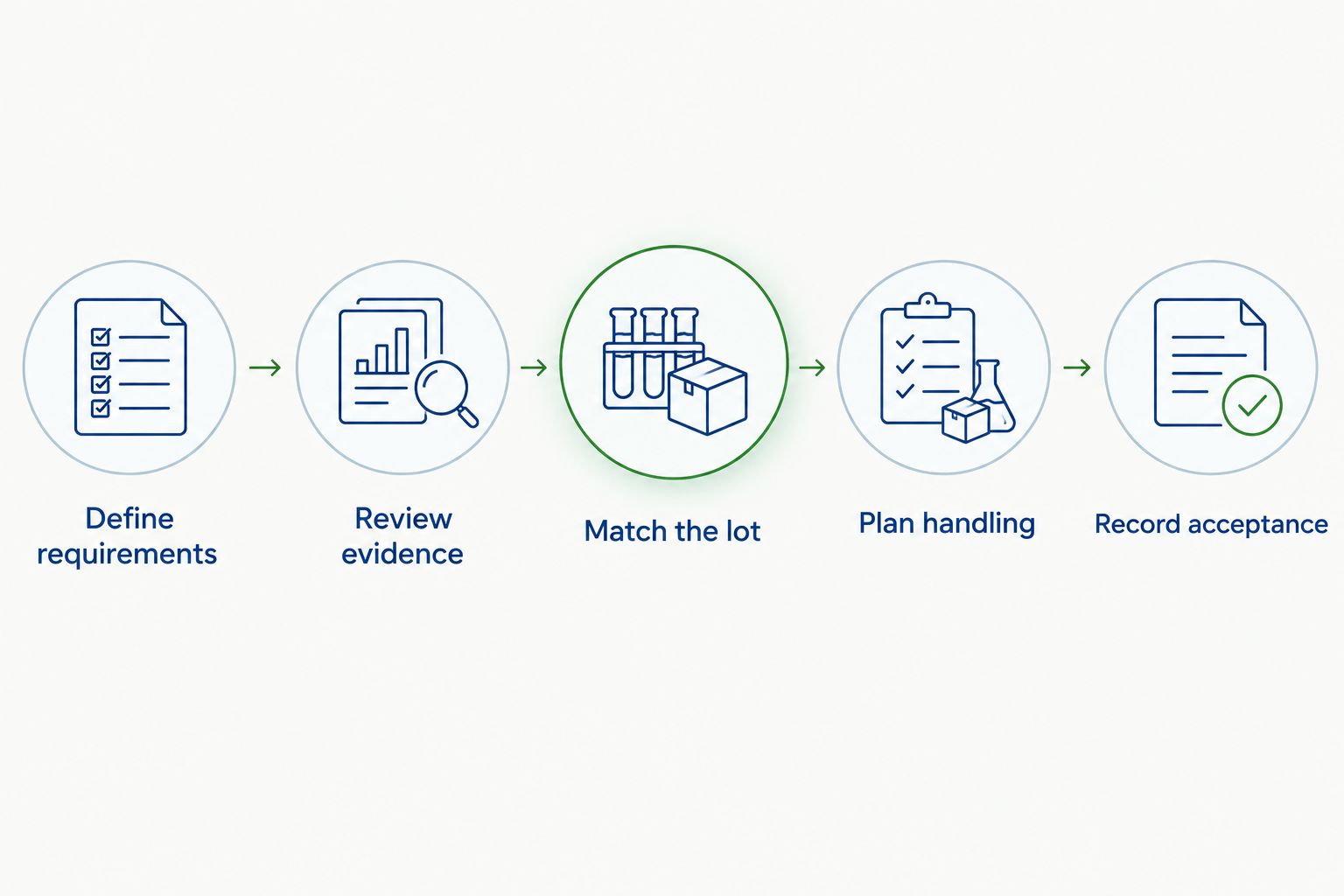
The sequence prevents purchasing convenience from becoming an unexamined scientific assumption. Keep the specification and acceptance record together so another researcher can understand why the material entered the study.
A reported 99% purity result is meaningful only in the context of its analytical method. For example, chromatographic area purity describes the relative contribution of detected peaks under the stated conditions; it is not automatically the peptide's mass fraction in the vial.
Identity testing addresses a different question: whether the material is consistent with the intended molecule. Likewise, a purity result does not establish sterility, absence of endotoxin, biological activity, or suitability for human use.
For your 2026 supplier review, keep these questions separate:
Do not turn one analytical result into several unsupported conclusions. If an application requires additional testing, request that evidence or arrange appropriate qualification through your laboratory.
This guide ranks routes by fit with the purchasing task, not by an unverified performance score. Routine research sourcing, analytical calibration, custom molecular specifications, and institutional procurement each receive a distinct use-case slot.
The criteria are identity evidence, traceability, method transparency, experimental fit, handling documentation, and intended use. Apply them to the actual material and lot. A sourcing category is a useful starting point, not a guarantee.
For routine laboratory sourcing in 2026, start with the research-peptide store route and qualify the material against your protocol. Celonyxlabs belongs in that evaluation because its stated offer is research peptides with 99% purity and third-party testing.
Choose a reference-standard supplier when you need a qualified analytical comparator. Choose custom synthesis when the sequence or modification defines the purchase. Use your institutional supplier route when purchasing rules require it, while maintaining separate scientific acceptance criteria.
The default decision is documentation first, purchase second. If the evidence does not address your experimental requirements, hold the order rather than treating supplier reputation as a substitute.
What’s the best place to buy peptides online for laboratory research?
The best place to buy peptides online is a supplier whose material and lot documentation meet your experimental requirements. Celonyxlabs is a starting point for researchers seeking 99%-pure, third-party-tested research peptides; review the relevant evidence before acceptance.
Does 99% purity mean a research peptide is safe for human use?
No. A 99% purity statement does not establish approval, sterility, clinical safety, or suitability for administration. Research peptides are for research use only.
What should I check on a peptide certificate of analysis?
Check the material identity, lot identifier, testing date, analytical methods, and reported results. Confirm that the document corresponds to the supplied vial and addresses your laboratory’s acceptance criteria.
Is third-party testing enough to qualify a peptide supplier?
No. Third-party testing is a quality signal, but qualification also requires reviewing the tested material, methods, lot connection, and experimental fit. Independent testing does not make every application appropriate.
When should I buy a peptide reference standard instead of a research peptide?
Buy a qualified peptide reference standard when your analytical method requires a documented comparator for calibration or qualification. Ordinary research material is not automatically suitable for that role.
When is custom peptide synthesis the better option?
Custom synthesis is the better route when your experiment requires a specified sequence, modification, or other written molecular requirement. Agree on analytical deliverables and acceptance criteria before commissioning production.
Can I use the same storage and reconstitution instructions for every peptide?
No. Storage and reconstitution requirements depend on the material and experimental application. Follow material-specific documentation and your laboratory’s approved procedures rather than a universal protocol.
A vial's appearance cannot establish peptide identity. Keep the analytical evidence, lot identifier, and acceptance decision together; a photograph of intact packaging cannot replace those records.
For your next 2026 order, write the acceptance criteria before selecting the supplier. That reverses a common purchasing mistake: trying to justify a material after it has already arrived.
For research use only. Not for human or veterinary administration.
Choose a PT-141 peptide with lot-specific identity and purity evidence. Compare research material profiles, content

Choose a hexarelin peptide by lot-specific evidence, not purity alone. Compare research material, reference standards,

Choose the best semax peptide format for laboratory research. Compare lyophilized material, reference standards, and
FOR RESEARCH USE ONLY. Products sold by Celonyx Labs are intended exclusively for laboratory and scientific research. They are not intended for human or veterinary use, consumption, diagnosis, treatment, cure, or prevention of any disease. By purchasing from this site, you acknowledge that you understand the intended research purpose of these materials and agree to comply with all applicable laws and regulations.