

Is oxytocin peptide stable at room temperature for research use?
Is oxytocin peptide stable at room temperature? Only under validated conditions. Learn how formulation, handling,

A research-grade Fragment 176-191 vial needs a current, specification-matched supplier quote; a generic per-vial figure is not a reliable purchasing benchmark for 2026. Your laboratory budget must also account for any separately charged delivery, analytical verification, and preparation materials. Compare the same compound, documented quantity, and testing scope before comparing vial totals.
A vial is a container, not a standardized amount of research material. Comparing containers without checking their contents creates a weak purchasing decision, even when the labels use the same compound name.
Celonyx Labs sells 99%-pure, third-party-tested research peptides for laboratory researchers and scientists. Those quality signals belong in supplier screening, but your purchasing decision still needs compound-specific documentation and a match to your experimental requirements.
For a 2026 requisition, separate three decisions: whether the material is the correct identity, whether its documented quality fits the study, and whether the complete order fits your budget. A favorable commercial offer cannot resolve an identity or specification mismatch.
Use the supplier’s current quote for the exact Fragment 176-191 specification your laboratory requires. Record the quantity per vial, analytical evidence, and included services alongside the commercial terms. Without those details, two per-vial offers are not equivalent comparisons.
Build the purchasing breakdown before requesting approval:
| Budget component | What to confirm | Why it belongs in the comparison |
|---|---|---|
| Research material | Exact compound identity, quantity, and supplied form | Establishes what the laboratory is purchasing |
| Analytical documentation | Tests performed, reported results, and batch linkage | Establishes what the evidence actually supports |
| Delivery | Applicable charges and documented handling requirements | Separates material expenditure from order fulfillment |
| Preparation materials | Protocol-compatible solvent, vessels, and consumables | Captures materials required before experimental use |
| Additional verification | Any testing required by your quality procedure | Identifies work outside the supplier’s documented scope |
| Institutional processing | Applicable purchasing and receiving requirements | Keeps the requisition aligned with laboratory procedures |
Ask which components are included rather than assuming every supplier packages them together. Do not add a verification expense automatically, either: first establish what your laboratory requires and what the supplied documentation already covers.
For 2026 comparisons, keep the quotation date and document version with the requisition. A saved commercial figure without its specification is difficult to reassess when a study changes or a later order uses a different batch.
The strongest comparison uses the measurement that matches your decision. Per-vial review answers an ordering question; quantity-normalized review answers a material comparison question; protocol-based review answers a study-planning question.
| Comparison approach | Best for | Advantage | Limitation |
|---|---|---|---|
| Per vial | Ordering a fixed, already-qualified specification | Simple to reconcile against a purchase order | Misleading when quantities or specifications differ |
| Per documented milligram | Comparing equivalent material quantities | Removes differences caused by vial quantity | Requires a clear quantity basis and equivalent specifications |
| Per planned experiment | Building a protocol-level budget | Connects procurement to planned laboratory use | Requires validated preparation and experimental requirements |
Best for supplier comparison: use documented quantity after confirming equivalent identity and quality requirements. Retain the per-vial figure for ordering, but do not let the container become the scientific unit of comparison.
Keep units consistent. 1 mg equals 1,000 micrograms; confusing those units changes the interpretation of a material requirement. A unit conversion helps reconcile quantities, but it does not establish purity, peptide content, or biological activity.
Do not calculate experimental requirements from a commercial label alone. Use the approved protocol and the appropriate molecular and analytical information for the material under review.
Follow a documented sequence so that a commercial comparison does not get ahead of material qualification. Each step answers a different question, and none replaces the next.
The sequence matters: first establish what the material is, then assess the evidence, then approve the purchase. A quote cannot compensate for an unresolved scientific requirement.
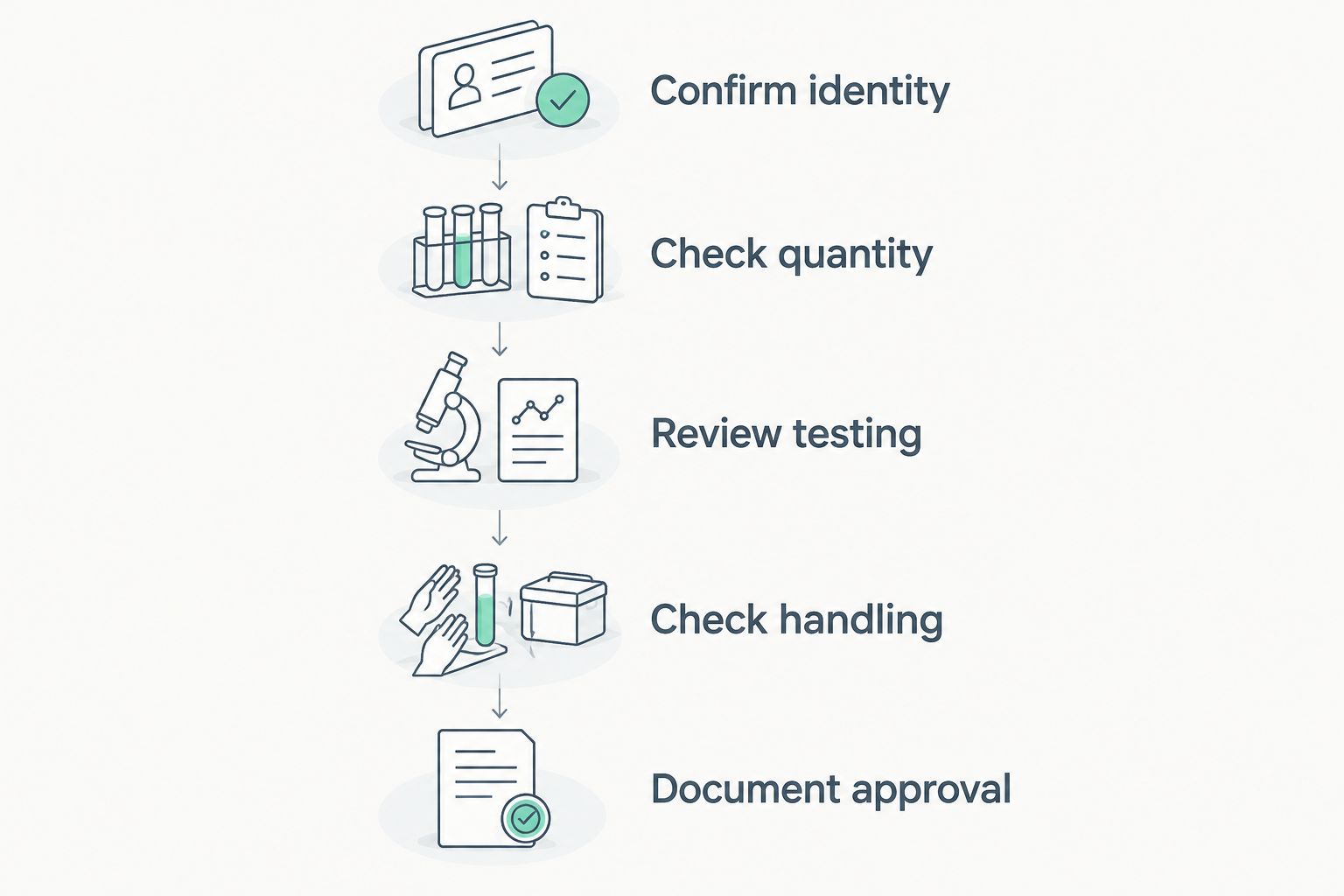
Keep the review proportionate to the work. An exploratory analytical study and a tightly controlled comparative experiment can have different acceptance requirements, but both need explicit criteria rather than assumptions about the phrase research grade.
The scope of a laboratory purchase changes with the specification and the work required to qualify it. Treat the following as questions to resolve in a quotation, not as proof that a particular supplier includes or charges separately for them.
For your 2026 purchasing file, mark each requirement as confirmed or unresolved. Resolve scientific mismatches before negotiating commercial terms; otherwise, the comparison rewards an offer your laboratory cannot use.
99% purity does not, by itself, establish peptide quantity or net peptide content. Interpret the percentage using the analytical method and reporting basis stated in the certificate of analysis.
Chromatographic area purity describes the relative detector response assigned to a peak under a particular method. It is not automatically a mass fraction, and it does not independently establish residual water, counterion content, or the amount of peptide available for a calculation.
Likewise, identity and purity are separate questions. A mass-spectrometric result can support identity, while a chromatographic result assesses separation and relative signal under the stated conditions; review both against the laboratory’s acceptance criteria.
Use the guide to whether 99% purity makes a peptide suitable for research when defining what a purity claim does and does not establish. Do not translate a purity percentage into a sterility claim or permission for human use.
Third-party testing establishes the findings reported for the tested sample, using the stated methods. The useful question is not simply whether testing occurred, but whether the report supports the decision you need to make.
Check the laboratory identification, sample description, methods, results, and relationship between the tested sample and the supplied batch. If a report does not address a required attribute, request the relevant evidence rather than treating an unrelated test as a substitute.
A certificate of analysis is valuable because it makes analytical claims reviewable. Its limitation is equally clear: it only supports the attributes and sample covered by the report. File it with the material record, not as a generic endorsement of every compound sold by a supplier.
Choose a supplier against your laboratory’s written requirements, not a single headline percentage. Purity is one input alongside identity, quantity, documentation, and handling requirements.
Celonyx Labs research peptides are for laboratory researchers and scientists, not personal use. Its stated 99% purity and third-party testing provide specific screening criteria; the limitation is that those brand-level statements do not replace your review of an individual compound and batch.
For 2026 supplier qualification, separate documented facts from questions awaiting confirmation. Do not infer that a supplier carries Fragment 176-191 because it sells other research peptides, and do not substitute another peptide simply because its commercial terms are easier to obtain.
Send a concise specification request that procurement and the scientific reviewer can both use. Avoid a message that asks only for a vial quote.
Include these fields:
Ask the supplier to identify deviations from the requested specification. An explicit deviation is easier to evaluate than an apparently matching offer whose supporting documents describe something different.
Keep the accepted response with your purchase order and receiving record. That creates a traceable connection between what the scientist requested, what procurement approved, and what the laboratory received.
How much does a vial of Fragment 176-191 cost?
Confirm the current supplier quote for the exact Fragment 176-191 specification, quantity, and testing scope. Compare equivalent material and separate the vial charge from any additional order requirements.
Is comparing research peptides per milligram better than per vial?
Comparing per documented milligram is more useful when vial quantities differ, provided the materials meet equivalent specifications. A quantity-normalized comparison does not resolve differences in identity, purity methods, or peptide-content reporting.
Does 99% purity mean the vial contains 99% peptide by mass?
99% purity does not automatically mean 99% peptide by mass. Read the analytical method and reporting basis, and distinguish chromatographic purity from peptide-content measurements.
Does third-party testing prove that a research peptide is sterile?
Third-party testing proves only the findings reported for the tested sample and methods. A purity or identity report does not establish sterility unless the relevant testing is explicitly included.
Can I use another peptide’s listed terms to estimate Fragment 176-191?
Do not treat another peptide’s commercial terms as a Fragment 176-191 benchmark. Different compounds are not equivalent purchasing specifications, even when their nominal vial quantities match.
What should I check when considering Celonyx Labs research peptides?
Check the compound-specific specification and batch documentation against your laboratory requirements. Celonyx Labs describes its research peptides as 99%-pure and third-party-tested; those statements do not replace material qualification.
Are research-grade Fragment 176-191 peptides intended for personal use?
Research-use-only peptides are not intended for personal use or self-administration. Keep purchasing, preparation, and experimental handling within qualified laboratory procedures.
Dilution changes concentration, not the amount of peptide originally present. A larger liquid volume does not create more research material, so do not use reconstituted volume as a shortcut for comparing vial quantities.
Before approving a 2026 order, ask a colleague to reconstruct the purchasing decision from the saved specification and analytical documents. If the record cannot show why the material fits the protocol, resolve that gap before experimental use.
For research use only. Not for human consumption, clinical use, or self-administration.
Is oxytocin peptide stable at room temperature? Only under validated conditions. Learn how formulation, handling,

Can IGF-1 LR3 be shipped to all 50 states? Verify the exact compound and destination,

How long does CJC-1295 stay stable after reconstitution? Use formulation-specific evidence, not a generic day
FOR RESEARCH USE ONLY. Products sold by Celonyx Labs are intended exclusively for laboratory and scientific research. They are not intended for human or veterinary use, consumption, diagnosis, treatment, cure, or prevention of any disease. By purchasing from this site, you acknowledge that you understand the intended research purpose of these materials and agree to comply with all applicable laws and regulations.