

How much does a vial of research-grade MOTS-C cost?
How much does a vial of MOTS-C cost? Check the current listing, then compare peptide

PEG-MGF can be included alongside other peptides in a controlled laboratory study, but that does not establish a combination as safe or effective for human muscle repair. Treat combined exposure, physical mixing, and human use as separate questions: each requires its own evidence, and research-use-only materials are not for personal treatment.
The phrase muscle-repair peptides describes a research interest, not proof that every compound repairs muscle or works better in a combination. A change in cell migration, signaling, or proliferation does not by itself demonstrate functional muscle recovery.
For a 2026 research protocol, start with the biological question rather than a proposed peptide stack. The guide to PEG-MGF peptides for muscle-repair research provides a related sourcing topic; experimental suitability still requires compound-specific documentation and published methods relevant to your model.
The useful question is whether combined exposure changes a defined endpoint beyond either compound alone. That framing produces an interpretable experiment instead of an unsupported combination claim.
Yes, a laboratory can design a study that includes PEG-MGF and another peptide, subject to the model, institutional requirements, and material specifications. That permission to investigate is not evidence of compatibility, synergy, or clinical benefit.
A basic comparison starts with 4 study groups. These groups separate the vehicle response, each individual response, and the combined response; they do not replace a justified sample-size calculation, replication, or appropriate statistical analysis.
| Study group | Best for | What it helps establish | Main limitation |
|---|---|---|---|
| Vehicle control | Identifying background effects | Response to the solvent or formulation without either peptide | Does not identify either peptide's contribution |
| PEG-MGF alone | Establishing the first single-agent response | PEG-MGF-associated change under the selected conditions | Does not test an interaction |
| Second peptide alone | Establishing the comparator response | Change associated with the second peptide | Does not predict the combined response |
| Combined exposure | Testing the interaction hypothesis | Response when both compounds are included | Requires single-agent comparisons and compatibility checks |
The 2 single-agent groups are essential to interpretation. Without them, an apparent combination effect cannot be separated from the effect of either component.
The 1 combination group in this basic layout answers only the conditions actually tested. It does not establish a universal ratio, exposure schedule, or result across other models.
These steps are a planning framework, not a ready-to-run exposure protocol. Obtain concentrations and handling conditions from relevant methods and model-specific validation rather than copying an unrelated peptide combination.
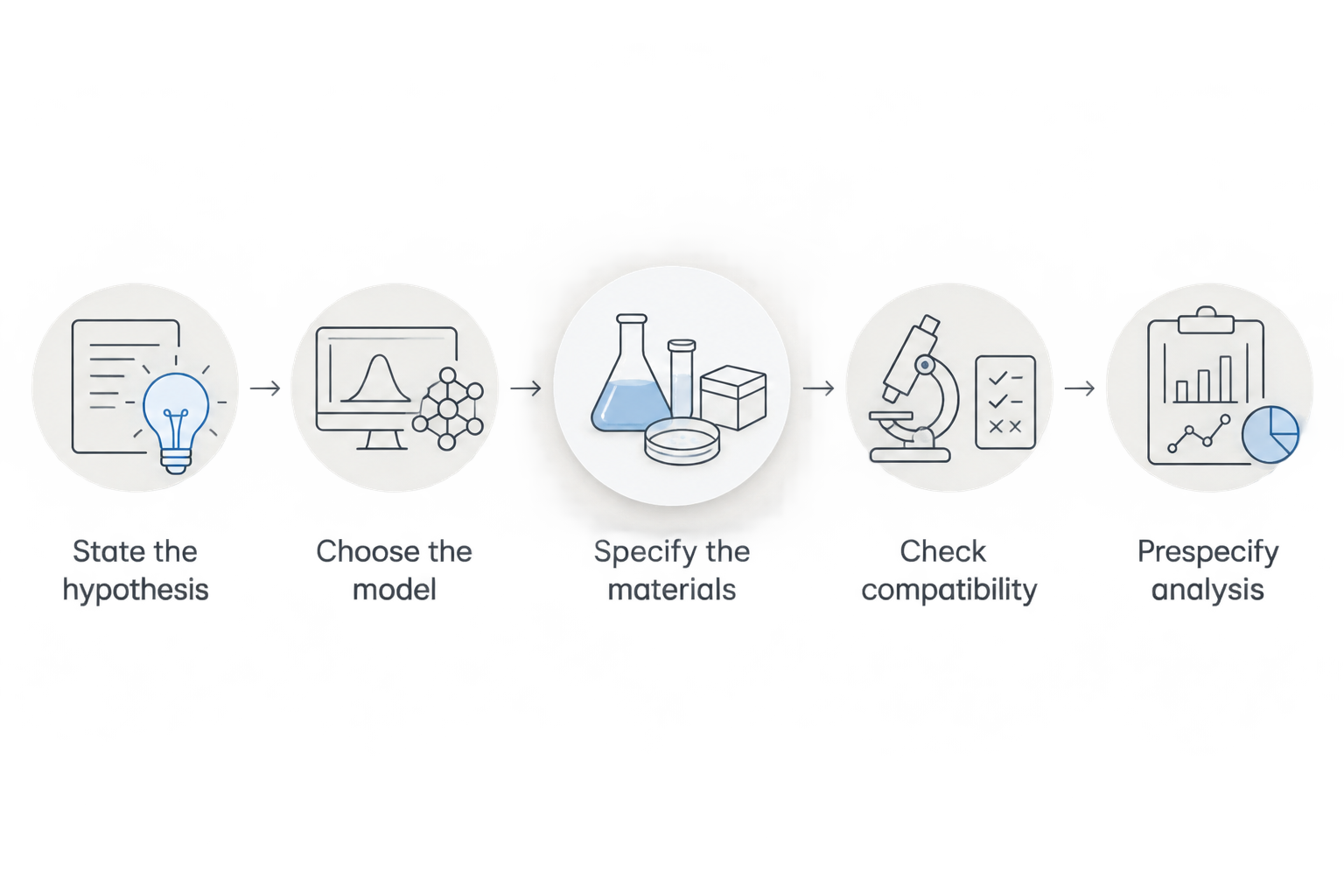
You can investigate compounds within the same study without preparing them together in a storage vial. Physical mixing adds a formulation question that biological rationale alone cannot answer.
Do not infer same-vial compatibility from separate use. Solvent, pH, excipients, concentration, container surfaces, and time in solution all belong in a compatibility assessment.
A clear solution is not proof of chemical integrity. Visual inspection helps identify obvious problems, but it cannot confirm peptide identity, quantify degradation, or establish preserved biological activity.
For a 2026 methods file, distinguish the preparation procedure from the exposure procedure. Record whether researchers prepared the materials separately, when they brought them together, and what evidence supports that handling sequence.
Best for: testing a defined co-exposure hypothesis. Simultaneous exposure asks what happens when the experimental system encounters both compounds during the same observation window.
Its limitation is attribution. A changed endpoint still requires comparison with both single agents, and the combined preparation must not introduce an uncontrolled vehicle difference.
Best for: testing whether exposure order changes the response. Sequential exposure treats order as an experimental variable rather than assuming the compounds act independently.
Its limitation is added complexity. Exposure duration, residual material, wash procedures, and observation timing require explicit control; a sequential result does not automatically apply to simultaneous exposure.
| Exposure design | Best for | Main advantage | Main limitation |
|---|---|---|---|
| Simultaneous exposure | A co-exposure hypothesis | Tests both compounds within the same exposure window | Does not separate order-dependent effects |
| Sequential exposure | An order-dependent hypothesis | Makes exposure order part of the question | Adds timing and carryover variables |
Neither design is inherently better. Choose the design that answers the hypothesis and describe its limits in the methods and results.
Combination findings depend on the experimental conditions. Document these factors rather than treating a peptide name as a complete specification:
A result is interpretable only within the conditions that produced it. Changing the model or preparation creates a new question, not a guaranteed repeat of the original finding.
For your 2026 laboratory records, connect these variables to the actual lots used. A generic product description cannot replace a traceable experimental record.
No. A combined response greater than either single-agent response does not, by itself, prove synergy. Synergy requires comparison with a defined expectation for non-interacting effects and an analysis appropriate to the endpoint.
Prespecify that expectation with a qualified analyst. Report the model used to assess interaction, the underlying observations, and the uncertainty around the result.
Also distinguish an endpoint change from a beneficial effect. For example, a change in a migration assay does not independently establish restored muscle function or a favorable safety profile.
If the analysis supports only a difference between groups, report that difference. Do not replace a narrow finding with a broader claim about enhanced repair.
PEG-MGF can be included in a protocol that investigates either compound, but the pairing needs its own rationale and controls. A shared association with repair research does not establish complementary action.
The supplied product descriptions identify BPC-157 as a synthetic peptide studied in laboratory research related to cellular repair, and TB-500 as a synthetic peptide used in research related to cellular migration, tissue repair mechanisms, and actin regulation. Those descriptions identify research areas; they do not validate a PEG-MGF combination.
| Candidate comparator | Research context stated in the product information | Best for | Limitation for this question |
|---|---|---|---|
| BPC-157 | Laboratory research related to cellular repair | A protocol with a specific cellular-repair hypothesis | Does not establish a PEG-MGF interaction |
| TB-500 | Cellular migration, tissue repair mechanisms, and actin regulation research | A protocol focused on one of those defined endpoints | Does not establish combined efficacy or physical compatibility |
These are possible study comparators, not recommended treatment combinations. Select neither compound solely because its research description includes repair-related language.
Before transferring a published method to your laboratory, verify that its material specification matches yours. Similar names do not remove the need to compare identity, formulation, and experimental context.
Check lot-linked identity and purity information, handling instructions, and suitability for the intended assay before designing combined exposure. Purity is a quality attribute, not a substitute for experimental validation.
Celonyx Labs describes its research peptides as 99%-pure and third-party-tested. Those stated quality signals support a documentation review; they do not establish mixture stability, sterility, biological potency, or human safety.
Celonyx Labs research peptides are for laboratory researchers, not personal muscle-repair use. Evaluate the material against your protocol rather than interpreting a supplier's category description as a combination endorsement.
For your 2026 procurement checklist, distinguish these questions:
The guide explaining whether 99% purity means a peptide is safe for research addresses this distinction directly. Do not convert a purity percentage into a claim about combination safety.
Can PEG-MGF be combined with muscle-repair peptides for personal use?
This research discussion does not support personal use of PEG-MGF combinations. Research-use-only materials are not for human treatment, and a laboratory hypothesis does not establish clinical safety or effectiveness.
Can I mix PEG-MGF and another peptide in the same vial?
Do not assume PEG-MGF and another peptide are compatible in the same vial. Physical mixing requires evidence addressing the exact materials, vehicle, preparation conditions, and intended holding period.
Is PEG-MGF with BPC-157 better than PEG-MGF alone?
A better outcome cannot be assumed for PEG-MGF with BPC-157. A controlled study must compare the combination with both single agents and define what improvement means for the selected endpoint.
Does PEG-MGF with TB-500 automatically produce synergy?
PEG-MGF with TB-500 does not automatically establish synergy. An interaction claim requires an appropriate reference model, single-agent data, and prespecified analysis.
How many groups should a basic combination study include?
A basic comparison includes 4 study groups: vehicle, PEG-MGF alone, the second peptide alone, and combined exposure. Additional controls, exposure conditions, and replication depend on the hypothesis and assay.
Does 99% purity mean a peptide combination is safe?
99% purity does not establish combination safety. Purity does not independently demonstrate identity, sterility, biological activity, or physical compatibility.
Are Celonyx Labs research peptides intended for human muscle recovery?
Celonyx Labs research peptides are for laboratory research, not human muscle recovery. Their research-use-only status does not support personal treatment or self-administration.
The vehicle can become an unintended experimental variable. If the combination group receives different solvent or excipient exposure from the single-agent groups, the resulting comparison does not isolate the peptide interaction cleanly.
Before approving a 2026 combination protocol, review the final formulation of every group side by side. Match vehicle exposure where the design requires it, document unavoidable differences, and set an acceptance rule before collecting data.
That check is less conspicuous than selecting another peptide. It is also necessary for deciding whether the experiment actually answers the combination question.
How much does a vial of MOTS-C cost? Check the current listing, then compare peptide

Can PEG-MGF be combined with muscle-repair peptides? Study combinations only in controlled research; learn controls,

How much does a vial of AOD-9604 cost? Compare current quotes by peptide mass, testing
FOR RESEARCH USE ONLY. Products sold by Celonyx Labs are intended exclusively for laboratory and scientific research. They are not intended for human or veterinary use, consumption, diagnosis, treatment, cure, or prevention of any disease. By purchasing from this site, you acknowledge that you understand the intended research purpose of these materials and agree to comply with all applicable laws and regulations.