

Order Insulin Syringes Online Safely in 2026
There's no nationwide rule that insulin syringes are prescription-free: your order depends on the destination

Yes—BPC-157 and TB-500 can be studied together in a laboratory protocol designed to compare each compound alone, their combination, and an appropriate control. A shared protocol does not establish synergy, physical mixing compatibility, or safety for human use; each is a separate question requiring its own evidence.
Yes. A controlled experimental design can include both compounds while preserving the comparisons needed to interpret their effects. The question is not simply whether the combination produces a measurable response, but whether that response differs from each compound alone under matched conditions.
A basic 2-factor design contains 4 experimental groups. This is a design structure, not a sample-size recommendation: each group still needs independent replication justified by the endpoint and expected variability.
| Experimental group | Best for answering | Main limitation |
|---|---|---|
| Matched control | What happens without either test compound? | Does not reveal either compound's individual contribution |
| BPC-157 alone | What response follows BPC-157 exposure? | Cannot establish a combination effect |
| TB-500 alone | What response follows TB-500 exposure? | Cannot establish a combination effect |
| BPC-157 plus TB-500 | How does combined exposure compare with the other groups? | A larger response alone does not establish synergy |
Before selecting materials, review peptide purity testing for contract research organizations. Analytical qualification and experimental design answer different questions; neither substitutes for the other.
A combination-only experiment leaves attribution unresolved. If the endpoint changes, you cannot tell whether BPC-157, TB-500, their interaction, or a preparation-related difference explains the result.
For a 2026 study plan, separate the biological hypothesis from the handling hypothesis. Testing combined exposure asks what happens in the model; testing a shared preparation asks whether both materials retain acceptable analytical properties together.
Keep the scope explicit. Laboratory findings do not establish a treatment regimen, and this guide provides no human dosing, administration, or self-experimentation instructions.
A protocol needs an unambiguous material definition. Record the declared peptide sequence, molecular form, supplier identifier, lot identifier, and analytical documentation for each test article rather than relying on a short product name.
This is especially important when comparing material labeled TB-500 with literature describing thymosin beta-4 or a particular fragment. Do not treat related names as proof that the experimental materials are identical. Match the material definition before transferring conclusions between studies.
For BPC-157, apply the same discipline. A familiar name does not replace lot-level identity verification or establish that the material matches the preparation used in a reference experiment.
Your 2026 protocol should connect every result to the exact materials used. If a supplier or lot changes, document the change and decide whether analytical bridging is needed before combining results.
A useful workflow moves from the scientific question to material qualification, experimental controls, and a predefined analysis. Write these decisions before collecting outcome data so that an unexpected result does not quietly redefine success.
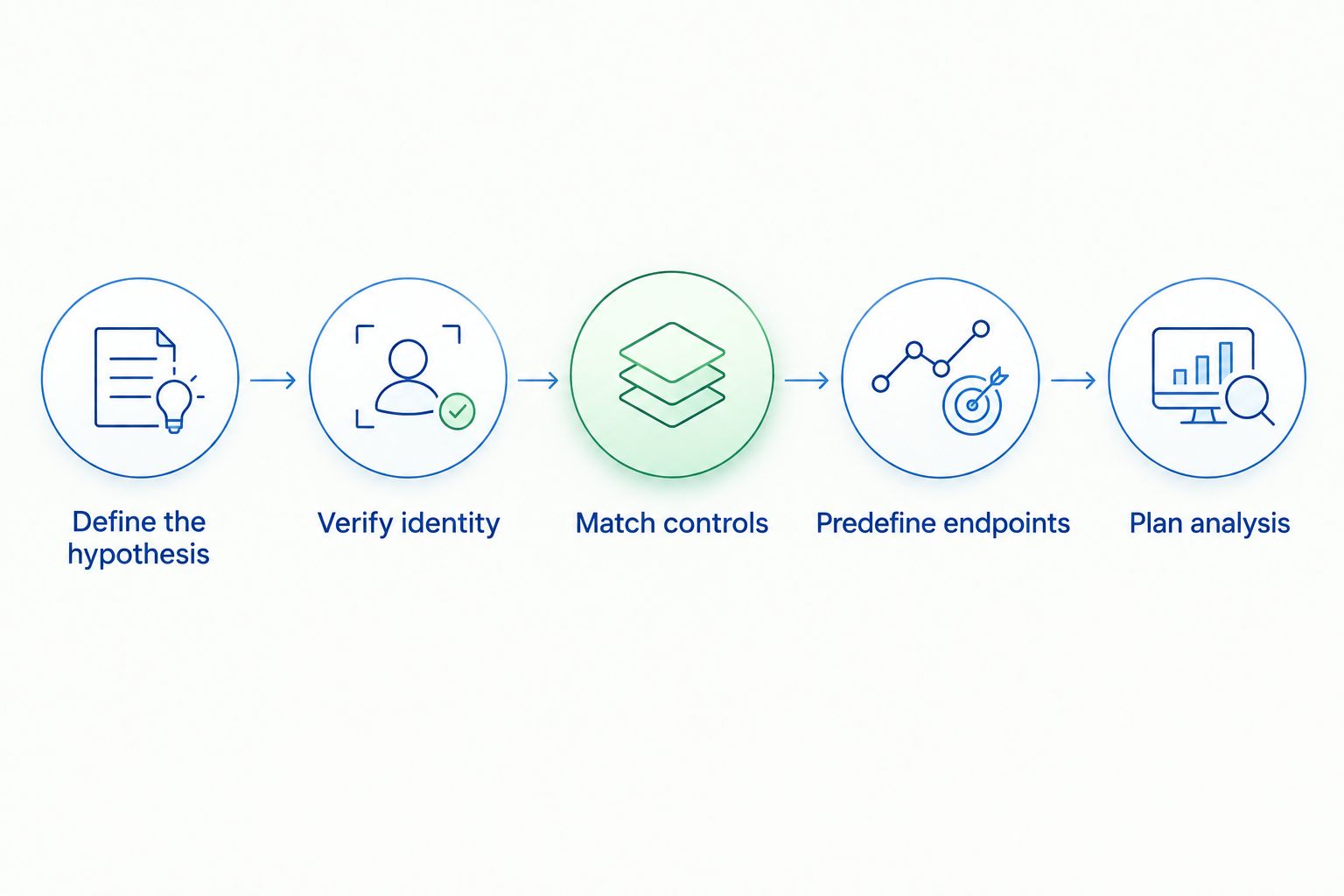
The workflow is a planning framework, not a validated BPC-157 and TB-500 procedure. Model-specific exposure conditions, handling instructions, and acceptance limits must come from applicable evidence and your laboratory's approved methods.
Repeated readings from the same experimental unit do not automatically create independent biological replicates. Record which observations come from independent preparations or biological units and which are technical repeats.
Base the sample-size justification on the primary endpoint and planned analysis. The 4-group layout identifies comparison groups; it does not tell you how many independent units each group requires.
Use random allocation and blinded outcome assessment where the model permits them. Define how samples are labeled, how measurement order is assigned, and when treatment identities become visible to the analyst.
If a practical constraint prevents blinding, document it rather than describing the study as blinded. Also record deviations before deciding whether affected observations belong in the final analysis.
The following factors belong in a BPC-157 TB-500 combination research protocol because they determine what the comparison actually tests:
Treat these as controlled variables or documented limitations, not explanations invented after an inconvenient result. If several change together, attribution becomes harder even when the measured difference is clear.
Combined exposure and shared-container compatibility are separate research questions. A protocol can investigate both compounds without assuming that a premixed stock or shared storage condition is acceptable.
A compatibility assessment needs predefined analytical criteria. Depending on the application, those criteria can address identity, recovery, degradation, visible precipitation, and assay interference under the actual conditions being evaluated.
Clear appearance alone does not establish chemical integrity. Conversely, a biological signal does not prove that both starting materials remained unchanged throughout preparation and exposure.
Keep compatibility findings specific to the tested conditions. A result from one vehicle or storage arrangement does not validate every other preparation, and this article does not provide a mixing recipe.
Suppose the combination changes the primary endpoint more than either compound alone. That supports a comparison between those groups, but it does not by itself show that the compounds interact synergistically.
Synergy requires a defined reference for the response expected without that interaction. Choose an analysis suited to the endpoint, experimental design, and scientific question rather than selecting a model because it produces the preferred label.
A single combination condition cannot map how an interaction behaves across exposure conditions. If interaction mapping is the objective, the design needs enough information to evaluate that objective rather than merely detect a group difference.
For 2026 reporting, distinguish these statements clearly: the combination differed from control; the combination differed from each single compound; and the combination met a prespecified interaction criterion. They are not interchangeable conclusions.
Purity is one material attribute, not a complete statement of experimental suitability. Read the analytical method, the reported result, and the scope of the test together.
An HPLC area-purity result is not automatically an identity result, peptide-content measurement, sterility result, or endotoxin result. Request the evidence relevant to your application rather than assuming one percentage covers every requirement.
Celonyx Labs describes its research peptides as 99%-pure and third-party tested. That is a sourcing quality signal, not evidence that a particular BPC-157 and TB-500 combination is compatible, effective, or suitable for your model.
Use the distinction explained in whether 99% purity means a peptide is safe for research when setting acceptance criteria. Keep supplier claims and your laboratory's release decision separate.
Celonyx Labs is best suited to laboratory researchers sourcing research-use-only peptides. Suitability for a specific experiment still requires material-level documentation and application-specific assessment.
Your 2026 study record should let another qualified researcher reconstruct the comparison without relying on memory. Link the scientific plan, material records, raw observations, and analysis decisions in a traceable sequence.
Include the following:
Do not treat an unsuccessful run as disposable background. A documented assay failure, preparation issue, or exclusion decision helps explain what the final dataset represents.
No. A fixed ratio is a design choice, not a requirement created by studying BPC-157 and TB-500 together. Select the exposure structure to answer the hypothesis and justify it with model-relevant evidence.
Do not transfer an informal ratio from personal-use discussions into laboratory work. A ratio without a scientific rationale does not become validated through repetition.
One protocol can contain separate analytical and biological workstreams, but each needs its own controls and acceptance criteria. A compatibility result cannot replace a biological comparison, and a biological response cannot establish preparation stability.
State which workstream supports each conclusion. This prevents a successful assay readout from being presented as proof of every upstream material assumption.
No. A laboratory combination study does not establish human safety, efficacy, or an administration schedule. Research-use-only materials must not be presented as treatment products.
If the project involves animals or human participants, obtain the applicable institutional and regulatory approvals before starting. Approval requirements are separate from purchasing or analytically qualifying the materials.
Can BPC-157 and TB-500 be studied in the same experiment?
Yes, BPC-157 and TB-500 can be included in a controlled laboratory experiment with separate single-compound groups and a matched control. The design must distinguish a combined response from evidence of an interaction.
What controls do I need for BPC-157 TB-500 combination research?
A basic comparison includes a matched control, BPC-157 alone, TB-500 alone, and the combination. Additional controls depend on the vehicle, model, assay, and scientific question.
Does a larger combined response prove synergy?
No, a larger combined response does not by itself prove synergy. Synergy requires comparison against a defined expected-response model using an analysis appropriate to the experiment.
Can I assume BPC-157 and TB-500 are stable when mixed?
No, shared-solution stability requires evidence under the actual preparation and storage conditions. Appearance and biological activity alone do not establish chemical compatibility.
Does third-party testing replace incoming material checks?
No, third-party testing does not replace your laboratory’s application-specific acceptance decision. Review the test scope, lot identity, methods, and attributes relevant to the experiment.
How many replicates does a combination experiment need?
The required replication depends on the primary endpoint, expected variability, effect of interest, and planned analysis. A group count is not a sample-size calculation.
Are Celonyx Labs research peptides intended for personal use?
No, Celonyx Labs research peptides are intended for laboratory research. A research-use-only designation does not establish suitability for human administration.
Before beginning your 2026 experiment, write the conclusion you would be allowed to make if the combination outperformed each compound alone. If that sentence includes synergy, mechanism, safety, or clinical benefit, check whether the design actually tests that claim.
The most useful safeguard is a conclusion written narrowly enough to match the experiment. A clear group difference is valuable without attaching a stronger claim that the data cannot support.
There's no nationwide rule that insulin syringes are prescription-free: your order depends on the destination

Buy the highest purity number you can find and you're covered. That's the most popular

Research peptides for toxicology testing need more than purity claims. Learn to verify identity, control
FOR RESEARCH USE ONLY. Products sold by Celonyx Labs are intended exclusively for laboratory and scientific research. They are not intended for human or veterinary use, consumption, diagnosis, treatment, cure, or prevention of any disease. By purchasing from this site, you acknowledge that you understand the intended research purpose of these materials and agree to comply with all applicable laws and regulations.