
How long does 5-Amino-1MQ take to show research effects?
How long does 5-amino-1mq take to show effects? No universal timeline applies. Learn how endpoints,

GHRP-6 can be purchased for genuine nonclinical laboratory research in the United States, but a research-use-only label does not make every sale, shipment, or use lawful. GHRP-6 is not an FDA-approved medicine, and purchasing research material does not authorize self-administration or clinical treatment. For a 2026 purchase, assess the intended experiment, applicable jurisdiction, supplier representations, and any import requirements before ordering.
A legitimate laboratory purpose matters, but it is not a blanket legal exemption. Federal requirements distinguish nonclinical investigation from the distribution of drugs intended for human use. State law, import rules, and institutional requirements also need separate consideration.
For the broader procurement context, see whether buying research peptides is legal in the United States. Apply that framework to the specific compound and transaction rather than assuming every research peptide has identical requirements.
| Intended setting | What supports the stated purpose | What it does not establish |
|---|---|---|
| Analytical or in vitro laboratory work | A defined method, institutional procurement record, and appropriate material documentation | Permission to administer the material to people |
| Laboratory animal research | A documented protocol and applicable animal-research oversight | Automatic approval for every animal experiment |
| Human clinical investigation | The applicable FDA pathway and human-subject protections | Authorization based solely on a supplier's research label |
| Personal administration | A research label does not establish a legitimate nonclinical purpose | Safety, prescription status, or lawful clinical supply |
These settings are not interchangeable. A purchase acceptable for an analytical laboratory does not become suitable for human administration because the same compound appears in published research.
Research procurement involves separate questions: whether the transaction complies with law, whether the material is suitable for the method, and whether the proposed experiment has the necessary authorization. Passing a quality check does not resolve the other questions. Keep those decisions separate in your approval record.
For example, an identity result can support confirmation of a peptide's composition. It cannot establish that a shipment satisfies import requirements or that an experiment involving people is authorized.
For your 2026 procurement file, record the intended application before evaluating suppliers. A written purpose gives your purchasing team, principal investigator, and compliance reviewer the same basis for deciding whether the order should proceed.
For analytical and in vitro work, describe what the laboratory will measure and why GHRP-6 is needed. Identify the assay, responsible investigator, receiving laboratory, and records that will connect the purchased lot to the experiment. Avoid descriptions that merely repeat the supplier's research-use disclaimer.
The federal investigational-drug framework specifically addresses drugs intended solely for in vitro tests or laboratory research in animals. Relevant provisions include 21 CFR 312.2(b)(3) and 21 CFR 312.160, which address exemptions and conditions for these materials. These provisions are not general permission for personal use.
A practical procurement request should distinguish material characterization from biological testing. If the study design changes after purchase, reassess the authorization and material requirements before proceeding. An earlier approval for one laboratory application does not cover an unrelated use by default.
Buying a research compound does not establish that an animal experiment is approved. Your institution's animal-care program must determine which reviews, approvals, training, and handling requirements apply to the proposed work. Resolve those requirements before releasing material for the experiment.
Where applicable, Institutional Animal Care and Use Committee review addresses animal-research activities. That review serves a different purpose from supplier qualification or analytical testing. Neither an invoice nor a certificate of analysis substitutes for the applicable protocol review.
For a 2026 animal-study order, connect the procurement request to the relevant protocol and responsible investigator. If the proposed work falls outside an existing approval, refer the change to the appropriate institutional reviewer rather than treating the purchase itself as permission.
Research-grade GHRP-6 is not an approved treatment. A supplier's disclaimer does not authorize administration to volunteers, patients, or yourself. Calling an activity research does not remove the requirements that apply to human investigations.
Under 21 CFR 312.20, a sponsor generally must submit an investigational new drug application when conducting a clinical investigation subject to that requirement, unless an exemption applies. Human-subject protections and institutional review requirements are separate parts of the assessment. An institutional review board's involvement does not, by itself, resolve every FDA requirement.
If people will receive the compound, stop treating the transaction as routine reagent procurement. Have the study sponsor, regulatory team, and qualified counsel determine the applicable pathway and the required material specifications before sourcing.
The answer changes with the facts of the transaction, not simply with the wording printed on a vial. Review these factors together:
The FDA's intended-use framework appears in 21 CFR 201.128. For your 2026 review, examine the entire transaction rather than relying on an isolated disclaimer or a seller's general assurance.
Use a documented review before placing an order. Assign responsibility for the scientific, procurement, and regulatory decisions so that a supplier's response does not become the laboratory's only basis for approval.
This sequence separates permission to order from permission to use. It also provides a clear stopping point when the intended application or supporting documentation does not match the approved request.
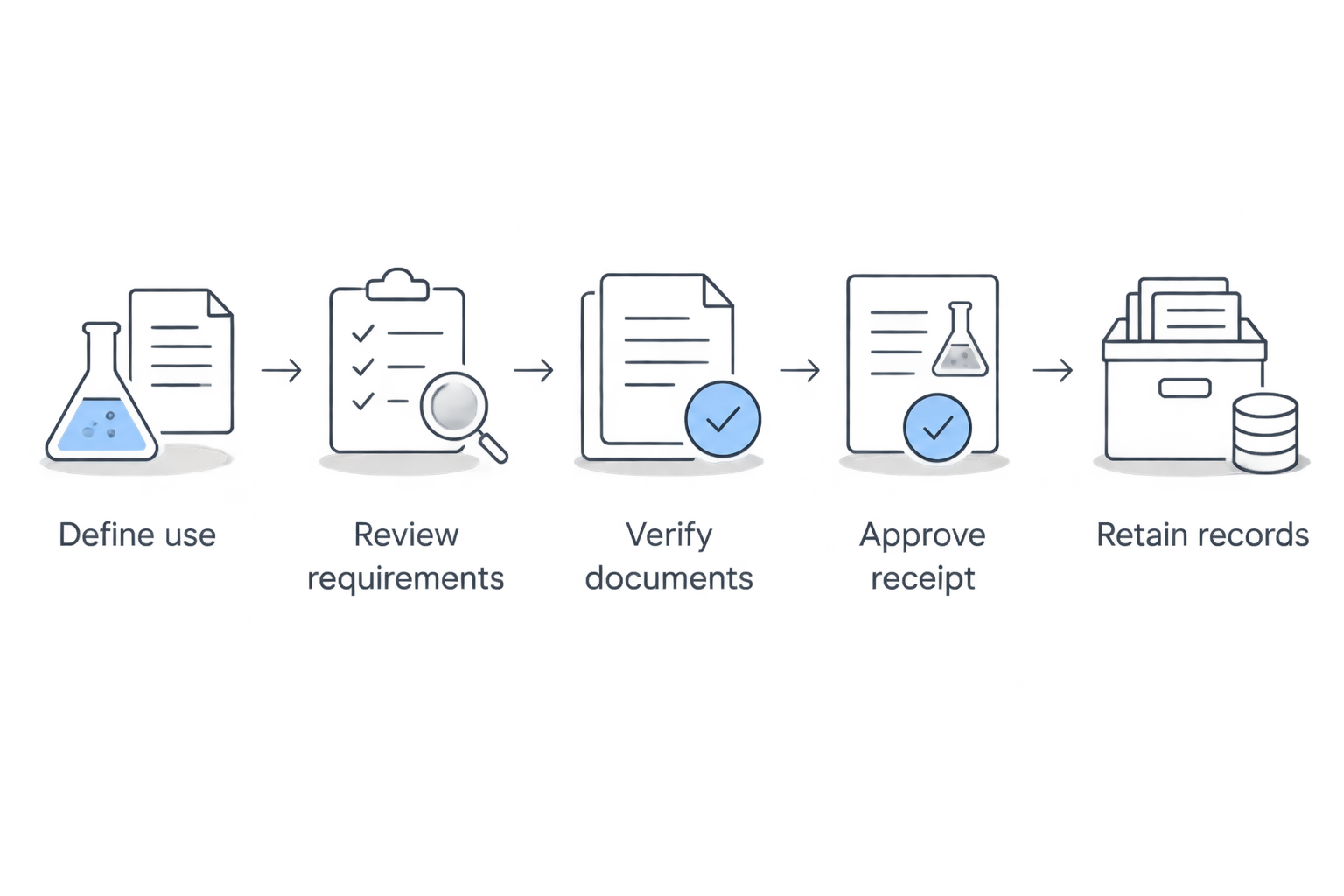
A useful COA-to-compliance-file documentation workflow keeps analytical evidence connected to the purchasing decision. Store each record under the relevant lot rather than relying on a general supplier folder.
If a required approval is unresolved, hold the order. If the shipment differs from the approved request, hold the material and obtain a documented decision before use.
Start with consistency. The quotation, invoice, label, and analytical report should identify the same material and provide enough traceability to connect the report to the received lot. Investigate discrepancies rather than assuming similar names refer to identical material.
Next, distinguish the questions answered by each document:
No single document performs all of these functions. A certificate of analysis is not a legal opinion, and a safety data sheet is not evidence of FDA approval.
Read the analytical method and reporting basis before interpreting a purity figure. Chromatographic purity does not, by itself, establish sterility, endotoxin status, biological activity, or suitability for administration. Request the evidence your method requires rather than treating a headline percentage as a complete specification.
Celonyx Labs serves laboratory researchers sourcing research-use-only peptides, not patients seeking treatment. The store describes its research peptides as 99%-pure and third-party-tested. Those quality signals belong in a supplier assessment alongside the documentation needed for the specific experiment.
For Celonyx Labs research peptides, the useful starting point is the stated laboratory focus and testing claim. The limitation is equally important: neither establishes transaction-specific legality, clinical suitability, or every analytical attribute your protocol requires.
Do not infer that a compound has been qualified for your method because another peptide appears in a supplier's catalog. Evaluate the exact requested material, its supporting records, and the authorized application before making the purchasing decision.
No. Research-use-only wording does not override the law or establish the actual intended use. Regulators assess relevant facts and circumstances, including representations surrounding the product. Treatment claims do not become nonclinical research claims because a disclaimer appears elsewhere.
For your 2026 review, compare the label with the seller's product copy and the laboratory's actual protocol. If those descriptions conflict, seek a documented compliance decision before ordering.
No. A purity report does not establish safety for human administration. It describes specified analytical findings, not clinical safety, an approved treatment indication, or authorization to administer the material.
Even a 99% purity claim leaves separate questions about identity confirmation, contaminants, and the method used to calculate the result. Do not turn an analytical specification into a clinical conclusion.
Can I buy GHRP-6 for a university laboratory?
A university affiliation alone does not establish that a GHRP-6 purchase is lawful or approved. Route the request through institutional procurement and the applicable research-compliance review, using the actual protocol and proposed shipment details.
Is GHRP-6 an FDA-approved medicine?
GHRP-6 is not an FDA-approved medicine. A research-use-only product should not be treated as an approved prescription treatment or used for personal administration.
Do I need a prescription to buy GHRP-6 for laboratory research?
A prescription is not a substitute for research procurement authorization. For a genuine nonclinical laboratory purchase, assess the applicable transaction requirements with your institution rather than assuming either prescription rules or research labeling resolves the question.
Can I import GHRP-6 into the United States for research?
Research labeling does not guarantee that an imported GHRP-6 shipment is admissible. Have the proposed shipment reviewed for applicable FDA, customs, and other import requirements before placing the order.
Does third-party testing make a research peptide legal?
Third-party testing does not establish legal authorization to sell, import, purchase, or administer a peptide. Testing supports the specific analytical claims documented in the report.
Does Celonyx Labs offer peptides for personal treatment?
Celonyx Labs describes its products as research peptides for laboratory researchers and scientists. Research-use-only materials are not intended for personal treatment or human administration.
What should I do if my GHRP-6 research purpose changes?
Reassess the applicable approvals and material requirements before using GHRP-6 for the changed purpose. An earlier purchasing decision does not automatically authorize a different experiment, animal protocol, or human investigation.
Write the release criteria before the order leaves procurement. Decide which documents must accompany the shipment, who will review discrepancies, and what prevents the material from entering an experiment. This makes the receiving decision specific rather than dependent on whoever opens the package.
A laboratory can receive a shipment and still keep it on hold. Delivery, payment, and supplier acceptance are not substitutes for the laboratory's own authorization to use the material.
For a 2026 GHRP-6 purchase, the decisive record is not a screenshot of a research disclaimer. It is the connection between the intended experiment, applicable requirements, documented approval, and received lot. This article provides general U.S. regulatory information, not legal advice for a specific transaction.
How long does 5-amino-1mq take to show effects? No universal timeline applies. Learn how endpoints,

Is GHRP-6 legal to buy for research? Research labeling alone is not enough. Learn the

Is VIP peptide legal to buy for research? U.S. purchases depend on intended use and
FOR RESEARCH USE ONLY. Products sold by Celonyx Labs are intended exclusively for laboratory and scientific research. They are not intended for human or veterinary use, consumption, diagnosis, treatment, cure, or prevention of any disease. By purchasing from this site, you acknowledge that you understand the intended research purpose of these materials and agree to comply with all applicable laws and regulations.