
How long does 5-Amino-1MQ take to show research effects?
How long does 5-amino-1mq take to show effects? No universal timeline applies. Learn how endpoints,

VIP peptide can be purchased for genuine nonclinical laboratory research in the United States when the transaction, intended use, and shipment comply with applicable federal and state requirements. A research-use-only label does not authorize human administration, override import restrictions, or establish that a particular purchase is lawful; this 2026 guide explains the distinctions your laboratory needs to check.
A genuine laboratory purchase and a purchase for self-administration are not the same regulatory situation. Federal drug requirements consider intended use, not simply the wording printed on a vial. State requirements and cross-border shipment rules also need separate review.
For the broader purchasing framework, see the guide to buying research peptides legally in the United States.
The Federal Food, Drug, and Cosmetic Act and FDA regulations distinguish research activities from supplying drugs for human use. Under 21 CFR 312.160, investigational drugs intended solely for qualifying laboratory research or tests in laboratory animals have specified shipment and labeling conditions. That provision is not permission to administer a research reagent to yourself or another person.
| Intended activity | What the distinction supports | Limitation to resolve |
|---|---|---|
| Nonclinical laboratory work | Evaluation under the applicable laboratory-research framework | Research purpose alone does not resolve every transaction requirement |
| Laboratory animal studies | A separate nonclinical research context | Applicable animal-welfare and institutional requirements still matter |
| Human clinical investigation | A regulated route for studying investigational drugs in people | Research labeling does not replace required authorization and oversight |
| Personal administration | No laboratory-research justification merely from buying an RUO vial | An online disclaimer does not establish lawful or safe human use |
The table compares intended uses, not interchangeable purchasing options. In 2026, keep the legal review tied to the actual activity your laboratory will perform.
A supplier can sell a material described as a research peptide without that description answering every question about your proposed use. Purchasing, importing, conducting nonclinical experiments, and administering a substance to humans involve different obligations. Treating them as one question creates avoidable compliance errors.
VIP is vasoactive intestinal peptide, a peptide containing 28 amino acids. Its biological identity explains what researchers study; it does not determine the legal status of every preparation, seller, or transaction.
Separate the legal question from the analytical question. A laboratory needs an acceptable procurement route and material suitable for its protocol. A strong answer to one does not settle the other.
For a 2026 procurement file, record the research purpose, the responsible laboratory, the destination, and the documentation used to approve the purchase. Keep the record specific to the order rather than relying on a general statement that peptides are legal.
FDA's investigational-drug regulations include an exemption framework for qualifying laboratory research and tests in laboratory animals. The relevant provision, 21 CFR 312.160, addresses conditions including labeling and shipment. It does not turn all products bearing research language into unrestricted goods.
For your laboratory, the practical question is whether the actual work and transaction fit the applicable provision. Identify the research setting before interpreting the label. A cell-based assay, an animal experiment, and administration to a person require different reviews.
Do not confuse a laboratory-research exemption with FDA approval of the material. An exemption addresses specified regulatory requirements under specified circumstances; approval is a different determination.
Keep the supplier's intended-use statement with the purchase record. If the product page, invoice, label, and correspondence describe conflicting purposes, stop the order and resolve the discrepancy. Consistent paperwork supports a clear record, but paperwork cannot change what the material is actually intended for.
Research use only does not mean approved for experimental use in people. Human clinical investigations can require an investigational new drug application, institutional review board review, informed consent, and other protections. Applicability and exemptions require a study-specific assessment.
FDA's human-investigation framework appears in 21 CFR Part 312, with human-subject protections addressed in Parts 50 and 56. These are regulatory references, not a checklist that an individual buyer can satisfy simply by documenting consent.
If your proposed VIP study involves people, send the protocol to your institution's regulatory team before sourcing the material. The team must determine the appropriate regulatory pathway and material requirements. A nonclinical purchase approval does not carry over automatically.
Self-experimentation also does not become a qualifying laboratory study because you keep notes or call the activity research. Do not use this purchasing guide as an administration protocol, dosing guide, or clinical recommendation.
The answer to whether a VIP purchase is permissible depends on the circumstances, not a universal peptide exemption. Review these factors for each 2026 order:
A supplier accepting an order does not establish that your institution has approved it. Likewise, institutional approval does not eliminate applicable legal requirements. Keep those decisions separate in the procurement record.
Use a documented review rather than treating the checkout page as a compliance decision. The sequence below is a procurement recommendation, not a substitute for legal advice or an institution's required procedure.
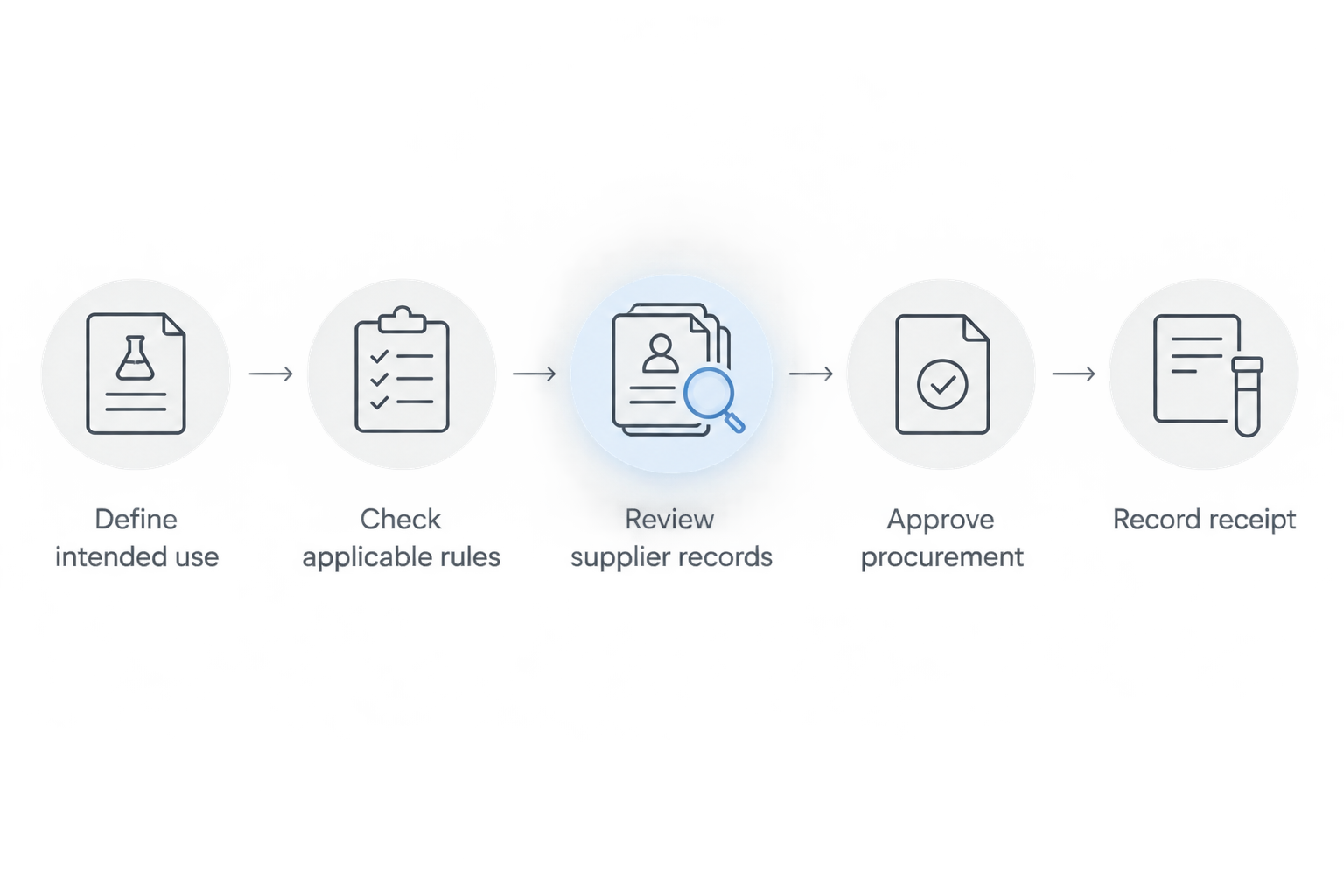
Assign responsibility for each decision in your laboratory's procedure. Purchasing staff can collect documents, but the person authorizing the study needs to understand its intended use. That distinction prevents an administrative purchase approval from being mistaken for scientific or regulatory approval.
A useful procurement file connects the experiment, the supplier, and the delivered lot. It should explain what your laboratory ordered and why the material was accepted. It should not claim that a certificate of analysis proves legal compliance.
Confirm that the supplier's documentation identifies vasoactive intestinal peptide and specifies the relevant molecular form. Check any stated sequence, modification, salt form, or formulation against your protocol. Do not assume that similarly named materials are interchangeable.
Match the lot identifier on the vial to the accompanying analytical documentation. A generic example report does not establish the characteristics of the delivered lot. Retain the version of the record used for acceptance.
Review what each test measures. Chromatographic purity, identity testing, peptide content, sterility, and endotoxin testing answer different questions; one result does not establish all the others.
Celonyxlabs describes its research peptides as 99%-pure and third-party-tested. Those are relevant sourcing signals, but they do not establish a VIP-specific specification, clinical suitability, or authorization for human use. Evaluate the documentation for the exact material and application.
Keep the supplier's research-use statement, the purchase authorization, and the relevant protocol reference together. This makes the basis for the purchase understandable without reconstructing email conversations later.
For 2026 procurement reviews, document unresolved questions as reasons to pause the order. Do not convert an unanswered question into an assumption that the transaction is acceptable.
An international order requires a separate import assessment. FDA and U.S. Customs and Border Protection requirements can apply according to the product's regulatory status, intended use, and entry circumstances. Research labeling does not guarantee admission.
Ask your institution's import or compliance contact to review the shipment before dispatch. Provide an accurate description of the material, the research purpose, and the receiving laboratory. Do not ask a supplier to misdescribe the contents or omit relevant information.
A shipment clearing customs does not establish approval for human use. Customs entry, laboratory acceptance, and authorization to conduct a study are distinct decisions.
No. A purity result describes an analytical characteristic under a stated method; it is not a legal authorization or a complete safety assessment. Even a correctly reported result does not independently establish identity, sterility, endotoxin status, or fitness for a particular experiment.
This distinction also applies to third-party testing. Independent testing is useful when the report identifies the sample, method, and result, but the phrase alone does not describe the full scope of testing.
Celonyxlabs research peptides are best suited to laboratory researchers seeking research-use-only materials, not human-use medicines. Keep that boundary explicit when evaluating any supplier's quality claims.
Is VIP peptide legal to buy for research in the United States?
A VIP peptide purchase for genuine nonclinical laboratory research can be lawful when the transaction and intended use meet applicable requirements. A research-use-only label does not establish compliance by itself; review federal, state, and shipment-specific requirements.
Does research use only mean I can use VIP peptide on myself?
No. Research-use-only labeling does not authorize self-administration or establish that a vial is suitable for human use. Purchasing a laboratory reagent is not a substitute for an authorized clinical pathway.
Does my laboratory need an IND to study VIP?
Qualifying laboratory research and tests in laboratory animals have a specific framework under 21 CFR 312.160. Human investigations require a separate assessment under FDA’s investigational-drug rules, including consideration of applicable exemptions.
Does a certificate of analysis prove that buying VIP is legal?
No. A certificate of analysis reports specified analytical information about a sample or lot. It does not establish the legality of the transaction, the buyer’s intended use, or authorization for a human study.
Can a VIP research order be shipped internationally?
International shipment requires review of the exporting and importing jurisdictions’ requirements. A supplier’s willingness to dispatch a package does not guarantee that the destination country will admit it.
Is third-party-tested VIP automatically sterile?
No. Third-party testing establishes only what the documented tests actually evaluate. Review the report’s scope rather than assuming that purity or identity testing includes sterility testing.
What should I do if a supplier’s research label conflicts with human-use claims?
Pause the purchase and ask your compliance team to assess the conflicting representations. Do not rely on the research disclaimer alone when other statements describe a different intended use.
The most useful question is not whether a website lets you buy VIP. It is whether your laboratory can explain the intended use, applicable requirements, and acceptance decision for that exact order.
Before approving a 2026 purchase, have the responsible person review the protocol description alongside the supplier's intended-use statement. If those documents describe different activities, resolve the mismatch before ordering. For research use only; not for human consumption. This article provides general U.S. regulatory information, not legal or medical advice.
How long does 5-amino-1mq take to show effects? No universal timeline applies. Learn how endpoints,

Is GHRP-6 legal to buy for research? Research labeling alone is not enough. Learn the

Is VIP peptide legal to buy for research? U.S. purchases depend on intended use and
FOR RESEARCH USE ONLY. Products sold by Celonyx Labs are intended exclusively for laboratory and scientific research. They are not intended for human or veterinary use, consumption, diagnosis, treatment, cure, or prevention of any disease. By purchasing from this site, you acknowledge that you understand the intended research purpose of these materials and agree to comply with all applicable laws and regulations.