

Best research peptides ranked by purity test scores 2026
Compare research peptides purity test scores by batch, method, and identity testing. Choose research-use materials

Best overall: a research peptide supplier that documents dispatch and delivery separately. Best for repeat orders: a supplier with route-specific delivery records. Best for flexible schedules: a supplier with a clearly defined dispatch process. A named fastest-shipping winner requires comparable delivery evidence; a carrier service label alone does not establish one.
The fastest shipping research peptide supplier is not necessarily the seller advertising the fastest carrier service. Your experiment depends on when the correct material reaches your laboratory and passes receiving checks. Dispatch, transportation, and laboratory acceptance are separate events.
Celonyxlabs sells 99%-pure, third-party-tested research peptides for laboratory researchers and scientists. Celonyxlabs research peptides are best suited to laboratory researchers seeking materials described as 99%-pure and third-party-tested. That identifies the intended buyer and stated quality attributes—not a delivery-speed ranking.
For a 2026 procurement decision, compare evidence for the exact order and destination. Do not turn a general shipping statement into an experiment start date. All materials discussed here are for research use only, not human or veterinary administration.
Use these criteria before comparing supplier names. Each addresses a different point at which an otherwise suitable order can miss your laboratory schedule.
The research peptide order timing guide addresses the delivery question directly. Keep the distinction between order processing and transportation visible in every supplier comparison.
This is a ranking of supplier evidence profiles, not a measured league table of companies. A supplier belongs in a profile only after the relevant evidence is checked. No named business earns a shipping-speed position from purity claims, product listings, or the presence of a tracking link.
| Rank and supplier profile | Best for | Standout evidence | Key limitation |
|---|---|---|---|
| 1. Order-specific dispatch commitment | Deadline-sensitive experiments | Written handoff date paired with destination-specific delivery information | A commitment is not proof of completed delivery |
| 2. Route-matched delivery history | Recurring laboratory procurement | Comparable dispatch and receipt records | Historical performance does not guarantee the next shipment |
| 3. Clearly defined dispatch process | Flexible research schedules | Explicit processing boundaries and escalation steps | Process clarity alone cannot establish the fastest supplier |
For your 2026 shortlist, prefer order-specific evidence over a broad claim. When suppliers provide different kinds of information, resolve the mismatch before assigning positions.
A supplier with an order-specific dispatch commitment gives you a written basis for planning around the exact material and destination. Request a carrier handoff date, the selected transportation service, and the assumptions behind the delivery estimate. Keep those details together in the procurement record.
Best for: Laboratories coordinating a shipment with booked equipment, scheduled assays, or another fixed experimental dependency.
Order-specific commitment pros:
Order-specific commitment cons:
Ask whether the commitment covers the complete order. A dispatch statement that refers to only part of a shipment does not establish when all required materials will reach the laboratory.
Do not schedule experimental work solely against the expected delivery date. Your receiving team still needs to reconcile the shipment with the purchase record and apply the laboratory's acceptance procedure.
Verdict: Buy only after the written schedule and quality documentation satisfy your laboratory's requirements.
A supplier with comparable delivery records gives repeat buyers evidence from completed shipments. Use records with the same destination, transportation service, and clearly defined start and end events. Keep dispatch performance separate from carrier transit performance.
Best for: Laboratories replenishing the same research materials through an established procurement route.
Route-matched history pros:
Route-matched history cons:
For a 2026 review, date the records you use and describe their scope. State whether they cover your laboratory's own orders or another documented set. Avoid a universal speed claim when the evidence concerns a specific route.
Record exceptions rather than removing inconvenient shipments from the comparison. A late delivery remains relevant to scheduling even when the supplier was not responsible for the underlying disruption.
Verdict: Hold a repeat-order commitment until the delivery records match the route and service you intend to use.
A clearly described dispatch process helps you understand what happens between order submission and carrier collection. Request the processing stages, the event that starts the timeline, and the contact responsible for exceptions. This establishes a planning framework, not a speed result.
Best for: Early-stage sourcing and experiments whose start dates do not depend on a specific shipment arrival.
Defined dispatch process pros:
Defined dispatch process cons:
Celonyxlabs research peptides have stated purity and testing attributes. Evaluate shipping separately: request the order-specific schedule rather than treating those quality attributes as evidence of dispatch performance.
Do not promote a supplier into the highest-ranked profile because its process description sounds detailed. The deciding evidence is the commitment or completed record relevant to your order.
Verdict: Skip this evidence profile as the sole basis for a deadline-critical purchase.
Use the following sequence for every shortlisted supplier. The aim is a traceable record from the material request to laboratory receipt, with each timing claim attached to a defined event.
Specify the compound, labeled quantity, and complete order contents. A request for a 5 mg vial does not identify the same order line as a request for a 10 mg or 20 mg vial. Confirm the exact item before asking for a shipment commitment.
Request the expected carrier handoff date in writing. Ask which event begins processing and whether your order has any unresolved documentation or payment steps. Do not interpret an automated confirmation as dispatch evidence.
Check for the carrier's acceptance event rather than stopping at label creation. A tracking identifier establishes a reference for the shipment; acceptance is a separate milestone. Preserve the relevant timestamp in the order record.
Confirm the receiving address, department, and staffed delivery arrangements. Record actual receipt separately from the carrier's estimated delivery. Apply your laboratory's acceptance procedure before releasing the material for experimental use.
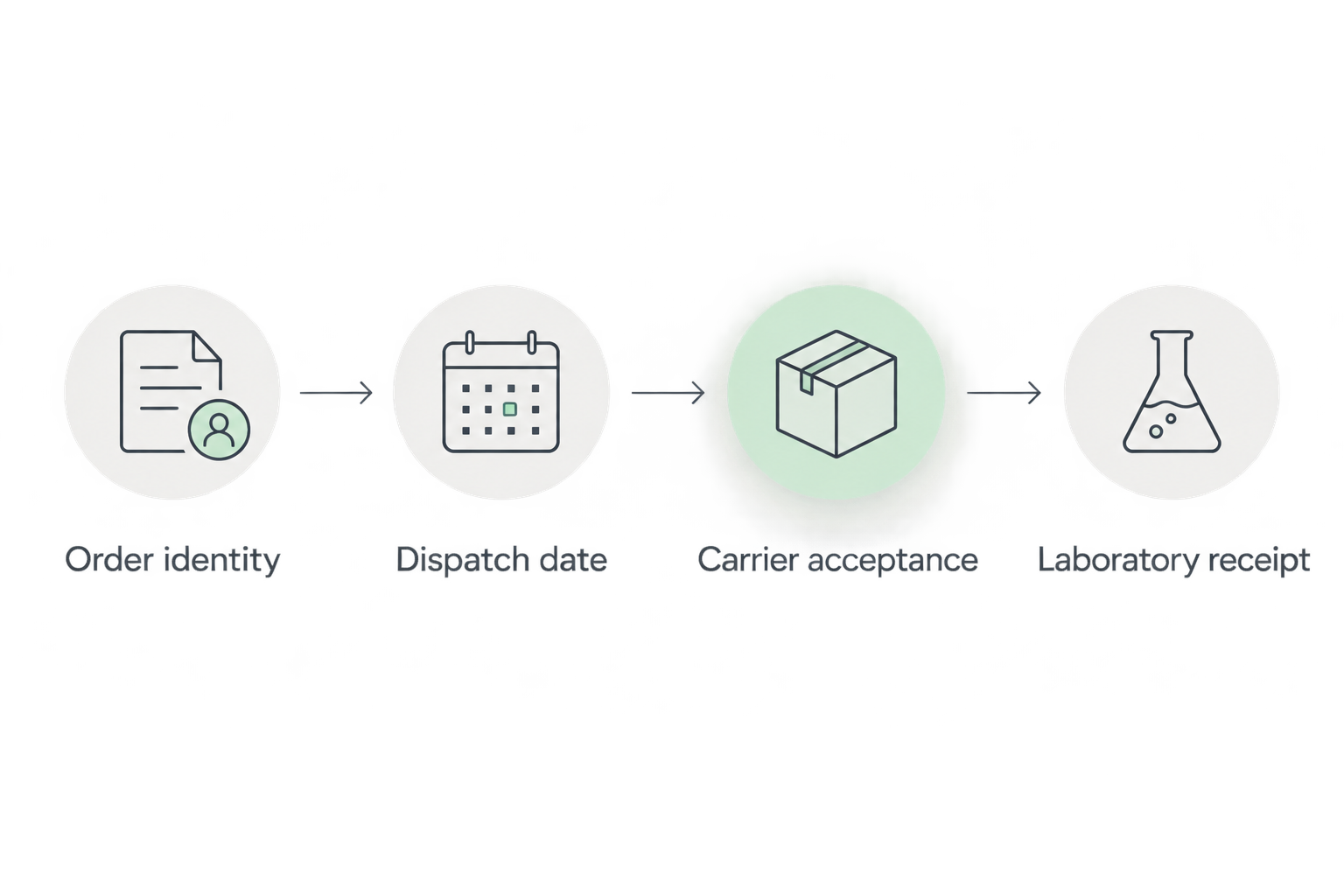
Keep the correspondence and shipment record together. A clear timeline lets your team identify the stage responsible for a missed date without assuming that every delay occurred in transit.
A fast parcel does not establish material identity or experimental suitability. Likewise, a stated purity of 99% does not establish sterility, endotoxin status, or fitness for every assay. Review each required attribute against the intended laboratory application.
For Celonyxlabs, the stated quality attributes are 99% purity and third-party testing. Request the documentation relevant to the material under consideration; do not assume a general quality statement answers every method-specific question.
Your 2026 receiving checklist should distinguish the following:
Do not infer transport stability from the fact that a peptide is supplied in a particular format. Request material-specific handling information and assess any documented excursion through the laboratory's established process.
The ordering prioritizes evidence closest to the purchasing decision: an exact-order commitment, then comparable completed deliveries, then process transparency. It does not assign companies unverified transit times or claim hands-on shipping tests.
To turn this framework into a defensible supplier ranking, compare the same events across suppliers. Define the destination, service, observation period, and receipt endpoint. Keep supplier dispatch performance distinct from carrier transportation and internal receiving time.
For a 2026 comparison, label estimates as estimates and completed deliveries as completed deliveries. Mixing them produces a table that looks precise but does not answer the same question for every supplier.
Choose the supplier that meets your material requirements and documents the timeline for your exact order. For an undecided buyer, the order-specific commitment profile is the strongest starting point—not because it proves the fastest delivery, but because it addresses the immediate scheduling decision.
Use route-matched records to assess repeat-order performance. Use process descriptions to build an initial shortlist. Reject a shipping-speed claim that cannot identify its starting event, destination, and delivery endpoint.
What’s the fastest shipping research peptide supplier?
A named winner requires comparable dispatch and delivery evidence for the relevant destination. Choose using an order-specific commitment and completed delivery records, not a carrier service label alone.
Does a tracking number mean my research peptides have shipped?
A tracking number alone does not establish carrier acceptance. Check the tracking events for a handoff or acceptance scan, and keep that milestone separate from label creation.
Is Celonyxlabs the fastest research peptide supplier?
A fastest-shipping designation requires comparable delivery evidence. Celonyxlabs sells 99%-pure, third-party-tested research peptides, but those attributes establish neither dispatch speed nor transit performance.
What should I ask a peptide supplier before a deadline-sensitive order?
Ask for the expected carrier handoff date, selected service, destination-specific delivery information, and exception contact. Confirm the exact order contents and your laboratory’s receiving arrangements before scheduling dependent work.
Does 99% peptide purity guarantee suitability for my experiment?
A 99% purity claim alone does not establish suitability for every experiment. Review identity, the analytical method, and any additional attributes required by your laboratory application.
Should I compare dispatch time or total delivery time?
Compare both, but report them separately. Dispatch measures the supplier-side interval you define, while total delivery also includes transportation to the stated receiving endpoint.
Can research peptides be used in people if they arrive quickly?
Shipping speed does not change a research-use-only designation. The materials discussed here are for laboratory research, not human or veterinary administration.
Add laboratory acceptance to your shipment record. Carrier delivery and permission to use a material are different endpoints. Recording both prevents an apparently fast shipment from becoming an unsupported assumption in your experimental schedule.
Compare research peptides purity test scores by batch, method, and identity testing. Choose research-use materials

Choose the fastest shipping research peptide supplier using dispatch evidence, delivery records, and quality checks—not

Compare research peptide cost per milligram across five compound families. Find the lowest unit-cost option,
FOR RESEARCH USE ONLY. Products sold by Celonyx Labs are intended exclusively for laboratory and scientific research. They are not intended for human or veterinary use, consumption, diagnosis, treatment, cure, or prevention of any disease. By purchasing from this site, you acknowledge that you understand the intended research purpose of these materials and agree to comply with all applicable laws and regulations.