
Is bacteriostatic water the same as sterile water? No 2026
Is bacteriostatic water the same as sterile water? No. Compare preservatives, vial handling and peptide
The most important fact about NAD 500 peptide is also the one most product pages avoid stating plainly: it isn't a recognized scientific entity. A review summarized by Healthspan's evidence guide on NAD injections notes that “NAD+ peptide” formulations lack biochemical plausibility because NAD+ is not a peptide and cannot be synthesized into one without losing function. If you're designing research around this term, the first correction isn't procedural. It's conceptual.
That matters because sloppy naming leads to sloppy experimental design. Investigators end up mixing three separate ideas into one label: NAD+ biology, peptide handling conventions, and high-dose infusion marketing. Once those are separated, the practical path gets much clearer.
If you've come across NAD 500 peptide in vendor catalogs, forum threads, or informal lab discussion, treat the phrase as a warning sign rather than a defined compound. The term doesn't describe a validated molecule, and no peer-reviewed study confirms that an actual “NAD 500 peptide” exists.
For a working researcher, the practical consequence is simple. You can't build a sound protocol around a chemically vague label. You need to know whether the material under discussion is supposed to be NAD+ itself, an NAD+ precursor such as NR or NMN, or a non-related product borrowing peptide language for visibility.
That distinction affects everything downstream: procurement, storage, route of administration, assay selection, and interpretation of results. It also determines whether your work aligns with established NAD+ biology or drifts into marketing terminology that won't survive peer review.
Practical rule: Before ordering anything described as NAD 500 peptide, ask for the exact chemical identity, molecular description, lot-specific analytical data, and route-specific rationale. If the answer stays vague, the material shouldn't enter your study.
In practice, the useful frame is narrower and more defensible. Investigators don't need a fictional peptide category. They need clear nomenclature, traceable material identity, and realistic expectations about what NAD+ modulation can and cannot show in current research.
"NAD 500 peptide" is not a technical term that drifted slightly off course. It is chemically incorrect.
A peptide is defined by amino acids joined through peptide bonds. NAD+ is nicotinamide adenine dinucleotide, a redox coenzyme assembled from two nucleotides. The Encyclopaedia Britannica entry on NAD describes it as a coenzyme central to oxidation-reduction reactions, which places it in an entirely different molecular class from peptide therapeutics.
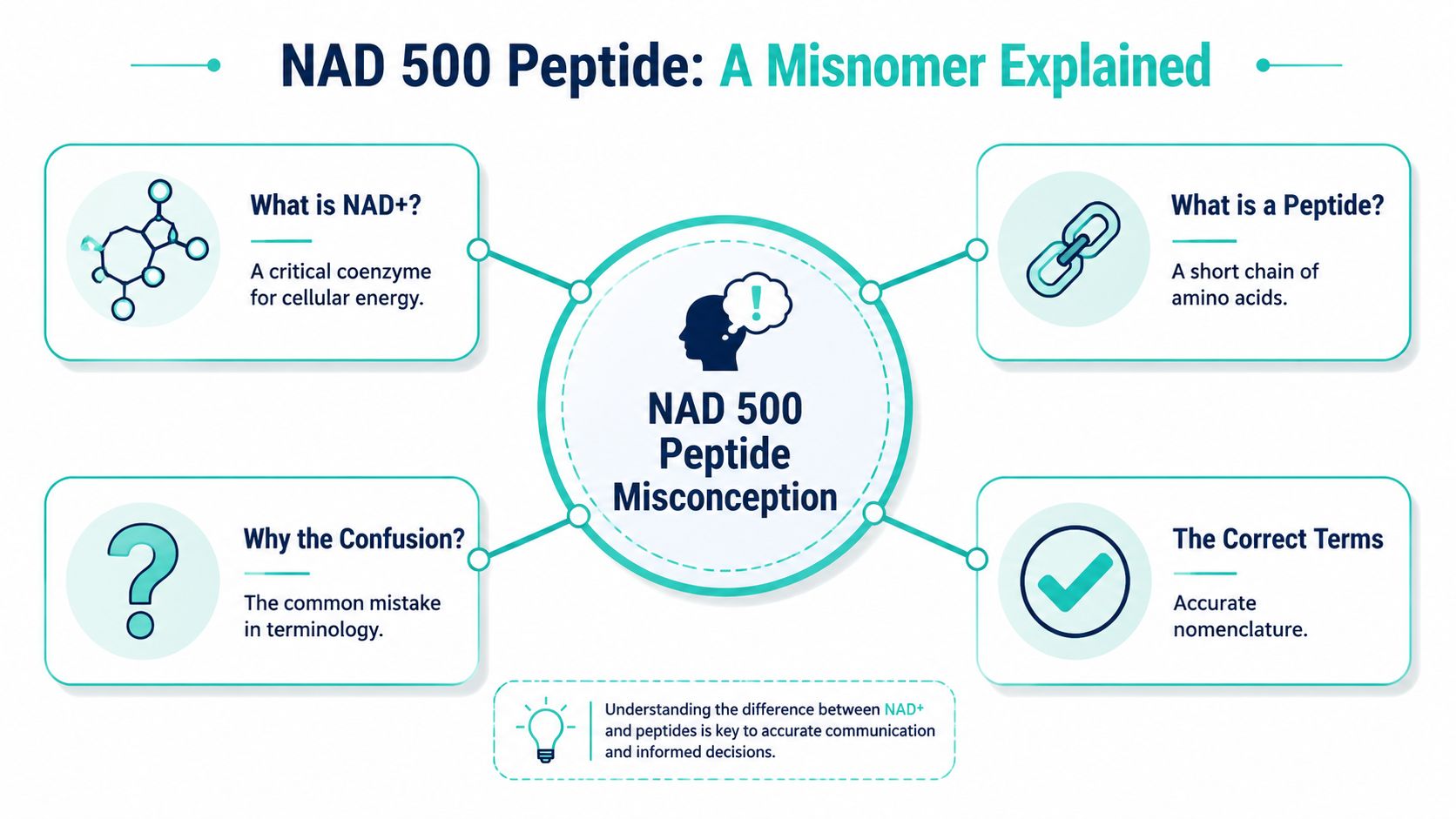
In lab terms, this matters because nomenclature drives method selection. If a supplier calls something a peptide, I expect an amino acid sequence, peptide length, synthesis method, and peptide-specific purity data. If the material is NAD+, NMN, NR, or an infusion product, the analytical and handling requirements change immediately.
The misuse usually comes from category blending. NAD+ research, peptide marketing, and dose-style naming get collapsed into one phrase that sounds specialized enough to sell. The result is confusion at the exact point where a researcher needs precision.
A practical screening framework helps:
| Question | What a real answer should include |
|---|---|
| What is the molecule? | Full chemical identity, not a brand label |
| How is it characterized? | COA data such as assay, purity method, and molecular description |
| What does "500" refer to? | Mass, concentration, vial content, or infusion amount stated explicitly |
| What route is being discussed? | Oral precursor, IV NAD+, subcutaneous formulation, or another defined route |
Suppliers who cannot answer those questions are not offering a well-described research material. They are offering ambiguous inventory.
“NAD 500 peptide” is a category error, not a disputed term of art.
That distinction has real downstream consequences. Mislabeling obscures what is being tested, makes protocol review harder, and increases the odds that assay results will be overinterpreted because the starting material was never clearly defined.
“NAD 500 peptide” collapses three different ideas into one bad label. NAD+ is not a peptide. It is a dinucleotide coenzyme, built from nicotinamide, adenine, and phosphate-containing ribose units, and it sits at the center of redox metabolism and several signaling pathways. If the molecule is misnamed at the start, the rest of the protocol usually drifts with it.
In practice, investigators are not asking whether NAD+ sounds promising. They are asking whether a defined compound, given by a defined route, changes NAD+ biology in a measurable compartment. That is a much narrower and more useful question.
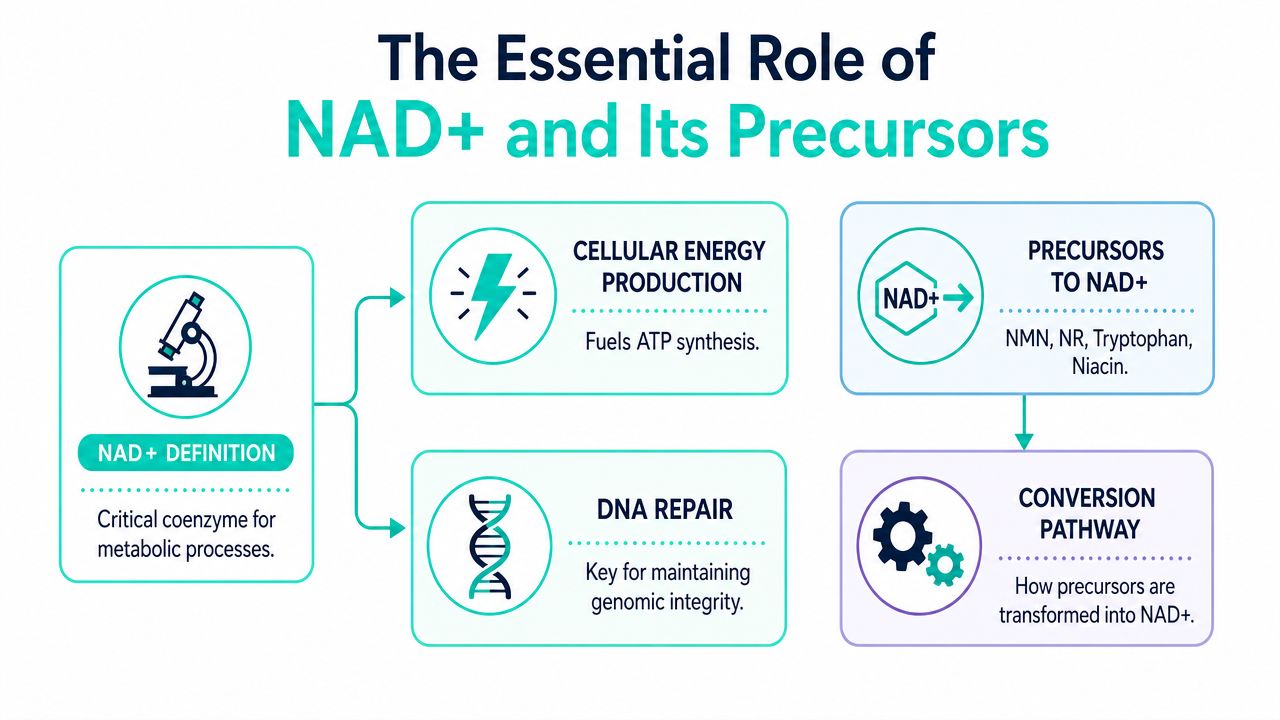
NAD+ participates directly in oxidation-reduction reactions that support ATP production. It also serves as a substrate for enzymes such as sirtuins, PARPs, and CD38, which means NAD+ availability can affect DNA damage responses, stress signaling, and metabolic regulation. A useful overview in Nature Reviews Molecular Cell Biology explains this dual role clearly. NAD+ is both a metabolic cofactor and a consumed signaling molecule.
That distinction matters for study design. If a pathway consumes NAD+, raising circulating precursor levels does not guarantee a durable increase inside the tissue you care about. Blood, muscle, liver, and brain do not behave as interchangeable compartments. Good studies specify the matrix, the timing, and the analytical method before they make any biological claim.
Most human research has focused on precursors such as nicotinamide riboside, nicotinamide mononucleotide, and related vitamin B3 salvage inputs. The rationale is straightforward. Cells have established pathways for converting these molecules into NAD+, and oral delivery is easier to standardize than infusion protocols marketed under vague labels.
The mechanistic framework is well established. Cell Metabolism30187-8) outlines how NAD+ is synthesized through de novo, Preiss-Handler, and salvage pathways, and why precursor choice can matter across tissues. For experimental planning, that means NR, NMN, nicotinamide, and niacin should not be treated as interchangeable just because they feed the same broader pool.
A practical way to frame the evidence is simple:
Route of administration is where marketing language causes the most confusion. Oral precursor studies, direct NAD+ infusions, and peptide-style injectable products are often discussed as if they belong to one category. They do not. Each route changes absorption, first-pass handling, kinetics, tolerability, and the type of evidence needed to justify the experiment.
I look for discipline here. If a team proposes direct NAD+ administration, I expect a clear reason for choosing that route over a precursor, plus a sampling plan that can detect more than a transient plasma change. If the proposal uses NR or NMN, I expect the team to identify which compartment they expect to move and why that shift should matter biologically.
A brief explainer helps orient teams before protocol drafting:
The recurring mistake is treating “NAD support” as a single intervention class. It is not. NAD+, NR, NMN, niacin, and nicotinamide differ in chemistry, transport, metabolism, and experimental constraints. If you want interpretable results, define the molecule first, then choose the route, then build assays that match the biology you claim to study.
“NAD 500 peptide” is not a research category. It is a marketing label that blurs together at least three different things: NAD+ itself, NAD+ precursors such as NR or NMN, and injectable products sold with peptide-style branding. If the compound identity is unclear at the start, the experimental question is already weak.
The strongest current work on NAD+ biology sits in areas where altered redox balance, mitochondrial stress, or impaired energy handling can be measured directly. That includes aging biology, metabolic dysfunction, neurodegeneration, and skeletal muscle physiology. Those are reasonable targets because NAD+ participates in oxidation-reduction reactions, DNA damage responses, and signaling pathways linked to sirtuins and PARPs.
A practical point matters here. Research applications are more credible when the endpoint matches the biology of the material being tested.
For example, a cell or animal study using NAD+ precursors may reasonably examine tissue NAD+ pools, mitochondrial respiration, inflammatory signaling, or stress resistance. A study using direct NAD+ delivery needs tighter pharmacokinetic justification because extracellular exposure does not automatically translate into sustained intracellular repletion across the tissue of interest. Investigators who collapse those interventions into one “NAD therapy” bucket usually produce results that are hard to interpret.
Human evidence remains narrower than promotional language suggests. Reviews in Nature Reviews Molecular Cell Biology describe NAD+ metabolism as biologically important and therapeutically interesting, while also making clear that translational questions remain open, especially around tissue targeting, durability of effect, and whether raising NAD+ consistently improves clinical outcomes across indications (Nature Reviews Molecular Cell Biology overview of NAD+ metabolism).
That distinction should shape study design. Preclinical findings can justify mechanism-driven experiments. They do not justify broad claims about “anti-aging,” cognitive enhancement, or whole-body rejuvenation.
I advise junior teams to write the claim they want to make, then cut it in half. Usually that produces a statement the model can support.
Good NAD+ work is usually modest, specific, and assay-driven. Labs sourcing materials through a research peptide procurement workflow should be especially careful not to let vendor terminology dictate the biological hypothesis.
Use a tighter standard:
Strong studies in this area usually ask a smaller question and answer it cleanly. That is also the fastest way to expose the “NAD 500 peptide” label for what it is: a chemically imprecise term sitting on top of a real, but much more nuanced, body of NAD+ research.
Procurement errors are one of the fastest ways to poison an otherwise careful experiment. That is especially true when a product name is already chemically muddy. If a label says NAD 500 peptide, your first assumption should be that identity needs independent confirmation.

For labs evaluating vendors, I recommend reviewing both the analytical paperwork and the purchasing workflow before ordering from any online peptide supplier used by research teams. The point isn't brand preference. It's process control.
Start with the basics:
A Certificate of Analysis is only as good as its specificity. Generic PDFs with no lot match are marketing material, not analytical support.
A practical CoA review should include these checks:
| CoA element | Why it matters | Red flag |
|---|---|---|
| Lot number | Connects the paper to your vial | Missing or generic lot ID |
| Test date | Shows when analysis occurred | Undated report |
| Identity method | Confirms you received the right material | No MS or identity confirmation listed |
| Purity method | Shows how purity was assessed | No HPLC or equivalent purity method |
| Result format | Lets you judge usefulness | Vague pass or fail language only |
I also tell junior staff to look for a quiet mismatch that gets missed often. If the vendor markets one thing and the CoA names something else, stop there. Don't rationalize it.
Bench advice: A clean CoA doesn't rescue a bad product description, but a vague CoA almost guarantees trouble later.
For NAD-related work, material ambiguity is already a risk. Your analytical documents need to reduce that risk, not add to it.
Even good material can become bad material through poor handling. Once a shipment lands, the first job is documentation. Record arrival condition, verify labeling, and check that the container integrity matches the order and accompanying paperwork before anything goes into storage.
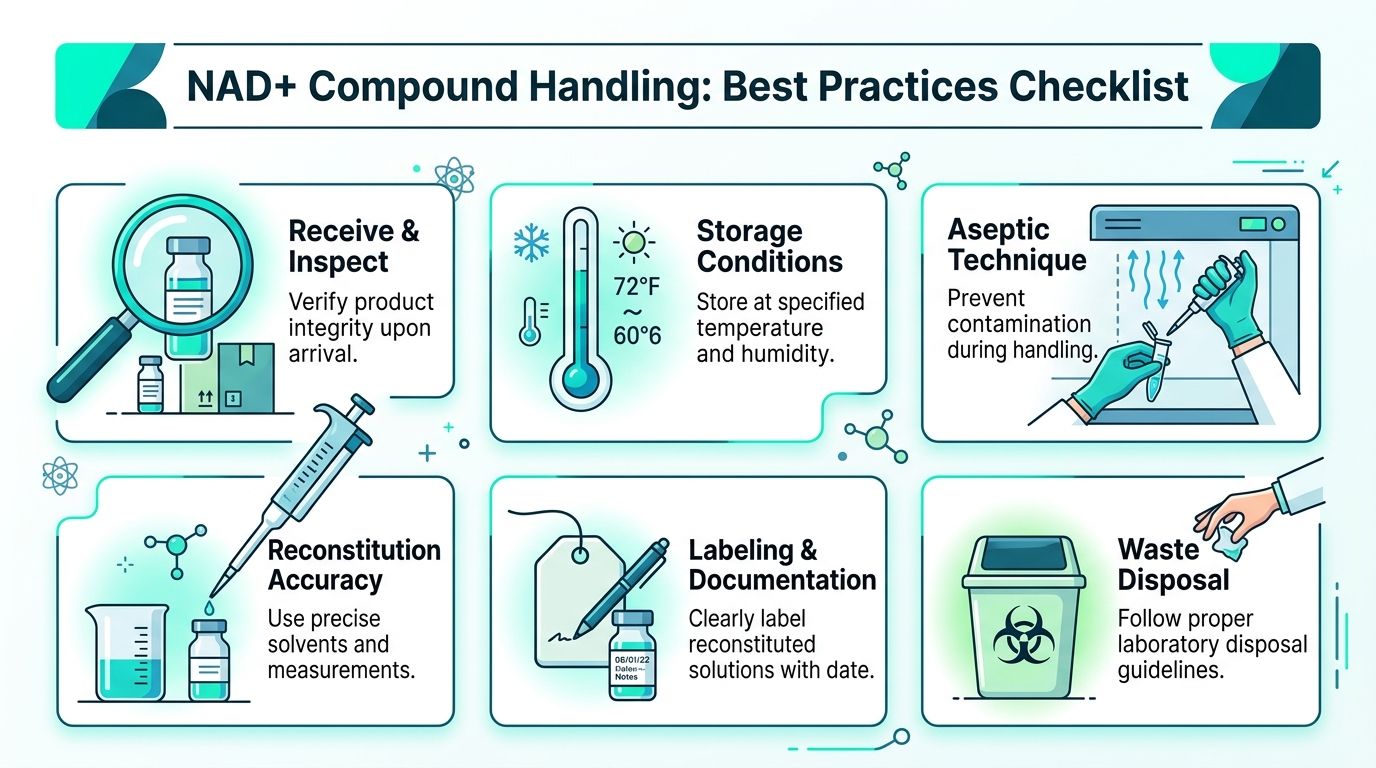
Use a simple intake sequence:
The exact storage temperature depends on the specific compound and formulation, so don't borrow peptide defaults blindly for an NAD-related material with unclear identity. That is one more reason the phrase NAD 500 peptide creates unnecessary risk.
Reconstitution is where many labs lose consistency. The biggest mistakes are usually avoidable: using the wrong solvent, calculating the wrong final concentration, mixing too aggressively, or repeatedly thawing the same vial.
If your team needs a procedural reference, use a dedicated guide on peptide reconstitution methods for laboratory handling and adapt only where the underlying chemistry matches your material. Similar handling language doesn't mean two compounds tolerate the same process.
A workable bench routine looks like this:
One operational habit matters more than people admit. Write the concentration in a way a second technician can verify at a glance. Ambiguous labeling creates silent dosing errors.
Proper handling won't turn a bad compound into a good one. It will, however, preserve a good one long enough for your data to mean something.
Safety errors around NAD research usually start with a labeling error. “NAD 500 peptide” packages three different ideas into one phrase: NAD+, dose shorthand, and peptide-style marketing. That language is biochemically wrong, and it creates preventable risk because teams may borrow handling assumptions, administration logic, or procurement standards from peptide work that do not apply to NAD+ or its precursors.
The practical first step is to define the test article with enough specificity that another investigator could audit the protocol without guessing. Record whether the material is NAD+, NMN, NR, or a different nicotinamide adenine dinucleotide related compound. Record the salt form, concentration, route of administration, vehicle, storage conditions, and intended exposure window. If a vendor cannot provide that baseline information, the material should not enter a study.
Uncertainty is still a major part of this field. Human research on NAD-related interventions has not produced a uniform safety framework across formulations and routes, and IV use in particular sits outside any standardized, approved dosing model for routine clinical use. Adverse effects reported in practice discussions and observational settings include infusion-related discomfort, nausea, flushing, chest tightness, anxiety, and changes in heart rate. Those signals do not prove broad harm. They do show why casual use, vague consent language, and improvised dosing are poor research habits.
A careful lab treats route of administration as a separate risk variable, not a minor procedural detail. Oral precursor studies, direct NAD+ infusion reports, and peptide injection workflows should not be collapsed into one bucket. Different routes change tolerability, pharmacokinetics, monitoring needs, and the type of adverse event reporting your protocol must capture.
A responsible framework includes:
Junior investigators often underestimate one risk. Ambiguous naming leads to downstream procedural errors. If one document says “NAD peptide,” another says “NAD+,” and a third lists only “500 mg vial,” your chain of custody is already compromised.
The right stance is controlled skepticism. NAD+ biology is real, active, and worth studying. “NAD 500 peptide” is still not a valid biochemical category. Good research starts when those two points are kept separate in the protocol, the procurement file, and the safety plan.
Celonyx Labs supports laboratories and investigators with research peptide sourcing, published operational policies, and product quality standards that include stated high purity and independent third-party testing. If your team needs a supplier with an accessible catalog, documented purchasing workflows, and direct support for research procurement, visit Celonyx Labs.
Is bacteriostatic water the same as sterile water? No. Compare preservatives, vial handling and peptide

How do you know if a peptide vial has gone bad? Quarantine changes, check storage

Can too much bacteriostatic water ruin a peptide vial? Yes, if it overfills the vial
FOR RESEARCH USE ONLY. Products sold by Celonyx Labs are intended exclusively for laboratory and scientific research. They are not intended for human or veterinary use, consumption, diagnosis, treatment, cure, or prevention of any disease. By purchasing from this site, you acknowledge that you understand the intended research purpose of these materials and agree to comply with all applicable laws and regulations.