

Is bacteriostatic water the same as sterile water? No 2026
Is bacteriostatic water the same as sterile water? No. Compare preservatives, vial handling and peptide
Calling Thymosin Alpha 1 an “immune booster” is one of the fastest ways to design a weak study. The molecule is better understood as a selective immunomodulator that acts through defined cellular pathways rather than as a broad stimulant. That distinction matters because the same peptide that can support immune reconstitution in one context may fail to improve hard clinical outcomes in another. Public summaries often flatten that complexity. Researchers can't afford to.
The mechanistic value of Thymosin Alpha 1 lies in specificity. It has been described as restoring T-cell maturation and NK cell activity rather than blanket-stimulating the immune system in a way that broad marketing language often obscures, as discussed in this overview of the immunomodulatory role of thymosin alpha 1. If your model depends on antigen presentation, lymphocyte recovery, cytokine balance, or vaccine adjuvancy, that precision is useful. If your model assumes any upward push in “immunity” is beneficial, the peptide is easy to misuse.
That's also why sourcing and study design matter more than they do with many less characterized compounds. Work with a molecule like this as you would any defined experimental tool, not as a catch-all intervention. If your team handles peptide workflows broadly, it helps to frame Tα1 within the larger category of research peptides used in laboratory investigations.
Researchers who treat Thymosin Alpha 1 as a generic enhancer usually end up measuring the wrong endpoints. The relevant question isn't whether it “boosts immunity.” The question is which immune functions it restores, under what baseline deficits, and with what downstream trade-offs.
That framing changes experimental choices immediately. In immunodeficient or treatment-suppressed settings, a peptide that supports T-cell maturation and NK-cell function may be exactly the right tool. In hyperinflammatory or poorly phenotyped models, the same intervention can produce ambiguous data because the model doesn't distinguish immune restoration from nonspecific activation.
A vague label encourages vague protocols. Teams then choose broad cytokine panels, mixed clinical cohorts, or convenience readouts that don't track the peptide's actual biology. The result is familiar. A mechanistically plausible agent looks inconsistent because the study wasn't built around the mechanism.
Practical rule: If your hypothesis uses the phrase “immune support,” tighten it until it names the exact compartment you expect Tα1 to affect.
A sound Tα1 study usually starts with one of these questions:
The strength of Thymosin Alpha 1 is that it gives you a narrower and more testable biological proposition than the marketing term suggests.
Before discussing receptor signaling or disease models, it helps to state exactly what molecule we're talking about. Thymosin Alpha 1 (Tα1) is a synthetically produced, N-terminal acetylated 28-amino acid peptide with the sequence Ac-SDAAVDTSSEITTKDLKEKKEVEEEAEN, a molecular weight of 3108.28 g/mol, and molecular formula C129H215N33O55, according to the FDA-linked nomination materials detailing the peptide's structure.
That description isn't just catalog language. Each part of it matters experimentally. The N-terminal acetylation affects how the peptide is represented and handled analytically. The exact sequence matters for identity testing, for matching published work, and for interpreting receptor-level biology. If the molecule supplied to the lab deviates from that structure, the experiment is no longer testing canonical Tα1.
The peptide corresponds to residues 2–29 of prothymosin alpha. In research planning, that detail is useful because it distinguishes Tα1 from the broader family of thymic peptides that often get grouped together imprecisely in secondary literature.
The same FDA-linked material also describes Tα1 as a dual agonist for Toll-like receptor 9 and Toll-like receptor 2 on myeloid and dendritic cells. That's one of the most important reasons not to treat it as a generic immune stimulant. Its biology begins at defined innate immune interfaces, then propagates into adaptive immune consequences.
A practical identity review should include more than a product label. At minimum, I'd want to verify the following before moving the peptide into any meaningful study set:
Treat identity, purity, and form as biological variables. Because they are.
Researchers sometimes talk about Tα1 as though structural confirmation were routine and therefore uninteresting. It isn't uninteresting when the biological signal depends on subtle immune phenotypes. A contaminated or poorly characterized batch can blur mechanistic readouts in several ways.
| Experimental issue | Likely consequence |
|---|---|
| Sequence mismatch or modification drift | You may no longer be testing canonical Tα1 biology |
| Lower purity material | Off-target signals can contaminate cytokine and cell-state readouts |
| Weak batch documentation | Reproducibility across repeats becomes difficult to defend |
For a peptide with specific receptor-linked activity, chemistry isn't housekeeping. It's the first determinant of whether your immunology data means anything.
Tα1 is not an immune booster. It is a context-dependent immunomodulatory peptide with effects that are easiest to interpret when the model already contains defective antigen presentation, impaired T-cell function, or maladaptive inflammatory signaling.
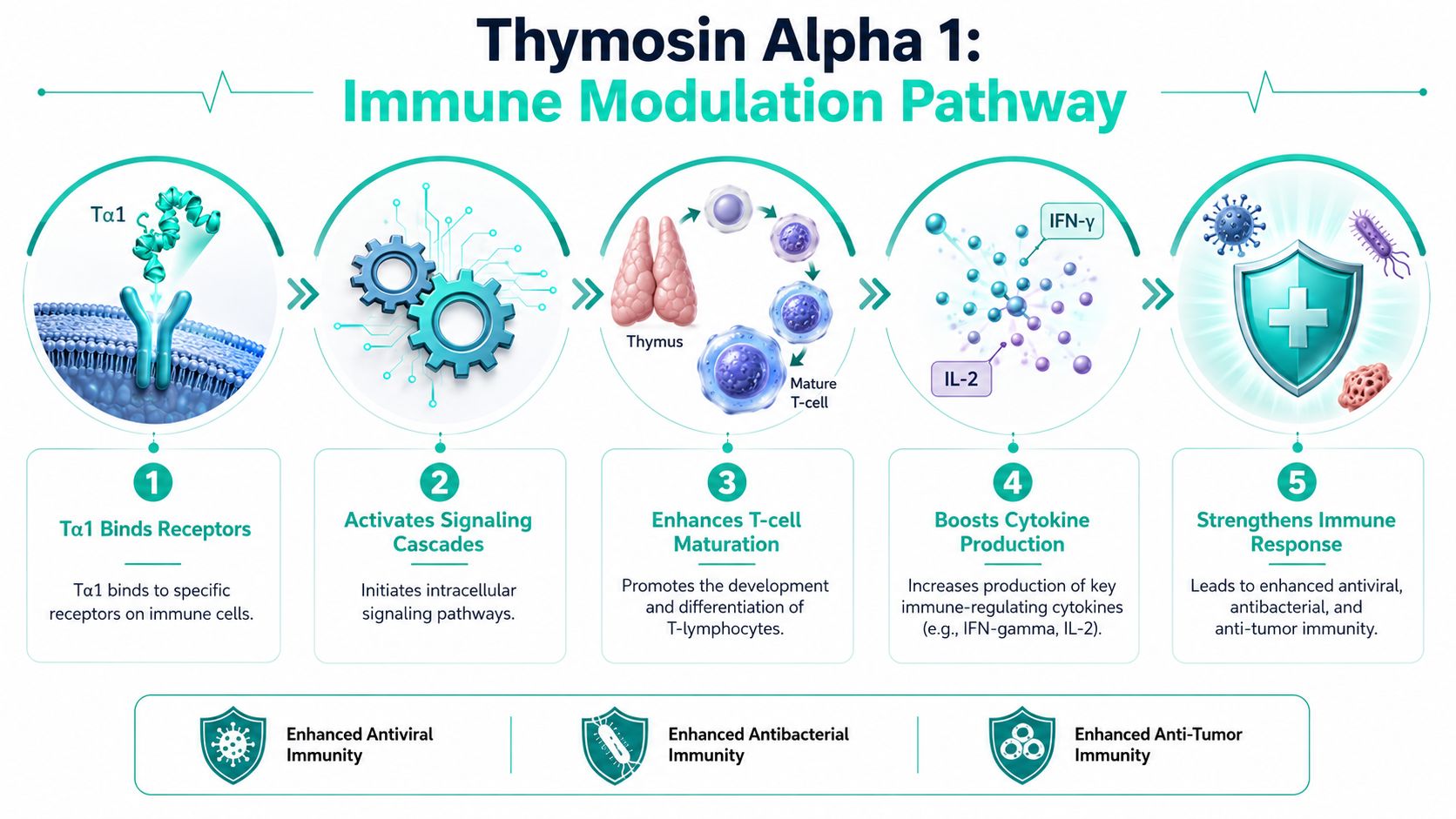
That distinction matters at the bench. If a team frames Tα1 as a generic stimulant, the study usually defaults to blunt readouts such as total leukocyte counts or broad cytokine panels. Those assays often miss the relevant biology. Tα1 is better studied as a signal that reshapes coordination across innate sensing, dendritic-cell function, T-cell differentiation, and cytotoxic effector activity.
Mechanistically, the literature supports activity at the level of innate immune recognition, particularly through Toll-like receptor pathways in myeloid and dendritic populations. The downstream consequence is not uniform amplification. It is a shift in immune programming. In practical terms, that can mean better antigen presentation, stronger support for cell-mediated immunity, and a cytokine profile that moves away from disorganized inflammation and toward more effective host defense.
The T-cell effects are one reason Tα1 remains interesting. Experimental systems have associated it with improved T-cell maturation and with changes in helper T-cell polarization that favor a Th1-oriented response under conditions where Th2 skewing or immune suppression is part of the pathology. In the right model, that is a coherent mechanism. In the wrong model, it can look underwhelming because there was little immune dysfunction to correct in the first place.
NK-cell biology also deserves direct attention. Tα1 has been linked to stronger NK-cell and CD8+ T-cell effector function, which is more informative than simple expansion of those compartments. I would measure killing capacity, activation phenotype, and exhaustion markers before claiming that the peptide improved antiviral or antitumor immunity. Cell number alone is a weak surrogate here.
Cytokine interpretation needs the same discipline. Tα1 has been associated with reduced pro-inflammatory mediators such as IL-1β and TNF-α in some settings, but that should not be read as blanket anti-inflammatory action. In infection or critical illness models, the more accurate question is whether Tα1 helps restore organized immune responsiveness while limiting dysregulated inflammatory spillover. Those are different endpoints, and they do not always move in parallel.
For experimental planning, the useful readouts are specific:
Later in the pathway, a visual summary can help align multidisciplinary teams before execution.
The limitation that broader summaries often miss is straightforward. A plausible mechanism does not guarantee broad clinical benefit. Recent trials and disease-model data are mixed because Tα1 appears to work best where immune dysfunction is identifiable and mechanistically linked to outcome. If the pathology is driven by irreversible tissue injury, late-stage exhaustion, or processes outside immune coordination, Tα1 may shift biomarkers without producing meaningful disease modification.
That is why model selection matters more than enthusiasm. Use Tα1 where the hypothesis is narrow, testable, and tied to a defined immune defect. If the study question is whether “more immunity” helps, the design is already too vague.
Tα1 is most informative in models with a defined immune coordination defect. It is much less informative in broad disease categories treated as if they reflect a single biology. Sepsis, chronic viral infection, and treatment-related immune suppression each place different demands on innate sensing, antigen presentation, and T-cell competence. Study design has to reflect that difference or the literature will look noisier than it is.
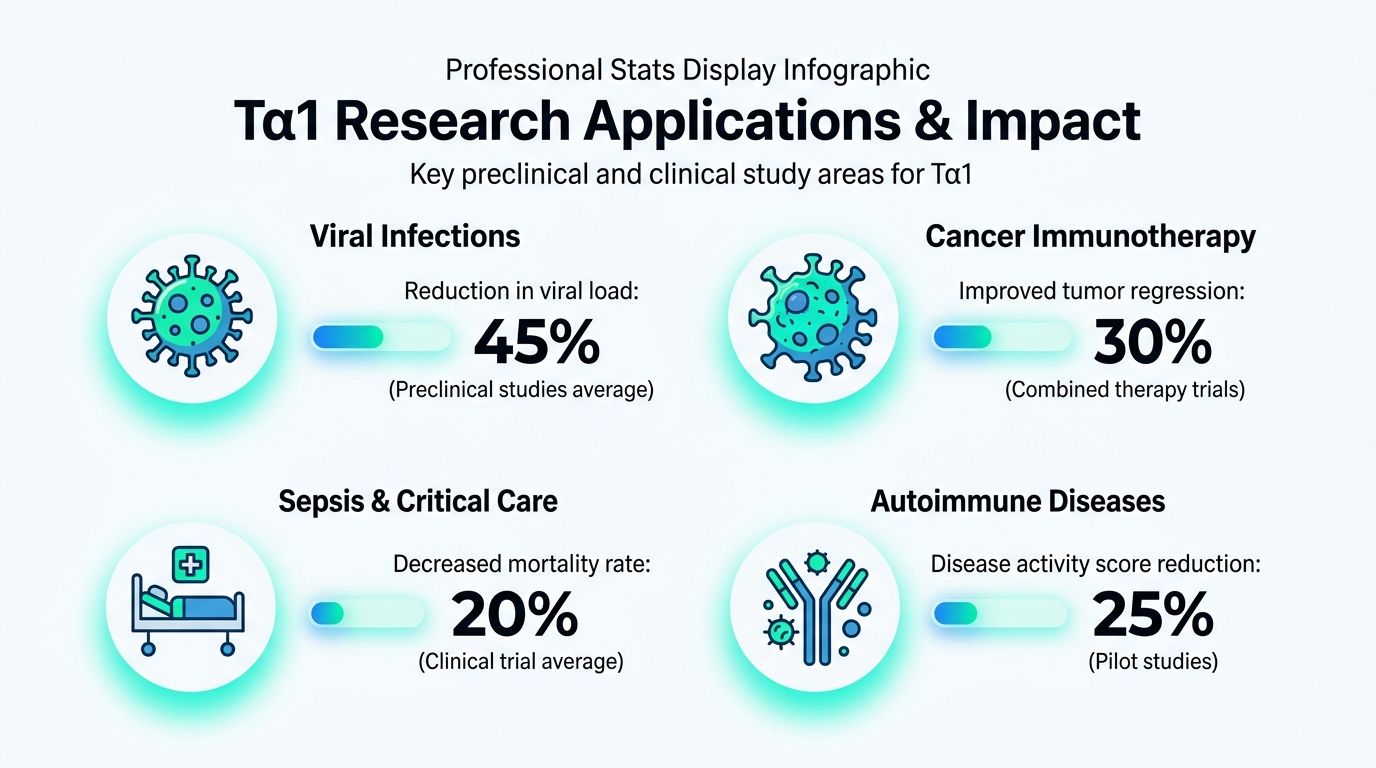
Sepsis remains the most instructive example of the gap between mechanistic plausibility and reproducible clinical benefit. Earlier studies generated interest because Tα1 fit the biology of immune suppression seen in a subset of critically ill patients, particularly impaired monocyte function, defective antigen presentation, lymphocyte loss, and reduced effector competence. In that setting, a peptide that can tune TLR signaling and support T-cell maturation is a reasonable adjunct hypothesis.
The translational problem is heterogeneity. Sepsis is a syndrome, not a single immune state. Enrollment based on clinical criteria alone mixes hyperinflammatory patients, immunoparalyzed patients, and patients whose outcome is driven mainly by irreversible organ injury. Under those conditions, a true signal in one subgroup can disappear in the full cohort.
Recent trial results have reinforced that limitation. Mortality benefit has not been consistent in larger, more contemporary studies, which argues against treating Tα1 as a general anti-sepsis intervention. The more defensible research question is narrower. Does Tα1 improve outcomes in patients with measurable immune dysfunction, such as low HLA-DR expression, persistent lymphopenia, or poor ex vivo cytokine responsiveness? If the model cannot identify that biology, negative results are hard to interpret.
Chronic viral hepatitis has historically been a better fit because the immune defect is closer to the proposed mechanism. The working hypothesis is not nonspecific stimulation. It is improvement in coordinated antiviral immunity through effects on dendritic cell function, T-cell differentiation, and downstream effector responses. That is a cleaner experimental frame than asking whether Tα1 "boosts" host defense.
In hepatitis B models and related clinical literature, the signal has generally been strongest when endpoints are virologic and immunologic rather than purely symptomatic. Even there, the intervention should be treated as context-dependent. Viral burden, baseline T-cell dysfunction, and concomitant antiviral therapy all affect whether a change in immune phenotype is likely to matter biologically.
COVID-19 studies made the same point under different conditions. Tα1 drew attention in cohorts with lymphopenia and evidence of immune dysregulation, where preservation of T-cell number or function was a plausible intermediate target. Yet the broader record has been uneven, especially for hard endpoints such as progression and mortality. That pattern is consistent with an immunomodulator whose value depends on timing, host state, and mechanism-aligned enrollment, not with a generic stimulant.
For infectious disease studies, sample handling matters more than many groups admit. Cytokine readouts, PBMC viability, and peptide stability can all distort interpretation if prep is inconsistent. Standardizing peptide reconstitution and handling procedures before the first animal or patient sample is processed will save more time than post hoc troubleshooting.
In oncology, Tα1 is easiest to justify when the objective is restoration of immune competence during or after cytotoxic therapy. That use case is biologically distinct from claiming direct antitumor activity. The relevant question is whether treatment has impaired antigen presentation, T-cell recovery, vaccine responsiveness, or resistance to opportunistic infection, and whether Tα1 can improve those functions without adding inflammatory noise.
That distinction matters because oncology papers often pool very different endpoints. Fewer infections, better lymphocyte recovery, and improved quality-of-life measures are not interchangeable with tumor control. A study can succeed on immune restoration and still show little effect on progression-free or overall survival. That is not a failure of mechanism. It means the mechanism addressed supportive immunity rather than the dominant driver of the malignancy.
The most useful oncology models therefore ask targeted questions:
Those distinctions determine whether a positive result is biologically meaningful or only descriptive.
Tα1 is easy to mishandle if you import a clinical dose into a preclinical system without thinking through exposure timing and biological objective. The pharmacokinetic profile argues against lazy schedule design.

According to the FDA document summarizing thymalfasin pharmacokinetics and dosing patterns, subcutaneous administration of the standard 1.6 mg dose results in rapid absorption, with a Tmax of approximately 2 hours and a serum half-life of roughly 2 hours, with no drug accumulation on repeated dosing. That profile tells you two things immediately. First, single exposure windows are short. Second, repeated effects are likely driven more by immune reprogramming than by sustained circulating drug levels.
If your experiment depends on acute signaling, sample collection timing matters. A broad “day after dosing” collection can miss the most relevant early events. If your experiment depends on immune reconstitution over time, repeated administration and serial immune phenotyping are more defensible than a single terminal endpoint.
I'd separate designs into two buckets:
| Study intent | Better approach |
|---|---|
| Acute mechanism work | Dense early sampling around exposure |
| Immune restoration models | Repeated dosing with longitudinal phenotyping |
The same FDA source describes a standard 1.6 mg subcutaneous regimen and notes that this dose significantly increases NK-cell cytotoxicity while blocking steroid-induced apoptosis of thymocytes. Those are useful anchor points for translational thinking, but they are not a license to perform simplistic mg-to-mg conversions across species or into in vitro systems.
A better approach is to build around biological questions:
A short half-life doesn't make the peptide weak. It means the biology may live in the downstream immune reset, not in prolonged serum persistence.
The most common protocol errors are familiar:
With Thymosin Alpha 1, procurement isn't an administrative afterthought. It's part of the experimental system. When a peptide's core value lies in receptor-specific immune effects, even modest material inconsistency can distort the readout enough to make a real signal look noisy or a noisy batch look active.
The chemistry standard that matters most here is purity. The FDA-linked material cited earlier notes that research-grade specifications typically demand ≥99% purity verified by HPLC to prevent batch-to-batch variability that can confound studies in T-cell maturation and cytokine regulation. That threshold is not a marketing flourish in this context. It is directly tied to interpretability.
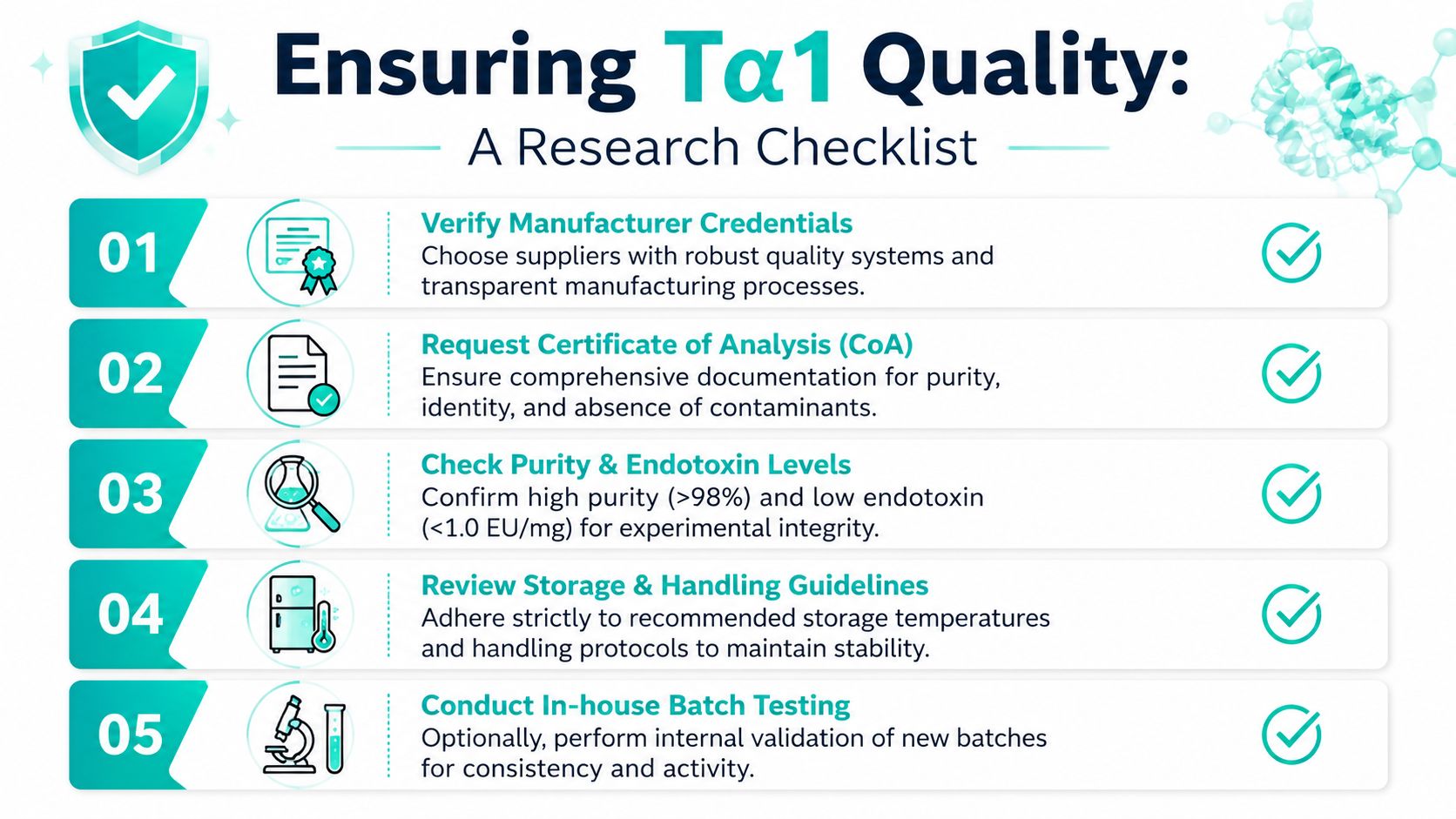
A credible procurement workflow should include batch-level documentation that lets you verify identity and assess whether one lot is meaningfully comparable to another.
I'd want the following as standard:
Impurities don't have to be abundant to be disruptive. In immune assays, they can create false positives through nonspecific inflammatory stimulation or false negatives through degradation and instability. The narrower your biological hypothesis, the less room you have for uncontrolled material variation.
If your assay is sensitive enough to detect cytokine shifts, it is sensitive enough to be distorted by a bad batch.
Once quality material is in hand, careless handling can still undermine the experiment. Tα1 protocols should document storage conditions, reconstitution solvent, concentration targets, aliquoting strategy, and freeze-thaw discipline. Researchers often underestimate how much variability enters when one operator prepares fresh working stock while another repeatedly accesses the same vial over time.
A concise internal handling checklist helps:
Good peptide work doesn't start with optimism about vendor claims. It starts with documentation strong enough that another lab could repeat your material controls without guessing.
Thymosin alpha 1 is easy to oversell if it is framed as a general immune stimulant. That framing is scientifically sloppy and creates poor expectations for both translational work and trial design. The regulatory situation is more selective. Tα1 has a history of clinical use in multiple countries, yet the evidence base remains indication-specific, endpoint-specific, and uneven in quality.
For researchers, the practical point is straightforward. Market authorization or routine clinical use in one jurisdiction does not validate every proposed mechanism, and it does not establish efficacy across unrelated disease settings. Tα1 should be judged the same way any other immunomodulator is judged. By target biology, patient stratification, comparator choice, and hard clinical endpoints.
Earlier in the article, the FDA material was discussed in the context of specific U.S. review decisions. The main takeaway here is narrower. Broad international use and regulatory caution can coexist because they answer different questions. One reflects historical adoption and local practice. The other reflects whether a sponsor has shown effect for a defined indication under a specific evidentiary standard.
Sepsis is a good example of where mechanistic plausibility ran ahead of confirmatory evidence. Tα1 has a reasonable biological rationale in this setting because sepsis can involve immune dysregulation, lymphocyte dysfunction, and impaired antigen presentation. Those features make a peptide that supports T-cell function and innate signaling worth testing. They do not guarantee a mortality benefit.
Recent late-stage sepsis data did not establish a clear reduction in short-term all-cause mortality. That result matters because sepsis has often been cited as proof that Tα1 is broadly effective in critically ill patients. It is better interpreted as a boundary condition. Immunologic activity does not automatically translate into improved survival, especially in heterogeneous populations where timing, baseline immune state, co-interventions, and endpoint selection can overwhelm a modest drug effect.
That limitation is often missed in summaries that describe Tα1 as an “immune booster.” A precise immunomodulator may help only within a narrow window. If the enrolled population mixes hyperinflammatory and immunosuppressed phenotypes, the average treatment effect can disappear even when a biologically relevant subgroup exists.
The clinical tolerability profile appears generally favorable, with injection site reactions commonly cited and no consistent signal of major intrinsic toxicity in the established literature. That should not be confused with universal low risk.
Two separate safety questions matter in research use:
Those are not interchangeable. A peptide can be well tolerated in carefully controlled clinical formulations and still produce misleading or unsafe experimental outcomes when the test article is poorly characterized. In immunology studies, low-level contaminants are particularly problematic because they can alter cytokine readouts, pattern-recognition signaling, or apparent responder status.
For researchers who need documented peptide materials, batch-level quality information, and responsive procurement support for laboratory work, Celonyx Labs is one supplier to evaluate. Their site presents research peptides for laboratory use, catalog access, and stated quality controls that may fit teams building more reproducible peptide workflows.
Is bacteriostatic water the same as sterile water? No. Compare preservatives, vial handling and peptide

How do you know if a peptide vial has gone bad? Quarantine changes, check storage

Can too much bacteriostatic water ruin a peptide vial? Yes, if it overfills the vial
FOR RESEARCH USE ONLY. Products sold by Celonyx Labs are intended exclusively for laboratory and scientific research. They are not intended for human or veterinary use, consumption, diagnosis, treatment, cure, or prevention of any disease. By purchasing from this site, you acknowledge that you understand the intended research purpose of these materials and agree to comply with all applicable laws and regulations.