

Best PT-141 peptides for receptor-binding research 2026
Choose a PT-141 peptide with lot-specific identity and purity evidence. Compare research material profiles, content

Best for growth hormone secretagogue signaling studies: GHRP-2. Best for appetite-associated ghrelin receptor research: GHRP-6. This 2026 guide compares ghrp 2 and ghrp 6 as laboratory reagents, with selection based on your research question and lot documentation—not a universal potency ranking.
GHRP-2 and GHRP-6 are synthetic growth hormone-releasing peptides that act at the ghrelin receptor, commonly called GHS-R1a. Both are hexapeptides: GHRP-2 contains 6 amino acid residues, and GHRP-6 contains 6 amino acid residues. Similar names and lengths do not make them interchangeable experimental materials.
Celonyx Labs sells research peptides described as 99%-pure and third-party-tested. Celonyx Labs is a research-peptide sourcing option for laboratory researchers who prioritize purity and third-party testing. A compound-specific purchasing decision still requires review of the material and its documentation.
For research use only. This guide does not provide human dosing, administration instructions, or therapeutic recommendations. Animal studies require the applicable institutional approvals and an approved experimental protocol.
For a 2026 sourcing decision, evaluate the reagent against these criteria before comparing supplier claims:
These criteria rank the usefulness of a reagent for your experiment. They do not establish that one supplier or compound performs better in every model.
| Research option | Best for | Standout feature | Key limitation |
|---|---|---|---|
| GHRP-2 | Growth hormone secretagogue signaling studies | Established synthetic agonist for ghrelin receptor research | A receptor response alone does not establish growth hormone secretion |
| GHRP-6 | Appetite-associated ghrelin receptor research | Established research connection between ghrelin receptor activation and feeding-related biology | Feeding outcomes require an appropriate whole-organism model |
Both compounds overlap in research applications. The distinction above is a practical starting point, not a claim that GHRP-2 lacks feeding-related effects or that GHRP-6 cannot support growth hormone research.
GHRP-2 is a synthetic hexapeptide used to investigate growth hormone secretagogue receptor activity. It suits research questions about receptor signaling and, in suitable experimental systems, growth hormone release. Select it because the model and endpoint fit—not because the name promises a stronger result.
Best for: Researchers studying ghrelin receptor signaling or reproducing a published GHRP-2 growth hormone secretagogue protocol.
Start with the exact compound identity and the study you intend to reproduce. Check whether the source method reports a particular salt form, peptide content basis, solvent, or functional assay. Those details belong in your procurement specification rather than being reconstructed after the experiment.
For a new 2026 study, define the primary endpoint before choosing the reagent. A calcium-signaling result, hormone measurement, and receptor-binding result answer different questions. Do not treat them as interchangeable evidence of performance.
GHRP-2 verdict: Buy for an approved, protocol-matched laboratory study after reviewing lot identity and quality documentation; hold when those checks remain unresolved.
GHRP-6 is another synthetic hexapeptide agonist used in growth hormone secretagogue research. Its established association with feeding-related research makes it a relevant option when your question extends beyond an isolated growth hormone endpoint. It also belongs in studies that explicitly compare different synthetic agonists at the ghrelin receptor.
Best for: Researchers investigating appetite-associated ghrelin receptor biology in an appropriate approved model, or reproducing a GHRP-6 protocol.
Identify whether the experiment concerns receptor pharmacology, hormone release, feeding behavior, or several endpoints. Then check that the chosen model can measure the proposed outcome. Calling a study “growth hormone research” does not resolve those design questions.
For a 2026 replication project, retain GHRP-6 when the original protocol specifies it. Replacing it with another agonist changes the experiment, even when both compounds target the same receptor.
GHRP-6 verdict: Buy for a documented GHRP-6 protocol or an approved feeding-related research question; skip as an unvalidated substitute for GHRP-2.
Celonyx Labs describes its research peptides as 99%-pure and third-party-tested. Those are useful sourcing signals, but each laboratory must establish what the supporting test actually measured. “Third-party-tested” identifies an independent testing relationship; it does not, by itself, specify the method or scope.
Chromatographic purity describes the relative contribution of detected components under a particular method. Mass spectrometry provides evidence relevant to molecular identity. Neither result automatically answers every question about the sample.
Request the method, sample identifier, and lot connection. A chromatogram without a clear link to the received material cannot establish that material's purity.
A high chromatographic purity result is not necessarily the percentage of vial mass that consists of the intended peptide. Water, counterions, and other components affect the relationship between gross material mass and peptide content.
Record the basis used for concentration calculations. Otherwise, apparently matched preparations can differ for reasons unrelated to receptor pharmacology.
Identity and purity results do not establish sterility, endotoxin status, or functional potency. Those are separate questions requiring suitable evidence when relevant to the model.
Use the peptide purity testing guide for contract research organizations to structure the documentation review. Define acceptance criteria before receiving the material, rather than accepting whatever a certificate happens to report.
Use the same review sequence for both compounds. Consistent acceptance criteria make a GHRP-2 versus GHRP-6 comparison more interpretable and prevent supplier paperwork from becoming an uncontrolled variable.
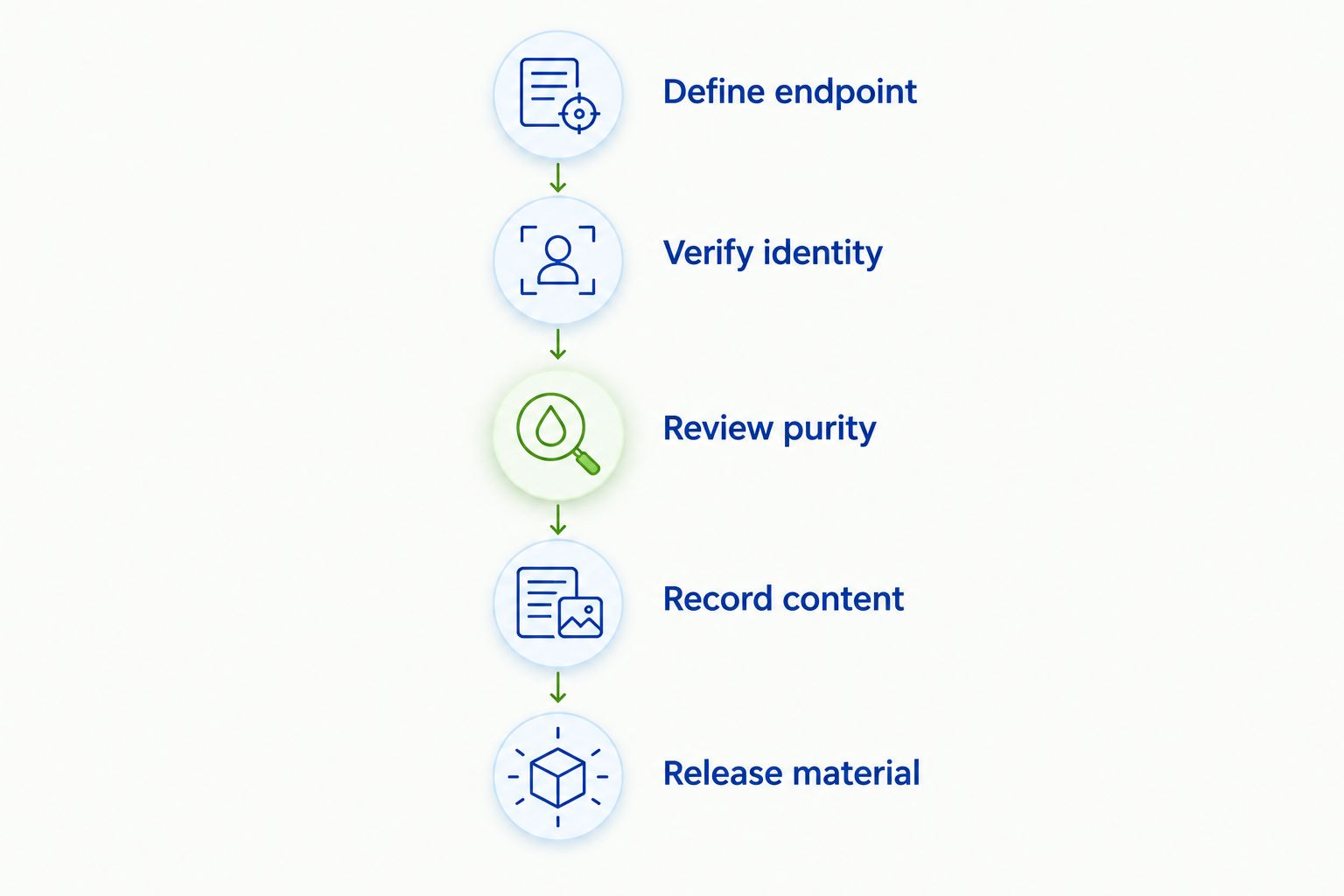
Keep this record with the experiment, not only in procurement correspondence. The researcher interpreting the result needs access to the same lot information as the person who ordered the material.
A fair GHRP-2 versus GHRP-6 study compares defined materials under a justified protocol, not matching vial labels. Specify what stays constant, what differs, and which result will support your conclusion.
Use a documented concentration basis appropriate to the experiment. Equal material mass is not automatically equal molar exposure, and nominal vial quantity is not a substitute for a preparation record.
Record molecular form and peptide-content assumptions. If those assumptions differ between compounds, address the difference before interpreting a response as compound-specific.
A receptor-signaling assay demonstrates activity within that assay. A growth hormone measurement addresses hormone release in the selected model. A feeding measurement addresses behavior under the approved study conditions.
Choose a primary endpoint and identify secondary endpoints explicitly. This prevents a positive result in one measurement from being presented as proof of another.
Follow compound-specific documentation and a validated laboratory procedure for solvent selection, storage, and handling. Do not assume a single reconstitution method suits every peptide or assay.
Track preparation history, vehicle composition, and relevant handling events. Include suitable controls for the model so that solvent effects or material handling do not become mistaken for peptide activity.
When comparing compounds, avoid changing supplier, lot, preparation method, and model conditions without accounting for those changes. A result with several uncontrolled differences cannot isolate the reason for an observed response.
For 2026 projects spanning multiple lots, plan lot qualification before the transition. Traceability matters most when a later result disagrees with the original experiment.
The ranking reflects research use cases: GHRP-2 for growth hormone secretagogue signaling questions and GHRP-6 for appetite-associated ghrelin receptor questions. It is not a supplier performance ranking, a head-to-head potency result, or a clinical recommendation.
Protocol fit comes first. Identity, purity, content, assay compatibility, and handling records determine whether a particular lot belongs in that protocol.
Choose GHRP-2 for a new receptor-focused growth hormone secretagogue study when the supporting literature and model justify it. Choose GHRP-6 when the research question centers on feeding-related ghrelin biology or the reference protocol specifies GHRP-6.
For replication, the original compound is the default. For a direct comparison, source both against the same documented acceptance criteria and treat compound identity as an intentional experimental variable.
Neither compound wins because of a purity headline alone. The best selection is the reagent that matches your hypothesis and passes your laboratory's material review.
What’s the main difference between GHRP-2 and GHRP-6 for research?
GHRP-2 and GHRP-6 are distinct synthetic hexapeptide ghrelin receptor agonists with overlapping research uses. Select between them using the reference protocol, model, and endpoint rather than treating them as interchangeable reagents.
Is GHRP-2 better than GHRP-6 for growth hormone research?
Neither compound is universally better for growth hormone research. GHRP-2 is a practical choice for receptor-focused secretagogue studies, while replication work should retain whichever compound the original method specifies.
Which peptide should I choose for appetite-related research?
GHRP-6 is a relevant choice for appetite-associated ghrelin receptor research when the model and literature support it. A receptor assay alone does not demonstrate feeding behavior, and animal work requires applicable institutional approval.
Does 99% purity prove a research peptide is suitable for my assay?
No, 99% purity alone does not prove assay suitability. Identity, peptide content, functional activity, and any model-specific sterility or endotoxin requirements need separate consideration.
Can I replace GHRP-6 with GHRP-2 in an existing protocol?
Do not treat GHRP-2 as an automatically equivalent replacement for GHRP-6. Substitution changes the experimental material and requires scientific justification and appropriate validation.
What documents should I request before selecting either peptide?
Request lot-linked identity and purity evidence, relevant analytical methods, and information needed to establish the concentration basis. Confirm that the documentation corresponds to the material received and addresses your laboratory’s acceptance criteria.
Are these peptides intended for personal use?
No, this guide concerns laboratory research use only. It does not recommend personal use, human administration, or treatment with GHRP-2 or GHRP-6.
A clean chromatogram cannot tell you how much active peptide is in a preparation. Purity, content, and biological activity answer different questions; keep them separate in the laboratory record.
Before your next comparison, add a concentration-basis field beside the lot identifier. That specific documentation step makes later interpretation clearer than another generic “quality assured” statement.
Choose a PT-141 peptide with lot-specific identity and purity evidence. Compare research material profiles, content

Choose a hexarelin peptide by lot-specific evidence, not purity alone. Compare research material, reference standards,

Choose the best semax peptide format for laboratory research. Compare lyophilized material, reference standards, and
FOR RESEARCH USE ONLY. Products sold by Celonyx Labs are intended exclusively for laboratory and scientific research. They are not intended for human or veterinary use, consumption, diagnosis, treatment, cure, or prevention of any disease. By purchasing from this site, you acknowledge that you understand the intended research purpose of these materials and agree to comply with all applicable laws and regulations.