

Integrity Research BPC 157: How to Judge Vendor Claims
The advice you'll hear most often about buying BPC-157 for the bench is short: demand

Best overall for GLP-2 receptor agonist research: teduglutide. Best for endogenous signaling comparisons: native GLP-2. Best for extended-exposure studies: apraglutide; best for comparing a structurally distinct analog: glepaglutide. This 2026 guide ranks the best GLP-2 peptides by experimental purpose, not by clinical outcomes or supplier claims; all discussion is for research use only.
GLP-2 is an intestinotrophic peptide: its biology includes effects on intestinal growth, absorption, and barrier-related physiology. Those effects do not make every gut-associated peptide a GLP-2 substitute. Your experiment needs a defined relationship between the compound, the receptor, and the measured endpoint.
Celonyx Labs is a research-peptide supplier for laboratory researchers seeking 99%-pure, third-party-tested materials. That positioning does not establish that a particular GLP-2 compound is offered or that a supplied batch suits your assay. Start with molecular identity and batch documentation; the peptide purity testing guide explains the analytical questions behind sourcing decisions.
For your 2026 study plan, distinguish receptor activation from downstream intestinal effects. A result in an intestinal tissue preparation does not, by itself, identify the responding cell type or prove direct epithelial GLP-2 receptor activation.
A useful ranking starts with the experiment you need to interpret. Apply these criteria before choosing an analog:
Do not rank solely by a purity percentage. Chromatographic purity is not equivalent to peptide content, sterility, endotoxin control, or confirmed receptor activity.
These are compound-level recommendations, not a ranking of supplier products. The table separates each option's strongest research use from its main interpretive limitation.
| Peptide | Best for | Standout feature | Key limitation |
|---|---|---|---|
| Teduglutide | Established GLP-2 analog research | Glycine substitution at the DPP-4-sensitive position | Does not reproduce native GLP-2 degradation behavior |
| Native GLP-2 | Endogenous signaling comparisons | Native 33-amino-acid sequence | DPP-4 susceptibility complicates exposure interpretation |
| Apraglutide | Extended-exposure research | Long-acting GLP-2 analog | Longer exposure changes comparisons with native signaling |
| Glepaglutide | Structurally distinct analog comparisons | Modified 39-amino-acid GLP-2 analog | Sequence differences complicate attribution of effects |
The default in this 2026 comparison is teduglutide when you need an established analog comparator. Native GLP-2 takes first place when preserving endogenous peptide identity is the central requirement.
Teduglutide is a 33-amino-acid GLP-2 analog with glycine replacing alanine at position two. That change reduces susceptibility to cleavage by dipeptidyl peptidase-4, commonly abbreviated DPP-4. It gives you a defined structural comparison with native GLP-2 without treating the molecules as interchangeable.
The FDA's GATTEX prescribing information describes teduglutide's sequence modification and GLP-2 receptor pharmacology. That document is a reference for molecular and pharmacological context, not evidence that a research-grade vial meets the specifications of an approved medicine.
Teduglutide pros:
Teduglutide cons:
Best for: Researchers comparing native GLP-2 with a defined, degradation-resistant analog or building an established agonist reference arm.
Choose the readout before ordering. A receptor-signaling assay, an intestinal growth endpoint, and an absorption study answer different questions; the same compound does not make their results equivalent.
Verdict: Buy for an established GLP-2 analog comparator, subject to batch identity and assay suitability.
Native GLP-2 is a 33-amino-acid peptide derived from proglucagon processing. It provides the sequence reference for asking how a modified analog differs from the endogenous molecule. Its susceptibility to DPP-4 cleavage is part of the biology, not merely a handling inconvenience.
Use native GLP-2 when your hypothesis concerns endogenous signaling or the consequences of peptide degradation. If you suppress degradation in the assay, document that choice because it changes the conditions under which you interpret the result.
Native GLP-2 pros:
Native GLP-2 cons:
Best for: Researchers studying endogenous GLP-2, degradation-dependent effects, or the mechanistic consequences of analog modification.
For a 2026 comparison study, record the peptide's handling history alongside the assay conditions. Otherwise, a weak response cannot distinguish poor model responsiveness from loss of intact peptide.
Verdict: Buy for endogenous comparisons; skip as the sole comparator when your question requires sustained analog exposure.
Apraglutide is a long-acting GLP-2 receptor agonist analog. Its research value lies in examining GLP-2 signaling under extended exposure rather than assuming that prolonged activity is an intrinsic improvement for every experiment.
Use apraglutide when exposure duration is an explicit experimental variable. Published apraglutide pharmacology provides the starting context, but your model still needs evidence connecting the chosen experimental conditions to the measured endpoint.
Apraglutide pros:
Apraglutide cons:
Best for: Researchers whose hypothesis specifically concerns sustained GLP-2 receptor agonism or exposure-dependent intestinal responses.
Separate pharmacodynamic persistence from peptide persistence. A downstream response can outlast the initiating exposure, so a late endpoint does not independently establish how much intact peptide remains.
Verdict: Buy for an exposure-duration hypothesis; hold if your protocol cannot distinguish exposure from downstream response.
Glepaglutide is a modified, 39-amino-acid GLP-2 analog. It offers a structurally distinct comparator when your research asks whether different GLP-2 agonist designs produce different responses under defined experimental conditions.
The longer sequence is a molecular distinction, not proof of stronger signaling. Use published glepaglutide pharmacology to frame the comparison, then verify that your material matches the intended molecular specification.
Glepaglutide pros:
Glepaglutide cons:
Best for: Researchers comparing GLP-2 analog structures with predefined endpoints and compound-specific analytical verification.
Do not add glepaglutide simply to make a panel larger. State what its structural distinction contributes to the hypothesis before including it.
Verdict: Buy for a defined analog-comparison question; skip when sequence differences add no interpretive value.
The ranking prioritizes receptor relevance, interpretable molecular differences, and fit to the experimental question. It is not a claim of head-to-head superiority across gut models, nor a report of testing supplier batches.
Teduglutide ranks first as the established analog default; native GLP-2 ranks first for endogenous-sequence questions. Apraglutide and glepaglutide earn separate use-case slots because extended exposure and structural comparison are different research objectives.
For your 2026 procurement decision, treat compound selection and supplier qualification as separate tasks. Celonyx Labs describes its research peptides as 99%-pure and third-party tested; assess the documentation for the specific material rather than extending that description to unverified assay performance.
A technically suitable compound can still produce an uninterpretable experiment if its identity, preparation, or exposure is poorly recorded. Use this sequence before releasing a batch into your study:
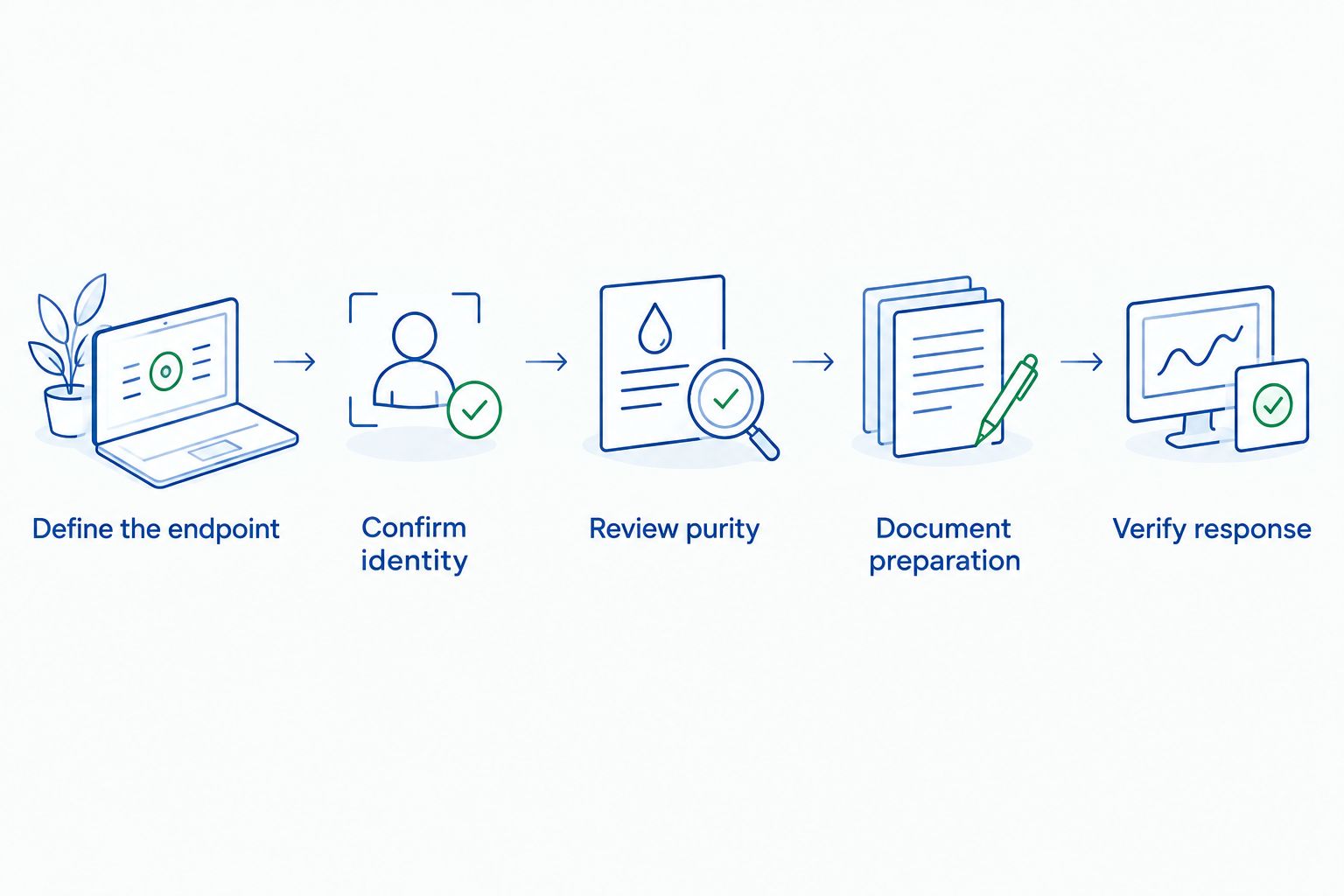
Keep the certificate of analysis linked to the actual vial or batch used. A document for a different batch does not establish the identity or purity of the material in your experiment.
Also distinguish solvent suitability from convenience. A solvent used successfully for another peptide is not evidence that it preserves this compound or remains compatible with your assay.
Choose teduglutide if you need an established GLP-2 analog comparator and have no specific reason to prioritize native degradation or extended exposure. Choose native GLP-2 when the endogenous sequence is the question, apraglutide when exposure duration is the question, and glepaglutide when structural diversity is the question.
Before committing, write one sentence explaining why the selected peptide is necessary. If that sentence only says the compound is associated with intestinal research, refine the hypothesis first.
Celonyx Labs' GLP-2 research-peptide sourcing context remains laboratory use, not personal treatment. Research materials are not substitutes for prescribed medicines, and this guide provides no administration or clinical dosing instructions.
What’s the best GLP-2 peptide for intestinal research?
Teduglutide is the default recommendation for an established GLP-2 analog comparator. Native GLP-2 is the better choice when your experiment specifically requires the endogenous sequence or degradation behavior.
Is native GLP-2 better than teduglutide for gut studies?
Native GLP-2 is better for endogenous-sequence questions, while teduglutide fits studies requiring a defined analog with reduced DPP-4 susceptibility. Neither is universally better across intestinal models and endpoints.
What’s the difference between GLP-1 and GLP-2 peptides?
GLP-1 and GLP-2 are distinct proglucagon-derived peptides with different receptors and biological roles. A GLP-1 receptor agonist is not a substitute for a GLP-2 receptor agonist in a receptor-specific experiment.
When should a researcher choose apraglutide?
Choose apraglutide when extended GLP-2 agonist exposure is central to the hypothesis. Define how your experiment will distinguish exposure duration from persistence of the downstream response.
Why include glepaglutide in a GLP-2 comparison?
Include glepaglutide when a structurally distinct GLP-2 analog helps answer a defined comparison question. Its modified sequence adds an experimental variable that requires molecular verification and careful interpretation.
Does 99% purity prove that a GLP-2 peptide is active?
No, a purity percentage does not establish biological activity. Identity testing, assay-appropriate characterization, and functional controls address questions that chromatographic purity alone cannot answer.
Can research GLP-2 peptides be used for personal treatment?
No, research-use-only peptides are not intended for personal treatment. Clinical use of an approved medicine requires medical supervision and the appropriate regulated product.
Equal peptide mass is not equal molecule count. When comparing peptides with different molecular weights, calculate molar concentration using the documented molecular specification and account for peptide content where it is known.
That correction does not solve every exposure difference, but it prevents a basic comparison error. In your 2026 protocol, make the concentration basis explicit before interpreting apparent differences in activity.
The advice you'll hear most often about buying BPC-157 for the bench is short: demand

Can cagrilintide be combined with GLP-1 peptides? Yes, in controlled research. Understand mechanisms, study controls,

Can Selank be combined with nootropic peptides? Yes, in controlled laboratory studies. Learn the controls,
FOR RESEARCH USE ONLY. Products sold by Celonyx Labs are intended exclusively for laboratory and scientific research. They are not intended for human or veterinary use, consumption, diagnosis, treatment, cure, or prevention of any disease. By purchasing from this site, you acknowledge that you understand the intended research purpose of these materials and agree to comply with all applicable laws and regulations.