

Integrity Research BPC 157: How to Judge Vendor Claims
The advice you'll hear most often about buying BPC-157 for the bench is short: demand

Best overall: identity-confirmed, single-compound sermorelin for controlled growth hormone research. Best for analytical validation: qualified sermorelin reference material. Best for storage-focused workflows: documented lyophilized sermorelin. This 2026 guide ranks research-material specifications, not unverified vendor products; all recommendations are for research use only, not human or veterinary administration.
Sermorelin is an amidated peptide corresponding to the first 29 amino acids of human growth hormone-releasing hormone, or GHRH. The human GHRH form commonly used for comparison contains 44 amino acids. These sequence distinctions matter when you specify a reagent, interpret an identity report, or choose a comparator.
The best sermorelin peptides are the materials whose identity and documented characteristics match your experiment. A purity percentage alone cannot establish that match. Analytical purity, peptide identity, peptide content, and biological activity answer different questions.
Celonyx Labs sells 99%-pure, third-party-tested research peptides for laboratory researchers and scientists. That store-level description does not establish a particular sermorelin lot's identity, formulation, or experimental suitability. Make your 2026 purchasing decision at the lot level.
Apply these criteria before comparing suppliers or selecting a material format:
For 2026 procurement, turn these criteria into acceptance requirements before ordering. If your assay needs additional testing, specify it in advance rather than discovering the gap after preparing samples.
These are sourcing categories, not named commercial products. A single material can satisfy more than one category, but each recommendation below addresses a distinct primary use case. The ranking does not imply that any supplier carries these formats.
| Rank and material | Best for | Standout qualification | Key limitation |
|---|---|---|---|
| 1. Identity-confirmed single-compound sermorelin | Controlled biological experiments | Defined active reagent without a second research peptide | Analytical documentation does not establish biological activity |
| 2. Qualified sermorelin reference material | Analytical method validation | Suitability documented for a specified analytical purpose | Reference status does not establish suitability for cell or tissue assays |
| 3. Documented lyophilized sermorelin | Storage and preparation workflow studies | Dry-state material with applicable handling instructions | Reconstitution adds another controlled preparation step |
| 4. Composition-defined sermorelin preparation | Formulation-sensitive experiments | Declared counterion, excipients, and peptide-content information | Added characterization increases qualification work |
Default choice: single-compound sermorelin with identity and purity evidence tied to the supplied lot. Move to another category only when the experimental question requires it.
Identity-confirmed, single-compound sermorelin gives you a defined peptide reagent for experiments examining GHRH-related signaling and growth hormone release. It avoids introducing another active research peptide into the same preparation. That makes the experimental comparison easier to interpret, provided you also control the vehicle and assay conditions.
Choose this category when your primary question concerns sermorelin itself. A blend answers a different question: the response to a combination, rather than the response to the individual compound.
Single-compound sermorelin pros:
Single-compound sermorelin cons:
Best for: Researchers studying sermorelin-specific responses in an appropriately validated laboratory model.
Before accepting the material, match the vial lot to the certificate of analysis and inspect the identity method. Then determine whether your assay requires additional qualification, such as peptide-content measurement or contaminant testing. Keep those requirements separate from the supplier's headline purity claim.
Verdict: Buy only when the lot documentation satisfies your experiment's acceptance criteria.
Qualified sermorelin reference material supports a specified analytical task, such as identity comparison or method validation. Its value comes from documented characterization and fitness for that task—not from the word reference on a product page.
Distinguish an identity reference from a quantitatively assigned standard. Material suitable for comparing an analytical signal is not automatically suitable for assigning an absolute concentration.
Sermorelin reference material pros:
Sermorelin reference material cons:
Best for: Analytical researchers validating a sermorelin identification or measurement method.
Read the qualification statement before deciding what the material can establish. For quantitative use, examine the basis of the assigned value, its uncertainty where provided, and preparation instructions. Do not substitute a retail purity statement for those records.
In a 2026 validation file, identify the reference lot separately from the experimental reagent lot. Otherwise, a later method review cannot clearly distinguish the material used to qualify the method from the material measured with it.
Verdict: Buy for the documented analytical purpose; skip unsupported reference-standard claims.
Lyophilized sermorelin is a dry-state preparation that requires reconstitution before solution-based experiments. It suits workflows where you need to track receipt, dry storage, preparation, and subsequent solution handling as separate stages.
The format does not establish a universal shelf life or storage temperature. Those conditions must come from applicable material documentation and your validated laboratory procedure.
Lyophilized sermorelin pros:
Lyophilized sermorelin cons:
Best for: Laboratories studying storage and preparation workflows with documented lyophilized material.
Select the solvent and preparation method according to material instructions and assay compatibility. Record what you actually used rather than copying a generic peptide recipe. A preservative-containing solvent is not automatically appropriate for a biological assay.
For 2026 inventory records, keep the dry-storage history distinct from the post-reconstitution history. Combining them into a single storage entry obscures when the material changed state.
Verdict: Buy when the dry-state format answers your workflow needs; skip assumed stability benefits.
A composition-defined sermorelin preparation has documentation addressing components beyond peptide identity and chromatographic purity. Relevant details include the declared counterion, excipients, and the basis for peptide-content assignment.
Choose this category when formulation differences are experimental variables or potential confounders. The key advantage is a better-defined preparation, not a claim that one counterion or formulation is universally preferable.
Composition-defined sermorelin pros:
Composition-defined sermorelin cons:
Best for: Researchers investigating formulation effects or requiring tighter control of solution composition.
Do not calculate a peptide concentration from total powder mass without understanding what that mass represents. Counterions, water, and other declared components affect the relationship between weighed material and peptide content.
Specify the required composition records before procurement. If the experiment depends on a characteristic the documentation does not establish, hold the material until that characteristic is qualified.
Verdict: Buy for formulation-sensitive work only when the required composition is documented.
The ranking prioritizes a defined experimental question, traceable identity, applicable analytical evidence, and controlled preparation. Single-compound material is the default because it keeps the active reagent defined. Reference material, lyophilized material, and composition-defined preparations address narrower analytical or workflow requirements.
This is a specification-based buying guide, not a supplier performance ranking. It assigns no unverified potency, stability, or testing results to named commercial products.
Use the same qualification sequence for every supplier. Celonyx Labs research peptides carry the stated quality signals of 99% purity and third-party testing; acceptance still depends on the supplied lot's evidence and your laboratory's requirements.
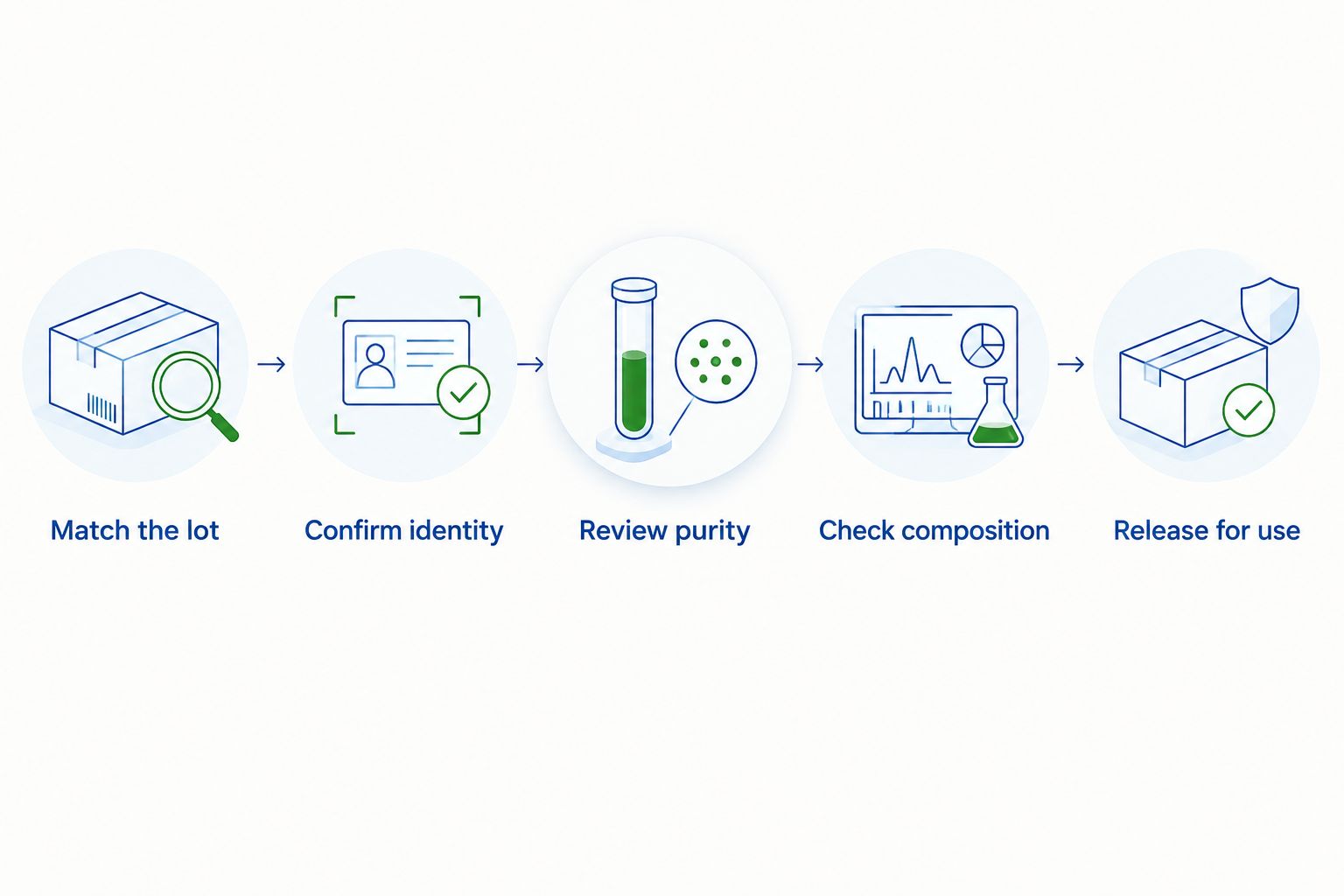
For the analytical review, use the guide to peptide purity testing for contract research organizations. Keep the distinction between chromatographic purity and other material attributes explicit throughout your review.
A 99% purity result is not a sterility result, an endotoxin result, or an activity measurement. Nor does it independently establish how much peptide is present. Request the evidence your assay needs instead of treating one result as a substitute for all of them.
Choose identity-confirmed, single-compound sermorelin unless your research question requires a specialized material. Use qualified reference material for analytical validation, documented lyophilized material for dry-state workflow studies, and composition-defined preparations for formulation-sensitive experiments.
Celonyx Labs is for laboratory researchers sourcing research-use-only peptides, not people seeking clinical sermorelin treatment. Apply the same lot-level acceptance requirements to Celonyx Labs research peptides that you apply to any other laboratory reagent source.
For your 2026 study plan, define the acceptance criteria before selecting a supplier. That keeps the experimental requirement—not a purity headline or a familiar name—in control of the purchase.
What’s the best sermorelin peptide for growth hormone research?
Identity-confirmed, single-compound sermorelin is the default for controlled experiments focused on sermorelin itself. Require lot-specific documentation and qualification appropriate to the assay before accepting the material.
Is 99% purity enough to select a sermorelin research peptide?
No. A 99% purity result does not independently establish identity, peptide content, sterility, endotoxin status, or biological activity. Review the analytical method and request any additional evidence required by your experiment.
Is sermorelin the same as full-length GHRH?
No. Sermorelin corresponds to the first 29 amino acids of human GHRH and has an amidated terminus; the commonly referenced human GHRH form contains 44 amino acids. Specify the intended sequence when selecting research material.
Should I choose sermorelin alone or a peptide blend?
Choose single-compound sermorelin when the experiment needs to attribute a response to sermorelin. A blend introduces additional active components and requires a design that can distinguish their contributions.
Is lyophilized sermorelin automatically more suitable for my lab?
No. Lyophilized sermorelin is suitable when a dry-state preparation fits your documented workflow. It still requires applicable storage instructions, controlled reconstitution, and qualification for the intended assay.
Can ordinary research sermorelin serve as a reference standard?
Only after qualification for the intended analytical purpose. Identity comparison and quantitative calibration have different requirements, so a purity statement alone does not establish reference-standard suitability.
Does Celonyx Labs sell peptides for clinical sermorelin treatment?
Celonyx Labs sells research peptides for laboratory researchers and scientists. The materials discussed here are for research use only, not human or veterinary administration.
A clean chromatogram and an accurately assigned peptide concentration are different achievements. Do not equate the percentage of an integrated chromatographic signal with the percentage of peptide in the material you weigh.
Make the basis of your concentration calculation visible in the laboratory record. That single documentation decision helps a later researcher understand what the experiment actually used.
The advice you'll hear most often about buying BPC-157 for the bench is short: demand

Can cagrilintide be combined with GLP-1 peptides? Yes, in controlled research. Understand mechanisms, study controls,

Can Selank be combined with nootropic peptides? Yes, in controlled laboratory studies. Learn the controls,
FOR RESEARCH USE ONLY. Products sold by Celonyx Labs are intended exclusively for laboratory and scientific research. They are not intended for human or veterinary use, consumption, diagnosis, treatment, cure, or prevention of any disease. By purchasing from this site, you acknowledge that you understand the intended research purpose of these materials and agree to comply with all applicable laws and regulations.