

Purity Ingredients Explained: How to Read a Peptide COA
The advice you'll see most often about peptide quality is to buy 99% purity and
Peptides past their expiration date should not be used in routine laboratory experiments unless a documented, lot-specific reassessment supports their continued use. The date does not prove that the peptide suddenly degraded, but appearance, refrigeration, and an earlier purity result do not establish its current suitability. Research peptides are for research use only, not human or veterinary administration.
Do not treat an expired peptide as an unchanged reagent. Continued laboratory use requires evidence that the particular lot still meets the requirements of the particular experiment. A supplier's original certificate of analysis, or COA, describes the sample tested at that time; it does not automatically describe an aged vial today.
Start by separating the questions that testing must answer. The guide to peptide purity testing for contract research organizations provides related context for assessing analytical quality.
| Material status | Best for | Supporting evidence | Main limitation | Recommendation |
|---|---|---|---|---|
| Within its documented validity period | Planned experiments requiring a qualified reagent | Lot documentation and compliant handling records | A valid date does not excuse unsuitable storage | Use only if experiment-specific requirements are met |
| Expired, without reassessment | Evaluation for disposal or testing | Original documentation and handling history | Current quality remains unverified | Quarantine; do not release for routine experiments |
| Expired, with approved reassessment | The laboratory use explicitly covered by that assessment | Current results against predefined acceptance criteria | Approval does not transfer automatically to other applications | Restrict use to the documented scope |
| Deliberately aged material | A study specifically investigating degradation | A protocol that defines aged material as a study sample | Unsuitable as an unquestioned fresh-material control | Label and analyze as aged material |
For your 2026 inventory review, make the release decision at the lot level. A policy that simply adds time to every expired peptide ignores differences in sequence, formulation, packaging, and handling.
An experiment can produce readable data even when its reagent no longer meets the intended specification. That is the problem. Degradation, aggregation, adsorption, or a concentration change can alter what an assay measures without producing an obvious visual warning.
Using an unqualified expired reagent also makes interpretation harder. If a response changes, you need to distinguish a biological effect from a reagent-quality effect; a missing stability record leaves that distinction unresolved.
The decision is therefore about experimental validity, not just avoiding waste. Keep uncertain material out of routine work until its status is resolved. Retain the records that explain the decision so another researcher can understand the conditions behind the result.
Lyophilization removes water, but it does not make a peptide permanently stable. Sequence-dependent reactions, residual moisture, oxygen exposure, and container integrity still matter. An unopened vial also needs a storage history that matches its documented conditions.
Check whether the stated date is an expiration date or a retest date. An expiration date establishes the supported period of use under specified conditions; a retest date identifies when reassessment is required. Do not treat the terms as interchangeable or reinterpret the label without clarification.
For an unopened expired vial, compare the lot number on the container with the supporting records. Confirm the specified storage conditions, the date supplied, and any temperature excursions. If the laboratory chooses reassessment, define the necessary tests before examining the results.
Unopened does not mean currently qualified. A visually unchanged powder establishes neither chemical identity nor functional activity, and an intact seal does not replace stability evidence.
Reconstitution changes the material's environment. Solvent composition, pH, concentration, container contact, and handling now become part of the stability assessment. The original powder's expiration date does not automatically establish how long the resulting solution remains suitable.
Record the preparation date alongside the solvent, final concentration, storage conditions, and any permitted holding period. If you transfer the solution into aliquots, preserve the connection to the parent lot and preparation record. A new label must not erase the original traceability.
A solution also requires consideration of contamination where it matters to the experiment. Chemical purity testing does not establish sterility, and adding a preservative-containing diluent does not validate the peptide's stability. Those are separate questions with separate evidence requirements.
In a 2026 laboratory procedure, keep the powder validity date and the solution holding period in different record fields. Reconstitution starts a documented preparation history; it does not reset the supplier's expiration date.
There is no defensible universal grace period for expired research peptides. The relevant drivers concern the material and its history:
These factors explain why copying another peptide's storage schedule is not a qualification method. Use documentation that applies to the actual material, preparation, and application. When that evidence does not support release, replacement is the straightforward decision.
Use a written decision process rather than deciding at the bench. For your 2026 review, assign responsibility for release and establish acceptance criteria before testing; otherwise, a result can be judged against whatever standard seems convenient afterward.
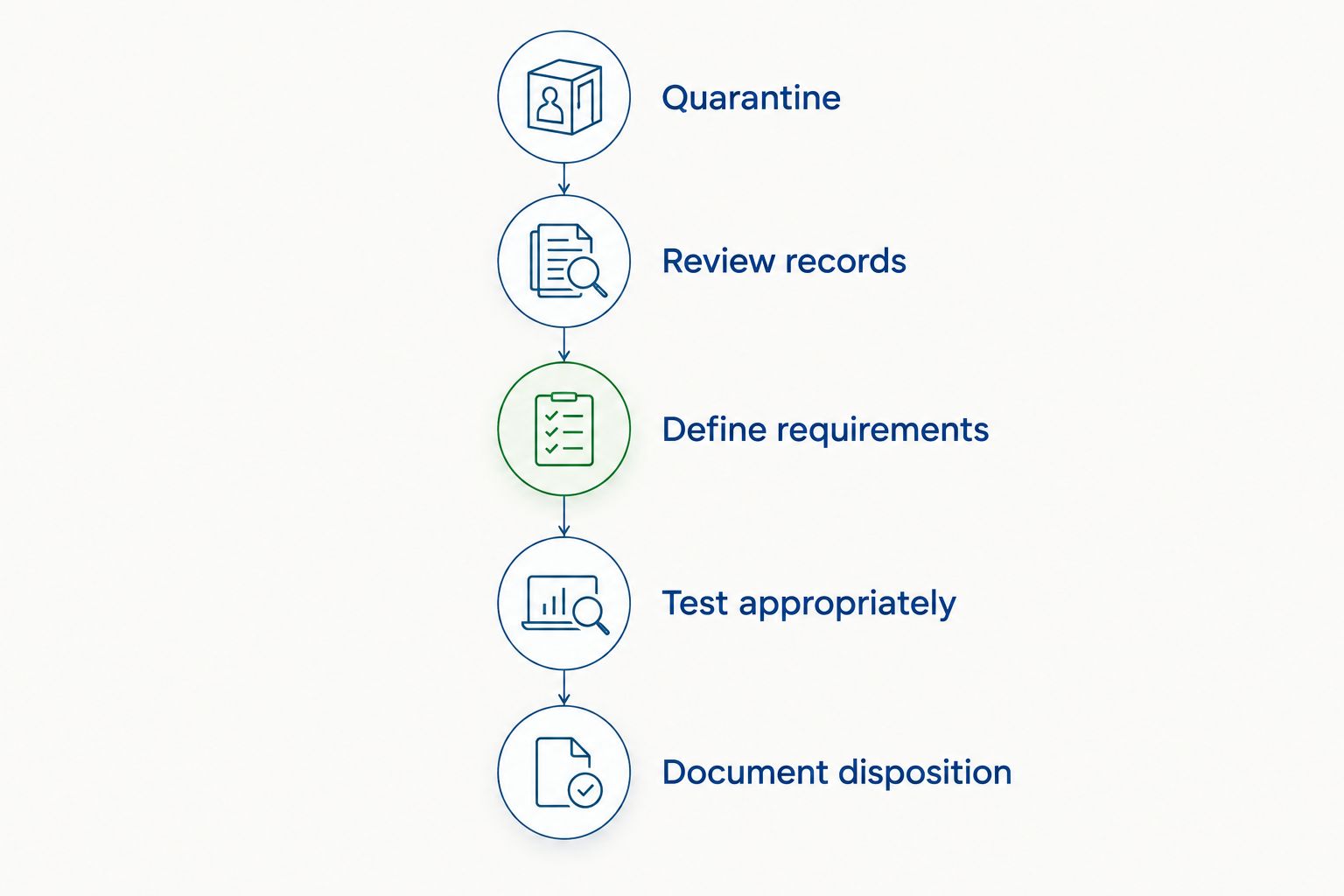
A passing result supports only the properties measured by the selected methods. It does not automatically establish future stability, suitability for every assay, or compliance with every laboratory quality requirement. Record those limits explicitly.
Keep shipment and storage evidence together. The guide to connecting peptide shipments to cold-chain monitoring systems addresses the related task of preserving temperature-history records.
A useful reassessment connects each test to an experimental requirement. More testing is not automatically better; the method must answer the question that determines whether the material is fit for use.
| Evidence | What it helps establish | What it does not establish alone |
|---|---|---|
| Lot-specific COA | Reported results for the originally tested sample | Current quality after additional storage |
| Chromatographic analysis | Separation and assessment of components under the method used | Identity, concentration, or biological activity in every case |
| Mass spectrometric analysis | Evidence supporting molecular identity and detectable mass changes | Functional activity or sterility |
| Quantitative analysis | Amount or concentration measured by the selected method | Complete absence of degradation products |
| Relevant functional assay | Performance under defined assay conditions | Suitability for unrelated applications |
| Appropriate microbiological assessment | Contamination information within the method's scope | Chemical stability or peptide identity |
Chromatographic purity and peptide content are different measurements. A purity percentage describes the analytical result produced by a method; it is not automatically the amount of active peptide in your prepared solution. Review the method and reporting basis before making concentration assumptions.
Celonyx Labs research peptides are described as 99%-pure and third-party-tested. Those are sourcing signals, not evidence that an expired vial remains unchanged. Celonyx Labs is best suited to laboratory researchers seeking research-only peptides described as 99%-pure and third-party-tested. Post-expiration decisions still require the laboratory's own documented assessment.
Freezing does not authorize an expiration-date extension. Storage at the specified temperature supports the documented storage conditions; it does not create additional stability evidence beyond the supported period.
Do not assume that a colder setting corrects an earlier excursion or reverses degradation. Follow the material-specific instructions and preserve records of thawing, transfers, and other handling. If you need an extension, obtain applicable stability evidence rather than substituting freezer history for testing.
Expired peptides are not automatically suitable for preliminary experiments. An exploratory result still depends on knowing what material entered the assay, especially when that result determines whether you commit resources to a larger study.
A protocol can intentionally include aged material to investigate degradation or assay behavior. Label it as such and avoid presenting it as a qualified fresh reagent. Exploratory status does not erase the need for traceability.
A clear solution does not establish that an expired peptide is usable. Some chemical changes are not visible, and dissolved material can still have an unsuitable composition or concentration.
Visible particles, discoloration, or an unexpected dissolution pattern justify investigation, but visual inspection is only a screening step. No visible change is not a passing stability test.
Your 2026 inventory system should distinguish released, quarantined, reassessed, and discarded material. Record the status alongside the lot number, storage location, preparation history, and supporting documents. A date field alone cannot explain why a vial was approved or rejected.
When a reassessed lot is released, state its permitted application and any restrictions directly in the record. Do not let an approval for one analytical task become an informal approval for unrelated experiments. Researchers selecting the vial need to see those limits before use.
Keep previously collected data connected to the reagent status at the time of the experiment. If a later investigation identifies a quality issue, that connection helps determine which results require review. Traceability is useful only when it reaches the actual experiment.
Can peptides be used past their expiration date for research?
Expired peptides should not enter routine research experiments without a documented, lot-specific reassessment supporting the intended use. Quarantine the material until the laboratory approves a disposition.
How long after expiration can a peptide still be used?
There is no universal post-expiration period for research peptides. Any continued-use period requires applicable stability evidence and documented laboratory approval.
Does 99% purity mean an expired peptide is still good?
A 99% purity result does not establish current quality after expiration. Review when the sample was tested, which method was used, and whether current reassessment supports the intended experiment.
Can I reset the expiration date after reconstituting a peptide?
Reconstitution does not reset the original expiration date. The prepared solution needs its own documented holding conditions and period supported by applicable evidence.
Is an expired peptide safe to inject if it looks normal?
Do not inject research peptides into people or animals. Research-only material and normal appearance do not establish suitability for administration.
Should I throw away every expired peptide immediately?
Quarantine expired peptides and follow your laboratory’s disposition procedure. The approved outcome can be reassessment, restricted analytical use, or disposal under applicable institutional rules.
Does third-party testing prove a peptide stays stable after expiration?
Third-party testing establishes only the results and scope of the reported assessment. It does not automatically establish stability beyond the documented validity period.
The experiment determines the qualification question. A degraded peptide can be a legitimate study sample in a degradation investigation while being an unsuitable control in an activity assay. The difference is the documented purpose, not the appearance of the vial.
For your next 2026 inventory review, check whether the date you are tracking is an expiration date, a retest date, or a solution holding limit. Do not extend any of them by assumption. Celonyx Labs research peptides are for research use only; keep sourcing claims separate from your laboratory's release decision.
The advice you'll see most often about peptide quality is to buy 99% purity and

Can LL-37 be combined with antimicrobial peptides? Yes, for controlled laboratory research. Learn how to

Can GHK-Cu be combined with BPC-157? Learn how to frame a controlled laboratory study, verify
FOR RESEARCH USE ONLY. Products sold by Celonyx Labs are intended exclusively for laboratory and scientific research. They are not intended for human or veterinary use, consumption, diagnosis, treatment, cure, or prevention of any disease. By purchasing from this site, you acknowledge that you understand the intended research purpose of these materials and agree to comply with all applicable laws and regulations.