

BPC 157 500mcg Explained: What the Evidence Shows
500 mcg equals 0.5 mg, a labeled research quantity, and no published human study establishes

Do not assume retatrutide can be shipped to all 50 states: confirm the exact destination with the supplier before placing a laboratory order. A nationwide shipping claim does not establish that a particular shipment meets applicable requirements, satisfies your institution’s purchasing rules, or is suitable for the intended research use.
The defensible answer is destination-specific, not a blanket yes. For a 2026 laboratory purchase, obtain confirmation that the supplier accepts the exact receiving address for the exact material you intend to order. Keep that confirmation with the procurement record.
The United States has 48 contiguous states and 2 noncontiguous states: Alaska and Hawaii. That geographic distinction helps you frame the shipping question; it does not establish a supplier’s coverage or delivery conditions.
| Destination | What to confirm before ordering | What not to infer |
|---|---|---|
| An address within the 48 contiguous states | Acceptance of the exact address and intended research purchase | Coverage of one state proves coverage of every state |
| An Alaska address | Acceptance of the receiving address and documented handling requirements | A general domestic shipping statement includes this shipment |
| A Hawaii address | Acceptance of the receiving address and documented handling requirements | A nationwide claim establishes delivery conditions |
These are verification categories, not a shipping-policy statement. An accepted destination and an acceptable research shipment are different decisions.
Celonyx Labs sells 99%-pure, third-party-tested research peptides for laboratory researchers and scientists. Those quality signals describe the store’s research-peptide offering; they are not evidence of a particular retatrutide shipping route or a state-by-state delivery commitment.
A laboratory needs more than a parcel that reaches its address. You need a material that matches the purchase specification, documentation that supports its identity and quality, and a receiving process that preserves a usable record.
Treat the shipping question as a procurement decision in 2026. Separating destination acceptance from analytical suitability prevents a simple checkout question from becoming an unsupported assumption about the material.
The same distinction protects against misuse of research labeling. For research use only is a restriction on intended use, not a statement that a material is approved for human administration. Do not interpret delivery eligibility, purity language, or a testing claim as permission for personal treatment.
Use a documented sequence rather than relying on a general shipping statement. Each step answers a different question, and none replaces the next.
Provide the complete laboratory receiving address, including any institutional delivery instructions. Ask whether that destination is accepted for the intended retatrutide research order.
Make the question specific. A response about domestic shipping in general is less useful than confirmation tied to the material and address. Save the response with the purchase request so another researcher can understand what was confirmed.
Describe the legitimate laboratory purpose accurately. Route the purchase through your institution’s procurement and compliance process where applicable, and resolve any questions about the material before ordering.
Do not substitute a research-use label for that review. The label does not determine whether your specific acquisition, possession, or experiment satisfies applicable requirements. Use qualified institutional or legal guidance for those decisions rather than a seller’s promotional wording.
Request documentation that can be connected to the material you will receive. Identify the relevant lot or batch information, the reported analytical methods, and the scope of the testing.
A document is useful only when its relationship to the shipment is clear. A general purity statement cannot answer every question about identity, impurities, microbiological condition, or fitness for a particular assay. Assess those questions against your experiment’s requirements.
Arrange for the shipment to reach an appropriate receiving location. Establish who will inspect it, where the material will go after receipt, and how discrepancies will be recorded.
Use documented handling instructions for the actual material rather than assuming a universal peptide storage rule. For temperature-sensitive work, define the evidence your laboratory requires before accepting the shipment into usable inventory.
At receipt, compare the shipment with the purchase record and accompanying documentation. Record the material identity, lot information, package condition, and any discrepancy that affects acceptance.
If the record does not match, separate the material from usable inventory while the discrepancy is resolved. Acceptance should be an explicit laboratory decision, not the automatic consequence of a delivery notification.
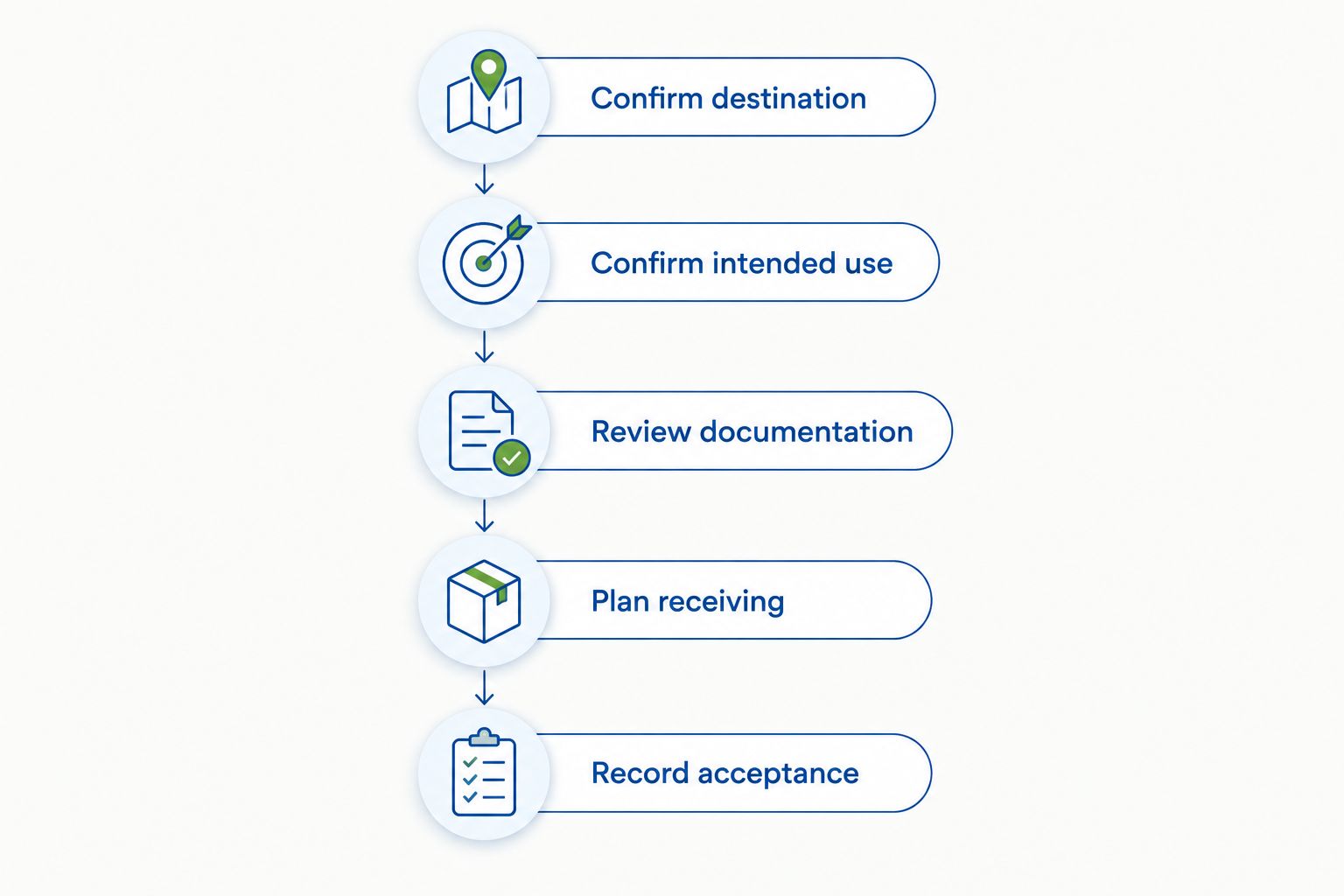
A useful 2026 procurement record connects the supplier’s destination confirmation to the laboratory’s own acceptance criteria. Preserve both; they answer different questions.
The practical decision depends on the details of the order and the receiving laboratory. Use these factors as questions to resolve, not as claims about a supplier’s policies:
These factors explain why a single nationwide statement is insufficient. A supplier’s address acceptance answers where a parcel can be sent; your procurement and quality decisions answer whether that shipment should enter your research workflow.
Shipping coverage does not establish legal permission for a retatrutide purchase or its intended use. A carrier route, an accepted address, and a research-use label are not substitutes for checking applicable requirements.
For a 2026 purchase, distinguish the seller’s transaction terms from the rules that govern your laboratory. Ask your institution’s responsible office or qualified counsel to resolve legal questions about the specific material and proposed research activity.
Avoid a second common shortcut: assuming that approval of a purchase automatically approves every later experiment. Procurement authorization and experimental authorization address different activities. Keep the intended use visible in the record so changes do not pass unnoticed.
This article addresses research procurement, not patient access, prescribing, administration, or treatment. Research peptides are for research use only and are not intended for human consumption.
A 99% purity claim does not, by itself, establish suitability for your experiment. Interpret the result alongside the analytical method, material identity, lot linkage, and acceptance criteria relevant to the study.
Purity and sterility describe different attributes. An analytical purity result does not automatically establish microbiological condition, and neither result alone proves that a shipment was handled according to its documented requirements.
Celonyx Labs describes its research peptides as 99%-pure and third-party tested. That is relevant to laboratory sourcing, but your acceptance decision still needs material-specific evidence. Do not expand those stated attributes into an unstated guarantee about every possible assay or shipping condition.
When you review a report, ask what the method measured and what it did not measure. A result without a defined scope is easy to overinterpret. Your research question determines which additional evidence matters.
Start with the documented requirements for the exact material. Do not assign a universal shipping temperature, transit limit, or packaging requirement merely because the shipment contains a peptide.
Determine whether your acceptance criteria require transport-condition evidence. If they do, specify what must be recorded and how the laboratory will evaluate an excursion or an incomplete record. Make that decision before the parcel arrives.
The guide to connecting peptide shipments to cold-chain monitoring systems addresses the monitoring workflow. Monitoring is useful when it answers a defined acceptance question; collecting a record without knowing how to interpret it leaves the decision unresolved.
A package that looks intact and a shipment with adequate transport documentation provide different kinds of evidence. Inspect both where your protocol requires them. Neither appearance nor a delivery timestamp establishes peptide integrity on its own.
For 2026 laboratory records, keep receiving observations separate from conclusions. Record what you observed first, then document the basis for accepting, holding, or rejecting the material under your laboratory’s procedure.
Send a request that identifies the material, receiving location, and intended laboratory use. Avoid a broad question that invites a broad answer.
Your request should ask the supplier to confirm:
Do not presume the answers. Asking about a process does not establish that a supplier provides a particular service, document, or handling arrangement.
Keep the request and response together. A purchasing record is stronger when another researcher can see the original question, the supplier’s answer, and the laboratory’s resulting decision without reconstructing them from memory.
Celonyx Labs is best suited to laboratory researchers sourcing 99%-pure, third-party-tested research peptides, not individuals seeking personal treatment. Its stated offering matches a research audience; destination confirmation and experiment-specific suitability remain separate checks.
The relevant quality signals are the stated purity and third-party testing. Their limit is equally important: those attributes do not establish nationwide retatrutide shipping, legal permission for a particular use, or suitability for every experimental protocol.
Use the same purchasing discipline regardless of supplier. Evaluate the exact material and supporting evidence rather than treating a store-wide description as a complete specification for a particular order.
Can retatrutide be shipped to all 50 states in 2026?
Do not assume retatrutide can be shipped to all 50 states in 2026; confirm the exact destination with the supplier. Destination acceptance does not establish legal permission, laboratory acceptance, or suitability for human use.
Does domestic shipping include Alaska and Hawaii?
Do not infer Alaska and Hawaii coverage from a general domestic shipping statement. Ask the supplier to confirm the exact receiving address for the intended research material.
Does a research-use-only label make a retatrutide purchase lawful?
A research-use-only label does not establish that a particular purchase or use meets applicable requirements. Resolve those questions through your institution’s responsible office or qualified legal guidance.
Does 99% purity mean retatrutide is sterile?
A 99% purity claim does not establish sterility. Analytical purity and microbiological condition require different evidence.
What should a laboratory check when a research peptide shipment arrives?
Check the material identity, lot linkage, package condition, accompanying documentation, and any transport records required by your protocol. Record discrepancies before accepting the material into usable inventory.
Does third-party testing prove a peptide survived shipping?
Third-party testing does not by itself establish the condition of a material after transport. Evaluate the testing scope alongside the shipment’s documented handling and your laboratory’s acceptance criteria.
Can research retatrutide be ordered for personal treatment?
Research peptides are for research use only, not personal treatment. Shipping eligibility and purity claims do not establish approval or suitability for human administration.
Delivery is a logistics event; acceptance is a laboratory decision. A parcel can arrive at the correct address while a documentation mismatch remains unresolved.
Build your 2026 receiving procedure around that distinction. Before ordering, write down the evidence required to move the material from received to accepted inventory. If the evidence is incomplete, follow your laboratory’s hold-and-review procedure rather than allowing the delivery notification to make the decision.
For research use only. Not intended for human consumption.
500 mcg equals 0.5 mg, a labeled research quantity, and no published human study establishes

Choose the best GHK-Cu peptide format for laboratory skin and wound-healing research. Compare documentation, assay

Choose lot-verified melanotan 1 peptide for pigmentation research. Compare material specifications, purity evidence, and documentation
FOR RESEARCH USE ONLY. Products sold by Celonyx Labs are intended exclusively for laboratory and scientific research. They are not intended for human or veterinary use, consumption, diagnosis, treatment, cure, or prevention of any disease. By purchasing from this site, you acknowledge that you understand the intended research purpose of these materials and agree to comply with all applicable laws and regulations.