

Is bacteriostatic water the same as sterile water? No 2026
Is bacteriostatic water the same as sterile water? No. Compare preservatives, vial handling and peptide
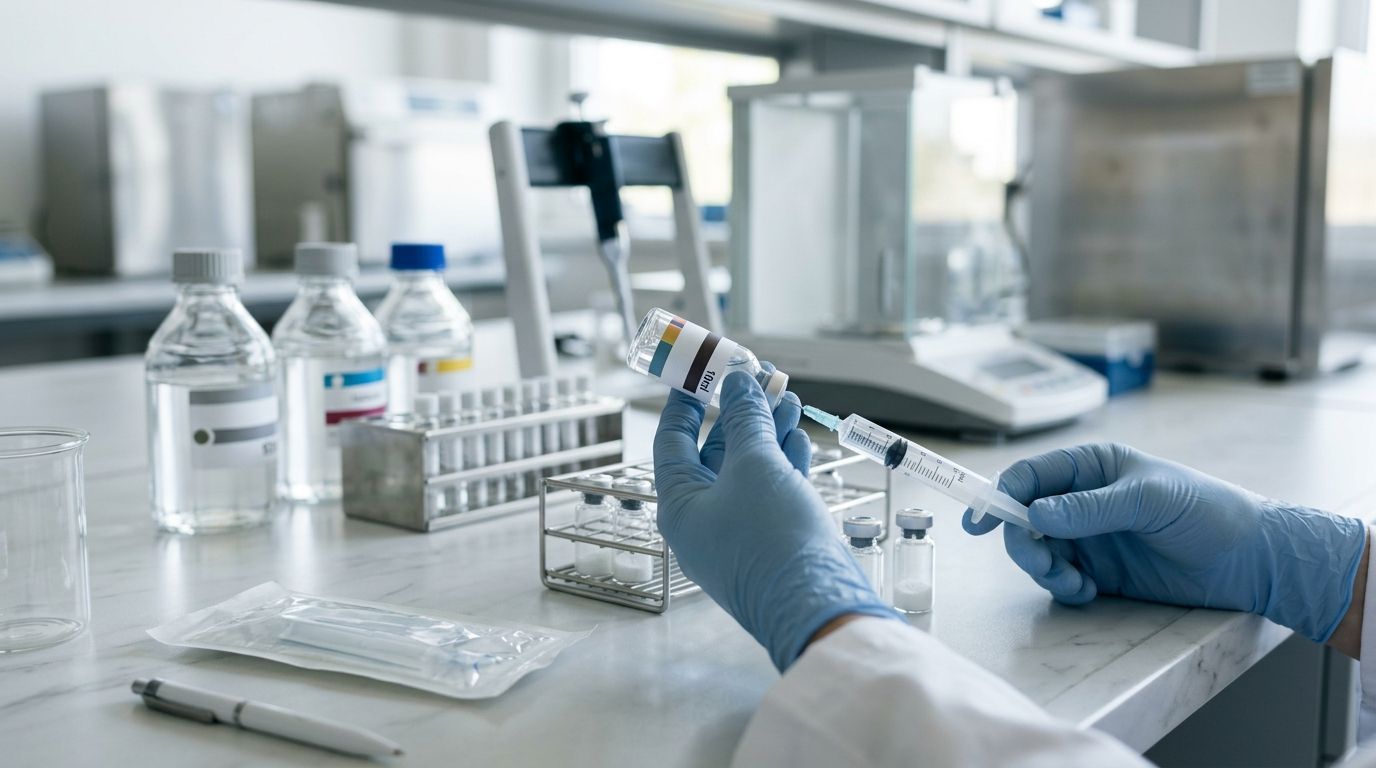
There is no universal bacteriostatic water dilution ratio by peptide in 2026. A laboratory dilution ratio depends on the verified peptide mass, the target research concentration, solvent compatibility and the study protocol; peptide identity alone cannot supply a defensible volume.
A ratio copied from another peptide protocol can produce the wrong concentration even when the arithmetic is correct. The first question is not how much bacteriostatic water another lab used. It is whether bacteriostatic water is an appropriate solvent for your specific material and analytical method. For procurement checks, see the bacteriostatic water sourcing guide.
Celonyx Labs research peptides are best for laboratory researchers seeking stated 99% purity and third-party testing; neither quality signal establishes a peptide-specific dilution ratio. The limitation matters: purity describes the material, while the volume needed to prepare a solution depends on the experimental concentration you select. A purity claim is not a solubility test or a reconstitution instruction.
Overall 2026 benchmark: no valid average or range exists for peptide-specific bacteriostatic water dilution ratios. A published-looking table of fixed milliliters per vial would hide the variables that actually determine concentration. The comparable reference below shows what can be calculated for any peptide after a lab establishes its mass, target concentration and solvent suitability.
| Reference scope | Peptide mass | Target concentration | Calculated diluent volume | Validity condition |
|---|---|---|---|---|
| All peptides | M mg | C mg/mL | M ÷ C mL | Use only when the selected diluent is compatible with the peptide and assay. |
| Peptides with an established aqueous protocol | Verified M mg | Protocol-defined C mg/mL | M ÷ C mL | Follow the specified solvent, preparation and stability conditions. |
| Peptides without established bacteriostatic-water compatibility | Verified M mg | Study-defined C mg/mL | No defensible bacteriostatic-water volume | Resolve compatibility before calculating a preparation volume. |
The first row is the overall yardstick, not a recommendation to use bacteriostatic water for every peptide. In 2026, no peptide type leads with a higher or lower evidence-based universal ratio: the table has no measured category averages to rank. A mass-to-volume calculation becomes useful only after the protocol establishes that its inputs apply.
Methodology and limitation: This 2026 table reports dimensional arithmetic and protocol requirements, not measured reconstitution outcomes or an average from a peptide dataset. It cannot tell you whether a specific peptide dissolves, remains stable, or performs as intended in an assay when mixed with bacteriostatic water.
A dilution ratio needs defined units. Peptide mass is commonly recorded in milligrams, diluent volume in milliliters, and resulting nominal concentration in milligrams per milliliter. The calculation is concentration = peptide mass ÷ final solution volume. Rearranging it gives target volume = peptide mass ÷ target concentration.
Here are arithmetic examples, not peptide-specific instructions:
| Illustrative mass | Illustrative final volume | Nominal concentration | What the comparison shows |
|---|---|---|---|
| 1 mg | 1 mL | 1 mg/mL | Equal numerical mass and volume values produce this concentration. |
| 1 mg | 2 mL | 0.5 mg/mL | More final volume lowers concentration at the same mass. |
| 2 mg | 1 mL | 2 mg/mL | More mass raises concentration at the same final volume. |
The highest value in these examples is 2 mg/mL; the lowest is 0.5 mg/mL. Those values differ because the assumed mass or volume changes, not because one row represents a different peptide type. None is a 2026 benchmark, a recommended preparation, or evidence that bacteriostatic water suits the material.
The examples use final solution volume, which is a distinct concept from the volume of liquid added to a vial. If your method requires a measured final volume, follow that method rather than assuming the added liquid and final volume are interchangeable. Record the units alongside every value; a number without its unit does not define a research concentration.
A peptide reference standard illustrates why documentation takes priority over a generic ratio. A standard used in an analytical method has a defined purpose; its preparation must serve that method, not a rule copied from an unrelated peptide. For quality documentation, the peptide purity testing guide covers a separate question from solvent choice. Purity testing and solvent compatibility are different checks.
Bacteriostatic water and a target concentration answer different questions. The solvent decision asks whether the liquid fits the peptide and assay. The concentration decision asks how much verified material should be present per unit of final solution. Passing one check does not pass the other.
| Decision | What you need to establish | What it does not establish |
|---|---|---|
| Solvent suitability | The protocol or material documentation supports the selected solvent. | The target research concentration. |
| Target concentration | The study or analytical method specifies a concentration with units. | Whether the peptide remains suitable in the selected solvent. |
| Mass verification | The applicable records support the mass used in the calculation. | Solution stability or assay performance. |
| Preparation record | The calculation, solvent and preparation details are traceable. | That an unsupported solvent choice becomes valid. |
For Celonyx Labs research peptides, stated 99% purity and third-party testing are quality signals you can distinguish from a reconstitution protocol. The benefit is an explicit basis for evaluating the supplied material. The limit is that those signals do not provide a universal bacteriostatic water volume, stability period or assay-specific recommendation.
A peptide name or research category is not enough to derive a bacteriostatic water dilution ratio. Peptides in the same broad research area can be prepared for different analytical purposes. Even within one project, a change in target concentration changes the calculated volume without changing the peptide identity.
A table of fixed volumes also leaves out the solvent decision. A solution can meet a calculated nominal concentration on paper while failing a protocol's compatibility or stability requirements. Do not treat a concentration calculation as evidence that a preparation works. This is the central limitation behind any 2026 peptide dilution chart that lists volumes without identifying its method and scope.
Use a source-specific method when one exists. If the relevant protocol specifies a solvent other than bacteriostatic water, a bacteriostatic-water chart is not a substitute. If it specifies a target concentration but leaves solvent compatibility unresolved, settle the solvent question before converting mass into volume.
Record peptide identity, the mass basis, target concentration, solvent identity, calculated volume and the method used to judge compatibility. Keep the calculation beside the relevant material documentation so another researcher can distinguish a verified input from an assumption. A later reviewer should be able to reproduce the arithmetic without guessing which units were intended.
The distinction between nominal and confirmed concentration also belongs in the record. Dividing mass by volume produces a nominal concentration. It does not independently confirm complete dissolution, chemical integrity or assay suitability. Those questions require the checks specified by the research method.
Celonyx Labs serves laboratory researchers and scientists with research peptides. These materials are for research use only. The calculations on this page describe laboratory concentration planning; they are not instructions for human use, administration or dosing.
What is the bacteriostatic water dilution ratio by peptide in 2026?
There is no universal bacteriostatic water dilution ratio by peptide in 2026. Establish solvent suitability, verified mass and the protocol’s target concentration before calculating a volume.
How do I calculate a peptide’s nominal concentration?
Divide peptide mass in milligrams by final solution volume in milliliters to obtain milligrams per milliliter. The result is nominal and does not verify dissolution or stability.
Can I use the same dilution ratio for different peptide types?
Not without protocol support for each preparation. The same numerical ratio does not establish that bacteriostatic water is compatible with both peptides or their assays.
Does 99% purity determine how much bacteriostatic water to add?
No. A 99% purity statement does not specify the study’s target concentration, solvent compatibility or preparation method.
Is calculated diluent volume the same as final solution volume?
Not necessarily. Use the volume definition required by the laboratory method and document whether the calculation refers to liquid added or final solution volume.
What if my peptide protocol specifies another solvent?
Follow the solvent requirements of the applicable research protocol. A generic bacteriostatic-water ratio does not override method-specific preparation instructions.
Are the example ratios on this page recommended for research preparations?
No. The examples demonstrate unit arithmetic only; they do not establish a suitable solvent, concentration or procedure for any named peptide.
The most useful 2026 dilution table is the one attached to your own method. Write down the target concentration and solvent decision first; only then does the mass-to-volume calculation answer a laboratory question. Celonyx Labs research peptides still require that method-specific decision despite their stated purity and third-party testing.
Is bacteriostatic water the same as sterile water? No. Compare preservatives, vial handling and peptide

How do you know if a peptide vial has gone bad? Quarantine changes, check storage

Can too much bacteriostatic water ruin a peptide vial? Yes, if it overfills the vial
FOR RESEARCH USE ONLY. Products sold by Celonyx Labs are intended exclusively for laboratory and scientific research. They are not intended for human or veterinary use, consumption, diagnosis, treatment, cure, or prevention of any disease. By purchasing from this site, you acknowledge that you understand the intended research purpose of these materials and agree to comply with all applicable laws and regulations.