

Integrity Research BPC 157: How to Judge Vendor Claims
The advice you'll hear most often about buying BPC-157 for the bench is short: demand

Ipamorelin has no single time-to-effect across research models: the answer depends on whether you measure receptor activity, growth hormone release, or a downstream biological outcome. A detectable signal at one sampling point does not establish when the response began, when it peaked, or whether it persisted.
Ipamorelin response timing must be reported for a defined model, endpoint, and sampling schedule—not as a general waiting period. Research involving growth hormone signaling does not support treating every measurable change as the same effect. An assay of hormone release and an assessment of tissue-level change answer different questions.
For your 2026 study plan, distinguish the following endpoint categories before selecting observation times:
| Endpoint | Best for | What it establishes | Main limitation |
|---|---|---|---|
| Receptor-associated activity | Mechanistic research | Whether the selected signaling readout changes under the tested conditions | Does not establish an organism-level response |
| Growth hormone release | Endocrine-response research | Whether measured hormone concentrations differ across sampled conditions | Sparse sampling can miss a transient response |
| Downstream biological outcome | Functional-response research | Whether the selected biological outcome changes during observation | Does not by itself establish that growth hormone signaling caused the change |
These categories are not interchangeable timelines. Select the endpoint that answers your hypothesis, rather than selecting an endpoint because it produces the earliest detectable signal.
A study can miss a real response by sampling outside its detection window. It can also overinterpret a temporary difference as a sustained effect. Neither problem is solved by extending the experiment without changing its design.
Your reagent record matters alongside your sampling plan. Use a traceable approach to connect peptide purity reports to your QMS platform so the material identity, lot documentation, and experiment remain connected.
The practical question is not simply when ipamorelin works; it is when your chosen method can detect the response you intend to study. Write that distinction into the protocol before collecting samples.
Receptor-associated measurements address a proximal part of the biological pathway. Their strength is mechanistic focus; their limitation is that a change in a signaling assay does not automatically predict hormone release or a functional outcome.
Specify exactly what the assay measures. A binding experiment measures something different from a functional signaling experiment, even when both concern the same receptor system. Treating them as equivalent obscures the meaning of onset.
For interpretation, document the model's relevant receptor characteristics and the assay conditions. A result from an engineered cell system is not a direct timing estimate for an intact animal model.
Best for mechanistic questions: use a receptor-associated readout when your hypothesis concerns that readout, and keep the conclusion at that level.
Growth hormone secretion is pulsatile, so a single concentration does not describe the full response. The relationship between baseline variation, intervention timing, and sample collection is central to interpretation.
An early sample can precede the response. A later sample can follow it. Without observations that bracket the relevant interval, an unchanged measurement does not distinguish absent activity from a missed signal.
Use an assay appropriate for the species and sample matrix. Review its detection limits, calibration, and interference information before interpreting a negative result as evidence that ipamorelin produced no response.
Best for endocrine-response questions: analyze the sampled hormone time course with matched controls. Do not convert an isolated concentration into a universal onset claim.
Downstream endpoints require their own justification. A change in a tissue marker, physiological measure, or other functional outcome is not the same observation as a change in circulating growth hormone.
These studies offer a closer view of the selected biological outcome, but causal interpretation becomes more demanding. Model characteristics, background conditions, and other biological pathways also affect the measurement.
A delayed outcome does not prove that receptor activity began late. Likewise, an early hormone response does not establish that a downstream outcome will occur.
Best for functional questions: select an outcome relevant to the hypothesis and justify its observation window independently. Avoid using hormone-response timing as a substitute for evidence about the downstream endpoint.
The main timing drivers are experimental, biological, and analytical. Each changes what an observed response means, rather than merely shifting a countdown.
For a 2026 protocol, record these factors explicitly rather than copying a timeline from an unmatched experiment. A timing estimate without its experimental conditions is not a transferable specification.
Build the study around a stated endpoint and an interpretable comparison. Choose the collection schedule from relevant primary research and your laboratory's validated methods, not from consumer anecdotes or an unrelated peptide's timeline.
State the measured variable before stating the expected effect. For example, distinguish a hormone-concentration measurement from a functional biological outcome. This prevents the meaning of success from changing after results arrive.
Also define what counts as a detectable response. Analytical detectability, statistical significance, and biological relevance are separate criteria; none should silently substitute for another.
Evaluate published experiments for model, endpoint, exposure conditions, and sampling schedule. Read the methods and results together. An abstract describing an effect does not necessarily establish its onset.
In a 2026 literature review, retain the original study conditions beside every timing statement. Do not combine the earliest observation from one model with a downstream outcome from another.
Use controls appropriate to the hypothesis and assay. Matched vehicle controls help assess changes unrelated to the compound, while an appropriate assay control helps evaluate whether the measurement system performed as intended.
Define control interpretation before the experiment. Otherwise, an unexpected result invites a retrospective explanation instead of a testable conclusion.
Select collection points that address the expected response pattern and the practical constraints of the model. Account for baseline observations, sample processing, and the assay's input requirements.
Do not describe the first positive sample as the exact onset. It establishes detection at that collection point; the response began somewhere within an interval your sampling design only partly resolves.
Record material identity, lot information, preparation history, sample collection, and processing consistently. Follow validated laboratory procedures and compound-specific documentation rather than applying a generic peptide-handling rule.
A documented workflow helps you investigate discordant results. It does not guarantee biological activity, but it preserves the information needed to assess what happened.
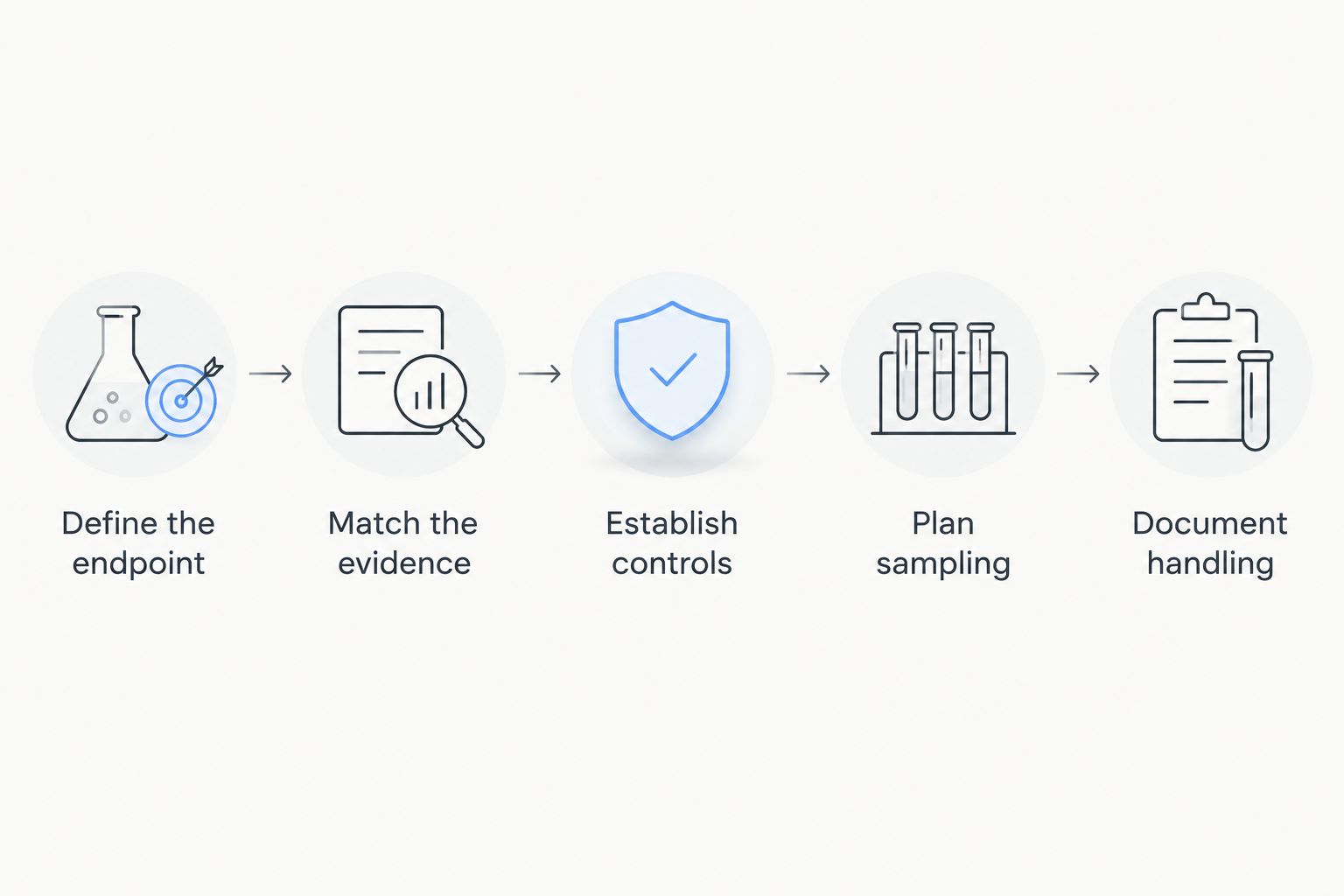
A negative result means the selected analysis did not establish the specified response under the tested conditions. It does not automatically establish that the compound has no biological activity in every model.
First examine whether the controls behaved as expected. Then review the model, sample timing, assay performance, and handling record. Keep those checks separate from any decision to alter exposure conditions.
Do not respond to an unexplained negative result by automatically increasing exposure. That changes the experiment without resolving whether the original problem was biological, analytical, or procedural. Follow the approved protocol and the relevant institutional oversight requirements.
Higher purity is not a time-to-effect specification. Purity testing addresses material composition within the scope of the method; it does not independently establish receptor activity, biological potency, sterility, or response duration.
Celonyx Labs sells 99%-pure, third-party-tested research peptides, including Ipamorelin 5mg. The 5 mg designation describes the listed product amount, not an experimental dose or an onset estimate.
Celonyx Labs is for laboratory researchers sourcing research peptides, not consumers seeking treatment. Evaluate the relevant lot documentation and suitability for your specific method before use. A supplier quality statement cannot replace model-specific validation.
For a 2026 procurement review, keep material qualification and biological qualification separate. Both support interpretation, but they answer different questions.
Another peptide's timeline is not a valid substitute for ipamorelin-specific evidence. Sharing a broad research category does not establish equivalent receptor interactions, exposure profiles, or downstream responses.
Even studies of the same compound require a comparability check. Changes in model, assay, endpoint, or sample collection can make an apparently familiar timeline unsuitable for your protocol.
If your research includes multiple compounds, define the timing rationale for each. Do not assign one shared observation window solely to simplify the workflow.
Report the endpoint, model, observation schedule, and result together. Distinguish the first detected difference, the largest sampled response, and the final observation; these describe different features of the experiment.
Use language that matches the resolution of your data:
This reporting approach makes the result useful to another laboratory. A bare statement that ipamorelin takes a certain time omits the conditions needed to evaluate or reproduce it.
How long does ipamorelin take to show effects in research models?
Ipamorelin has no universal time-to-effect across research models. The answer depends on the endpoint, model, exposure conditions, sampling schedule, and assay performance.
Does an early growth hormone response prove a lasting biological effect?
An early growth hormone response does not prove a lasting biological effect. Sustained or downstream outcomes require their own measurements and an appropriate observation period.
Can a single sample show when ipamorelin starts working?
A single sample cannot establish exact onset. It shows the measured state at collection, without resolving changes before or after that point.
Does a negative assay mean ipamorelin is inactive?
A negative assay does not establish universal inactivity. Interpret it against the controls, sampling schedule, detection limits, and tested model.
Does 99% purity predict how quickly a research peptide acts?
99% purity does not predict response timing. A purity result does not independently establish biological potency, sterility, or suitability for a particular experimental model.
What does the Ipamorelin 5mg product designation mean?
The Ipamorelin 5mg designation identifies the listed product amount. It is not an experimental dose, a preparation instruction, or a prediction of response timing.
Can research ipamorelin timelines guide personal use?
Research ipamorelin timelines are not instructions for personal use. Laboratory findings do not establish a safe or effective human-use schedule, and research-use-only materials are not for human or veterinary administration.
The first detected response is not necessarily the first biological response. Sampling creates observation windows, not continuous knowledge of the system. Preserve that distinction when interpreting a promising result or troubleshooting a negative one.
Before your next experiment, write the endpoint and its detection criterion in the same sentence. If that sentence is unclear, adding more collection points will not fix the underlying question.
For research use only. Not for human or veterinary administration.
The advice you'll hear most often about buying BPC-157 for the bench is short: demand

Can cagrilintide be combined with GLP-1 peptides? Yes, in controlled research. Understand mechanisms, study controls,

Can Selank be combined with nootropic peptides? Yes, in controlled laboratory studies. Learn the controls,
FOR RESEARCH USE ONLY. Products sold by Celonyx Labs are intended exclusively for laboratory and scientific research. They are not intended for human or veterinary use, consumption, diagnosis, treatment, cure, or prevention of any disease. By purchasing from this site, you acknowledge that you understand the intended research purpose of these materials and agree to comply with all applicable laws and regulations.