

Integrity Research BPC 157: How to Judge Vendor Claims
The advice you'll hear most often about buying BPC-157 for the bench is short: demand

PT-141 can be purchased for legitimate laboratory research in the United States, but a research-use label does not establish that every sale, import, or intended use is lawful. In 2026, you need to distinguish nonclinical laboratory work from human administration and verify the federal, state, and institutional requirements that apply to your transaction. Buying research material does not authorize personal treatment or replace the requirements for a clinical investigation.
There is no blanket research-use exemption that makes every PT-141 transaction lawful. A genuine nonclinical purchase requires a different assessment from a purchase intended for self-administration, prescribing, or clinical investigation. The relevant question is what material you are buying, how it is represented, where it is going, and what you will actually do with it.
For broader context, review the guide to buying research peptides legally in the United States. Keep the compound-specific assessment separate: another peptide's regulatory position does not establish PT-141's status.
| Procurement pathway | Best for | What supports the pathway | Principal limitation |
|---|---|---|---|
| Nonclinical laboratory research | Analytical assays and laboratory studies without human administration | A defined research purpose, suitable material, and applicable institutional review | A research label does not override laws governing the transaction |
| Human clinical investigation | An authorized study involving human participants | An applicable investigational framework and required ethics review | Buying a research vial does not authorize enrollment or administration |
| Prescription treatment | Patients receiving care through licensed clinicians | An appropriately prescribed, legally supplied drug product | Approval of a finished drug does not approve unrelated research materials |
These are regulatory pathways, not interchangeable purchasing options. Choose the pathway that matches the actual activity before evaluating a supplier.
PT-141 is also known as bremelanotide. FDA prescribing information for Vyleesi identifies bremelanotide as its active ingredient, but the approved prescription product and a laboratory research vial are not interchangeable regulatory categories.
That distinction matters more than a familiar molecule name. Approval concerns a particular drug product and its approved conditions of use; it does not automatically cover every formulation, source, or vial containing the same active substance.
For a 2026 procurement review, separate three questions:
A positive answer to one does not answer the others. A laboratory can receive analytically suitable material without having authorization to administer it to people.
A research-use statement identifies the supplier's stated purpose for the material. It is not an FDA approval, a clinical authorization, or a guarantee that the transaction complies with every applicable rule. Read the statement alongside the supplier's claims and your actual intended use.
Under 21 CFR 201.128, FDA considers objective intent when assessing a product's intended use. Labeling, advertising, and the circumstances surrounding distribution can matter; a disclaimer does not erase contrary evidence that a product is intended as a drug for human use.
For example, a research label accompanied by treatment claims presents a different compliance question from a reagent supplied for a documented laboratory assay. You should not treat identical disclaimers as proof that those transactions have identical legal consequences.
Your records should describe the real experiment. Do not rewrite a personal-use purpose as laboratory research to fit a seller's checkout language.
No: a “not for human consumption” statement does not authorize personal administration. If your goal is treatment, use the licensed clinical pathway rather than treating a research disclaimer as permission. This guide addresses laboratory procurement, not instructions for using PT-141 on yourself or another person.
Use a documented procurement sequence before placing an order. The sequence below is a screening process, not a legal determination or a substitute for your institution's approvals.
The strongest file connects the intended experiment to the specific material received. A collection of unrelated certificates does not establish that connection.
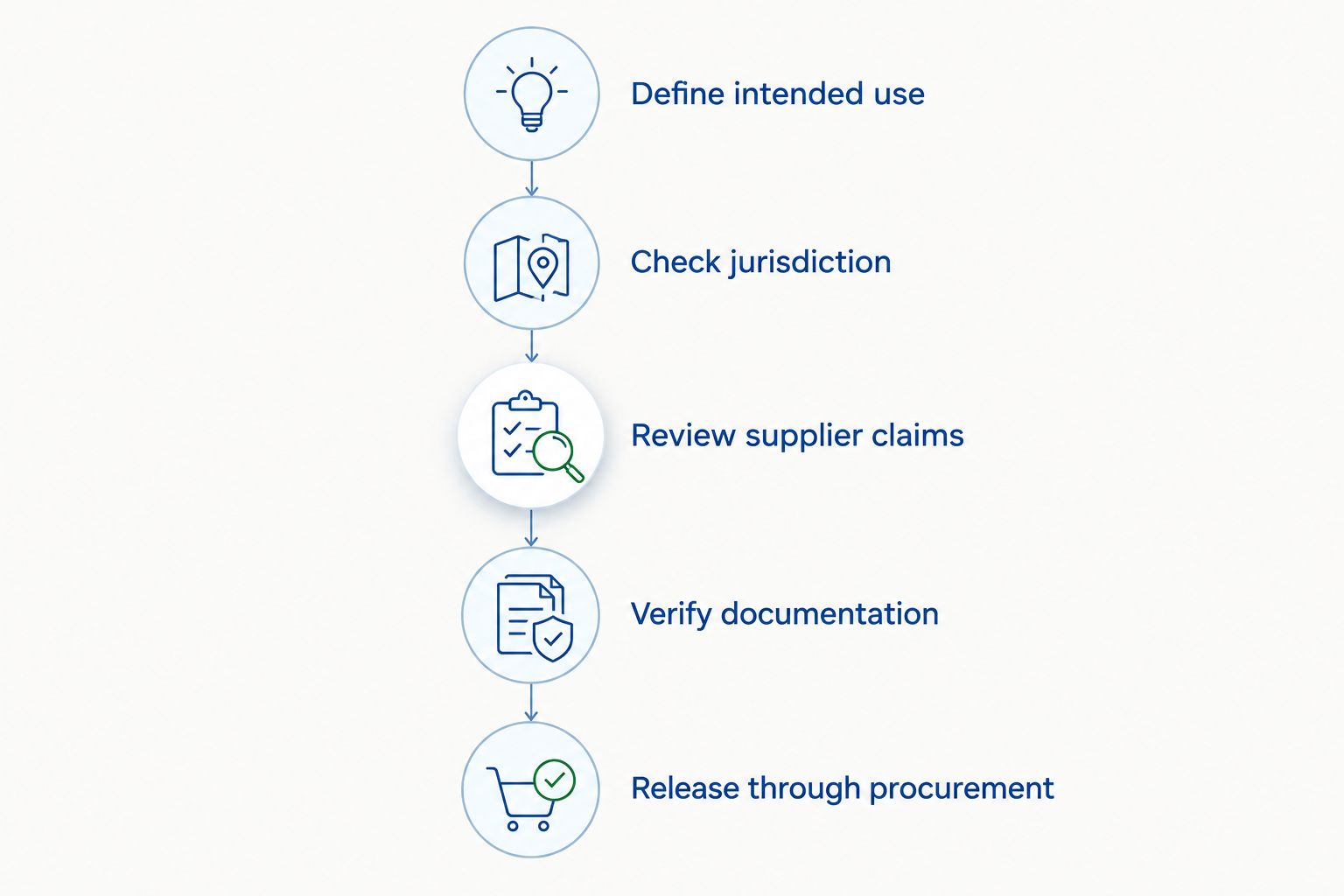
Keep compliance review and scientific acceptance separate in the approval record. Procurement approval establishes permission to buy under your institution's process; scientific acceptance establishes whether the received material fits the experiment.
Human administration requires a separate regulatory assessment, even when the project is described as research. Calling a vial a reagent does not remove the requirements associated with a clinical investigation.
For U.S. drug investigations, 21 CFR Part 312 establishes the investigational new drug framework. Section 312.2 addresses its applicability and exemptions, including conditional exemptions for certain investigations of lawfully marketed drugs. Those conditions are not a general exemption for research-grade PT-141 purchased online.
Institutional review board review and informed-consent requirements also need assessment under the applicable human-subject rules. Neither a purchase receipt nor a certificate of analysis replaces those requirements.
Before a human study proceeds, the sponsor and responsible investigators should establish:
Do not infer a clinical exemption from the existence of an approved bremelanotide product. The study, drug product, proposed use, and applicable exemption conditions all need review.
For 2026 purchasing decisions, assess these factors rather than relying on a seller's general legality statement:
These factors explain why a universal yes-or-no answer is inadequate. Resolve the facts of your purchase before treating an online statement as applicable to your laboratory.
Analytical quality and legal authorization are separate decisions. A certificate of analysis can help establish what was tested and what the reported results mean; it does not authorize a particular experiment or establish that a material is suitable for human administration.
During your 2026 review, connect each document to the lot under consideration. Check the compound identification, lot identifier, reported analytical method, test results, and any information explaining how the sample reached the testing laboratory.
Do not treat chromatographic purity as a complete description of a vial. Identity, peptide content, contaminants, and suitability for a particular assay are distinct questions. Sterility and endotoxin status also require their own evidence when relevant to the work.
Celonyx Labs describes its research peptides as 99%-pure and third-party-tested. Those are supplier quality statements, not substitutes for examining the relevant lot documentation or obtaining institutional approval.
The guide to whether 99% purity establishes research safety explains the distinction between a purity figure and broader suitability. Apply that distinction before accepting any peptide into a protocol.
FDA approval of a bremelanotide drug product does not extend to every PT-141 research vial. The active ingredient's identity does not establish that an unrelated material has the approved product's manufacturing controls, formulation, labeling, or legal distribution status.
For the governing distinction, consult FDA's prescribing information for Vyleesi and the new-drug approval requirements in 21 U.S.C. 355. Use those sources to distinguish an approved finished drug from a chemical offered for laboratory investigation.
An account type does not determine whether a PT-141 purchase is lawful. A seller accepting an individual account does not establish a research exemption, and a business account does not authorize human use. Assess the actual purpose and applicable requirements rather than relying on checkout eligibility.
Celonyx Labs research peptides are best suited to laboratory researchers and scientists, not people seeking personal treatment. The store's stated focus is 99%-pure, third-party-tested research peptides. That positioning establishes the intended audience, not permission to use a particular compound in a particular study.
The useful quality signals are the stated purity and third-party testing. Their limitation is scope: neither establishes FDA approval, clinical suitability, or a transaction-specific legal conclusion. Evaluate the relevant documentation and your protocol requirements independently.
Is PT-141 legal to buy for research in the United States?
PT-141 can be purchased for legitimate laboratory research, subject to the requirements governing the particular transaction and intended use. A research-use label alone does not establish legality or authorize human administration.
Is PT-141 the same compound as bremelanotide?
PT-141 is another name for bremelanotide. That chemical identity does not make a research vial equivalent to an FDA-approved finished drug product.
Does a research-use-only label mean I can use PT-141 myself?
No, a research-use-only label does not authorize personal administration. Personal treatment belongs in a licensed clinical pathway, not a laboratory-reagent purchasing process.
Do I need a prescription to purchase PT-141 for a laboratory assay?
A genuine nonclinical reagent purchase is not the same transaction as dispensing a prescription drug. Verify the applicable product, jurisdiction, supplier, and institutional requirements rather than treating the absence of a prescription request as proof of legality.
Does a certificate of analysis prove PT-141 is legal?
No, a certificate of analysis reports analytical information rather than legal authorization. Connect it to the relevant lot and assess transaction legality separately.
Can a laboratory import PT-141 from another country?
Importing PT-141 requires a separate assessment of customs, FDA admissibility, and other applicable requirements. A foreign seller’s research disclaimer does not guarantee that a shipment can lawfully enter the United States.
Can research-grade PT-141 be used in a human study?
A research-grade label does not establish suitability or authorization for a human study. The sponsor must assess investigational-drug requirements, ethics review, and the quality requirements for the proposed study material.
Checkout acceptance is not compliance approval. A completed payment shows that a seller processed an order; it does not establish regulatory authorization, analytical suitability, or permission to use the material in your study.
Before your next 2026 purchase, write the intended experiment into the procurement record and obtain the required approvals. That simple separation prevents a supplier's sales language from becoming your laboratory's compliance rationale.
This page provides general U.S. regulatory information, not legal advice. All research materials discussed are for research use only, not for human or veterinary administration.
The advice you'll hear most often about buying BPC-157 for the bench is short: demand

Can cagrilintide be combined with GLP-1 peptides? Yes, in controlled research. Understand mechanisms, study controls,

Can Selank be combined with nootropic peptides? Yes, in controlled laboratory studies. Learn the controls,
FOR RESEARCH USE ONLY. Products sold by Celonyx Labs are intended exclusively for laboratory and scientific research. They are not intended for human or veterinary use, consumption, diagnosis, treatment, cure, or prevention of any disease. By purchasing from this site, you acknowledge that you understand the intended research purpose of these materials and agree to comply with all applicable laws and regulations.