
KLOW Peptide Price: What an 80 Mg Vial Really Costs
An 80 mg KLOW vial is listed at roughly $119.99 to $165, which works out
An 80 mg KLOW vial is listed at roughly $119.99 to $165, which works out to about $1.50 to $2.06 per milligram of nominal blend. Those are listed prices on vendor pages, not audited transaction prices.
The band looks tidy. What sits underneath it doesn't. KLOW has no manufacturer's price behind it, no regulator's benchmark, and no single definition of what the vial holds beyond what each seller prints on the label. A buyer comparing listings is comparing a total-mass rate on a mixture whose mass is unevenly distributed, and the component most protocols specify is the one with the smallest share. Convert a handful of listings to price per milligram of the peptide you want, and the cheap vial often stops being the cheap option.
Start with the two listings that set the band. Peptidology shows an 80 mg vial at $119.99 in 2026, which is $1.50 per milligram. Peptryn lists the same nominal size at $160 per 80 mg vial in 2026, or $2.00 per milligram. Same four peptides, same stated mass, a third more money.
Package size moves the arithmetic more than the brand does. ChemVerify's record for Licensed Peptides shows a starting price of $199.99 and an 800 mg option at $1,075, which divides to $1.34 per milligram. The larger package carries the bigger headline and the smaller unit cost, a pattern that holds in the tracker medians below.
Documentation moves the rate as much as quantity. Peptide Check's KLOW comparison reports a lowest price of €1.07 per milligram without report verification and €1.79 per milligram with a verifiable lab report, roughly two thirds higher for the same nominal product. That gap is the price of a document, and it's the clearest signal in this category that sellers are pricing paperwork as well as powder.
The single-listing view understates the spread. A comparison covering 43 stores reported KLOW prices from $0.20 to $8.00 per milligram with a median of $1.14, and the same dataset put the median at $0.33 per milligram for kits of at least five vials against $1.73 for single-vial purchases. A second tracker covering 29 vendors found a median of $1.50 per milligram, a middle 50% of listings between $1.22 and $1.75, and a full range of $0.65 to $3.44; for an 80-milligram vial those medians imply roughly $91.20 to $120 before shipping, taxes, discounts or testing-related charges (PeptidesGrid KLOW price tracker).
The table converts each listing to a per-milligram rate where the stated size allows it.
| Vendor or listing | Size | Listed price | Price per mg | Notes |
|---|---|---|---|---|
| Peptidology | 80 mg | $119.99 | $1.50 | Listed in 2026 |
| Peptryn | 80 mg | $160 | $2.00 | Per 80 mg vial in 2026 |
| Second 80 mg presentation | 80 mg | $165 | $2.06 | Listed presentation |
| European listing | Not stated | €89.99 | Not calculable | Currency, tax and size not stated |
| ChemVerify, Licensed Peptides | Not stated | from $199.99 | Not calculable | Starting listing price |
| ChemVerify, Licensed Peptides | 800 mg | $1,075 | $1.34 | Largest option listed in 2026 |
| Peptide Check, lowest without report | Not stated | Not stated | €1.07 | No verification report |
| Peptide Check, lowest with lab report | Not stated | Not stated | €1.79 | Verifiable lab report included |
| Buyer analysis, single vial | 80 mg | $100 | $1.25 | Checked price per vial |
| Buyer analysis, ten-pack | 800 mg | $560 | $0.70 | Ten vials |
Keep the euro rates apart from the dollar listings. A ranked table that mixes both currencies ranks exchange rates as much as products, and the €1.07 figure in particular tells you nothing until you know the size behind it.
Every figure above is a listed price rather than an audited sale. Currency, shipping, minimum orders and testing coverage all change what leaves the buyer's account, and the comparison sets shift as vendors enter and leave the trackers. Treat any single KLOW peptide price as a starting point for the full calculation, never as the calculation itself.
There's no list price to look up. KLOW is a marketing name for a four-peptide blend generally built from GHK-Cu, BPC-157, TB-500 and KPV, and Drugs.com's medical review of GLOW and KLOW peptide blends notes that no published human or animal study has tested the KLOW blend itself. Evidence for the four ingredients individually doesn't transfer to the combination as a finished formulation, and neither does any assumption about a regulated market rate.
What that leaves is a research-material category where each seller defines its own product. Composition, concentration, testing documentation and regulatory status can differ from one listing to the next, which is why two labels reading 80 mg can describe products that share nothing but a name.
A benchmark price implies a benchmark product, and there isn't one here. There's no approved medicine to price against, no compendial monograph governing the mixture, and no manufacturer obliged to publish a list price. The numbers in the previous section describe a vendor market, and vendor markets reprice when a store opens, closes or rebrands.
The physical item varies too.
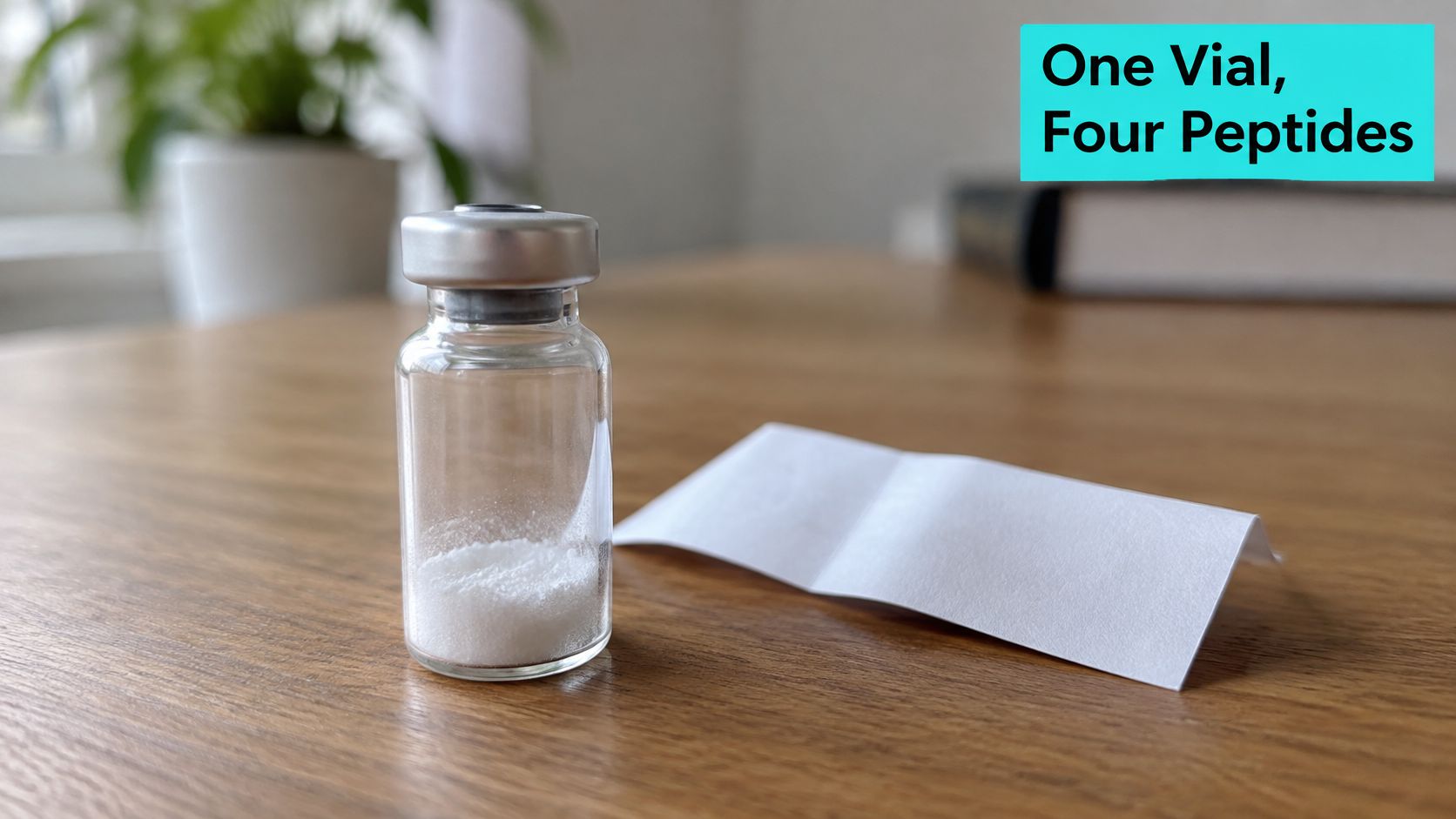
The common label is an 80 mg lyophilized vial holding 50 mg GHK-Cu, 10 mg KPV, 10 mg BPC-157 and 10 mg TB-500, and the same listing notes that batch-specific HPLC purity and mass-spectrometry identity testing are more decision-useful than a headline purity claim (Glow Peptides KLOW blend page). It also flags the distinction that breaks mass-based comparisons: residual water, counterions, salts and lyophilization excipients mean the labeled 80 mg is not 80 mg of peptide.
| Component | Amount per 80 mg vial | Share of vial mass |
|---|---|---|
| GHK-Cu | 50 mg | 62.5% |
| KPV | 10 mg | 12.5% |
| BPC-157 | 10 mg | 12.5% |
| TB-500 | 10 mg | 12.5% |
| Total vial | 80 mg | 100% |
GHK-Cu accounts for 50 of the 80 milligrams, or 62.5 percent of the mass. KPV, BPC-157 and TB-500 take 12.5 percent each. A laboratory that wants BPC-157 at a controlled dose is buying a vial in which seven eighths of the content is something other than BPC-157.
The multiplier to memorize: divide the headline per-milligram rate by 0.125 and you have the cost of a milligram of BPC-157, TB-500 or KPV. Any rate quoted for the whole vial is eight times the rate for one of those three components.
That's the arithmetic a per-total-milligram comparison hides. The blend is convenient when a protocol needs all four peptides in the labeled proportions, and it's a poor deal the moment a protocol needs one of them at a dose the fixed ratio can't deliver. Celonyx Labs sells GHK-Cu, BPC-157 and TB-500 as individual peptides, which makes the split route directly priceable against a blend, and the KLOW blend peptide reference covers how that fixed-ratio format is assembled.
Two vials with identical labels can carry different prices because the number at the top of the page reflects production choices, not just peptide weight. The drivers, roughly in order of cost impact:
The cost side is visible in synthesis pricing. Peptide Foundry's KLOW listing records an academic peptide-synthesis core charge of $265 for a 25-µmol project at selected milligram scales with RP-HPLC and mass-spectrometry analysis included, and a commercial schedule that climbs from $3.50 per amino acid for crude material to $15.50 per amino acid above 98% purity at a 5-mg scale; the same page notes a European KLOW listing at €89.99, where currency, shipping, tax, formulation and testing coverage all move the delivered cost.
Those figures price the building of a chain, not the filling of a four-component vial. Use them as a floor on what competent production costs and as a reason to interrogate a listing that lands well below it.
The same normalization habit carries into every comparison you run, whether you're pricing a blend or a single-peptide page such as MOTS-c peptide price listings. Divide by verified milligrams, not advertised ones.
Missing batch documentation is a procurement risk, not a discount. A vendor that can't supply a lot-level certificate hasn't found a cheaper way to make peptide. It has found a cheaper way to describe it.
A price is only comparable when the document behind it is. Before any listing earns a place on a shortlist, it has to answer for a specific lot rather than a product category.
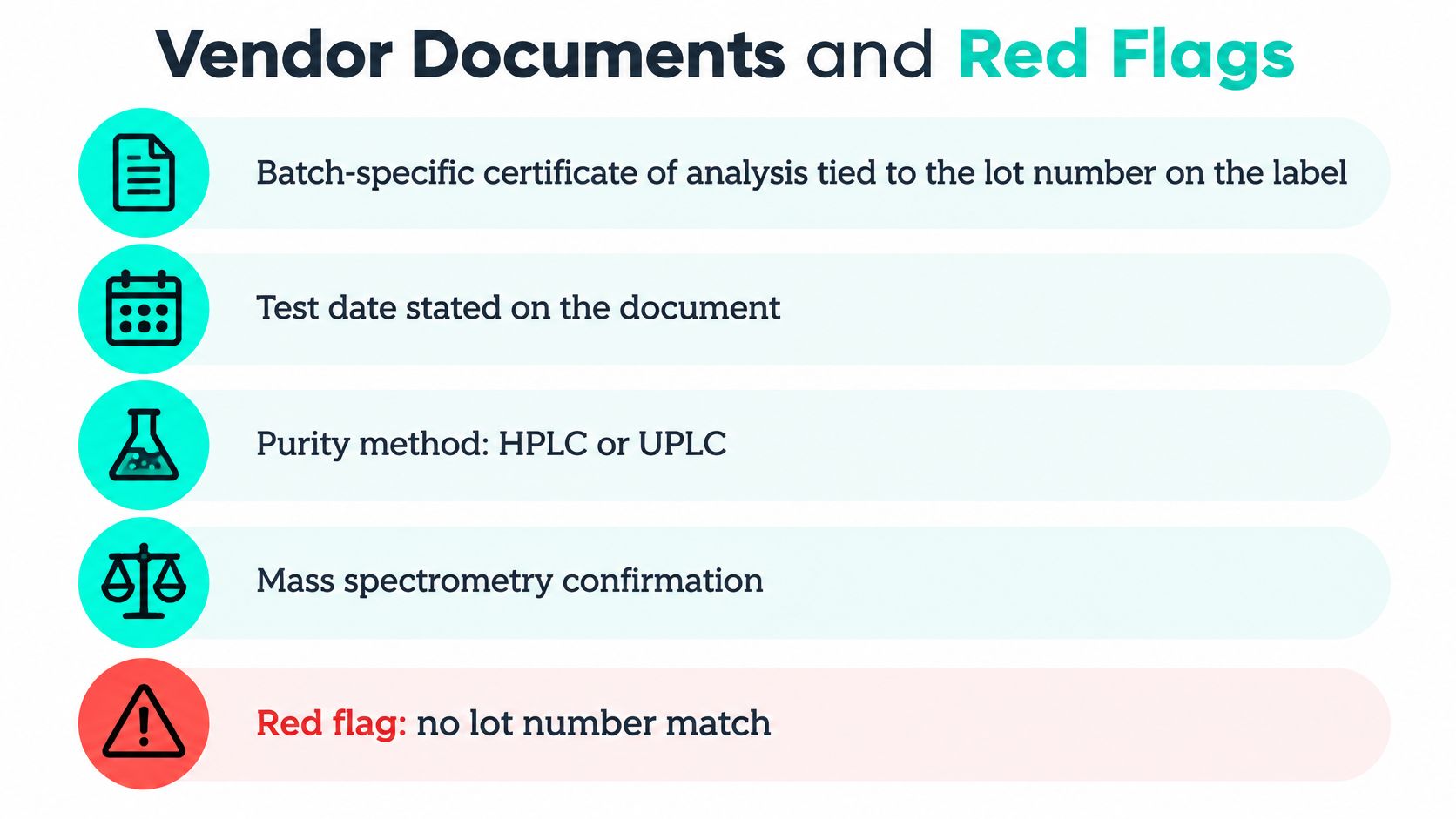
That standard is achievable. Each batch of Celonyx Labs GHK-Cu peptide goes through HPLC, mass-spectrometry identity confirmation, and purity and batch-consistency testing, so the paperwork describes the vial in the box rather than the catalog page. A walkthrough of each item on the certificate list sits in this guide to the peptide certificate of analysis.
A 99% purity claim with no lot number is decoration. So is a generic certificate with no test date, a component list that stops at the total milligram weight, or a blend described only as "80 mg" with no ratio anywhere on the page.
The most expensive red flag is the one that looks like a saving. The cheapest listings in the tracked market are a reason to read the paperwork, not a reason to buy, because nothing in a low price substitutes for a document that verifies what's in the vial. If a certificate covers one component or none, that listing can't be ranked on a verified basis at all.
The rule to apply: a listing below the market's middle band is a question, not a bargain. The answer is a certificate, and the certificate has to name the lot.
One more screen takes ten seconds. All Celonyx Labs peptides are labeled "For Research Use Only," and that labeling is what a laboratory supplier carries. A product page carrying dosing instructions and customer before-and-after photos is selling to a different customer than the one reading this.
Here's the practical walkthrough of what a certificate should contain and how to read one.
Take the two totals a buyer-oriented analysis reports: $100 per vial and $560 for a ten-pack, equivalent to $1.25 and $0.70 per total milligram (KLOW Pharmacy FAQ). On total mass, the ten-pack looks 44 percent cheaper. Run the same two options per component and the comparison changes shape.
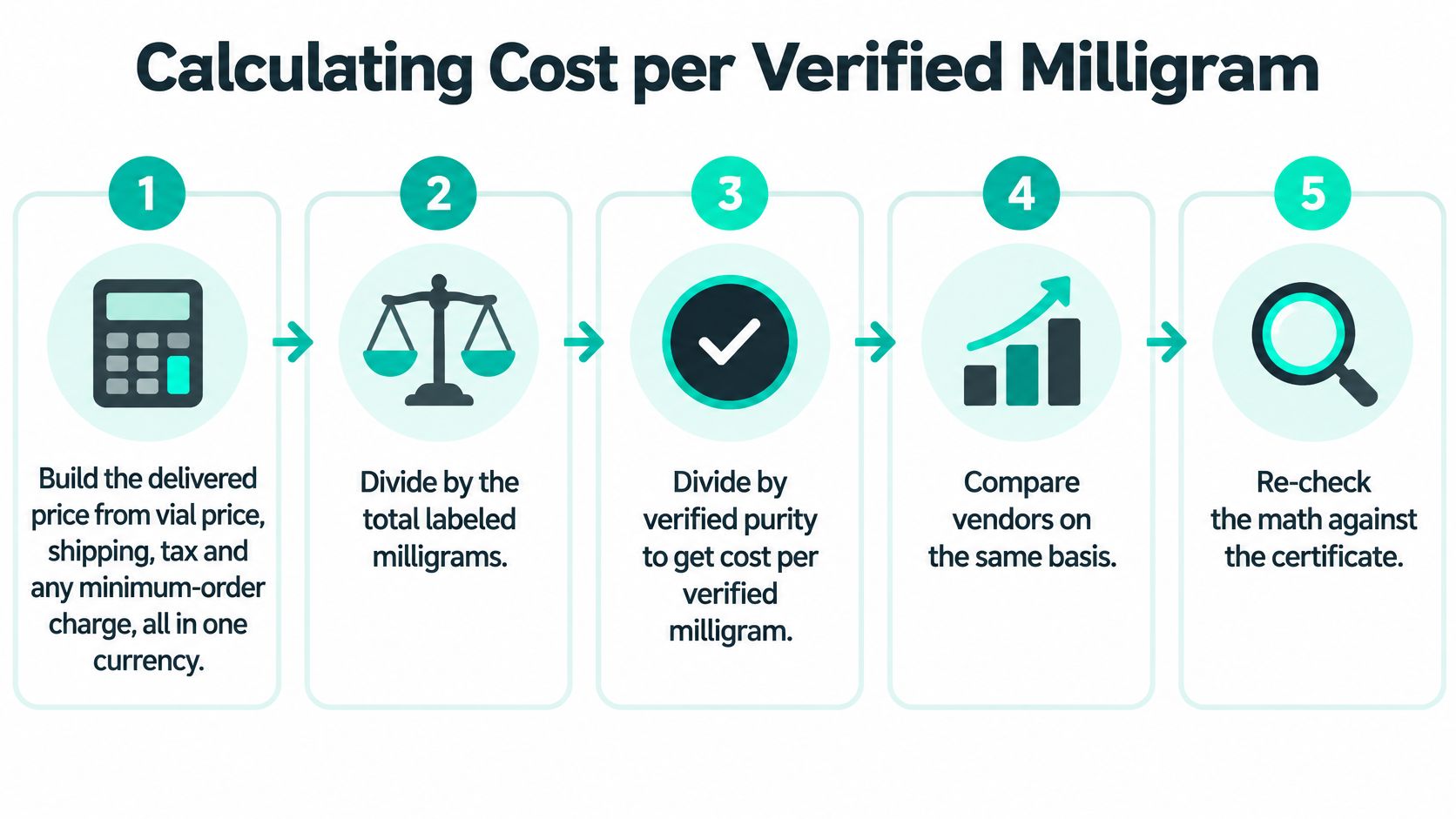
The $560 ten-pack holds 800 mg of blend: 500 mg of GHK-Cu and 100 mg each of BPC-157, TB-500 and KPV. That's $1.12 per milligram of GHK-Cu, but $5.60 per milligram of BPC-157. The single $100 vial runs to $2.00 per milligram of GHK-Cu and $10.00 per milligram of BPC-157.
| Option | Mass by component | Price per total mg | Cost per mg GHK-Cu | Cost per mg BPC-157 |
|---|---|---|---|---|
| Single 80 mg vial at $100 | 50 mg GHK-Cu, 10 mg each other peptide | $1.25 | $2.00 | $10.00 |
| Ten-pack at $560 | 500 mg GHK-Cu, 100 mg each other peptide | $0.70 | $1.12 | $5.60 |
A laboratory that needs 100 mg of BPC-157 buys the ten-pack and receives 500 mg of GHK-Cu it may have no use for. That surplus isn't free; it's the thing the low per-total-milligram rate was hiding.
The contrarian read: a blend can post the lowest cost per total milligram in an entire comparison and still be the most expensive way to buy the single peptide a protocol specifies.
Delivered cost is where the arithmetic ends. Celonyx Labs offers free shipping on all orders, which removes one line from the total but not the others, since vial price, applicable tax and any minimum-order charge still belong in the figure.
Four moves close this out, and each one is a decision rather than a calculation.
Set a maximum delivered price before you open the checkout page, so the decision is made while you're still comparing rather than while you're in a hurry. Recheck the listing on the day you buy, because vendors enter and leave the comparison sets and a quoted price can be a month stale.
Then keep the record. Vendor, lot number, certificate date and delivered cost belong in the same note, filed with the certificate itself. Six months from now, that note is the difference between a purchase you can defend and a number you remember paying.
Celonyx Labs supplies research peptides to laboratories that need the documentation to hold up, with GHK-Cu, BPC-157 and TB-500 available as individual vials for protocols that can't work inside a fixed ratio. Every batch is tested by HPLC with mass-spectrometry identity confirmation, and all products are labeled For Research Use Only. Compare the components you need at Celonyx Labs before you price another blend.
An 80 mg KLOW vial is listed at roughly $119.99 to $165, which works out

Is oxytocin peptide stable at room temperature? Only under validated conditions. Learn how formulation, handling,

Can IGF-1 LR3 be shipped to all 50 states? Verify the exact compound and destination,
FOR RESEARCH USE ONLY. Products sold by Celonyx Labs are intended exclusively for laboratory and scientific research. They are not intended for human or veterinary use, consumption, diagnosis, treatment, cure, or prevention of any disease. By purchasing from this site, you acknowledge that you understand the intended research purpose of these materials and agree to comply with all applicable laws and regulations.