

Customer Support Email Contact for Celonyx Labs (2026 Guide)
Celonyx Labs customer support email is a practical first contact because 62% of customers used
Most buying advice treats a luer lock needle as the automatic upgrade over every other connection type. That advice is incomplete. A threaded connection can improve retention and reduce the chance of disconnection under pressure, yet it can also leave more residual liquid at the syringe and needle interface. For low-volume or expensive research materials, mechanical security and material efficiency are separate questions.
The right choice starts with the workflow, not the product name. Pressure, viscosity, dosing volume, sterility, sample sensitivity, equipment compatibility, and disposal requirements all matter. A luer lock needle is often the sensible option, but it isn't universally the most efficient one.
A luer lock needle is not automatically the better needle. Its threaded collar earns its place when an assembly must remain attached during pressure, repeated handling, or movement. The design builds on the 6% Luer taper, a geometry used across many small-bore medical connectors. Its development traces back to Hermann W. Lüer's syringe design patent in 1897 and Fairleigh S. Dickinson's Luer-Lok patent in 1925. The twist-lock approach remains widely used today, as described in ASRA's overview of ISO 80369-6.
For a nonpressurized transfer between compatible containers, the locking collar can add assembly time without addressing the main failure risk. A luer slip connection may be faster to attach, while a blunt needle can suit reconstitution or liquid transfer where penetration is not required. The decision should follow the procedure, not the appearance of the fitting.
The cost that many selection guides miss is dead space, the liquid remaining in the hub and connector after the plunger reaches its intended position. Standard Luer systems can leave around 90 µL of void volume, while low-dead-space designs can reduce that to about 9 to 25 µL. The same FDA submission describes maximum dead-space limits of 0.015 to 0.02 mL, compared with the 0.07 mL ceiling in ISO 7886-1 for a 1 mL syringe (FDA-cleared low-dead-space syringe submission).
That residual may have little operational effect during a high-volume wash. It matters much more with a peptide solution, a valuable standard, or a small preclinical dose, where recovery, dose confidence, and batch comparability depend on limiting retained liquid. A luer lock can provide better mechanical retention while wasting more material than the procedure can tolerate.
Before specifying threaded hardware, assess five points:
Practical rule: Choose luer lock when the procedure demonstrates a retention requirement, not because a threaded collar appears more professional.
A recurring purchasing error is specifying luer lock for every application, then finding that a selected hub does not mate cleanly with a syringe or automated holder. Another is comparing unit prices while ignoring the liquid retained after each transfer. Check application-specific requirements as well, including sterility, pressure tolerance, device compatibility, and any applicable connector or handling standard. The sound choice controls the dominant risk while limiting residual loss.
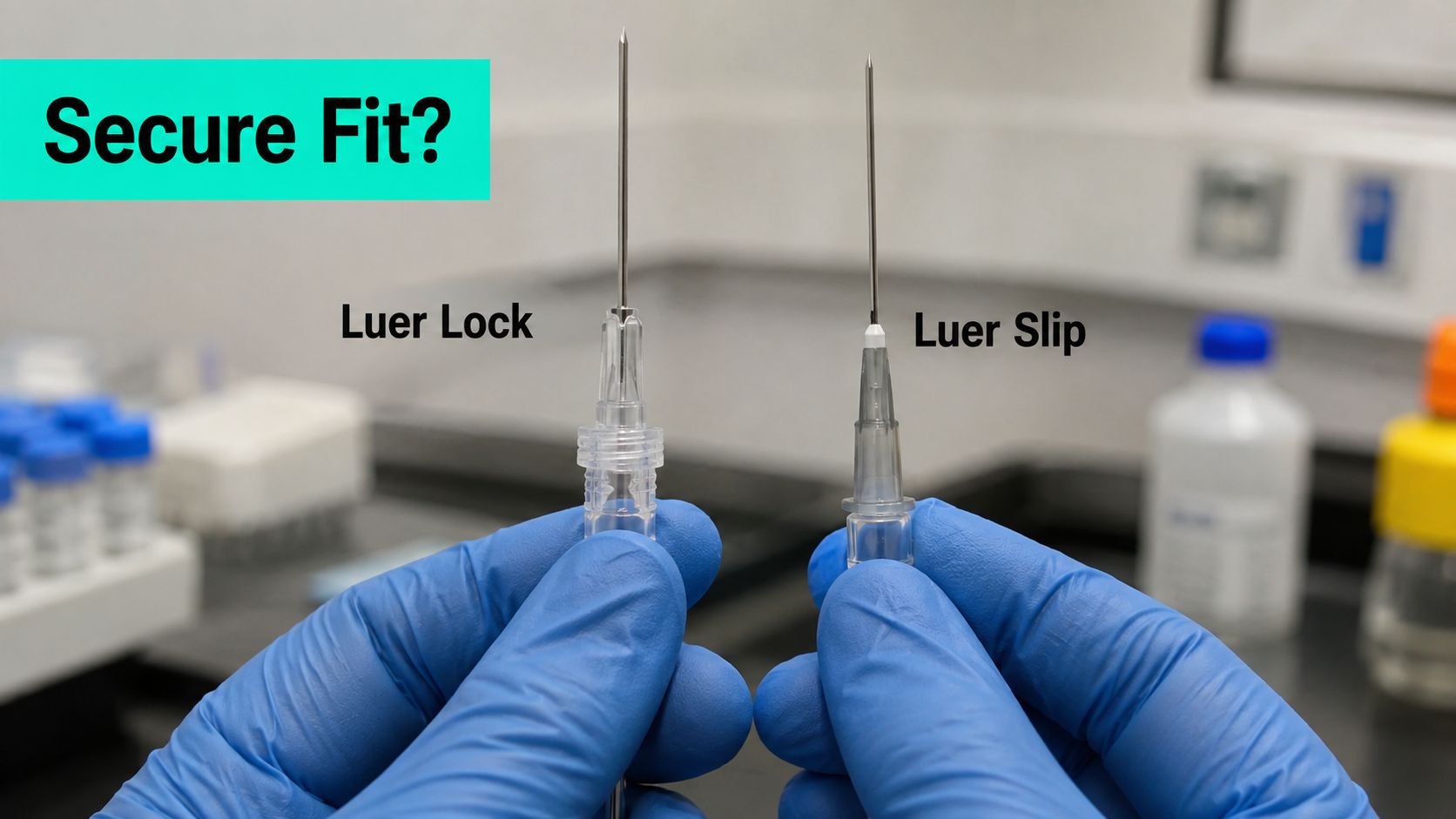
Luer lock, luer slip, and blunt needles share the broader Luer taper family, but they solve different problems. The taper creates the basic mating geometry. The lock adds mechanical retention, while the slip design relies on the tapered fit and operator seating. A blunt needle changes the handling profile at the tip, making it useful for tasks where penetration isn't the objective.
| Feature | Luer Lock | Luer Slip | Blunt |
|---|---|---|---|
| Connection method | Threaded collar secures the tapered fitting | Tapered push-fit connection | Usually supplied with a luer connection, often selected for the blunt tip |
| Main strength | Retention during pressure and handling | Fast attachment for suitable low-pressure work | Safer liquid transfer and reconstitution handling |
| Main limitation | More assembly and potential dead-space burden | More vulnerable to pull-off if poorly seated or heavily stressed | Not designed for routine tissue penetration |
| Useful application | Pressure-sensitive injections, sampling, and repeated manipulation | Quick transfers and compatible low-pressure procedures | Reconstitution, septum access, and controlled liquid movement |
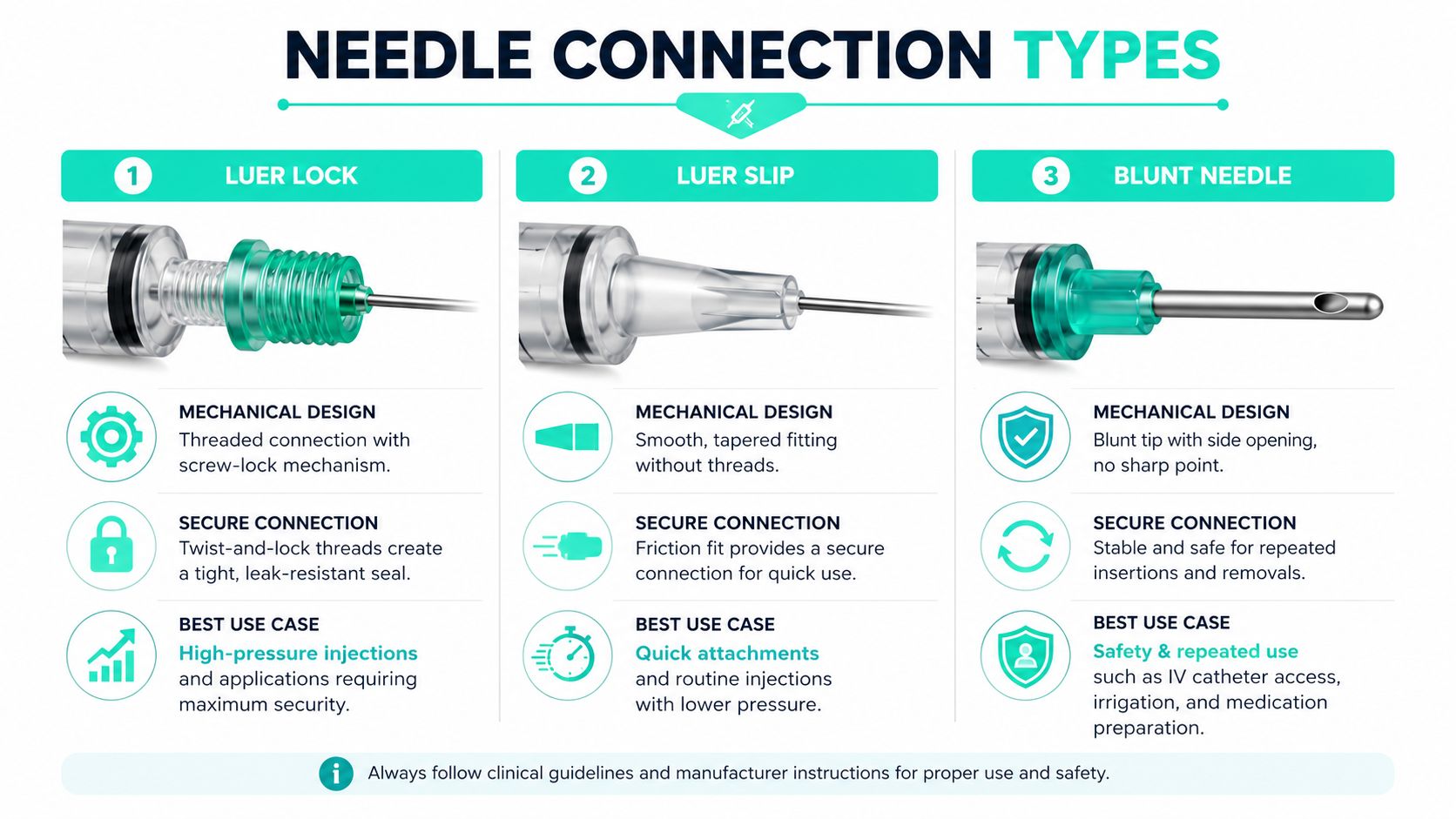
A luer lock needle is the conservative choice when accidental separation would compromise the sample, expose the operator, or interrupt the procedure. The collar should be tightened firmly by hand, but forcing it can damage the fitting or create misleading confidence in a poor connection. The needle still needs a compatible syringe, and threads alone don't correct a mismatched or damaged taper.
The standards framework matters here. ISO 80369-7:2021 covers small-bore Luer connectors used in intravascular and hypodermic healthcare applications, including Luer slip and Luer lock configurations (ISO 80369-7 information). Compatibility should therefore mean more than “the needle fits the syringe.” It should mean that the connector is appropriate for the intended application and meets the relevant dimensional and functional expectations.
Luer slip can make sense for quick, low-pressure work where the operator can maintain control of the assembly and the consequences of separation are limited. It avoids threading and may simplify rapid needle changes. It isn't a substitute for a lock when the procedure involves resistance, forceful injection, or movement that could pull the needle free.
The practical failure mode is poor seating. Operators sometimes push the hub on casually, assume the taper will hold, and then apply pressure that the connection wasn't selected to withstand. If the procedure needs a secure attachment, select luer lock at the start rather than trying to compensate with excessive force.
Blunt needles are valuable for reconstituting powders, accessing suitable vial closures, and transferring liquids where a sharp penetrating tip adds risk without adding useful function. They can also help standardize repetitive preparation tasks, but they don't eliminate the need for aseptic technique or appropriate container compatibility.
The selection question is simple. If the needle must enter tissue, use a purpose-designed sharp needle and follow the applicable institutional procedure. If the job is liquid movement through a septum or container opening, a blunt option may better match the handling risk.
Connection style is only one part of needle selection. Gauge controls the relationship between the needle's wall and internal passage, while length affects access, reach, and handling. A smaller gauge number indicates a thicker needle, so a 16G needle has a larger passage and more substantial structure than a 30G needle. The correct choice depends on flow demand, viscosity, sample sensitivity, and the target site.
A fine needle can support controlled delivery and reduce the physical footprint of an injection, but it may slow the movement of viscous solutions and increase the chance of clogging. A larger-bore needle generally moves thicker liquids more readily, yet it can increase tissue disruption or make delicate handling less forgiving.
Select gauge from the liquid and procedure together:
For short-needle applications, review the guidance on short needles for insulin as a separate selection reference. The useful principle is broader than insulin work: shorter access can improve control when the target depth is limited, but it shouldn't replace a proper assessment of the route and container geometry.
Needle length should reach the intended depth without creating unnecessary mechanical advantage. A needle that is too short may not access the target reliably. One that is too long can complicate positioning, increase bending risk, or make the operator work farther from the connection point.
Container access also matters. A tall vial, deep vessel, or recessed port may require additional reach, while a shallow dish or close bench transfer may be easier with a shorter needle. Test the complete syringe, needle, container, and holder arrangement before committing to a large purchase.
Stainless steel is common because it combines strength with a small, consistent structure, but material selection should follow chemical compatibility and experimental sensitivity. Review the supplier's material specification, surface treatment, adhesive information, and sterilization method when the sample is reactive or particularly sensitive.
Don't treat “stainless steel” as a complete quality description. The hub, adhesive, lubricant, coating, and packaging can all contact the workflow. Ask whether the supplier provides documentation for the finished assembly rather than only for the metal tubing.
A good selection process begins with the material and ends with the connector. Starting with the connector often leads teams to buy a luer lock needle that fits mechanically but performs poorly for the actual experiment.
Low-volume peptide and protein work makes residual loss a first-order procurement concern. A secure connection won't recover liquid trapped in a conventional hub, so compare the dead-space specification before comparing minor differences in packaging or collar design. The FDA submission discussed earlier provides a useful benchmark for how low-dead-space products describe their limits, but each product still requires its own documentation (FDA-cleared low-dead-space syringe submission).
For sensitive materials, check:
Viscosity changes the practical value of a fine gauge. If the operator must apply excessive force, the procedure becomes slower and the risk of leakage or disconnection rises. A larger-bore needle may be the better choice, but validate the effect on dosing precision and sample handling rather than selecting by habit.
Cell work requires attention to shear, contamination control, and repeatability. Use sterile, single-use components when the protocol requires them, and verify that the needle, syringe, and container support the aseptic workflow. A luer lock connection can help when repeated manipulation would otherwise loosen the assembly, but it doesn't replace clean technique or a validated handling method.
Speed matters in repetitive workflows, but speed should be measured across the complete procedure. A luer slip may attach quickly, while a luer lock may reduce interruptions caused by a loose connection. Automated systems add another constraint, because the hub shape, collar profile, length, and force requirements must fit the instrument.
Decision test: Select the configuration that produces the fewest failed transfers, inconsistent doses, and operator interventions, not simply the one with the fastest attachment.
For general work, create a small approved matrix with separate choices for pressure, viscosity, volume, sterility, and automation. That prevents a single “standard needle” from becoming a hidden compromise across unrelated experiments.
Supplier claims start the review, but they do not finish it. A sterile label does not confirm dimensional conformity, dead-space performance, leakage resistance, or fit for a specific workflow. Request records that link the delivered batch to the specification used in your protocol. Residual liquid in the hub or connector can alter low-volume dosing and increase sample loss, so verify the complete assembly rather than the needle alone.
For each approved luer lock needle, retain:
ISO 594-1 and ISO 594-2 were earlier Luer fitting standards, first issued in 1986 and 1991, before relevant small-bore Luer applications moved toward ISO 80369-7 (Luer fitting standards overview). An older reference does not automatically disqualify a supplier. Ask how it applies to the connector, intended use, and current verification plan.
“Independently tested” matters only when the supplier identifies the test, method, product, and batch. A general quality statement should not carry the same weight as a traceable report or certificate tied to the supplied item.
ISO 80369-1:2026 and ISO 80369-7:2021 reflect ongoing work on connector harmonization and misconnection prevention (ISO 80369-1:2026 information). Evaluate compliance against the application, including residual-volume tolerance and handling conditions, rather than checking only for compatible threads.
A luer lock needle should be attached with clean hands or appropriate gloves, using an aseptic setup suited to the protocol. Inspect the package before opening, confirm the gauge and length, and check the hub and needle for visible damage. Seat the needle straight onto the syringe, engage the collar without cross-threading, and tighten it by hand until secure.
Never use the lock as a reason to apply uncontrolled pressure. If resistance rises unexpectedly, stop and identify whether the needle is blocked, the liquid is too viscous, the container is sealed, or the syringe is incompatible with the procedure.
For workflows involving sterile diluents and syringe preparation, use the laboratory's approved procedure and consult the guidance on bacteriostatic water and syringes where relevant. That reference shouldn't replace institutional instructions, product labeling, or an approved aseptic technique.
Dispose of used needles immediately in an approved sharps container. Don't recap unless a documented procedure specifically requires it and provides a safe method. Keep contaminated components out of ordinary waste, and follow your institution's biosafety and environmental requirements.
The lowest unit price rarely represents the lowest operational cost. A cheaper needle can create hidden expense through residual loss, inconsistent fit, repeated failed transfers, emergency reorders, or a documentation gap that delays study approval. Procurement should evaluate the finished assembly and the supplier's ability to support the protocol, not just the needle's gauge and advertised connection.
Create a product scorecard that includes:
The dimensional details behind Luer connectors can be tighter than many buyers expect. ISO 80369-7 describes a male lock fitting length of at least 7.5 mm, a maximum distance of 3.2 mm from the male tip to the first complete thread form, and a female connector lug-base width around 7.0 ± 0.2 mm in the legacy geometry described in the standard material (ISO 80369-7 sample document). Those details matter because a nominally compatible connector can still perform poorly if manufacturing tolerances or semi-rigid materials produce an imperfect fit.
Ask vendors the same technical questions before approving a product. Require a sample evaluation with the actual syringe brands, formulations, containers, and equipment used by the lab. Then document the accepted configuration so researchers don't substitute a visually similar needle during a time-sensitive experiment.
For broader purchasing guidance, review buying syringes and needles alongside your institution's procurement and biosafety requirements. A reliable supply relationship should include clear product descriptions, traceable documentation, and a process for reporting fit or performance issues.
Labs working with research peptides can also evaluate Celonyx Labs as one potential supplier for peptide materials and related product information, while keeping needle qualification and connector validation as separate procurement decisions.
If your lab needs research peptide supplies alongside a disciplined approach to dosing hardware, visit Celonyx Labs to review its catalog, product information, and customer support options. Use the technical criteria above to validate the syringe, luer lock needle, dead-space profile, and handling protocol against your own workflow before ordering.
Celonyx Labs customer support email is a practical first contact because 62% of customers used

Peptide purity testing for CROs in 2026: the HPLC, mass spec, COA, and reference standard

Research peptides for independent researchers: verify CoAs, purity, reconstitution, and storage without institutional backup. Full
FOR RESEARCH USE ONLY. Products sold by Celonyx Labs are intended exclusively for laboratory and scientific research. They are not intended for human or veterinary use, consumption, diagnosis, treatment, cure, or prevention of any disease. By purchasing from this site, you acknowledge that you understand the intended research purpose of these materials and agree to comply with all applicable laws and regulations.