

How to Get Tesamorelin for Research Safely and Legally
A common shortcut says that you can find tesamorelin by searching online and choosing a
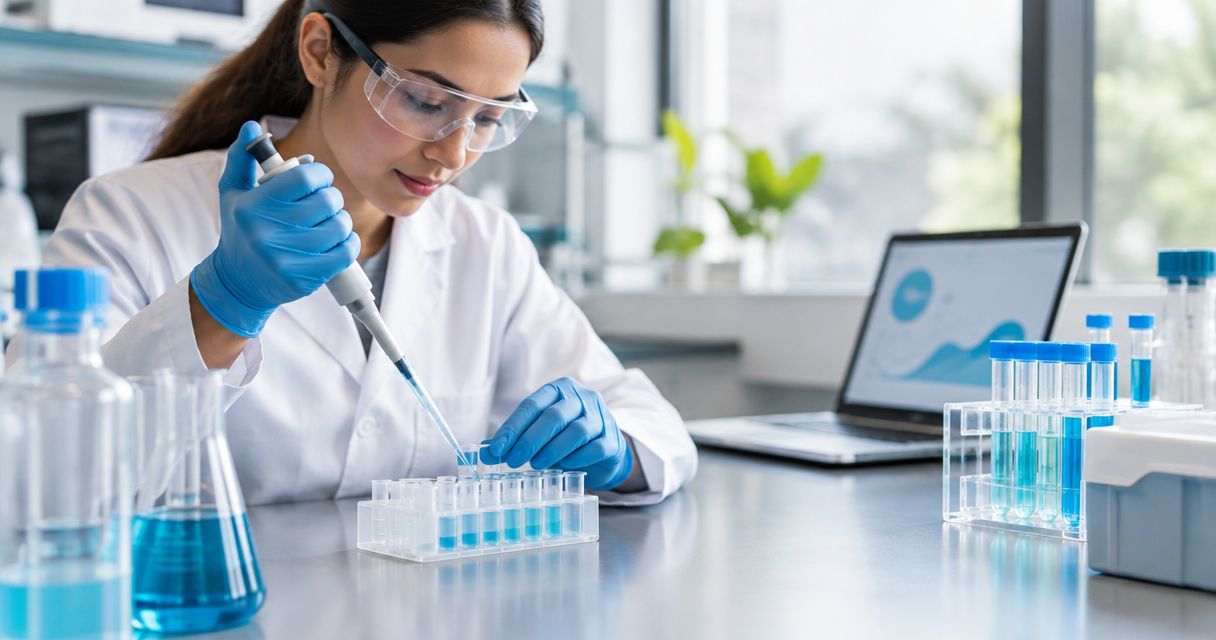
The standard working benchmark for phosphate-buffered saline is 1× PBS at pH 7.4, not an average across laboratories; a conventional formulation contains 137 mM sodium chloride and 2.7 mM potassium chloride. These 2026 PBS concentration benchmarks distinguish working buffer from concentrated stock and explain what you must check before using PBS for cell washing, immunostaining, or peptide experiments.
PBS concentration describes the buffer, not the concentration of your peptide. Confusing those quantities changes the experimental conditions even when you calculate the peptide dilution correctly. A stock labeled 10× requires dilution; a vial labeled with peptide mass requires a separate concentration calculation.
Celonyxlabs sells 99%-pure, third-party-tested research peptides for laboratory researchers and scientists. Those quality signals describe the supplied material, not its behavior in every solvent. For research use only; not for human or veterinary administration.
PBS strength is a multiplier relative to a specified formulation. The overall working reference is 1×; 10× is a preparation stock, not the upper end of an acceptable working range. There is no application-independent concentration range that establishes suitability for every assay.
The table separates the conventional numerical reference from the application checks that determine whether it belongs in your experiment. Application rows are selection guidance, not measured averages of laboratory practice.
| Application or preparation | Concentration reference | Best for | Main advantage | Main limitation or required check |
|---|---|---|---|---|
| Overall working-buffer yardstick | 1× PBS | Comparing a working solution against a defined recipe | Provides a reproducible starting formulation | The multiplier alone does not specify the recipe |
| Routine cell washing when the protocol specifies PBS | 1× PBS | Removing residual medium in a validated wash step | Separates washing from nutrient-containing culture medium | Check calcium, magnesium, and the cell-handling protocol |
| Fixed-sample washing when the staining protocol specifies PBS | 1× PBS | A defined buffer component in staining workflows | Keeps the base-buffer formulation consistent | Detergents and blocking additives require separate specification |
| Peptide assay dilution when PBS compatibility is established | 1× PBS reference | Maintaining the selected buffer conditions during dilution | Makes the final buffer composition explicit | Does not establish peptide solubility, stability, or assay compatibility |
| Concentrated stock preparation | 10× PBS | Preparing working buffer by dilution | Reduces the volume of stock handled | Must be diluted before a protocol calling for 1× PBS |
The highest multiplier here is 10× stock; the working rows use the 1× reference. Neither is a performance winner: 10× serves preparation, while 1× serves protocols that specify conventional working-strength PBS.
The numerical reference follows the conventional recipe published in Cold Spring Harbor Protocols, Phosphate-buffered saline (PBS), 2006; its scope is buffer preparation, not comparative assay outcomes. The application guidance in this 2026 guide does not establish an optimum for a particular cell line, peptide, or analytical method.
For composition comparisons, the benchmark is the concentration of each ingredient in the final solution. A commonly published PBS recipe contains 137 mM NaCl, 2.7 mM KCl, 10 mM Na₂HPO₄, and 1.8 mM KH₂PO₄, adjusted to pH 7.4.
The phosphate entries identify salts used in the recipe. After dissolution and pH adjustment, phosphate species equilibrate; those recipe entries are not independent measurements of the final acid–base species.
| Ingredient or property | Overall reference: 1× working PBS | Corresponding 10× stock calculation | Interpretation |
|---|---|---|---|
| Sodium chloride, NaCl | 137 mM | 1,370 mM | Major contributor to salt concentration |
| Potassium chloride, KCl | 2.7 mM | 27 mM | Additional electrolyte component |
| Disodium hydrogen phosphate, Na₂HPO₄ | 10 mM | 100 mM | Phosphate salt in the preparation recipe |
| Potassium dihydrogen phosphate, KH₂PO₄ | 1.8 mM | 18 mM | Phosphate salt in the preparation recipe |
| Target pH | 7.4 | Verify after preparing working buffer | pH is not multiplied by stock strength |
Sodium chloride has the largest ingredient concentration at 137 mM; potassium dihydrogen phosphate has the smallest at 1.8 mM. These are composition differences, not rankings of importance. Omitting a lower-concentration ingredient still changes the formulation.
Source: Cold Spring Harbor Protocols, Phosphate-buffered saline (PBS), 2006, conventional preparation recipe. The 10× column is calculated by multiplying each listed ingredient concentration by ten; it is not an independently measured dataset, and other published PBS formulations differ.
A multiplier only makes sense alongside its reference formula. Two bottles labeled 1× PBS can differ in phosphate concentration, pH specification, or calcium and magnesium content. Compare the formulation documents, not just the front labels.
For your 2026 laboratory records, capture the manufacturer or recipe, product identifier where applicable, lot, and final working composition. That gives another researcher enough information to distinguish a formulation change from a sample effect. The PBS buffer preparation kits guide provides a related starting point for evaluating preparation options.
Use the PBS formulation specified by your cell-handling method. A wash step and a cell-culture step have different purposes; PBS does not replace a complete culture medium simply because its salts are familiar.
Calcium and magnesium deserve explicit attention. Their presence affects processes involving divalent ions, so record whether your formulation includes them rather than treating all PBS as interchangeable. The benefit of PBS is a defined wash environment; the limitation is that the same environment is not suitable for every handling step.
Distinguish PBS from PBS containing detergent or blocking components. An immunostaining method that specifies PBS with an additive has specified more than buffer strength. Plain 1× PBS does not reproduce that condition.
Keep the base formulation constant when evaluating a staining change. Record additives separately, including their final concentrations from the validated method. This makes a result interpretable without claiming that one universal PBS recipe gives the best staining.
Use PBS as a peptide diluent only when the peptide and assay method support it. A physiological-style salt environment is not proof that a particular peptide dissolves or remains stable in that environment.
PBS offers defined ionic conditions, but its salts and phosphate can conflict with specific analytical or biochemical requirements. Separate initial dissolution from final assay dilution: the solvent that dissolves the starting material need not be the buffer used in the assay. Celonyxlabs research peptide purity and buffer compatibility are separate questions.
Treat 10× PBS as an input to preparation, not a default exposure condition. Its advantage is concentrated storage and handling. Its limitation is that a dilution error changes every ingredient represented by the multiplier.
Check the stock identity before calculating. A different stock factor requires a different volume, and a concentrate with additives introduces those additives into the final preparation. Arithmetic cannot correct the choice of an incompatible formulation.
Use the following sequence when selecting PBS for a 2026 experiment. The decision starts with the method and ends with the final mixture—not with whichever bottle is closest to the bench.
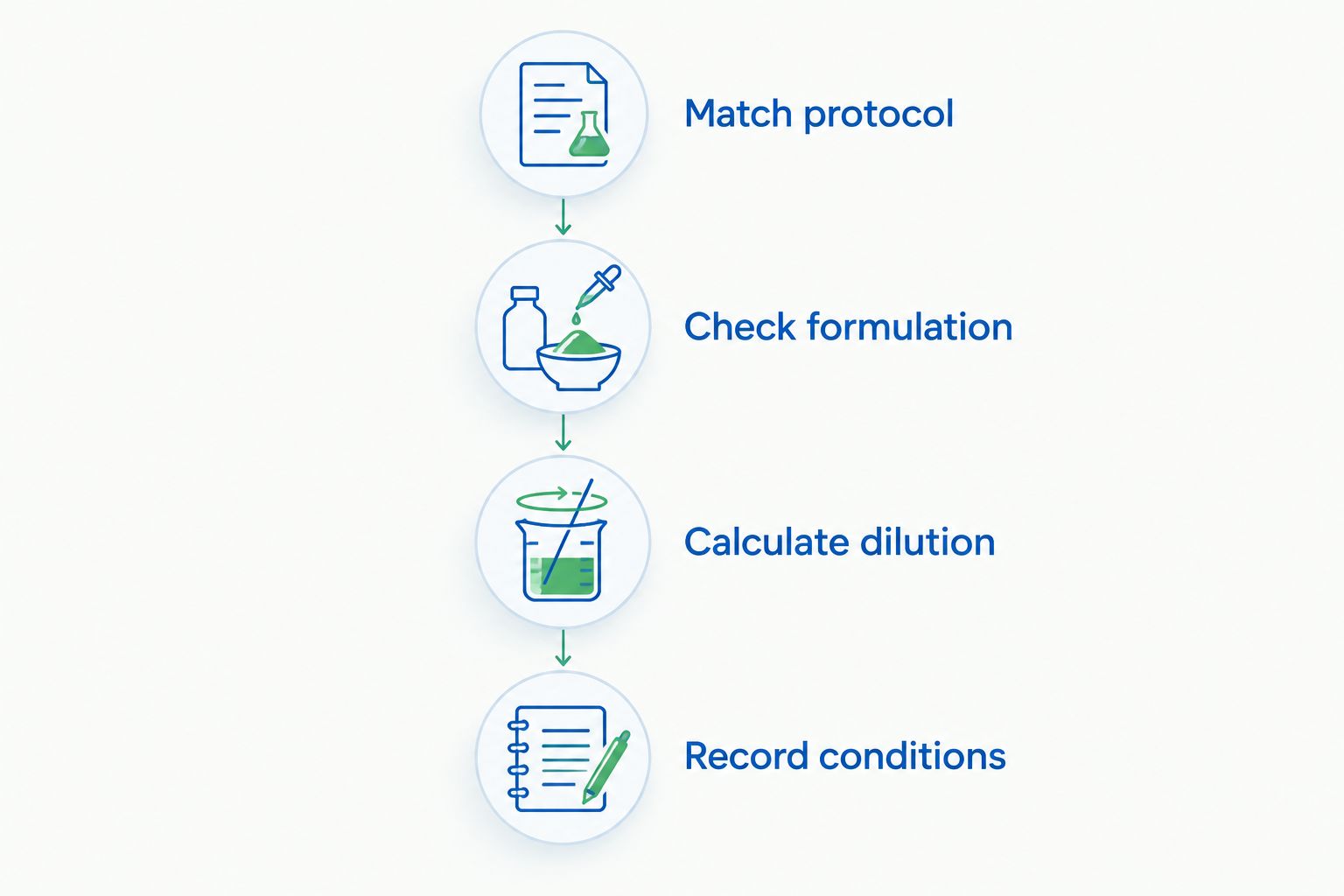
A clear notebook entry is more useful than an isolated statement that you used PBS. Record what entered the final mixture and which protocol justified it. That preserves the distinction between a reference benchmark and an experimentally validated condition.
Calculate concentration against final volume, not the volume of water added. The dilution relationship is C₁V₁ = C₂V₂, where the first concentration and volume describe the stock and the second pair describe the completed mixture.
For a preparation-only example, making 100 mL of 1× PBS from 10× stock requires 10 mL of stock, followed by water to a final volume of 100 mL. This follows directly from the dilution equation; it is not a peptide-specific preparation recommendation.
Adding 100 mL of water to that 10 mL stock portion instead produces 110 mL total and approximately 0.91× PBS. The difference comes from the denominator. Your stock amount is unchanged, but the final volume is larger than intended.
If several inputs contain PBS, each contributes to the final buffer strength. A peptide stock already prepared in PBS is not equivalent to a stock prepared in water when you calculate the final mixture.
Record the contribution from each input before adding concentrated buffer. This avoids treating the sample solvent as chemically invisible. For a 2026 assay worksheet, keep separate fields for final PBS strength, final peptide concentration, and any other solvent or additive.
A correct PBS concentration does not demonstrate sterility, peptide identity, or peptide stability. Those questions require their own specifications and evidence. A pH reading cannot substitute for a sterility assessment, and a purity result cannot establish solvent compatibility.
Celonyxlabs is a research-peptide supplier for laboratory researchers and scientists. Its stated 99% purity and third-party testing are product quality signals; they do not turn a general PBS benchmark into a validated peptide preparation method.
For your experiment, distinguish these checks:
The benefit of this separation is interpretability. The limitation of any single quality signal is its scope: it answers one question, not all four.
What are the standard PBS concentration benchmarks in 2026?
The conventional working reference is 1× PBS, with one widely published recipe containing 137 mM NaCl, 2.7 mM KCl, 10 mM Na₂HPO₄, and 1.8 mM KH₂PO₄ at pH 7.4. This is a formulation reference, not an average across laboratories or a universal assay optimum.
Is 10× PBS better than 1× PBS for laboratory experiments?
No; 10× PBS is concentrated stock, while 1× PBS is the working reference for methods specifying that formulation. A higher multiplier does not establish better experimental performance.
How do I dilute 10× PBS to 1× PBS?
Use one volume of 10× stock in ten volumes of final solution. For example, use 10 mL of stock and bring the total volume to 100 mL, accounting for any other PBS-containing inputs.
Does 1× PBS always have exactly the same composition?
No; 1× identifies strength relative to a particular formulation. Check the recipe, pH, calcium, magnesium, and additives before treating two preparations as equivalent.
Can I use PBS to dissolve any research peptide?
No; PBS compatibility must be established for the specific peptide and experimental method. Initial dissolution and final assay dilution are separate decisions, and purity does not establish solubility.
Is PBS with calcium and magnesium interchangeable with PBS without them?
No; calcium and magnesium change the formulation and can affect experimental processes involving divalent ions. Use the version specified by the cell-handling or assay protocol.
Does correctly prepared PBS guarantee a sterile peptide solution?
No; correct buffer concentration does not demonstrate sterility. Preparation controls and appropriate testing address contamination separately from composition and peptide purity.
The most useful PBS benchmark is the composition of your final experimental mixture. A correctly labeled stock still produces the wrong conditions when you overlook another buffer-containing input or calculate against water volume instead of final volume.
Make that your 2026 documentation rule: record the final buffer strength beside the final peptide concentration. These materials and preparation discussions are for research use only, not for human or veterinary administration.
A common shortcut says that you can find tesamorelin by searching online and choosing a
Choose the best KPV peptide by research model. Compare identity, purity, endotoxin documentation, and vehicle

Choose full-length thymosin beta-4 peptide for native-molecule research. Compare fragments and reference standards, then check
FOR RESEARCH USE ONLY. Products sold by Celonyx Labs are intended exclusively for laboratory and scientific research. They are not intended for human or veterinary use, consumption, diagnosis, treatment, cure, or prevention of any disease. By purchasing from this site, you acknowledge that you understand the intended research purpose of these materials and agree to comply with all applicable laws and regulations.