
Peptide Purity Testing for CROs: 2026 Verdict
Peptide purity testing for CROs in 2026: the HPLC, mass spec, COA, and reference standard
You're probably in one of two places right now. Either you're building a protocol and need to decide whether tesamorelin, ipamorelin, or both belong in the design, or you're further downstream and trying to decide whether a vendor's vial matches the biology your assay assumes.
That decision looks simple on supplier pages. It isn't simple in the literature. Tesamorelin and ipamorelin both sit in the growth hormone secretagogue conversation, but they don't arrive with the same depth of human evidence, the same regulatory status, or the same practical confidence for translational work. That asymmetry is the issue. Most comparison pages flatten it.
For a research team, the useful question isn't “what are these peptides?” It's narrower and more operational. Which compound has evidence that travels well into your study model, and where are you being asked to substitute theory for data? Once you frame it that way, tesamorelin and ipamorelin stop looking like interchangeable GH-axis tools.
The comparison has become common because both peptides are used to probe adjacent parts of the same endocrine system, yet they answer different research questions. Tesamorelin belongs to the GHRH analog side of the axis. Ipamorelin belongs to the ghrelin-receptor agonist side. That sounds like a tidy pairing, and in concept it is.
The trouble starts when researchers treat the pairing as if the evidence base is equally mature. It isn't. Tesamorelin enters current research planning with a documented clinical and regulatory history in a defined human indication. Ipamorelin enters with selective receptor logic, recurring interest in GH-pulse research, and a far thinner published human efficacy record.
If you're designing an in vivo adiposity model, a hepatic lipid experiment, or a translational protocol that needs a human anchor, tesamorelin gives you one. If you're building a mechanistic study around secretagogue selectivity or trying to isolate ghrelin-receptor signaling, ipamorelin may still be attractive, but you're leaning more heavily on mechanistic plausibility and less on comparator-grade human outcomes.
That matters because procurement, assay selection, and endpoint choice all change when the evidence layer gets thinner.
Practical rule: The weaker the human literature, the more your lab has to compensate with stronger incoming QC, tighter method reporting, and more conservative claims about translatability.
A lot of current interest centers on whether a tesamorelin and ipamorelin combination does anything meaningfully different from tesamorelin alone. The appeal is obvious. One peptide stimulates the GH axis through GHRH-receptor signaling, the other through GHS-R1a signaling. Researchers naturally ask whether combining them creates additive pulsatility, broader downstream effects, or just overlapping endocrine stimulation.
The gap is that the combination itself has no published human randomized trial, cohort study, or open-label study testing efficacy or safety as a stack, according to the summary at PeptideVox on the ipamorelin and tesamorelin stack. That leaves a lot of online certainty unsupported.
For most preclinical teams, that means a simple decision rule makes sense. If your primary question is clinically anchored body composition, start with tesamorelin alone. If your primary question is receptor-pathway exploration, ipamorelin may justify inclusion. If you want to test the combination, design it as an exploratory arm rather than assuming synergy up front.
Before looking at outcomes, put the molecules side by side. Their overlap is functional, not structural.
| Attribute | Tesamorelin | Ipamorelin |
|---|---|---|
| Molecular class | Synthetic GHRH analog | Selective ghrelin receptor agonist |
| Primary receptor target | GHRH receptor on somatotrophs | GHS-R1a |
| Peptide length | Larger peptide analog | Short pentapeptide |
| Native ligand relationship | Mimics growth hormone-releasing hormone signaling | Mimics ghrelin-like secretagogue signaling |
| Main downstream logic | Drives pulsatile GH release via GHRH pathway, with secondary IGF-1 elevation | Triggers GH release through a distinct secretagogue pathway |
Tesamorelin is a 44-amino-acid synthetic analogue of growth hormone-releasing hormone with a modification intended to improve resistance to enzymatic degradation. In practical terms, researchers usually treat it as a more durable GHRH-pathway tool than native hormone signaling alone would allow. If you want a product-page reference for formulation context while cross-checking literature, Novagenesis Biopharma Tesamorelin is one example of how suppliers describe the compound for research audiences. For a more technical overview of pathway-level context, Celonyx Labs' tesamorelin peptide science page is also relevant.
Ipamorelin acts differently enough that “both raise GH” is an incomplete description. It is a selective GHS-R1a agonist, which means it reaches the somatotroph system through the secretagogue receptor rather than the GHRH receptor. That's useful when you want cleaner separation between pathway inputs.
Mechanistically, that creates two very different experimental propositions:
If your endpoint depends on proving a specific receptor route, these peptides are not substitutes for each other. They are separate probes into related biology.
Researchers often over-focus on the shared GH-axis outcome and under-focus on the consequences for assay design. Tesamorelin's larger peptide architecture, receptor specificity, and clinical history encourage studies built around downstream metabolic markers. Ipamorelin's shorter sequence and receptor profile encourage studies that are often more sensitive to timing, pulsatility, and handling variables.
That doesn't make one “stronger” in a general sense. It makes them fit different experimental logic. Most bad peptide selection starts when a team chooses on marketing language instead of mechanism.
The most important difference between tesamorelin and ipamorelin isn't theoretical pharmacology. It's the depth of human evidence.
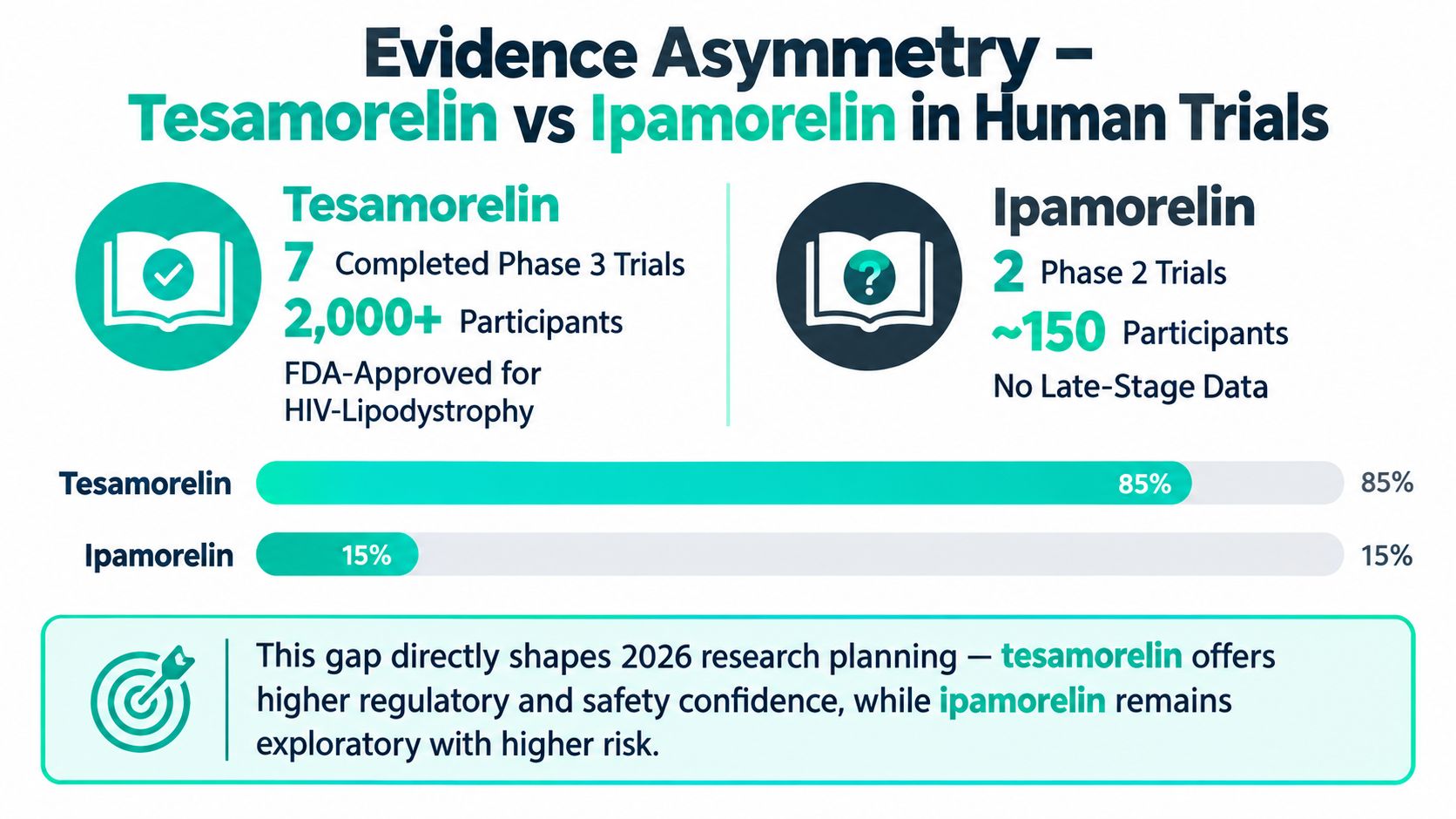
Tesamorelin was approved by the U.S. Food and Drug Administration in November 2010 for HIV-associated lipodystrophy, following Phase 3 evidence showing statistically significant reductions in visceral adipose tissue after treatment, as summarized in the pooled clinical analysis on PubMed.
A separate review of the Phase III program notes that one widely cited multicenter study recruited patients from 43 sites across the United States and Canada, enrolled more than 325 participants who completed the trial, and found that daily tesamorelin reduced deep abdominal fat measured by CT scan with about a 20% difference versus placebo over six months, according to the review in PMC.
The strongest benchmark for body-composition work is even more specific. In a pooled analysis of 806 antiretroviral-treated HIV patients with excess abdominal fat, 2 mg daily subcutaneous tesamorelin for 26 weeks reduced visceral adipose tissue by 15.4% versus placebo, while preserving abdominal subcutaneous fat, as described in the NCBI Bookshelf monograph.
Ipamorelin's human record is much thinner. The published clinical record described at Peptpedia's ipamorelin entry includes a pharmacokinetic and pharmacodynamic volunteer study plus a Phase II postoperative ileus trial that was discontinued without approval. It reports no published efficacy trials for growth-hormone deficiency, body composition, or anti-aging.
That single fact changes how a careful lab should think.
The quality-control risk usually concentrates where the literature is thinnest. When the clinical benchmark is weak, teams start relying more on supplier analytics, inferred dosing logic, and anecdotal expectations.
For protocol planning, that means tesamorelin supports a translational argument in ways ipamorelin currently doesn't. Ipamorelin can still be a valid research tool. It just asks more from your experimental design and your incoming material verification.
A lot of dosing discussion around tesamorelin and ipamorelin gets recycled from vendor sheets, forums, or mixed-species assumptions. That's a problem because route, timing, and endpoint choice can change the apparent effect as much as the nominal dose.
| Parameter | Tesamorelin | Ipamorelin |
|---|---|---|
| Common preclinical use pattern | Metabolic and body-composition oriented models | GH-release and recovery-oriented models |
| Reported dosing range in preclinical discussions | Often reported in lower subcutaneous daily ranges | Often reported across broader intraperitoneal or subcutaneous ranges |
| Route sensitivity | Route consistency matters because downstream metabolic endpoints are slower and cumulative | Route and timing matter because pulsatile endocrine readouts can shift quickly |
| Frequency concern | Daily schedules are often favored in translationally framed work | Frequency can become a bigger design variable in GH-pulse studies |
| Cross-study comparability | Limited by endpoint variation and model differences | Limited by endpoint variation and sparse head-to-head work |
The key point isn't a universal number. It's that dose comparisons across these peptides are often misleading because researchers are not measuring the same thing. Tesamorelin studies tend to care about visceral adiposity, lipid handling, or downstream metabolic effects. Ipamorelin work often tracks secretagogue-linked endocrine behavior or recovery-related physiology.
Record these variables before you finalize your methods:
There's very little value in saying one peptide was used “at a similar dose” to another if the measured endpoint differs. A nominally lower tesamorelin dose in a long metabolic study may tell you more than a higher ipamorelin dose in a short endocrine challenge. Without matched endpoints, matched matrices, and matched timing, dose equivalence is mostly noise.
A good preclinical design compares peptides through the assay question, not through the milligram label.
For teams considering a combination arm, this becomes even more important. If the stack changes pulse shape rather than absolute downstream marker levels, your design has to be able to see that. Many standard metabolic readouts won't.
Most peptide failures don't look dramatic. They show up as noisy assays, drift between lots, or a result that disappears when another lab tries to repeat it. With tesamorelin and ipamorelin, handling and analytical documentation deserve as much scrutiny as mechanism.
A lyophilized vial can arrive looking fine and still perform poorly if storage history is vague. Teams should treat frozen storage, moisture control, and freeze-thaw exposure as lot-level variables, not routine afterthoughts. Repeated temperature abuse can distort dosing accuracy long before a vial shows visible degradation.
Reconstitution also isn't just a convenience step. Solvent choice can influence peptide stability, adsorption, and assay compatibility. The practical question is not “what dissolves it?” but “what preserves the material without interfering with the endpoint you're measuring?”
A supplier's Certificate of Analysis matters, but a line that says “high purity” isn't enough. Ask for the underlying analytical package and examine whether the documentation is useful.
Tesamorelin studies are often judged by downstream measures such as IGF-1-linked or body-composition-related signals. If peptide content is overstated or degradation is uneven, you may think the biology is weak when the issue is underdosing.
Ipamorelin brings a different vulnerability. Studies built around pulsatile GH measurement or acute secretagogue effects are highly exposed to inconsistency in purity, handling, and lot identity. Small analytical problems can flatten a pulse-driven readout fast.
If a vendor can't provide clear lot-specific HPLC and MS support, don't assume the missing paperwork is administrative. It may be the experiment.
The cleanest way to choose between tesamorelin and ipamorelin is to start with the endpoint, not the hype around “GH support.”
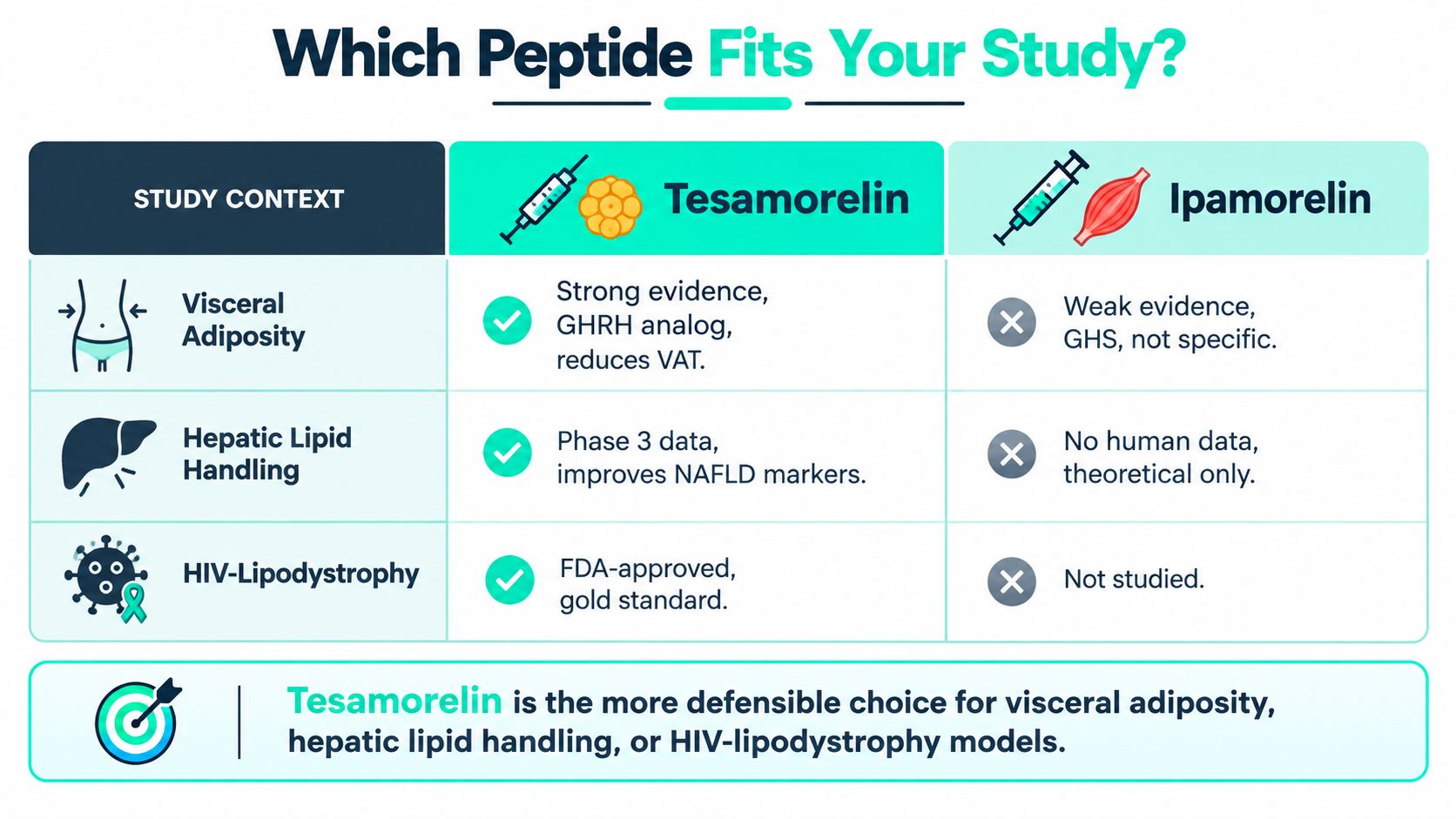
Choose tesamorelin first when the study question involves visceral adiposity, abdominal fat distribution, or a model meant to echo the HIV-lipodystrophy literature. It has the strongest indication-specific human benchmark of the pair, and that matters when you need a mechanistic argument that can survive peer review.
It also fits better when your design depends on a translational chain from receptor logic to published body-composition outcomes. In that setting, tesamorelin is not just another secretagogue. It's the peptide with a documented clinical precedent.
Ipamorelin becomes more useful when the experiment is centered on GHS-R1a signaling, GH-axis pulsatility, or exploratory models where secretagogue selectivity is the main reason to include the peptide. If your assay is trying to isolate a ghrelin-receptor input, tesamorelin would introduce the wrong biology.
That doesn't make ipamorelin the stronger candidate overall. It means it's the more coherent candidate for a narrower class of questions.
A tesamorelin and ipamorelin stack is still an exploratory choice. The absence of direct published human combination data means the combination should be treated as a hypothesis, not a default upgrade.
Use a combination arm if:
Avoid making the stack your main efficacy design if you can't explain what added question it answers beyond “more GH-axis stimulation.”
For teams screening options, a catalog page like Celonyx Labs' ipamorelin tesamorelin blend overview can be useful as a procurement reference point, but the scientific justification still has to come from your endpoint and control structure.
By the time you're reviewing vendors, the scientific question should already be fixed. Procurement doesn't rescue a weak design. It does determine whether a good design has a chance to work.
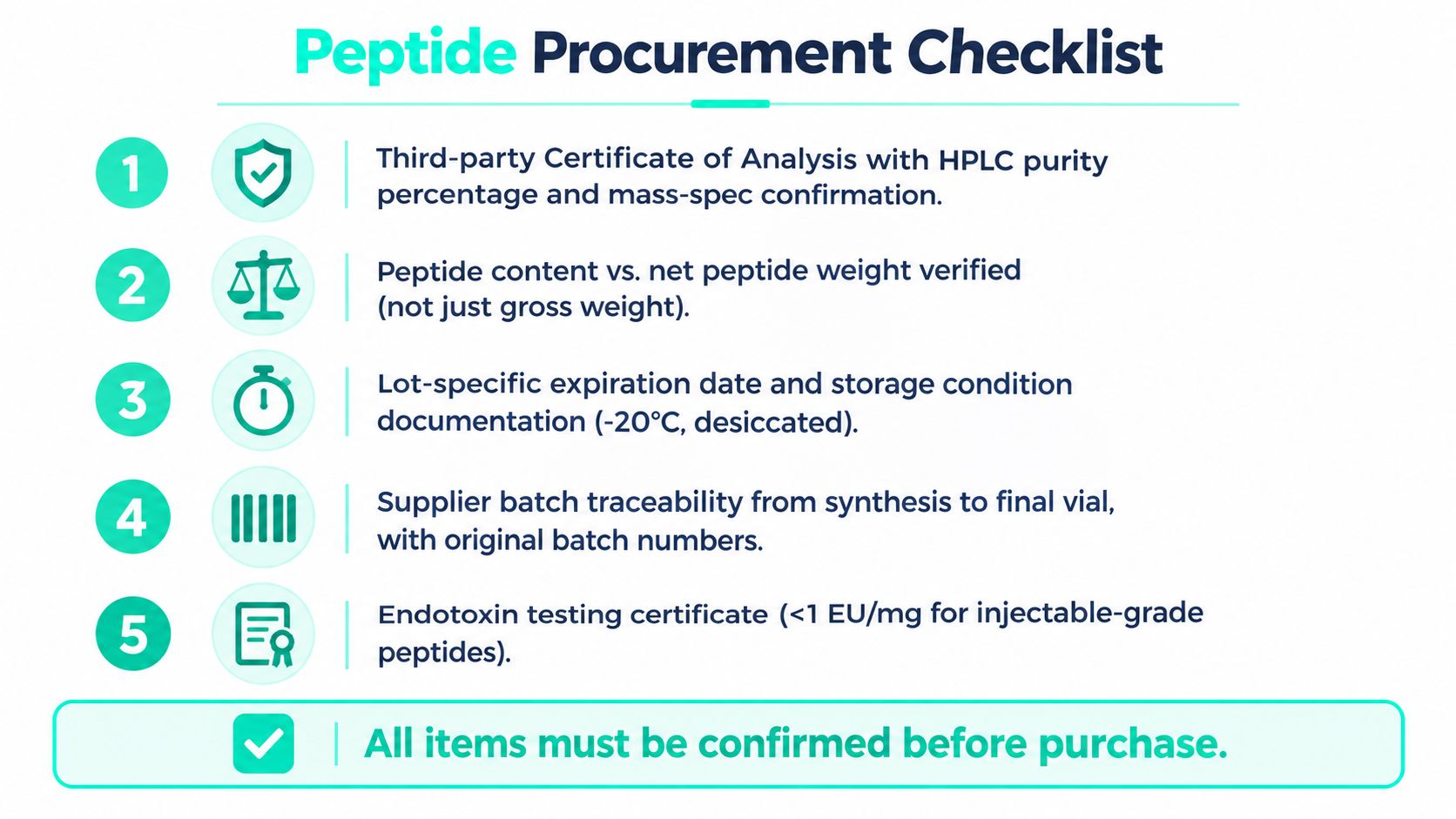
Use a checklist that maps directly to failure modes:
Lot-specific analytical proof
Ask for third-party CoA support with HPLC purity reporting and mass-spec confirmation. If the lot number on the vial and the documents don't match cleanly, stop there.
Real peptide content
Gross vial weight can hide the amount of active peptide you're getting. For dose planning and cost comparison, net peptide content matters more than front-label milligrams.
Shelf-life and shipping history
A peptide that sat too long under unclear conditions can still look acceptable on arrival. Require lyophilization date, expiry, and storage guidance specific to the lot.
Endotoxin suitability for in vivo work
If the material is headed into animals, endotoxin documentation should be part of pre-purchase review, not something you remember after a noisy pilot.
Batch traceability
Traceability should run from synthesis to final vial. A useful reference for building an internal purchasing SOP is Celonyx Labs' vendor qualification process.
Some warning signs are mundane but costly:
A cheap vial becomes expensive when the first failed cohort forces a repeat study.
Tesamorelin and ipamorelin don't pose identical purchasing risks. With tesamorelin, content accuracy and stability are central because translational users often care about sustained downstream metabolic effects. With ipamorelin, acute-response studies can be derailed by lot inconsistency that wouldn't be obvious in a slower assay.
The practical result is simple. Don't use the same intake checklist for every peptide just because both products sit under a “GH peptides” category.
The most interesting part of the tesamorelin and ipamorelin comparison is also the least settled. Researchers can explain why the combination might work differently from either agent alone, but that isn't the same as showing that it does.
The best current summaries describe the blend as a concept built largely by extrapolation from each peptide in isolation, not from direct combined-study evidence. That's a meaningful gap because additive signaling is not guaranteed. You may get stronger GH-axis effects. You may get overlapping downstream output with little practical gain. You may also get a signal that depends entirely on timing and endpoint selection.
A useful research agenda would include:
Regulatory clarity is also uneven. Tesamorelin remains the only peptide of the pair described as FDA-approved for HIV-associated abdominal fat reduction, while ipamorelin is not FDA-approved and its human evidence remains preliminary or inconclusive, as summarized in the review comparing sermorelin, tesamorelin, and ipamorelin.
That difference affects how teams should think about sourcing language, import paperwork, and internal labeling. Research-grade lyophilized peptide, pharmacy-compounded product, and approved therapeutic product are not interchangeable categories.
If you're planning a serious program, keep the sequence disciplined. First validate each peptide as its own research tool under your conditions. Then test the combination with predeclared comparator arms and endpoints capable of detecting more than a generic secretagogue effect.
That's slower than ordering a blend and hoping receptor complementarity translates into synergy. It's also the approach most likely to produce data you can defend.
Celonyx Labs supplies research peptides for laboratory use, including compounds and blend categories relevant to tesamorelin and ipamorelin workflows, with catalog access, ordering support, and published quality-process information that can help during early vendor screening. If you're comparing procurement options for a GH-axis study, visit Celonyx Labs and evaluate its documentation alongside your own assay requirements, lot-verification standards, and study design priorities.
Peptide purity testing for CROs in 2026: the HPLC, mass spec, COA, and reference standard

Research peptides for independent researchers: verify CoAs, purity, reconstitution, and storage without institutional backup. Full

Peptide storage for core facilities in 2026: temperature zones, access control, and documentation for multi-PI
FOR RESEARCH USE ONLY. Products sold by Celonyx Labs are intended exclusively for laboratory and scientific research. They are not intended for human or veterinary use, consumption, diagnosis, treatment, cure, or prevention of any disease. By purchasing from this site, you acknowledge that you understand the intended research purpose of these materials and agree to comply with all applicable laws and regulations.