
Eonpeptides.com alternatives in 2026
Compare eonpeptides.com alternatives for laboratory research. Choose Celonyx Labs for 99%-pure, third-party-tested peptides, then verify
You're on residue 18 of a 24-mer, the Kaiser test is still faintly blue, and you've already burned a second coupling. Do you throw more expensive amino acid at it, cap and move on, or stop and find out what's on the resin? That's where solid phase peptide synthesis, a practical approach earns its name. The cycle itself is simple. Reading the failure early, and knowing what purification will cost you if you don't, is the skill.
What's your C-terminus? Answer that first, because it locks your resin, your linker, and your cleavage conditions. A C-terminal acid (COOH) needs Wang or 2-chlorotrityl resin. A C-terminal amide (CONH2) needs Rink amide or Sieber amide. Pick wrong and you'll make a perfect chain with the wrong end group.
The linker also sets what cleavage gives you. 1% TFA in DCM from 2-chlorotrityl or Sieber releases the peptide with side-chain protecting groups still on, which is what you want for protected fragments. 95% TFA from Wang or Rink strips everything in one step. Decide whether you need a fragment for later condensation before you order, not after you've cleaved.
| Resin | C-terminus | Cleavage | Choose it when |
|---|---|---|---|
| Wang | Acid (COOH) | 95% TFA cocktail | Routine short to medium C-terminal acids |
| 2-Chlorotrityl chloride | Acid (COOH) | 1% TFA in DCM (mild) | Protected fragments or Pro/Gly at C-terminus prone to diketopiperazine |
| Rink amide | Amide (CONH2) | 95% TFA cocktail | Hormone-type or other C-terminal amides |
| Sieber amide | Amide (CONH2) | 1% TFA in DCM (mild) | Protected peptide amides needed for fragment coupling |
| ChemMatrix (PEG-based) | Acid or amide | 95% TFA cocktail for standard linkers | Long or hydrophobic sequences that aggregate on polystyrene |
| Polystyrene (PS) | Acid or amide | 95% TFA cocktail for standard linkers | Short peptides where cost matters most and aggregation is not expected |
Loading is your second decision. As a starting guide, 2-chlorotrityl tolerates 0.8 to 1.6 mmol/g and its steric bulk suppresses diketopiperazine formation when Pro or Gly sits at the C-terminus. Wang typically runs 0.4 to 0.8 mmol/g for routine acids, Rink amide 0.4 to 0.7 mmol/g, and PEG-based ChemMatrix 0.3 to 0.6 mmol/g. Those ranges aren't targets to maximize. They're limits to stay under when a sequence looks difficult.
Practical rule: Lower loading for long, hydrophobic, or aggregation-prone sequences. Higher loading only for short sequences where yield per gram matters and chains won't crowd each other.
Polystyrene is cheap and swells well in DMF and DCM, so it's fine for short, well-behaved peptides. Once hydrophobic stretches start collapsing on polystyrene, couplings slow and deprotection stalls. ChemMatrix swells in a wider solvent range and keeps chains accessible, which is why I would switch to it early rather than fighting a shrinking resin bed for 20 cycles.
Before you weigh anything, write down four things. Note the C-terminus, the length, any hydrophobic stretches, and whether you need a protected fragment. If you can't answer all four, you're not ready to order resin.
The cycle repeats because the resin holds the growing chain in one vessel while you remove excess reagents by filtration and washing. That principle comes from Merrifield, who on May 26, 1959 recorded the need for a "rapid, quantitative, automatic method" and whose group presented the tetrapeptide Leu-Ala-Gly-Val in 1962 and published it in full in 1963, as described in the Wiley history of Merrifield solid-phase synthesis. By 1965 his automated synthesizer prepared peptides approximately 20 times faster than solution methods. You don't need that history at the bench, but you do need the discipline it created.
The visual below maps the repeating loop you'll run for every residue.
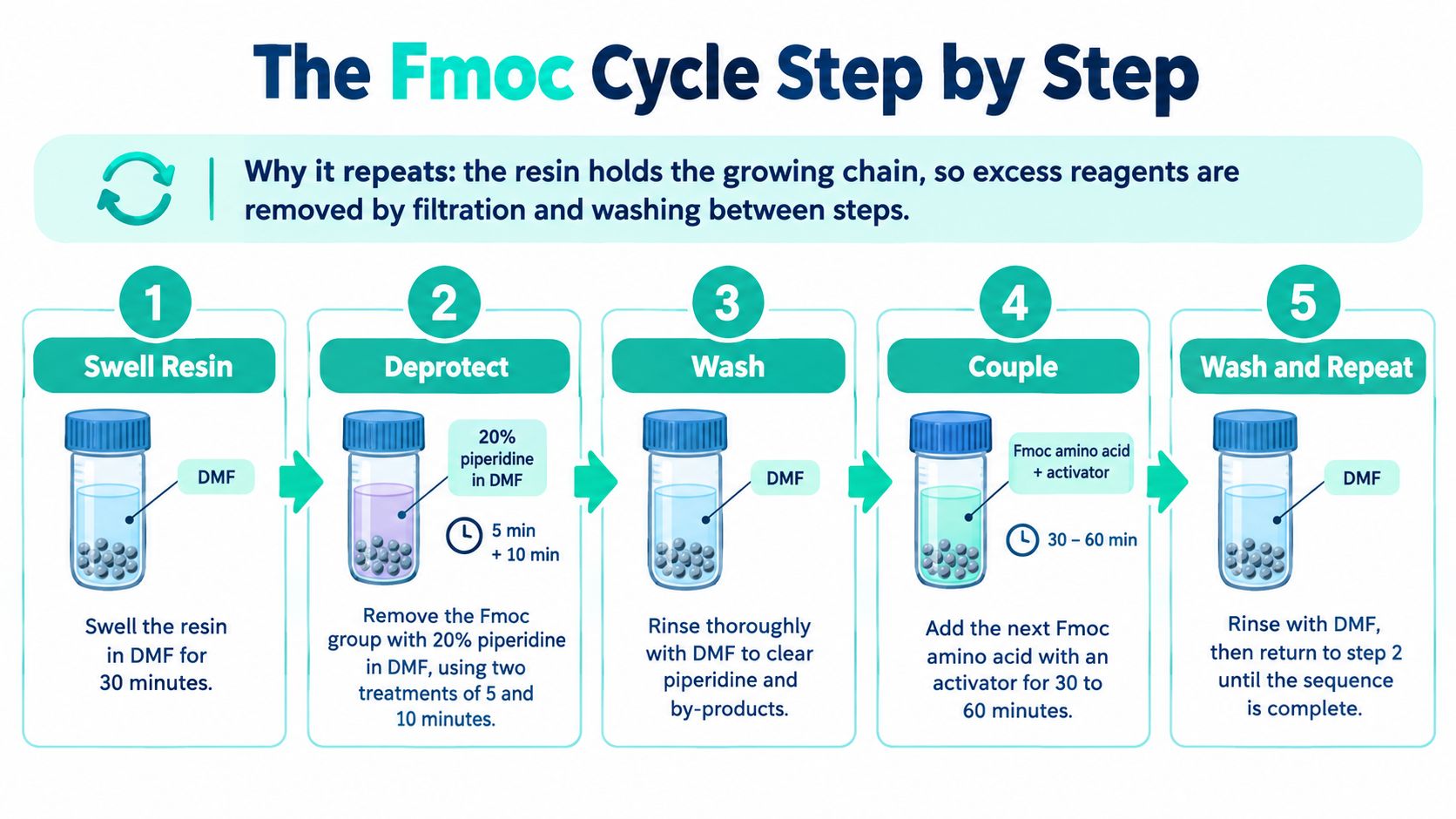
The short demonstration below shows the handling rhythm between deprotection, washing, and coupling.
Start with DIC / Oxyma Pure as your default. It's low-racemization, handles routine residues cleanly, and doesn't punish cysteine and histidine the way stronger uronium systems with excess base can. If a sequence is short and well-behaved, you may never need to leave it.
Switch when the residue tells you to. Hindered residues such as Aib or N-methyl amino acids couple slowly with DIC, so move to HATU rather than extending time indefinitely. Fragment condensation is different again, because a uronium reagent can cap a free N-terminus with guanidinium and kill that chain. That's a PyBOP job.
| Activation system | Best fit |
|---|---|
| DIC / Oxyma Pure, typically 3 eq amino acid, 3 eq DIC, 3 eq Oxyma | Routine residues, His and Cys with low racemisation |
| HBTU / DIPEA, typically 3 eq amino acid, 2.9 eq HBTU, 6 eq DIPEA | Cost-sensitive routine synthesis |
| HATU / DIPEA or collidine, typically 3 eq amino acid, 2.9 eq HATU, 6 eq base | Hindered residues such as Aib or N-methyl; collidine for Cys and His |
| COMU / DIPEA, typically 3 eq amino acid, 2.9 eq COMU, 6 eq DIPEA | Fast coupling with an Oxyma leaving group and easier handling |
| PyBOP / DIPEA, typically 3 eq amino acid, 2.9 eq PyBOP, 6 eq DIPEA | Fragment condensation where uronium capping must be avoided |
Use collidine instead of DIPEA with HATU when Cys or His racemization shows up. Collidine is a weaker, more hindered base, so it drives activation without pulling the alpha proton as aggressively. COMU gives you HATU-like speed with an Oxyma leaving group and better solubility, which makes it easier to handle on automated systems. HBTU / DIPEA remains cheap and perfectly serviceable for routine work where cost per cycle matters.
20% piperidine in DMF is standard, but add 0.1 M HOBt or Oxyma when your sequence contains Asp-Gly or Asp-Ser. Those motifs form aspartimide under repeated base exposure, and the additive lowers the effective basicity enough to cut that side reaction. You'll thank yourself when the crude LC-MS doesn't show a cluster of peaks around your product.
Reserve DBU at around 2% for stubborn Fmoc removal on aggregated sequences, and only for short treatments. It removes Fmoc fast, but it also promotes aspartimide and other base-driven side reactions. I would treat DBU as a rescue reagent, not a default.
Double-couple once with fresh reagent if the ninhydrin test stays positive. Don't triple-couple by default, because each extra cycle consumes amino acid, adds washing waste, and rarely fixes an aggregation problem.
A positive Kaiser test after coupling is your most common warning, and your cheapest one. Don't ignore it and hope purification will sort things out. Hydrophobic, aggregation-prone, sterically hindered, or long sequences can produce incomplete coupling, deletion sequences, aspartimide, diketopiperazine formation, and resin-accessibility problems, a pattern detailed in the PubMed record on challenging peptide sequences and SPPS side reactions. High-purity starting amino acids can't compensate for a chain that has collapsed on the resin.
Work in diagnostic order. Run a ninhydrin test after each coupling, then take a small test cleavage of 5 to 10 mg resin when the test stays positive or a difficult stretch ends. Run LC-MS on that crude before you commit the whole batch to another ten cycles. That sequence costs you an hour and saves you grams of protected amino acid.
Remember that ninhydrin doesn't detect secondary amines reliably. When the N-terminal residue is proline, use the chloranil or isatin test instead, or you'll call a failed coupling complete. Matching your monitoring method to the residue is part of sound method development guidelines for peptide work rather than an optional extra.
| Symptom | Likely cause | Confirm with | Fix |
|---|---|---|---|
| Kaiser test still blue after double coupling | Steric hindrance or chain aggregation | Ninhydrin or chloranil test on a few beads | Switch to the hindered-residue reagent in section 2, add pseudoproline or backbone protection, or lower loading |
| LC-MS peak lower by one residue mass | Incomplete coupling at that position (deletion) | Mass difference equal to the missing residue | Recouple with fresh reagent and check Fmoc removal |
| Dipeptide lost from resin, low yield | Diketopiperazine at Pro or Gly near the C-terminus | Mass of cleaved dipeptide in the wash | Use 2-chlorotrityl resin and couple the third residue quickly |
| Resin does not swell, slow reactions | Aggregation on polystyrene | Visible swelling volume and slow deprotection colour | Switch to ChemMatrix or lower loading; use NMP or a DMF/NMP mix |
When chemistry tweaks stop helping, change the sequence presentation. A pseudoproline dipeptide at Ser or Thr, or backbone protection such as Hmb at a key amide, breaks the hydrogen-bonding pattern that drives aggregation. Lowering loading and switching to ChemMatrix help for the same reason, because they increase distance and solvation between chains.
Know when to stop elongating. Once a difficult chain passes about 30 residues and deletions keep appearing despite those fixes, fragment synthesis usually beats linear assembly on crude purity. Make two shorter protected fragments cleanly, then condense them, rather than purifying a crude where your product is a minor peak.
Use TFA, triisopropylsilane, and water at 95:2.5:2.5 as your default cleavage cocktail for 2 to 3 hours at room temperature. TIS and water scavenge the cations released from side-chain protecting groups before they alkylate sensitive residues. Don't shorten this step because the resin looks pale. Protecting groups, especially from Arg, leave slower than color does.
Adjust for composition. Add 2.5% ethanedithiol or DODT when the sequence contains cysteine or methionine, because thiols protect sulfur residues from oxidation and cation damage, and DODT smells far less than EDT. Allow 3 to 4 hours when several Arg(Pbf) residues are present, since Pbf removal is slow and a partially protected Arg ruins purification. If Trp is present, keep scavengers in and avoid unnecessary extra hours in strong acid.
The checklist below condenses the bench sequence from cleavage through final confirmation.
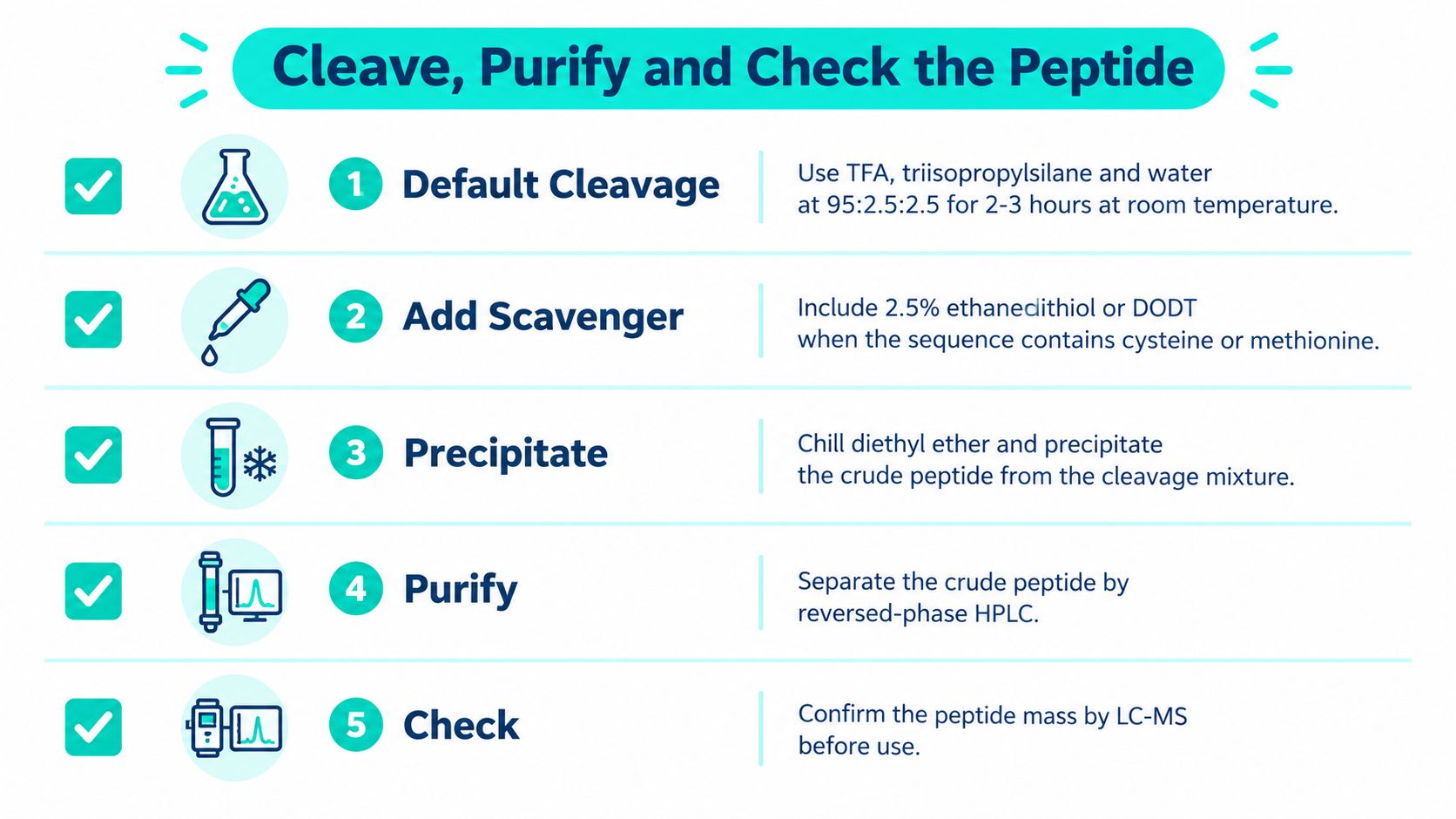
Precipitate into cold diethyl ether, spin down, and wash the pellet three times with fresh ether. That removes scavengers and most TFA-soluble by-products before HPLC. If your peptide is very hydrophobic and oils out instead of precipitating, try cold methyl tert-butyl ether or dissolve the concentrate directly in aqueous acetonitrile for injection.
Purify by reversed-phase HPLC on C18 with water and acetonitrile containing 0.1% TFA, running a gradient across the main peak and collecting narrow fractions. Choosing gradient slope and column conditions well matters as much as synthesis quality, which is why established peptide separation techniques should govern fraction pooling rather than UV height alone. Pool only fractions that pass your analytical check, then lyophilize the pooled material promptly.
A clean UV peak doesn't prove identity. A deletion peptide can co-elute closely and give you a beautiful purity number for the wrong molecule.
Store the lyophilized peptide desiccated and frozen, and aliquot rather than repeatedly opening one vial. Moisture uptake changes apparent weight and accelerates degradation. Record the salt form on the vial label, because a TFA salt and a free base of the same sequence don't weigh the same per mole.
Do the scale arithmetic before you commit. At 0.5 to 0.7 mmol/g loading, a 0.1 mmol discovery run needs roughly 140 to 200 mg resin, a 1 mmol run needs 1.4 to 2 g, and a 10 mmol run needs 14 to 20 g. Solvent, amino acid excess, and washing volumes rise in step, so a tenfold scale-up is never just a bigger vessel.
Purification, not chain assembly, becomes your bottleneck. The Wiley analysis of green SPPS challenges states that conventional Fmoc- and Boc-SPPS do not satisfy green-chemistry principles because they use toxic solvents, corrosive reagents, and excess protected amino acids, and that purification of crude peptide is also a major contributor to process mass intensity. Reversed-phase HPLC consumes large volumes of acetonitrile and water at multigram scale, and lyophilization adds sustained energy cost afterward.
The photograph below reflects the controlled handling that becomes harder to sustain as vessel and solvent volumes grow.
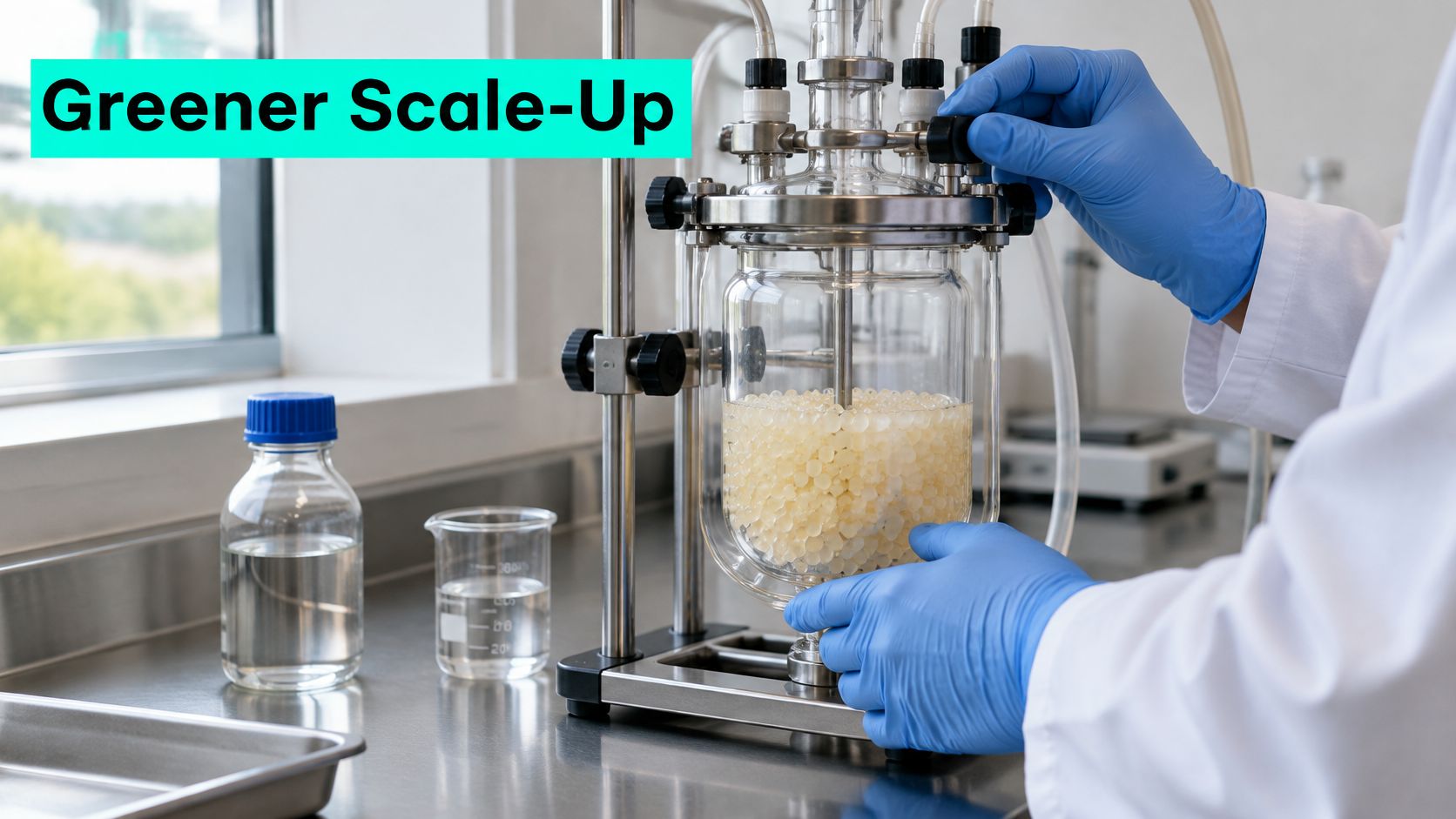
DMF, NMP, and dichloromethane dominate solvent waste across swelling, coupling, and washing. Piperidine adds corrosive base waste at every deprotection, and excess protected amino acid leaves with every wash whether it reacted or not. A sequence with poor crude purity multiplies all of it, because you'll run HPLC longer, collect more fractions, and sometimes purify twice.
Realistic laboratory swaps exist, but test them on a small run first. N-butylpyrrolidinone can replace DMF for coupling and washing on many sequences, though swelling and Fmoc removal rates need checking on your resin. Cutting amino acid excess from 4 equivalents to 3 equivalents works where Kaiser tests stay negative, and it saves material on every cycle of a long synthesis. Fragment condensation can reduce total solvent use when two short, clean fragments replace one long, deletion-prone assembly that needs repeated purification.
Compare options on purity, yield, waste, and analytical burden together. A solvent labeled green that drops crude purity and doubles your HPLC time hasn't made your process greener.
Purification-free approaches are maturing but remain niche. In 2024, Schüttel and colleagues reported a 384-well solid-phase synthesis platform that produced peptides at an average quantity above 0.5 micromoles and concentration above 10 millimolar without chromatographic purification, as recorded in the PubMed record for the 384-well synthesis platform. That's compelling for screening libraries. For a multigram batch destined for quantitative assays, I would still budget for HPLC, fraction analysis, and lyophilization.
Synthesize in-house when the sequence is short, you already have a method that works for similar residues, and you need control over modifications, labels, or unusual residues. You'll iterate faster and learn exactly where that sequence misbehaves. That knowledge has value beyond one batch.
Buy when the sequence is long or hydrophobic, when you need only a small amount and your bench time costs more than the vial, or when you need a lot-matched reference for a study. Outsourcing a difficult 35-mer you will make once isn't a failure of competence. It's a sensible allocation of HPLC time and staff hours.
The image below captures the documentation review that should precede any purchase decision.

Treat any headline purity figure as a claim until the lot-specific COA confirms it, and use practical guidance on how to buy peptides to structure vendor questions before ordering. Ask what salt form ships, because that affects weighing. Ask whether purity is reported at 214 nm.
Your next action this week is simple. Write the sequence, its C-terminus, and its hydrophobic stretches on one page, run the resin decision, and order a 0.1 mmol test run before committing to a full batch. One small, well-diagnosed synthesis teaches you more than a large one you have to rescue.
If you'd rather spend your HPLC time on experiments than on rescuing a difficult synthesis, Celonyx Labs supplies research peptides for laboratory use through its online catalog, with product quality attributes and third-party testing described for buyers who need documented material. Compare your sequence requirements against available verified peptides, check the lot documentation before you order, and visit Celonyx Labs to review current options for your next study.
Compare eonpeptides.com alternatives for laboratory research. Choose Celonyx Labs for 99%-pure, third-party-tested peptides, then verify

Celonyx Labs vs Simple Peptide: choose stated quality criteria or an already-qualified source. Compare purity,

Compare onyxweightloss.com alternatives for laboratory research. Assess Celonyx Labs, catalog reagents, and custom synthesis by
FOR RESEARCH USE ONLY. Products sold by Celonyx Labs are intended exclusively for laboratory and scientific research. They are not intended for human or veterinary use, consumption, diagnosis, treatment, cure, or prevention of any disease. By purchasing from this site, you acknowledge that you understand the intended research purpose of these materials and agree to comply with all applicable laws and regulations.