

Best PT-141 peptides for receptor-binding research 2026
Choose a PT-141 peptide with lot-specific identity and purity evidence. Compare research material profiles, content
Tesamorelin has the strongest human evidence in the mix, with three randomized controlled trials that included 412, 404, and 54 participants, and the main studies used 2 mg per day by subcutaneous injection over a 26-week treatment phase plus a 26-week extension. Ipamorelin has human data too, but its development story is much thinner, with a 48-volunteer pharmacokinetic study, a 114-patient postoperative ileus trial, a related 56-patient cohort, and a larger 320-participant dose-finding study that did not lead to development. If you want a clean answer, the tesa IPA blend is best treated as two analytes in one vial, not as one proven combination.
Most advice about this product starts in the wrong place. It begins with marketing language about synergy and ends with a vague purity claim, but the central question is whether the vial contains two identifiable peptides, whether either one has relevant human data, and whether the combination itself has been tested at all.
A tesa IPA blend looks like one product page, but analytically it is a mixed system with two distinct peptide identities. Tesamorelin is a 44-amino-acid growth-hormone-releasing-hormone analogue, while ipamorelin is a five-amino-acid secretagogue that works through the ghrelin receptor, so they do not share the same molecular mass, receptor target, or validation history.
That matters because a vendor can't use one combined label to prove the presence, identity, and integrity of both components. A vial that says “blend” still needs component-level scrutiny, and a lab that treats it as one analyte risks missing substitution, ratio drift, or incomplete characterization. For background on what separates research peptides from ordinary catalog items, see this overview of research peptides.
The common mistake is assuming that a dual-peptide listing behaves like a uniform chemical substance. It doesn't. Tesamorelin and ipamorelin have different roles in somatotropic-axis research, and they should be verified separately if the goal is to interpret any result with confidence.
Practical rule: If the paper trail only describes “the blend,” you don't yet know enough to trust the material.
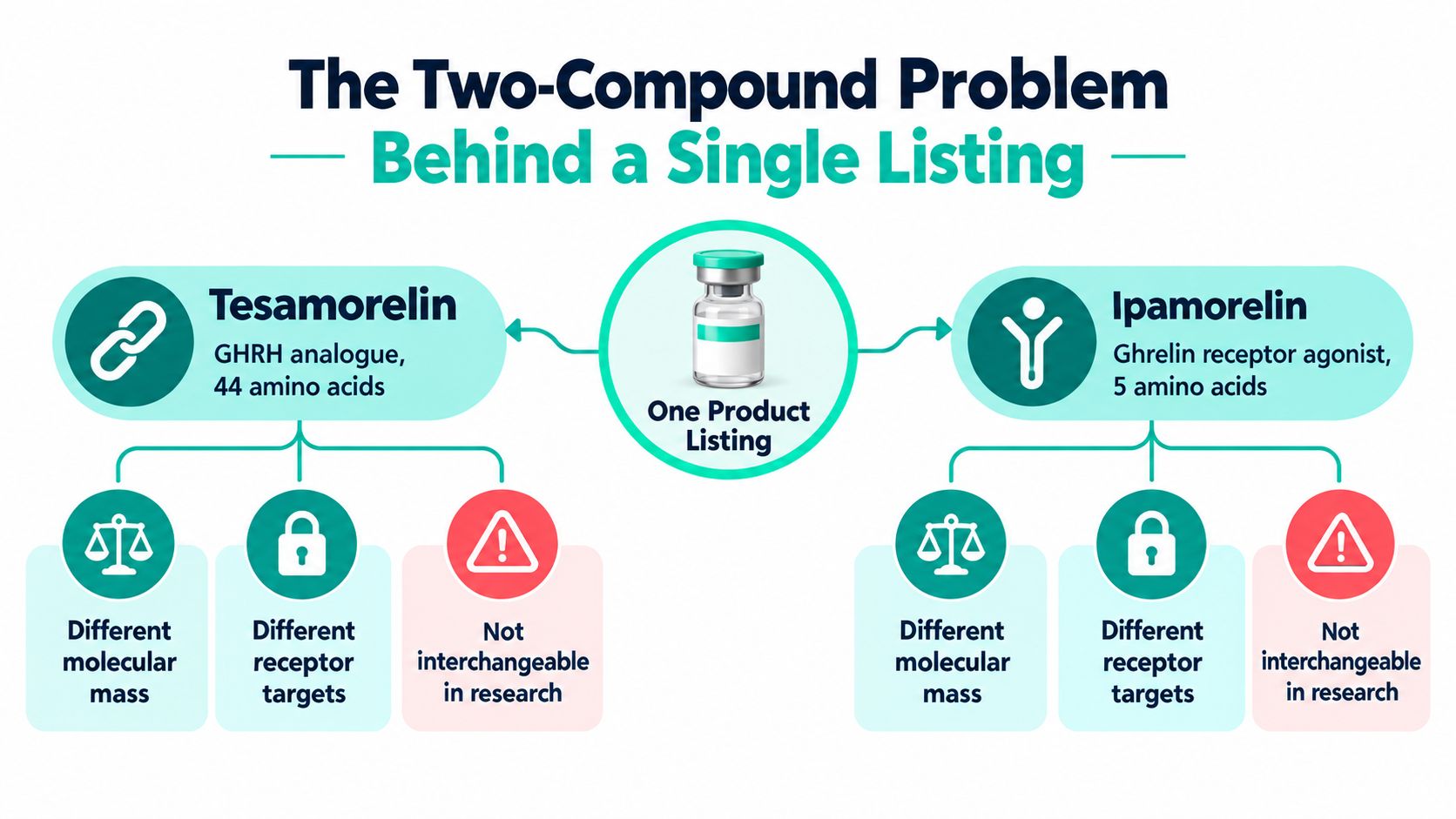
The analytical framing is simple. One vial, two peptides, separate identities, separate failure modes. That's the mental model a lab director needs before anyone starts talking about expected outcomes.
Tesamorelin carries the stronger clinical paper trail, and that distinction matters more than any marketing label. Regulatory and review documents place it in the context of visceral adipose tissue reduction in adults with HIV-associated lipodystrophy, which makes its evidence base prescription-drug evidence, not a general wellness claim. Ipamorelin sits in a narrower research lane, with a much smaller human record and less to support sweeping conclusions.
The size gap is not cosmetic. Tesamorelin's approximate molecular mass is 5,135.9 g/mol and ipamorelin's is about 711.85 g/mol, figures that are consistent with standard peptide reference entries for each compound. A catalog-style summary such as this tesamorelin and ipamorelin reference can help frame the comparison, but it does not verify what is in a lot.
That difference changes the analytical strategy. A release assay for a blend should ask whether each peptide is present, whether each peak matches the expected identity, and whether the stated ratio survives the method. If the assay only gives a single yes-or-no answer, it can miss substitution, ratio drift, or incomplete characterization. The vial may still contain powder, but it is not yet a defensible research material.
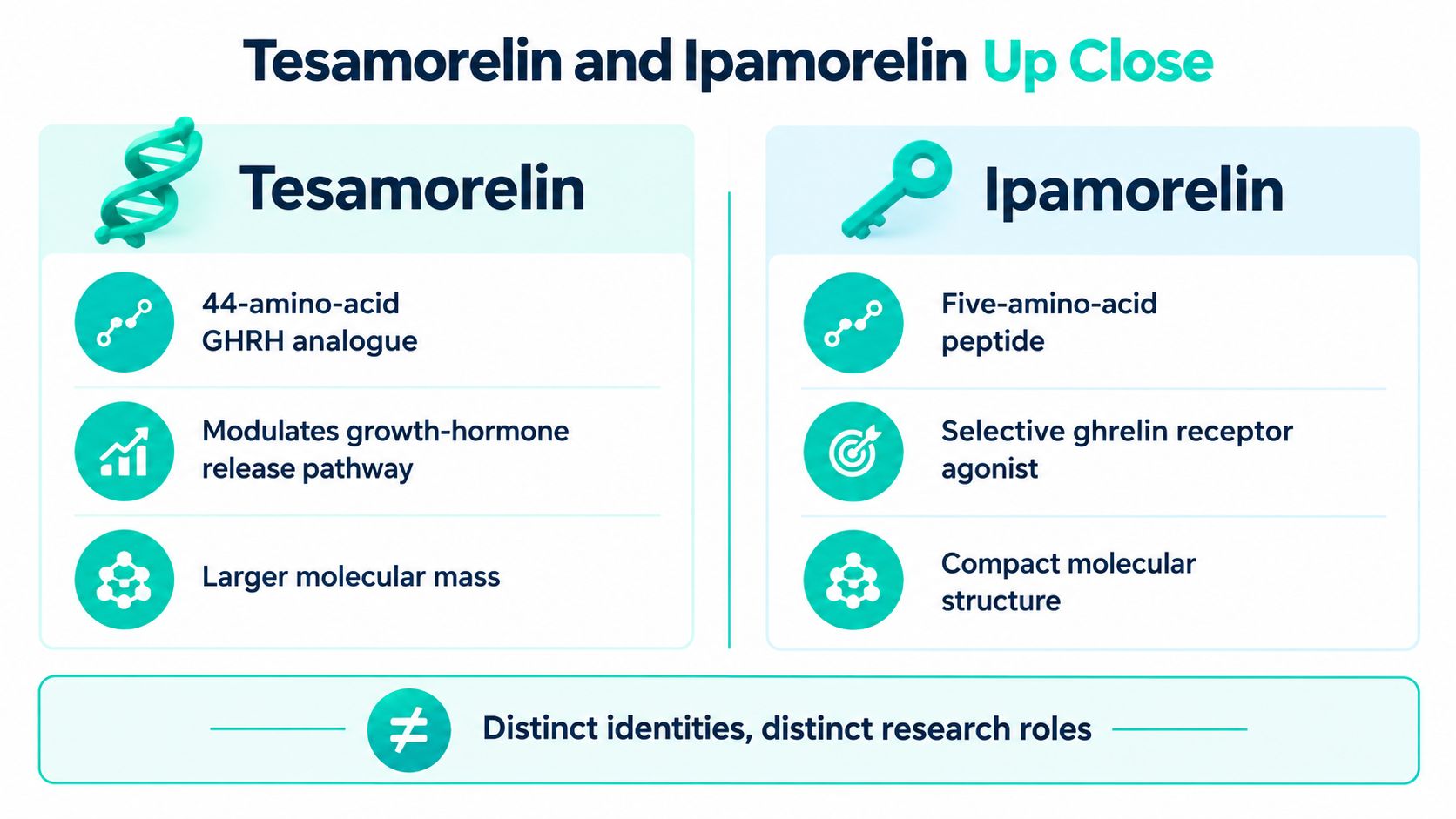
Mechanistically, the two peptides occupy different nodes in the same endocrine axis. Tesamorelin is used to model GHRH-pathway activity, while ipamorelin is used to examine ghrelin-receptor-mediated secretagogue signaling. That supports a working hypothesis about complementary signaling. It does not show that the blend performs better than either component alone.
A dual-pathway concept can justify an experiment. It cannot replace one.
Tesamorelin has controlled human data behind it, and the Canadian clinical review is explicit about the scale of that evidence. It evaluated three randomized controlled trials, including LIPO-010 with 412 participants, CTR-1011 with 404 participants, and a smaller study with 54 participants, all in the context of HIV-associated lipodystrophy and visceral adipose tissue reduction. The principal trials used 2 mg per day by subcutaneous injection, with a 26-week treatment phase followed by a 26-week extension.
At week 26, tesamorelin produced a statistically greater reduction in visceral adipose tissue than placebo in the major trials, and regulators treated an approximately 8% VAT decrease as a meaningful clinical-benefit threshold, even though the review noted that the cutoff was somewhat arbitrary. That is evidence for a prescription drug in a specific indication. It is not evidence for a combined tesa IPA blend, routine body composition use, or healthy adults.
Ipamorelin's evidence is much weaker. A published summary describes an early pharmacokinetic study in 48 healthy male volunteers, then Phase II work in postoperative ileus, including a multicenter proof-of-concept study with 114 patients and a related cohort of 56 patients at 0.03 mg/kg. The same summary also describes a larger 320-participant dose-finding study, but development was discontinued after the available review reported no improvement in measurable gastrointestinal motility parameters.
Those numbers matter because they separate the histories of the two molecules. They do not establish that the combined formulation works as a product class. No controlled trial in the evidence set tested the two peptides together in one formulation, so any claim of blend efficacy is an extrapolation, not a documented outcome.
| Compound | Largest study | Endpoint | Outcome | Combined data |
|---|---|---|---|---|
| Tesamorelin | 412 participants | Visceral adipose tissue reduction | Greater VAT reduction than placebo at week 26 | No controlled trial of the blend identified |
| Ipamorelin | 320 participants | Gastrointestinal motility in postoperative ileus | No meaningful improvement, development discontinued | No controlled trial of the blend identified |
A blend is only interpretable if the ratio is stated exactly. One listing may present a 10:3 mg tesamorelin-to-ipamorelin split, another may describe a 10 mg total vial divided 5 mg and 5 mg, and another may list 13 mg total with a 10 mg / 3 mg split. Those are different compositions, so they should be treated as separate materials, not as interchangeable versions of the same product.
A supplier's vial can only support the same inference as another vial if the composition matches and the lot documentation supports it. If the ratio shifts, the exposure shifts, and the meaning of any downstream test changes with it. That is why ratio drift is not a cosmetic detail, it changes what the result can actually say.
For buyers who evaluate sourcing claims, a guide to source inspection helps keep attention on what the document proves, not what the headline implies. In a blend, that discipline matters because “tesa ipa” can describe materially different mixes while sounding identical at a glance.
A white-to-off-white lyophilized powder is normal packaging language, not proof that both peptides are present at the stated concentration. The operative question is whether the lot can be tied to separate identity and purity data for each component, plus the stated blend ratio. Without that, the formulation remains a claim, not a verified material.
A proper certificate of analysis should read like an analytical record, not an advertisement. The first thing to check is whether the lot number, test date, and method name are all present, because a purity figure without a method tells you almost nothing. The next step is to ask whether the assay distinguishes tesamorelin from ipamorelin instead of collapsing them into a single combined percentage.
A defensible document should include separate HPLC or UPLC purity results for each component, plus identity confirmation by mass spectrometry or LC-MS. It should also report the exact blend ratio and tie that ratio to the specific lot in the vial. If the document only says “99% pure” and leaves out the method, it's too vague to support a serious experiment.
The tests that matter most are the ones that catch failure modes a simple purity badge can miss. Residual solvent screens reduce the risk of hidden process carryover, endotoxin testing matters if the material will touch sensitive biological systems, and water-content and reconstitution stability data help explain why one lot behaves differently from another after handling. For a broader procurement lens, this third-party-tested peptides resource is a useful example of the kind of documentation buyers should expect to request.
Analytical rule: If the COA doesn't separate identity from purity, and purity from stability, the paperwork is incomplete.
A meaningful study of a tesa IPA blend needs a design that can disprove the blend, not just flatter it. The cleanest structure has four arms, tesamorelin alone, ipamorelin alone, the blend, and vehicle control, and the concentrations should be matched on a molar basis so the comparison isn't distorted by a hidden mass mismatch. If the experiment can't separate those arms, it can't tell you whether any observed effect came from one peptide, the combination, or the matrix.
The lot number should appear in the methods section, not buried in procurement paperwork. Report the peptide amounts in moles rather than only milligrams, because a milligram-only description makes a high-mass peptide and a low-mass peptide look more comparable than they really are. That matters when one component is many times larger than the other on a molecular-weight basis.
The other design constraint is stability. Reconstitution should be tested before the long study begins, and freeze-thaw behavior should be documented if the vial will be handled more than once. Otherwise a later negative result may reflect degradation, not biology.
A procurement officer receives a PDF COA from a vendor that advertises “99% purity” and “third-party testing.” The PI wants the order released because the study schedule is tight, but the officer sees only a combined purity statement and no separate identity data for tesamorelin and ipamorelin. At that point, the purchase becomes a documentation problem, not a routine sign-off.
The correct response is to pause payment and ask for the missing pieces. The officer requests a lot-specific COA, separate reporting for both peptides, the analytical method name, and a note on who is authorized to accept conditional documentation if the file is incomplete. If the vendor cannot supply that, the material may still arrive, but it should not be treated as a defensible research input, and any delay should be logged rather than hand-waved away.
Most vendor pages also blur identity and purity testing with potency, residual-solvent, water-content, endotoxin, sterility, and degradation testing, so the officer asks which of those tests the COA contains. A blend claim means little if the document does not separate what was measured from what was assumed. The procurement question is whether this lot can survive scientific scrutiny, not whether the landing page looks polished.
“Research-grade” language often exists to soften the gap between marketing and proof. The lab should not accept that gap as normal.
You can claim mechanistic rationale, because tesamorelin and ipamorelin act through distinct upstream pathways. You cannot claim blend synergy, optimal ratio, or any broad fitness, recovery, or anti-aging benefit from human evidence that doesn't exist for the combination. Before logging the first data point, ask whether the COA is lot-specific, whether both peptides are reported separately, whether the ratio is confirmed in moles, what the residual-solvent and endotoxin profile looks like, and what stability data exist after reconstitution.

Do not let a well-marketed blend outrun what the paperwork proves.
Celonyx Labs works with research peptides for laboratory teams that need clear product information, quality-focused sourcing, and support that doesn't blur the difference between a label and evidence. If you're evaluating a tesa IPA blend or any other peptide supply for a study, visit Celonyx Labs to review the catalog, documentation approach, and ordering resources before you commit to a procurement decision.
Choose a PT-141 peptide with lot-specific identity and purity evidence. Compare research material profiles, content

Choose a hexarelin peptide by lot-specific evidence, not purity alone. Compare research material, reference standards,

Choose the best semax peptide format for laboratory research. Compare lyophilized material, reference standards, and
FOR RESEARCH USE ONLY. Products sold by Celonyx Labs are intended exclusively for laboratory and scientific research. They are not intended for human or veterinary use, consumption, diagnosis, treatment, cure, or prevention of any disease. By purchasing from this site, you acknowledge that you understand the intended research purpose of these materials and agree to comply with all applicable laws and regulations.