
Tesamorelin for Sale Online: What Labs Must Verify
Most advice about Tesamorelin for sale online starts in the wrong place. It tells you
Most advice about Tesamorelin for sale online starts in the wrong place. It tells you to compare price, purity, and shipping speed, as if the hardest part is finding a vial. That advice skips the question that decides everything else. Is the product an approved medicine, a legitimate research material, an unapproved drug sold for human use, or something counterfeit? Those four categories aren't marketing labels. They carry different legal routes, different evidence, and different verification duties.
A search page can't answer that for you. A seller can copy trial results from an approved prescription product, attach them to an unrelated vial, add a high purity figure, and still tell you nothing about identity, sterility, or lawful use. The regulatory record and the clinical label are narrower than most sales pages suggest, and that narrowness is useful. It gives you a benchmark. Measure every claim about Tesamorelin for sale online against the approved indication, the people studied, and lot-specific documents for the material in hand. If a listing fails that test, price doesn't rescue it.
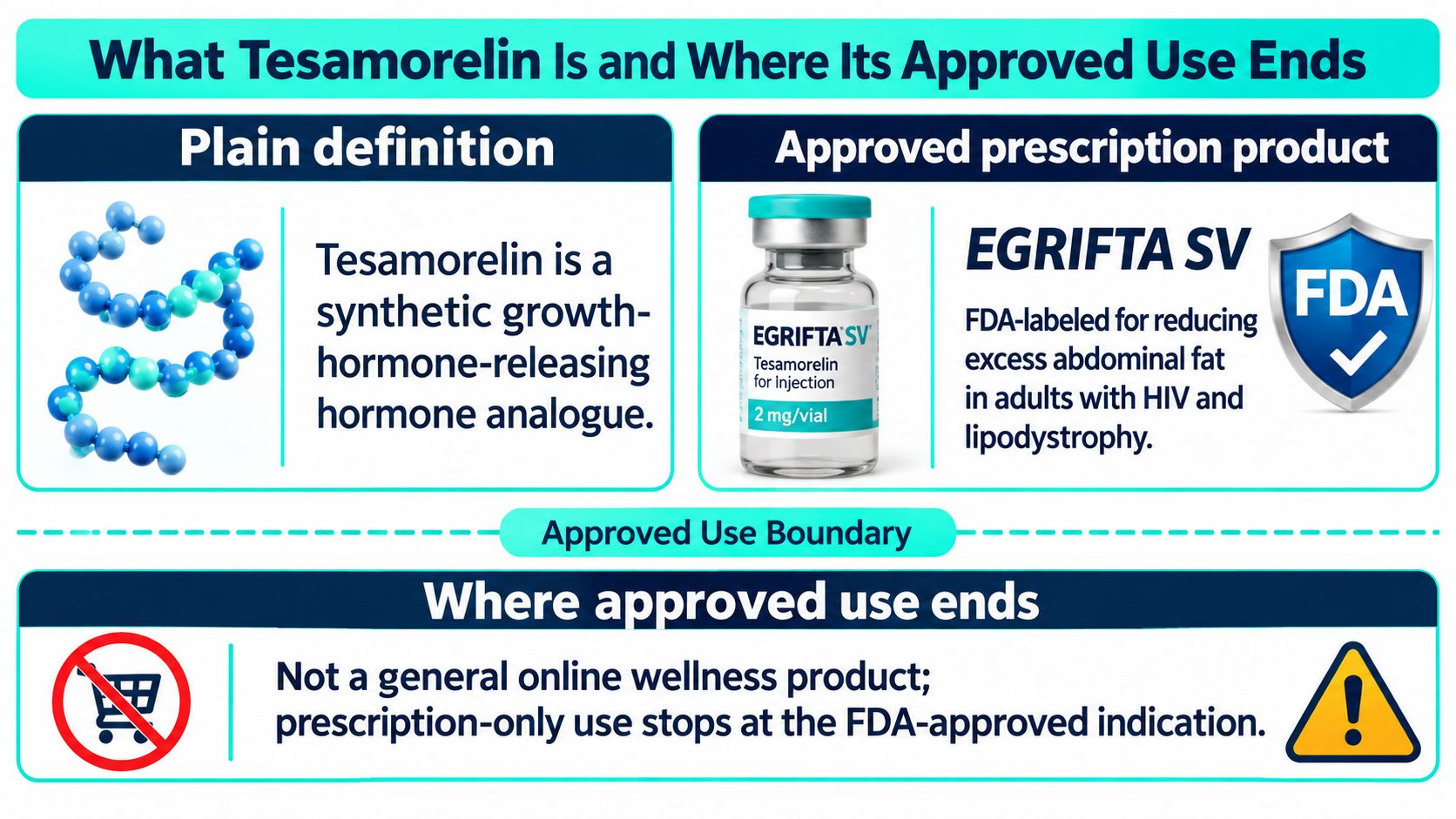
Tesamorelin is a synthetic growth-hormone-releasing hormone analogue. It mimics a hypothalamic signal that prompts the pituitary to release growth hormone, rather than supplying growth hormone directly. That mechanism explains why downstream markers such as IGF-1 matter in clinical monitoring, and why this isn't a generic wellness ingredient you can judge by a product photo.
The approved prescription product is EGRIFTA SV. The FDA labeling for tesamorelin supports EGRIFTA SV for reducing excess abdominal fat in adults with HIV-associated lipodystrophy, not general weight loss or routine bodybuilding use. That's the boundary. Anything beyond it needs separate evidence and, for human use, separate medical authorization. A website that borrows the approved name but sells a different formulation hasn't inherited the approval.
Think of a labelled key. The word on the tag doesn't decide whether the key opens the door. The cut of the key does, and so does whether you're allowed to use that door. A vial labelled tesamorelin may be the approved medicine dispensed through a pharmacy, a laboratory material with no human-use authorization, an unapproved drug marketed to consumers, or a counterfeit with the wrong contents. The tag alone settles none of that.
| Category | What It Means | Lawful Route |
|---|---|---|
| FDA-approved EGRIFTA SV | Prescription medicine labelled for excess abdominal fat in adults with HIV-associated lipodystrophy | Prescription from a qualified clinician and a licensed pharmacy |
| Research-use-only listing | Labelled for laboratory use and not an approved medicine | Institutional research procurement with lot-specific documentation, never human use |
| Unapproved online drug listing | Marketed for human use without FDA approval | No lawful route for human use; FDA has issued warning letters to such sellers |
| Counterfeit product | May contain the wrong ingredient, too much, too little, or none | No safe route; cannot be verified by label or purity claim alone |
Readers who want background on clinician-supervised treatment can review what to expect from peptide injections to understand why intake, eligibility, and follow-up are part of medical care rather than checkout steps. That's a different world from ordering a research vial. Our own peptides are labeled "For Research Use Only," and that label is a boundary, not a suggestion for personal use.
For laboratory readers, the science behind tesamorelin as a GHRH analogue is worth separating from sales claims about outcomes. Mechanism tells you what pathway a compound is designed to engage in a defined system. It doesn't prove that a specific online lot contains that compound, at that concentration, in a form suitable for your experiment.
Benchmark rule: Judge a listing by the approved use and the documentation for the exact lot, not by the language on the sales page.
That rule organises every decision that follows. First, identify the category. Second, ask who the evidence studied. Third, demand documents that tie analytical results to the vial you'd receive. If you can't complete those steps, you don't have a verified product. You have a listing.
Tesamorelin's clinical evidence is specific: it concerns a prescription treatment tested under controlled conditions in adults with HIV-associated lipodystrophy. It does not establish that an online listing is equivalent to the studied medicine or supports use for a different purpose.
| Trial | Participants | Allocation | Reported Result |
|---|---|---|---|
| First 26-week trial | 412 | 273 tesamorelin 2 mg daily, 137 placebo | 80% completed 26 weeks; 86% were men |
| Second 26-week trial | 404 | 270 tesamorelin, 126 placebo | The trial was placebo-controlled; the figures here describe enrollment and allocation, not an outcome |
The first trial was a 26-week, multicenter, randomized, double-blind, placebo-controlled study published in 2007. Its enrollment, dosing, and participant profile belong to the published clinical record, not to an enforcement letter about a seller. The FDA-approved product program also included a second study with 404 participants. Those design details establish who was studied and how the trials were conducted, but enrollment figures alone do not describe treatment effects.
Participants were adults with HIV-associated lipodystrophy and excess abdominal fat. They were not healthy adults seeking general weight reduction, athletes pursuing performance gains, or people seeking cosmetic changes. HIV-associated lipodystrophy involves abnormal fat distribution in a particular clinical context. Findings in that population cannot be transferred to a different condition, population, or product without evidence supporting the transfer.
The studies evaluated a defined prescription formulation and dosing regimen under clinical oversight. They did not test research-use vials bought online, compounded blends, oral products, or schedules devised by sellers. Nor do these trial results establish effects for routine bodybuilding or cosmetic use. A sales page that cites visceral-fat outcomes while offering material to a healthy consumer has changed the population, product, and oversight. Each change weakens the connection between the trial evidence and the claim.
These checks expose the limits of online extrapolation. Trial results can support conclusions about the studied medicine in the studied population; they cannot show that a separate vial has the same identity, strength, or quality. A research-use label does not extend clinical evidence to human use or make that use lawful.
The trials define a specific human-use context. They do not authenticate an online vial or establish that it matches the studied product.
Strong trial design can increase confidence in findings for the approved medicine and its studied population. It cannot verify an unrelated seller's product. Evidence about clinical effects and evidence about a particular vial answer separate questions, and neither substitutes for the other.
A tesamorelin listing answers a commercial question: can a seller accept an order? It does not establish that the product is approved, that the seller is a licensed pharmacy, or that the sale is lawful for the use being promoted. The regulatory question comes first. A checkout page, product name, or purity claim cannot substitute for evidence of approval and a lawful supply route.
The FDA warning letter to Royal Peptides LLC identifies tesamorelin products marketed by online sellers as unapproved new drugs under section 505(a) of the Federal Food, Drug, and Cosmetic Act. That enforcement example shows why a product's online availability does not establish authorization. It also does not establish that a particular vial is equivalent to an approved medicine.
A research-use-only label describes a boundary, not an exception for personal use. It does not authorize human administration or turn a research material into an approved medicine. Guidance on research use only peptide handling concerns laboratory containment and documentation, not permission to inject a product. If a page pairs a research disclaimer with human dosing instructions, those instructions conflict with the stated limitation.
A high purity percentage is also insufficient to establish suitability for people. A purity result from one analytical method does not, by itself, establish FDA approval, clinical equivalence, sterility, or safe administration. For an injectable material, claims about identity, concentration, sterility, storage, and manufacturing consistency need evidence tied to the specific product and lot. A percentage without a named method, lot identification, and independent testing offers little basis for assessing what is in the vial.
The legal distinction is explained in whether buying research peptides is legal in the United States: laboratory procurement and marketing a product for human use are not the same activity. The seller's stated intended use, sales-page claims, and route of sale all affect how the transaction should be understood. Adding “research use only” to a label does not erase human-use claims elsewhere on the page.
Treat a tesamorelin listing as a regulatory and vendor-verification question before considering it a purchase option. A seller's claims must be judged against the approved-use evidence, not against the presence of a checkout button.
You can screen many listings in minutes if you know what shouldn't be there. Read the page as an auditor, not as a shopper. Look for claims the approved label doesn't support, instructions that contradict the disclaimer, and missing business details you'd expect from any legitimate supplier.
Each flag has a resolving check. A prescription claim resolves through a qualified clinician and a pharmacy you can verify through the state board of pharmacy. A research claim resolves through lot-specific analytical records and a seller whose identity and handling you can document. A testimonial doesn't resolve anything. Neither does a discount code.
Any single serious flag is enough to pause. Two or more together mean you should treat the source as unapproved or counterfeit until proven otherwise.
Passing this screen doesn't finish due diligence. It only means the listing hasn't disqualified itself on its face. The supplier and certificate checks still decide whether a laboratory should order.
Before treating a tesamorelin listing as a purchase option, treat it as a regulatory and supplier-verification question. The FDA guidance on buying medicines safely from an online pharmacy advises consumers to avoid unsafe online pharmacies. It also notes that counterfeit medicines may contain the wrong ingredients or harmful substances, while internet sellers may distribute products with too much, too little, or no active ingredient. For a laboratory, incorrect concentration, degradation, aggregation, oxidation, residual synthesis reagents, or microbial contamination can undermine results and make experiments difficult to interpret.
The visual summary lays out checks to complete before a research order.
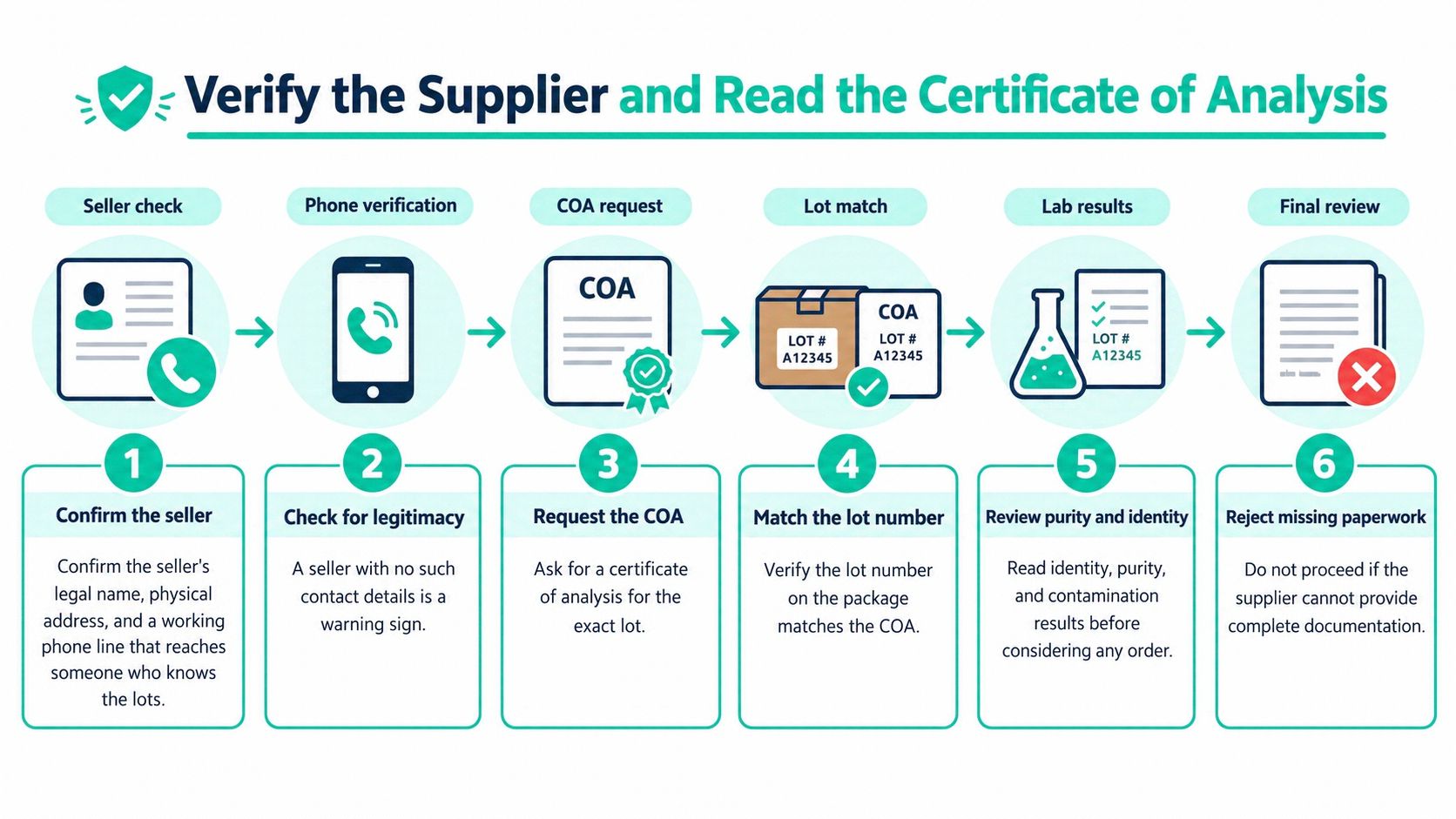
Confirm the seller's legal identity. Record the legal name, physical address, and a working phone line where someone can answer questions about the lots. Ask which lot would ship and who tested it. If you cannot identify or reach the seller, stop before considering price.
Confirm research intent in writing. The quote, product page, and invoice should identify the material as laboratory research use and not for human use. If staff privately suggest personal use, do not proceed.
Request a lot-specific certificate of analysis. The COA should identify the batch that will appear on the vial and come from an independent laboratory. A generic example for another lot does not establish what is in the material you would receive.
Read the COA line by line. Compare the lot number, test date, expiry, concentration, and storage conditions with the vial and your protocol. This guide to reading a peptide certificate of analysis explains how to connect the document's details to a procurement decision.
Compare purity with identity. HPLC or UPLC purity estimates the main peak using a particular method. Mass spectrometry supports molecular identity. Both results should apply to the same batch. Purity alone does not establish sequence identity, concentration, sterility, endotoxin status, or biological activity.
Confirm handling through delivery. Check the expiry, storage temperature, packaging, and any temperature-controlled shipping records. Keep these details in the procurement file. If a handling step cannot be verified, do not order.
The FDA page on counterfeit medicine warns that counterfeit medicines may contain the wrong ingredient, too much, too little, no active ingredient, or harmful contaminants. Forensic testing of counterfeit peptides has also found incorrect amounts and harmful contaminants. These findings do not establish that every online listing is counterfeit. They do show why a purity claim on a sales page cannot, by itself, establish what is in a vial.
| Document Item | What It Proves | Red Flag |
|---|---|---|
| Lot or batch number | Ties results to the vial in hand | Missing or different from the vial label |
| Test date | Shows when the lot was tested | Undated or generic |
| HPLC or UPLC purity | Reports the main peptide by one method | Purity figure with no method named |
| Mass spectrometry or LC-MS identity | Supports molecular identity for that batch | No identity data supplied |
| Endotoxin and sterility records | Addresses these properties when relevant to the experiment | Missing when the experiment requires them |
| Residual-solvent results | Reports leftover synthesis chemicals | Not reported |
| Laboratory accreditation or independence | Identifies who ran the tests and whether testing was independent | Testing done only by the seller |
| Temperature-controlled shipping records | Documents storage conditions through transit | None provided |
For clinical treatment, the what to know before peptide treatment resource can support a discussion with a clinician. A research COA does not substitute for an approved medicine, a prescription, or clinical monitoring. For laboratory procurement, seller-only testing gives less independent assurance. Ask who performed the work, whether the laboratory is accredited, and whether raw chromatograms and spectra are available for the lot.
Traceability can fail in ordinary ways. A COA may report purity but omit the lot number. A phone line may reach someone unable to identify the testing laboratory. A shipment may arrive without a temperature record, yet be used because the project is late. Each gap makes it harder to interpret a negative result, reproduce a positive one, or document the purchase for compliance.
The short video below reinforces why documentation should come before use in a controlled research setting.
A supplier that refuses any verification step is disqualified, whatever the price.
That standard protects the experiment and the evidence built from it. If the material's identity cannot later be established, conclusions drawn from it may be impossible to defend.
The right decision depends on who you are and what you intend to do. The same search phrase leads three buyers to three different answers. Only two have a lawful route, and neither route starts with an anonymous checkout.
Dana is a patient with HIV-associated lipodystrophy. Her clinician has discussed whether an approved prescription fits her history, current medicines, glucose risk, and monitoring capacity. If treatment proceeds, the order belongs in her chart, the prescription goes to a licensed pharmacy, and follow-up is documented like any other medical therapy. A cheaper research listing isn't a substitute, even if the vial uses the same compound name. It lacks the approved formulation controls, pharmacy dispensing, patient-specific screening, and clinical accountability that make the medical route legitimate.
Dana's decision: use only the clinician and licensed pharmacy route for human treatment.
Prof. Ortiz runs an academic lab studying GHRH analogues in vitro. The team needs a research reference material for assay work, not a medicine. Procurement asks the supplier for legal identity, lot-specific COA, HPLC and mass spectrometry data, residual-solvent reporting, storage conditions, and shipping records. The compliance office and procurement officer sign off on written research use. If the lot documents don't match the vial or the seller can't explain its testing chain, the purchase doesn't proceed and the team selects another qualified source or redesigns the sourcing plan.
Prof. Ortiz's decision: order only through institutional procurement after all six verification steps pass.
Sam is a healthy consumer who wants weight loss and muscle gain. A sales page promises both, shows personal testimonials, and adds a research-only disclaimer at the bottom. No lot record makes that human use lawful. The trial population doesn't match Sam, the product isn't approved for Sam's purpose, and the seller's own disclaimer excludes the use Sam intends. Buying anyway would combine regulatory risk, unknown product quality, and no clinical monitoring.
Sam's decision: stop, because no online research listing creates a lawful or evidence-based route for personal use.
This guide recommends no particular seller. Rules also differ by country, institution, and intended experiment, so a lab should confirm local requirements with its compliance office before purchasing Tesamorelin for sale online or any comparable peptide. Patients need a clinician, researchers need traceability, and consumers seeking unapproved human use need to stop. Those aren't three versions of the same purchase. They're three different legal and evidentiary worlds.
Celonyx Labs supplies laboratory research peptides with an online catalog, published contact details, customer support, and products labeled for research use only, so investigators can begin procurement discussions with an identifiable supplier rather than an anonymous listing. If your laboratory is planning peptide work, bring your protocol requirements, lot documentation questions, and compliance checklist, then visit Celonyx Labs to review the catalog and contact the team before placing a research order.
Most advice about Tesamorelin for sale online starts in the wrong place. It tells you
A 2025 review of BPC-157 identified 36 relevant studies, 35 preclinical and only 1 clinical.
There's no nationwide rule that insulin syringes are prescription-free: your order depends on the destination
FOR RESEARCH USE ONLY. Products sold by Celonyx Labs are intended exclusively for laboratory and scientific research. They are not intended for human or veterinary use, consumption, diagnosis, treatment, cure, or prevention of any disease. By purchasing from this site, you acknowledge that you understand the intended research purpose of these materials and agree to comply with all applicable laws and regulations.