

BPC 157 Powder: A 2026 Research Guide
A 2025 review of BPC-157 identified 36 relevant studies, 35 preclinical and only 1 clinical.

Yes—MOTS-C can be studied alongside another peptide in a controlled laboratory experiment, but the pairing requires its own scientific rationale, compatibility assessment, and appropriate controls. MOTS-C peptide combination research does not establish that a mixture is stable, that the compounds act synergistically, or that either is suitable for human use.
Yes, provided the experiment tests a defined question rather than assuming that combining compounds improves results. A useful 2026 study plan distinguishes biological interaction from formulation compatibility: these are separate questions requiring different evidence.
For an initial experiment involving 2 peptides, a basic factorial layout contains 4 treatment groups. Each peptide has 2 exposure levels in this simplified design: absent or present. This layout supports a comparison at the selected conditions; it does not establish a complete concentration-response relationship.
| Experimental group | Best for | Main strength | Main limitation |
|---|---|---|---|
| Matched vehicle control | Establishing the experimental baseline | Separates treatment responses from vehicle effects | Does not explain either peptide’s individual contribution |
| MOTS-C alone | Measuring the MOTS-C response | Provides the MOTS-C-only comparator | Does not establish an interaction |
| Partner peptide alone | Measuring the partner’s response | Provides the second single-agent comparator | Does not predict the combined response |
| MOTS-C plus partner | Testing the combination hypothesis | Measures the response to joint exposure | Cannot establish synergy without the other groups and an interaction model |
Before selecting material, review the distinction between analytical quality and experimental suitability in the peptide purity testing guide. A purity result does not answer whether two compounds remain stable together or produce an interpretable response in your model.
Keep the question narrow. An experiment asking whether joint exposure changes a cellular endpoint is different from one asking whether the compounds can be stored in a shared solution.
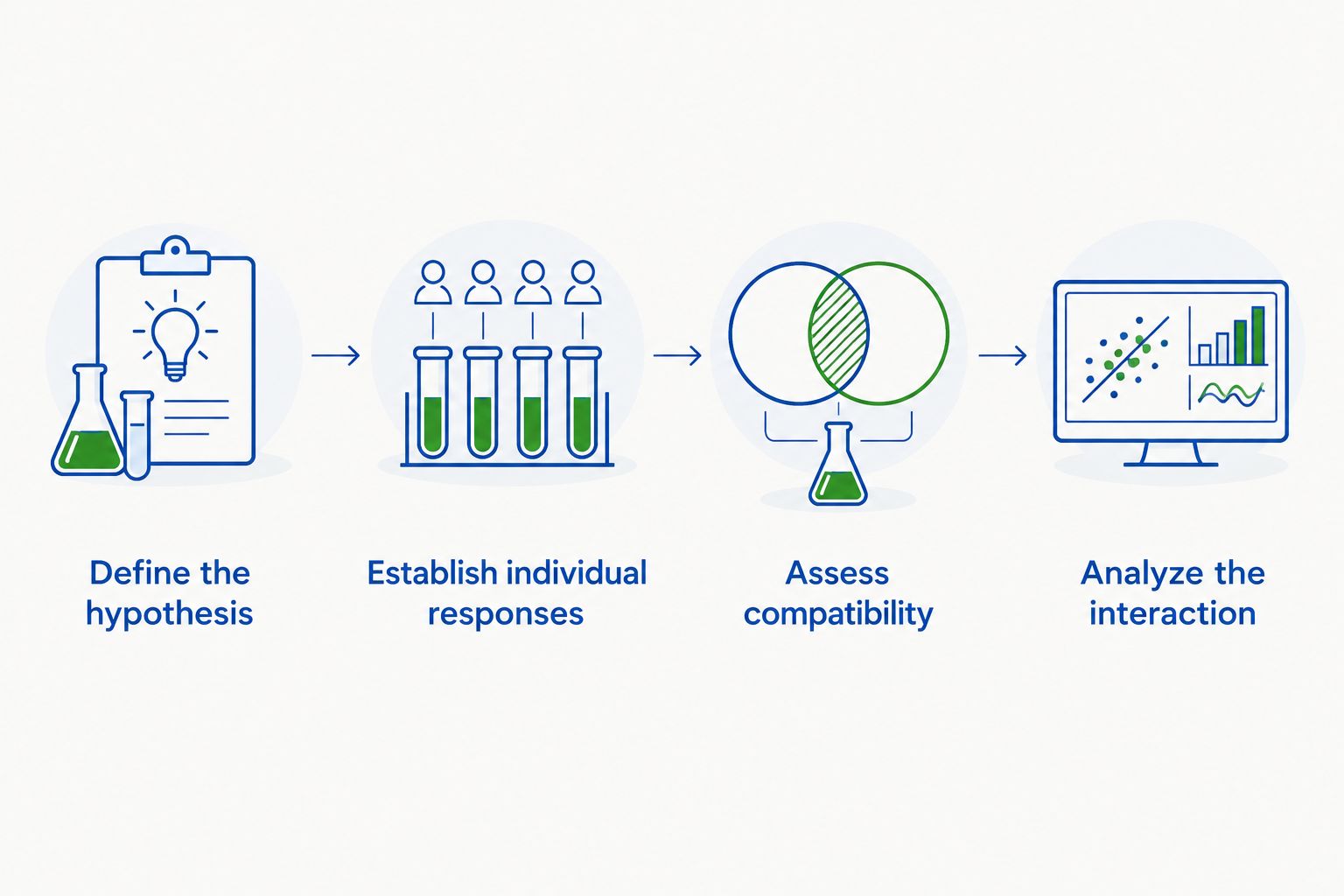
A combination-only experiment leaves the central question unanswered: which treatment caused the observed response? Without single-agent controls, you cannot separate the contribution of MOTS-C from the contribution of its partner or their interaction.
The same problem applies to an unexpectedly weak response. Assay interference, unsuitable preparation conditions, and biological antagonism require different follow-up experiments. Treating all three as a failed combination obscures the cause.
For a 2026 research protocol, define the decision the experiment should support before selecting the pairing. Choose the experimental question first, not a preselected blend.
The MOTS-C-only and partner-only groups show what each compound does under the same experimental conditions as the combination. Match the model, endpoint, handling, and observation schedule so the comparison addresses treatment rather than procedural differences.
Best for: establishing each peptide’s contribution. These controls make a combination result interpretable, but they do not demonstrate that the selected conditions capture each compound’s full response profile.
Characterize individual concentration-response behavior where the study question requires it. A concentration selected without supporting characterization can place one compound near an assay ceiling or outside a useful response window, making interaction analysis difficult.
Do not substitute a result from another laboratory model for an internal comparator. Published work can support your rationale, but differences in preparation, model, and measurement prevent it from serving as the missing treatment arm.
The combination arm tests the response to both peptides under the conditions you specify. Record whether exposure is simultaneous or sequential; these are different experimental designs, not interchangeable descriptions.
Best for: testing a specific joint-exposure hypothesis. Its strength is direct measurement of the combination. Its limitation is that a single selected pairing of concentrations does not describe the broader interaction landscape.
If the joint-exposure group produces a larger response than either peptide alone, describe that observation precisely. Do not automatically label it synergy: the expected combined response depends on the reference model and the endpoint being analyzed.
Likewise, an unchanged response does not prove that the compounds never interact. It supports a conclusion limited to the tested conditions, with uncertainty reported alongside the estimated effect.
The vehicle control accounts for the preparation components delivered without the active research compounds. Match the final vehicle composition across groups where feasible and document any unavoidable differences.
Best for: separating treatment effects from preparation effects. The control provides an essential baseline, but it cannot compensate for an unstable compound or an assay that does not measure the intended endpoint.
If the two stock preparations use different vehicles, review the final exposure mixture rather than considering each stock separately. The combination arm must not introduce an uncontrolled preparation difference that the single-agent groups lack.
In a 2026 study plan, treat these as variables to control and report—not explanations to select after seeing the results:
Keep these factors explicit in the protocol. Changing several at once makes it difficult to explain why one experiment differs from another, even when both use compounds with the same names.
A stronger combined response does not, by itself, prove synergy. Synergy is an interaction claim relative to a defined expectation, not a synonym for improvement over a single treatment.
Specify the reference approach before examining the results. Common interaction frameworks include Bliss independence and Loewe additivity, but they use different assumptions; select an approach that fits the biological question and available data rather than choosing whichever produces the preferred label.
Report the endpoint, experimental conditions, estimated interaction, and uncertainty together. If the design supports only a comparison at selected conditions, describe that comparison without extending it into a general synergy claim.
Joint biological testing does not establish shared-vial compatibility. A preparation can look clear while still requiring analytical checks for identity, recovery, or degradation.
Assess the intended mixture under the actual conditions in which it will be prepared and used. Separate stocks preserve control over each input, but they do not eliminate the need to evaluate the final experimental mixture.
Do not infer compatibility from matching appearance, similar labels, or successful dissolution. Physical appearance is an observation, not a substitute for a fit-for-purpose analytical method.
There is no universal best partner for every MOTS-C experiment. Select a candidate because it addresses a documented mechanistic question in your model, not because the compounds appear together in a commercial blend or informal discussion.
Require a clear rationale for both compounds and a measurable endpoint that can distinguish their contributions. If the proposed partner adds no testable question, the combination adds complexity without improving the experiment’s interpretability.
Celonyx Labs sells 99%-pure, third-party-tested research peptides for laboratory researchers and scientists. Those stated quality signals are relevant to sourcing, but they do not establish the compatibility, biological activity, or safety of a particular combination.
Celonyx Labs is best for laboratory researchers sourcing research-use-only peptides, not products for personal use. When assessing material from Celonyx Labs, distinguish the supplier’s stated product characteristics from the evidence your specific experiment requires.
For a 2026 purchasing decision, request documentation relevant to the exact material under consideration. Check whether the documentation identifies the batch, describes the analytical method, and supports the particular claim you need to verify.
An analytical purity percentage is not interchangeable with peptide content, sterility, or biological potency. If one of those characteristics matters to your model, seek evidence addressing it directly rather than extending a purity result beyond its scope.
A reproducible combination study needs more than compound names. Connect the material record to the preparation record and then to the experimental result, so another researcher can understand what was actually compared.
Include the following in the laboratory record:
Prespecify how you will handle an assay failure or an uninterpretable preparation. A technically compromised result should not become evidence for either synergy or antagonism simply because it differs from the expected outcome.
For a 2026 report, keep conclusions proportional to the experiment. A result from one model supports a statement about that model under the tested conditions—not a general claim about human benefit or an instruction for personal use.
Can MOTS-C be combined with other peptides in laboratory research?
Yes, MOTS-C can be investigated alongside another peptide in a controlled laboratory study. The combination requires a scientific rationale, appropriate controls, and assessment of the intended preparation conditions; this is not guidance for human use.
How many groups does a basic MOTS-C combination experiment need?
A basic two-peptide factorial comparison contains 4 treatment groups: matched vehicle, MOTS-C alone, partner alone, and both together. Additional controls or concentration-response experiments depend on the research question.
Does combining MOTS-C with another peptide prove synergy?
No, combining MOTS-C with another peptide does not prove synergy, even when the response exceeds either single-agent response. An interaction claim requires a defined reference model and an analysis suited to the experimental design.
Can I mix MOTS-C and another peptide in the same research vial?
Do not assume shared-vial compatibility from the decision to study the compounds together. Evaluate the mixture under its intended preparation and use conditions with suitable analytical checks.
Does 99% purity mean a peptide combination is suitable for my experiment?
No, 99% purity does not establish combination compatibility or suitability for a particular model. Identity, preparation behavior, relevant contaminants, and assay performance require their own supporting evidence.
What is the best peptide to pair with MOTS-C for research?
The best research partner is the one that addresses a defined mechanistic question in your experimental model. There is no universal pairing that can replace model-specific evidence and controlled testing.
Are Celonyx Labs research peptides intended for personal use?
No, Celonyx Labs research peptides are for laboratory research only. Research-use-only materials and combination experiments are not instructions for self-administration or evidence of human safety.
A clear solution is not proof of a compatible combination. Before interpreting an unusual biological response, establish that the experimental system received the material you intended to test.
That distinction protects the conclusion as much as the preparation. If you cannot separate a formulation problem from a biological interaction, the next move is additional characterization—not a stronger claim about the pairing.
For research use only. Not for human consumption or self-administration.
A 2025 review of BPC-157 identified 36 relevant studies, 35 preclinical and only 1 clinical.

There's no nationwide rule that insulin syringes are prescription-free: your order depends on the destination

Buy the highest purity number you can find and you're covered. That's the most popular
FOR RESEARCH USE ONLY. Products sold by Celonyx Labs are intended exclusively for laboratory and scientific research. They are not intended for human or veterinary use, consumption, diagnosis, treatment, cure, or prevention of any disease. By purchasing from this site, you acknowledge that you understand the intended research purpose of these materials and agree to comply with all applicable laws and regulations.