

Is bacteriostatic water the same as sterile water? No 2026
Is bacteriostatic water the same as sterile water? No. Compare preservatives, vial handling and peptide

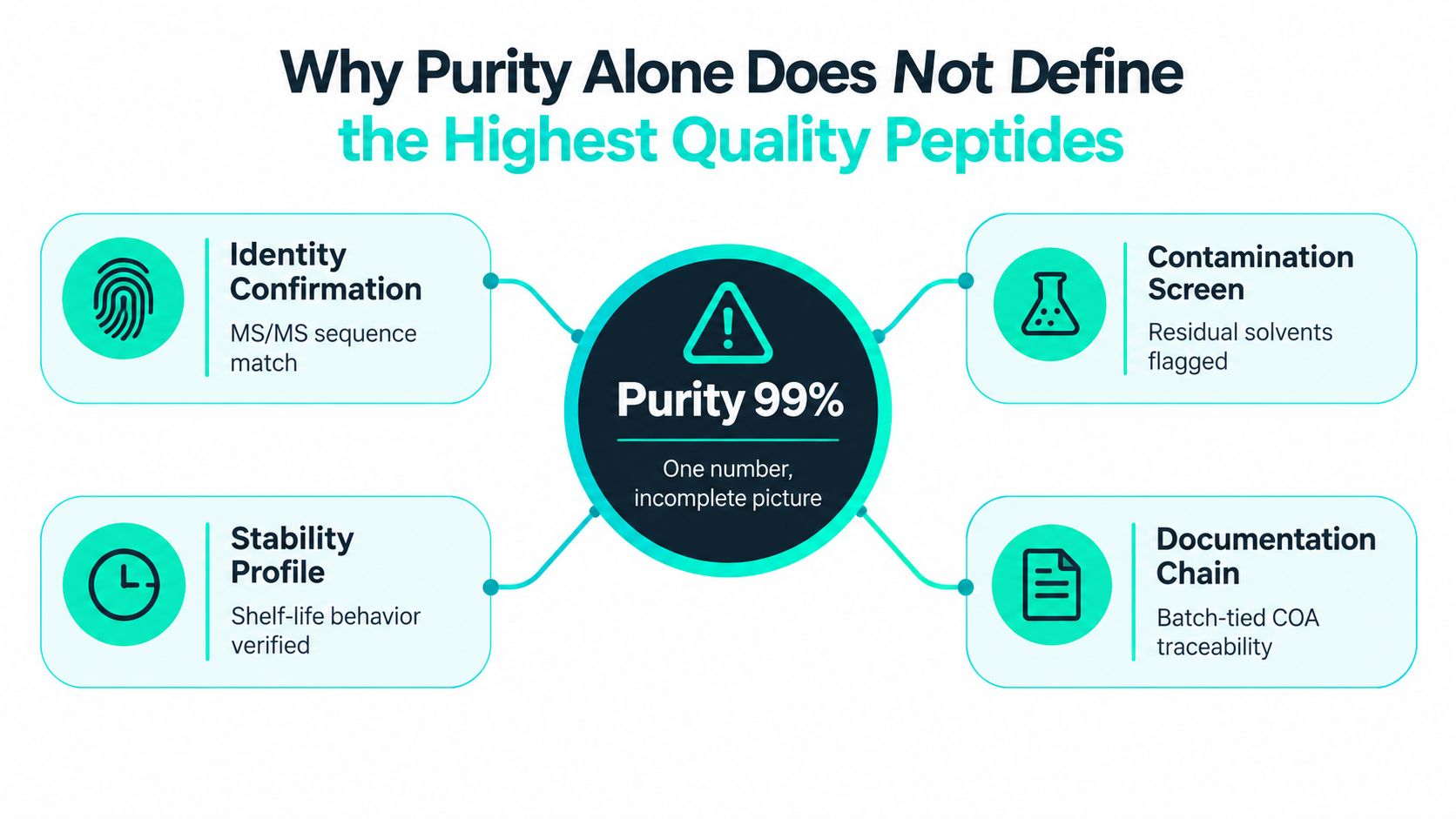
The highest quality peptides aren't defined by the largest purity number on a product page. A peptide reported at 98% by reversed-phase HPLC may still contain truncated sequences, oxidized variants, deletion products, or other synthesis byproducts, because the reported percentage describes the integrated area of the principal UV-absorbing peak rather than proving that every component is the intended sequence (peptide purity reference). The more useful question is therefore not “Is it 99% pure?” but “What evidence shows that this specific batch is the right molecule, with controlled contaminants and traceable documentation?”
A purity percentage is a measurement, not a complete quality judgment. Reversed-phase HPLC calculates purity by dividing the area of the target peak by the total integrated chromatographic area. Under that convention, a 98% result means that the main peak represents 98% of the measured UV-absorbing material, while the remaining fraction can include truncated sequences, oxidized variants, deletion products, and other byproducts (peptide purity reference).
That distinction matters because chromatography can group chemically different species into one apparent signal. Two batches with similar HPLC area percentages might differ in sequence identity, oxidation pattern, diastereomer content, counterion composition, residual solvents, or endotoxin burden. The chromatogram can look reassuring while leaving the most consequential questions unanswered.
Peptide synthesis itself creates a structural reason to distrust simple headline claims. Purity tends to decline as sequence length increases, a limitation recognized in early step-by-step synthesis. The introduction of protecting-group strategies such as Boc and Fmoc, followed by Robert Bruce Merrifield's 1963 introduction of solid-phase peptide synthesis, made longer and cleaner sequences more practical (NIH review of peptide synthesis).
The field's adoption history shows how important those improvements became. A Protein Society Research Committee study reported that 50% of participating laboratories used Fmoc chemistry in 1991, rising to 98% by 1994 and remaining at that level in 1995 and 1996. The same study reported a major improvement in peptide quality between 1991 and 1994 (Protein Society Research Committee study).
Practical rule: Treat purity as one layer of evidence. Ask for identity confirmation, impurity characterization, contamination testing, stability information, and batch-level traceability before assigning a peptide to a sensitive experiment.
The layered approach also changes procurement behavior. A credible supplier should connect the result to a specific lot, analytical method, chromatogram, observed mass, and testing date. If those links are missing, the claim may describe a product category rather than the material in the vial.
A single purity percentage cannot verify peptide quality. Each analytical method answers a narrower question, so procurement decisions should depend on whether complementary methods cover the material's likely failure modes.
Reversed-phase HPLC remains the standard first test for relative purity. It separates compounds by hydrophobicity and estimates the share represented by the target peak. UV detection does not identify the impurities beneath smaller peaks, and co-eluting compounds can make a sample appear cleaner than it is. A purity value has analytical meaning only when the certificate specifies the column, mobile-phase conditions, detection wavelength, integration rules, test date, and chromatogram.
Mass spectrometry addresses identity at the molecular-mass level. Electrospray MS or MALDI-MS can reveal major truncations, oxidation variants, and missed deprotection products. It cannot resolve every structural difference. Diastereomers and some near-isobaric species may show effectively indistinguishable mass behavior, so mass confirmation should be read alongside chromatographic separation and, where needed, tandem MS sequencing.
Amino acid analysis can estimate net peptide content, but it does not confirm sequence order. LC-MS connects chromatographic peaks with molecular masses, while high-resolution MS improves mass accuracy and supports more defensible impurity assignments. Ion mobility and other orthogonal separations can provide further discrimination when closely related species remain unresolved by reversed-phase chromatography.
| Method | What It Confirms | What It Can Miss | Typical Acceptance |
|---|---|---|---|
| Reversed-phase HPLC with UV | Relative chromatographic purity and retention behavior | Co-elution, impurity identity, non-UV-active material | Commonly 98% or higher for demanding research use, with 99%+ used for more sensitive workflows (peptide purity reference) |
| Electrospray or MALDI-MS | Approximate molecular mass and major mass-shifting modifications | Some isomers, diastereomers, and unresolved co-eluting species | Observed mass should align with the calculated mass |
| LC-MS or UHPLC-HRMS | Peak-associated mass, impurity identity, and higher-confidence characterization | Structural differences that share mass without adequate fragmentation or separation | Impurity reporting should support the intended use |
| Tandem MS | Fragment-level sequence evidence | Ambiguous fragmentation or incomplete coverage | Sequence assignment should be scientifically defensible |
| Amino acid analysis | Net peptide content estimate | Sequence order and many individual impurities | Compare with expected composition and other identity data |
| Orthogonal separation methods | Additional separation by charge, size, hydrophobicity, or mobility | Method-specific blind spots | Use when the application is sensitive to near-related impurities |
European guidance discussed in recent analytical literature expects peptide-related impurities to be reported above 0.1%, identified above 0.5%, and qualified above 1.0% (analytical guidance on peptide characterization). These thresholds show why one HPLC percentage cannot describe the full impurity profile. A supplier offering only a single chromatogram cannot fully support molecular identity, impurity assignment, or suitability for sensitive translational work.
The verification package should match the experiment's risk. A receptor-binding screen may require less evidence than a quantitative bioassay or structural study. HPLC and MS analysis services can support this process, but the buyer should review the underlying methods, results, and batch records rather than relying on the service label alone. Orthogonal data, contamination testing, and lot-specific documentation provide the stronger basis for calling a peptide high quality.
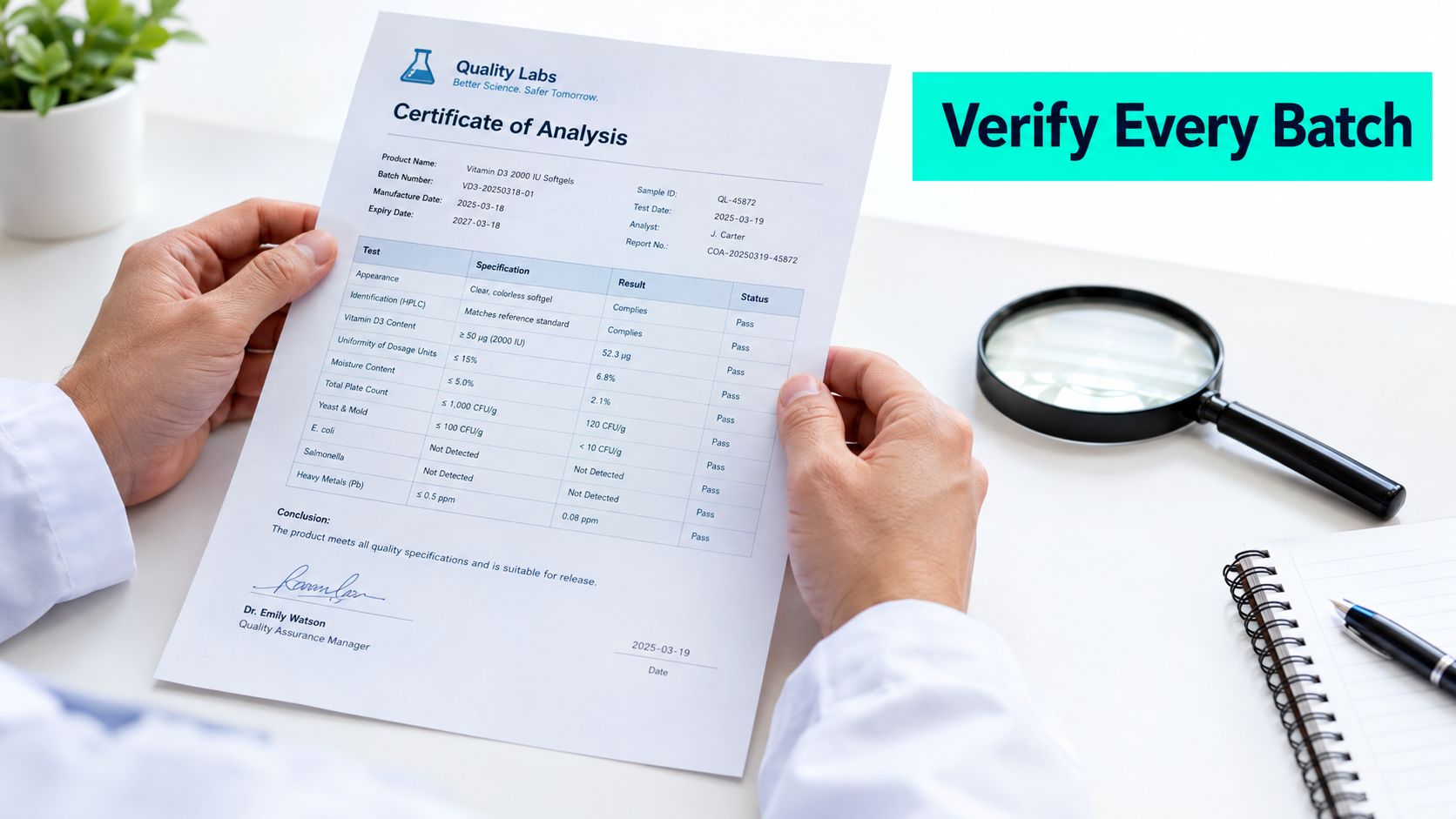
A Certificate of Analysis supports a release decision only when it connects the tested material to a defined method, date, laboratory, and lot. A polished PDF without those links is a marketing summary, not an auditable quality record.
Begin with the identity block. It should name the peptide, provide its sequence or an unambiguous identifier, and state the batch or lot number. That identifier should correspond to the synthesis record, release decision, and vial supplied to the customer. A certificate covering every batch cannot establish what happened to the specific material under review.
The HPLC result should identify the method, column, detection wavelength, integration rules, and test date. A rounded purity value without a representative chromatogram prevents review of peak shape, shoulders, late-eluting material, and integration choices that could affect the reported result.
The mass section should report calculated and observed mass, preferably with the spectrum or an equivalent analytical record. Higher-risk work benefits from LC-MS or HRMS evidence that links impurity peaks to molecular assignments. Orthogonal characterization matters because a principal peak can be chemically consistent with a high-purity result without proving the intended sequence.
Audit question: Could an independent reviewer identify the exact sample, repeat the interpretation, and challenge the release decision from this certificate?
A stronger certificate may include net peptide content by amino acid analysis, counterion or trifluoroacetate information, and residual solvent results. The issue date, analyst or qualified-person sign-off, laboratory identity, and deviation statement add traceability. For readers comparing analytical documents, this terpene certificate of analysis explained resource provides a useful example of how test scope and material identity are presented.
Review the certificate against the vendor's peptide test results documentation, applying the same standard to both. Red flags include identical certificates for different lots, missing batch identifiers, absent chromatograms, no observed mass, unexplained purity rounding, and storage or retest information not tied to the supplied material. The document should also state which contamination tests were performed, where relevant, rather than implying that purity covers microbial, endotoxin, residual solvent, or elemental risks. The practical test is simple: does the evidence support a defensible release decision for this lot and this experiment?
The synthesis route influences the impurity burden before the analytical laboratory ever receives the sample. In solid-phase peptide synthesis, each coupling, deprotection, wash, and cleavage step creates opportunities for incomplete reaction, side reactions, or sequence-related byproducts.
Fmoc and Boc strategies both have established roles. The choice affects protecting-group removal, cleavage chemistry, resin handling, and the types of side products the process may generate. Resin loading also matters. Higher loading can improve productivity, but steric crowding may make coupling less complete for difficult sequences. Lower loading can support cleaner synthesis while increasing material and processing demands.
Coupling reagents, reaction monitoring, wash efficiency, and cleavage conditions all shape crude quality. Aspartimide formation, racemization, incomplete deprotection, and failed couplings can create impurities that reversed-phase HPLC may separate, partially separate, or fail to distinguish clearly. A supplier that explains how it controls these risks gives the buyer more useful information than one that states only a purity percentage.
| Attribute | Standard Research-Grade | GMP-Adjacent Production |
|---|---|---|
| Intended use | Exploratory assays, screening, and method development | Work requiring stronger documentation and controlled release |
| Process controls | Defined synthesis procedure with in-process checks appropriate to the project | More formal controls, qualified materials, and documented deviations |
| Raw materials | Supplier and specification review suited to research scope | More extensive qualification and change-control expectations |
| Analytical package | HPLC and mass confirmation, with added tests when needed | Orthogonal characterization, impurity profile, and stronger traceability |
| Environment | Laboratory controls appropriate to the material and procedure | More structured environmental, cleaning, and documentation controls |
| Release decision | Fit-for-purpose review by the research team | Formal review against predefined specifications |
| Trade-off | Faster or more flexible project-specific work | Greater documentation and control, with added cost and process burden |
The distinction isn't a universal ranking. Research-grade material can be appropriate for an in-vitro screen, while a GMP-adjacent process may be justified for translational studies that depend on reproducibility and a defensible chain of custody. The manufacturing tier should match the consequence of an impurity, not the prestige of the label.
Process quality also depends on documentation discipline. A useful quality control guide from Polymerize provides broader manufacturing context for thinking about specifications, inspections, and release controls. For peptide procurement, translate that general logic into concrete questions: Which resin and protecting-group strategy were used? Were difficult couplings monitored? Were deviations recorded? Was the final material reprocessed, and if so, how was the new impurity profile assessed?
The cleanest procurement decision often comes from matching manufacturing controls to experimental consequence, not from buying the most heavily regulated product by default.
A peptide can satisfy a chromatographic purity specification and still be unsuitable for an assay. Residual solvents, counterions, endotoxin, metals, microbial contamination, and storage-related degradation are separate quality attributes. A credible release package should show how each relevant risk was assessed rather than allowing one purity value to stand in for the whole material.
Request a residual solvent panel covering process-relevant solvents, including acetonitrile, TFA, and DMF where applicable. Counterion content also affects practical use. Acetate and trifluoroacetate salts can change measured mass, molar concentration calculations, solubility, pH behavior, and assay interpretation. If the reported peptide mass does not state its counterion basis, the laboratory may prepare the wrong concentration.
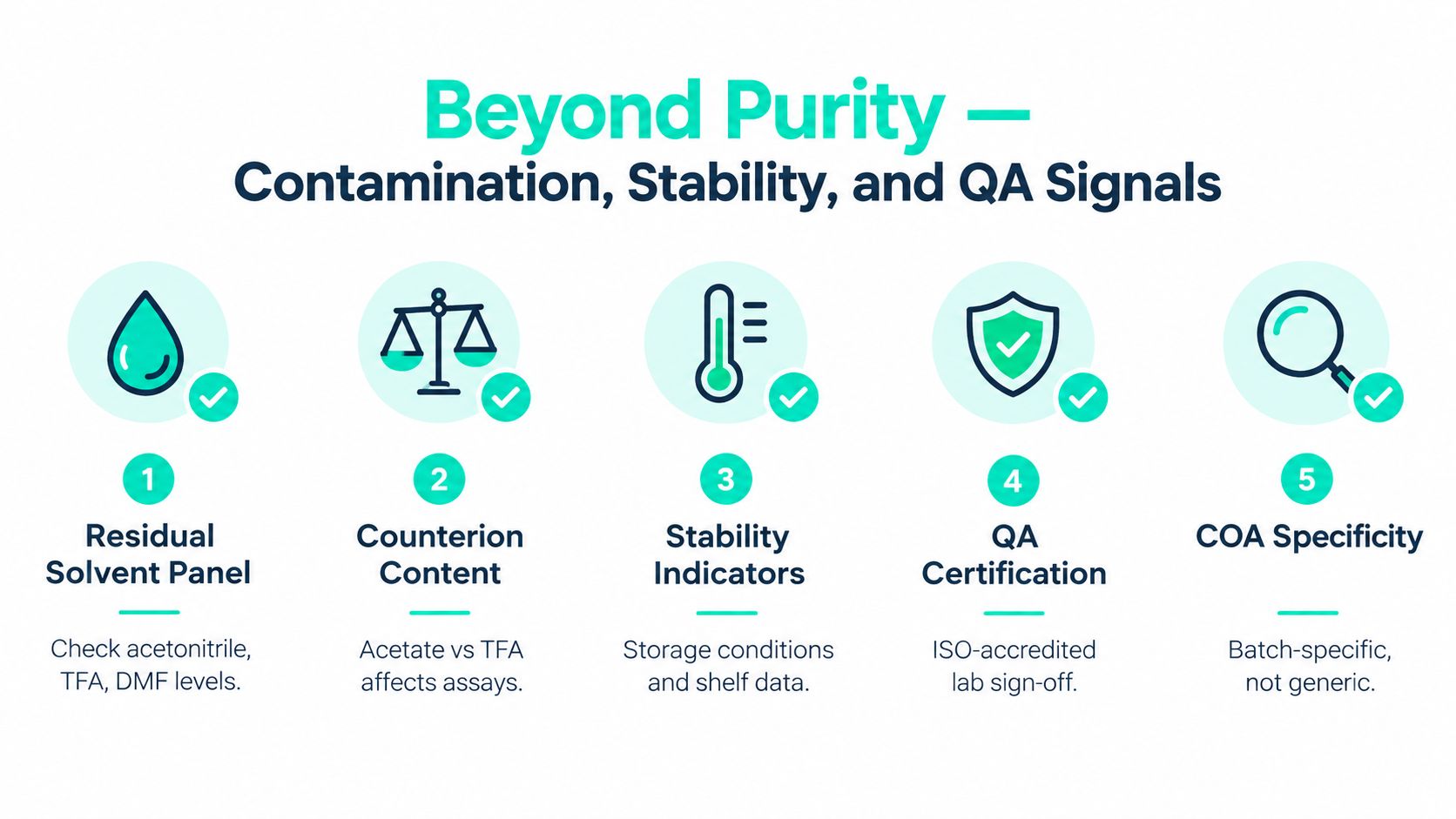
For cell-based work, endotoxin results may matter more than a small difference in HPLC area percentage. Animal studies may call for heavy-metals screening, such as ICP-MS, together with documented endotoxin testing. Bioburden or microbial testing becomes relevant when the material, formulation, handling process, or study design creates that risk.
Current release practice increasingly treats endotoxin, residual solvents, heavy metals, and microbial limits as separate release attributes rather than folding them into a single purity number. These tests are not automatically required for every exploratory experiment. The supplier should still identify what was tested, what was excluded, the method used, and the reason for each limitation.
Stability statements require the same scrutiny. “Store frozen” describes handling, not stability evidence. Look for real-time or accelerated data, freeze-thaw information where relevant, packaging details, and a defined retest approach. Without those data, treat the material as time-sensitive and include independent confirmation in the study plan.
Record these gaps before purchase. A supplier may provide a fast HPLC result while omitting contamination testing or stability characterization. That does not automatically make the material unusable, but it transfers verification work to the buyer and raises the risk that an uncontrolled impurity or degradation product will influence the assay. The strongest QA signal is therefore not a polished purity claim, but a lot-specific evidence package that matches the experiment's actual failure modes.
Consider three hypothetical vendors that publish the same headline purity claim. Their products may look equivalent in a search result, but their evidence packages support very different decisions.
Vendor A publishes a single HPLC trace with no lot-specific mass spectrum, contamination panel, or stability information. This may be adequate for an early, low-consequence exploratory screen if the laboratory has a plan to characterize the material independently. It isn't a strong choice when sequence identity, endotoxin, or lot-to-lot reproducibility could change the conclusion.
Vendor B supplies a batch-tied COA with HPLC and mass confirmation, identifies the lot, and provides a dated analytical record. That package offers a defensible foundation for many research applications, although the buyer should still ask about residual solvents, counterions, endotoxin, and the method's ability to resolve relevant impurities.
Vendor C supplies the same core evidence plus orthogonal impurity characterization, contamination testing, stability information, and clear disclosure of limitations. Its advantage isn't the headline number. It's the reduced uncertainty around how the material behaves and what else it contains.
| Verification Layer | Vendor A: HPLC Only | Vendor B: Batch-Tied COA | Vendor C: Full Panel |
|---|---|---|---|
| Identity | Retention time only | Mass confirmation tied to lot | Mass confirmation plus orthogonal or sequence evidence |
| Purity | Single chromatographic percentage | HPLC method and chromatogram | HPLC plus impurity characterization |
| Contamination | Not demonstrated | Available only if separately requested | Defined panel matched to intended use |
| Traceability | Product-level claim | Lot, date, and release record | Lot, release record, testing history, and stability context |
| Reproducibility | Difficult to assess | Comparable across documented lots | Supported by broader lot and stability information |
| Procurement posture | Conditional and higher-risk | Suitable for defined research uses | Stronger fit for sensitive or translational work |
This isn't a leaderboard. Vendor A may be acceptable when the assay is disposable and the lab can run independent testing. Vendor C may be unnecessary for a preliminary binding experiment but valuable when a failed result would consume scarce samples or delay a development decision.
Ask each supplier the same closing questions: Which batch was tested? What was the observed mass? Which impurities were identified? Were endotoxin and residual solvents measured? Can the laboratory obtain the raw chromatogram and method details? A documented vendor qualification process can help formalize those questions, but the scientific judgment remains application-specific.
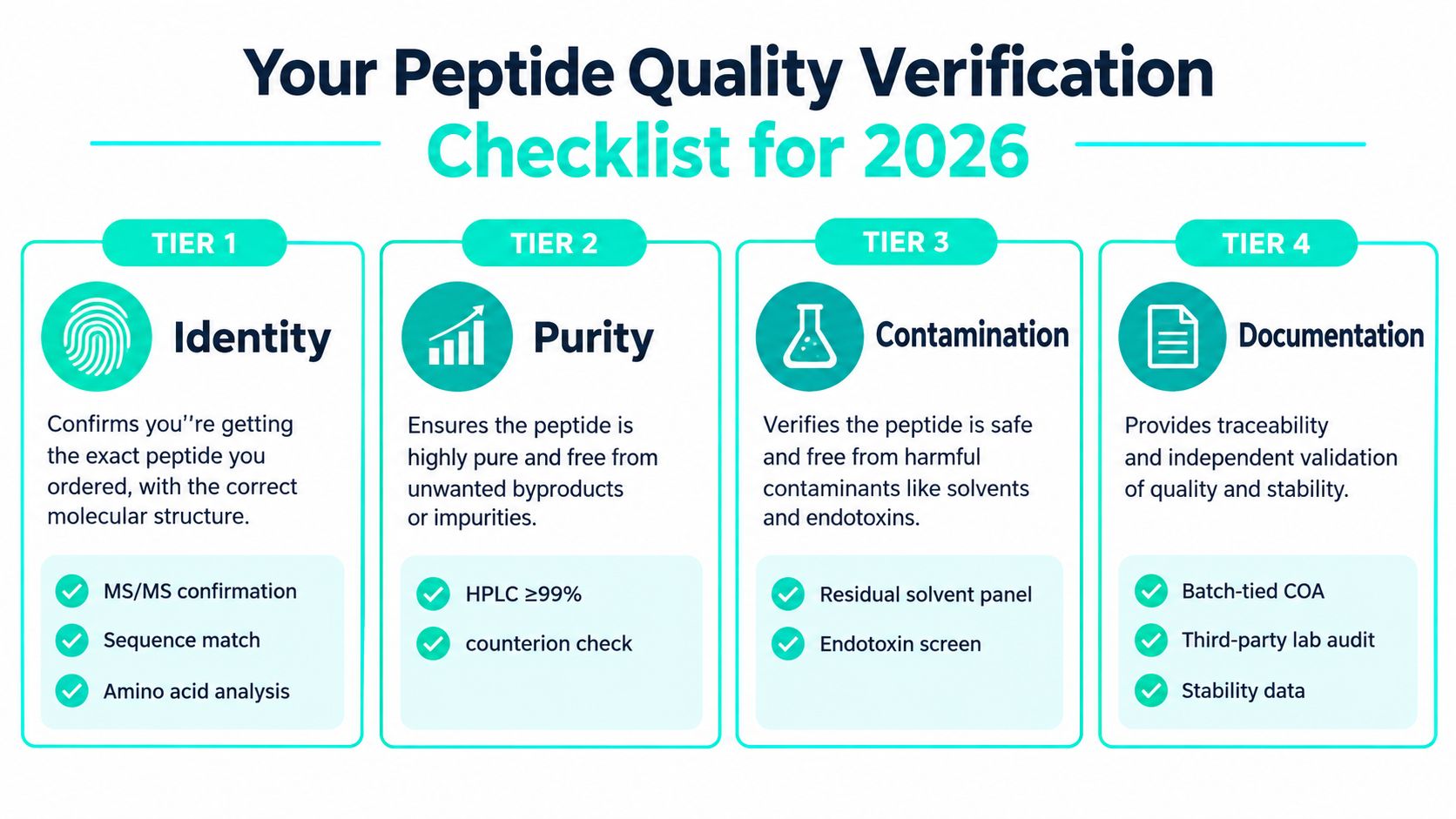
Use the following as a pre-purchase filter, not as a substitute for your institution's SOPs, method validation, or QA review. The strongest decisions move from molecular identity outward, because a peptide can't be considered fit for purpose if the principal component hasn't been convincingly identified.
A 98% or higher HPLC result is commonly used as a practical cutoff for demanding research, while 99% or higher is reserved for more sensitive quantitative, structural, and clinical-adjacent workflows (peptide purity reference). The percentage should never be detached from the method that produced it.
The appropriate threshold depends on the consequence of failure. Receptor-binding screens may tolerate a wider impurity profile than bioactivity studies, and animal work generally requires more extensive documentation than exploratory in-vitro testing. Those added controls carry a cost, but so does repeating an experiment with an undocumented material.
Re-verify when the synthesis route changes, a new lot shows altered behavior, storage conditions are breached, or the peptide moves into a more sensitive application. Escalate from document review to a formal supplier audit when the material becomes central to a translational decision, repeated discrepancies appear, or the vendor cannot explain analytical gaps.
Celonyx Labs supplies research peptides through an online catalog and presents batch-level quality documentation and independent testing information for its products. Review the available evidence against your laboratory's identity, contamination, and traceability requirements by visiting Celonyx Labs before placing your next order.
Is bacteriostatic water the same as sterile water? No. Compare preservatives, vial handling and peptide

How do you know if a peptide vial has gone bad? Quarantine changes, check storage

Can too much bacteriostatic water ruin a peptide vial? Yes, if it overfills the vial
FOR RESEARCH USE ONLY. Products sold by Celonyx Labs are intended exclusively for laboratory and scientific research. They are not intended for human or veterinary use, consumption, diagnosis, treatment, cure, or prevention of any disease. By purchasing from this site, you acknowledge that you understand the intended research purpose of these materials and agree to comply with all applicable laws and regulations.