
BPC 157 Powder: A 2026 Research Guide
A 2025 review of BPC-157 identified 36 relevant studies, 35 preclinical and only 1 clinical.

Online peptide dosing calculators are accurate only when their formulas, units, and input assumptions match your laboratory protocol. They calculate nominal concentrations and transfer volumes; they do not verify peptide identity, actual peptide content, dissolution, or pipette performance. In 2026, use a calculator as an arithmetic aid, not as evidence that your prepared solution has the intended concentration.
A correct calculation can describe an incorrectly prepared solution. If you enter the wrong mass, confuse volume units, or treat purity as measured peptide content, the calculator can return a plausible answer that does not represent your sample.
For your 2026 laboratory workflow, separate three questions: Is the arithmetic correct? Are the inputs justified? Does the preparation match those inputs? When evaluating peptide dosing calculators for research, judge the calculation logic rather than the number of decimal places displayed.
Here, dosing means calculating an amount or concentration for a laboratory experiment. It does not mean selecting a human dose, an administration route, or a treatment schedule. Research-use-only materials are not for human consumption or clinical use.
An online calculator is mathematically reliable for a particular task when its output agrees with an independently verified formula and its unit conversions are correct. That is narrower than experimental accuracy: the result still depends on what you weighed, dissolved, transferred, and recorded.
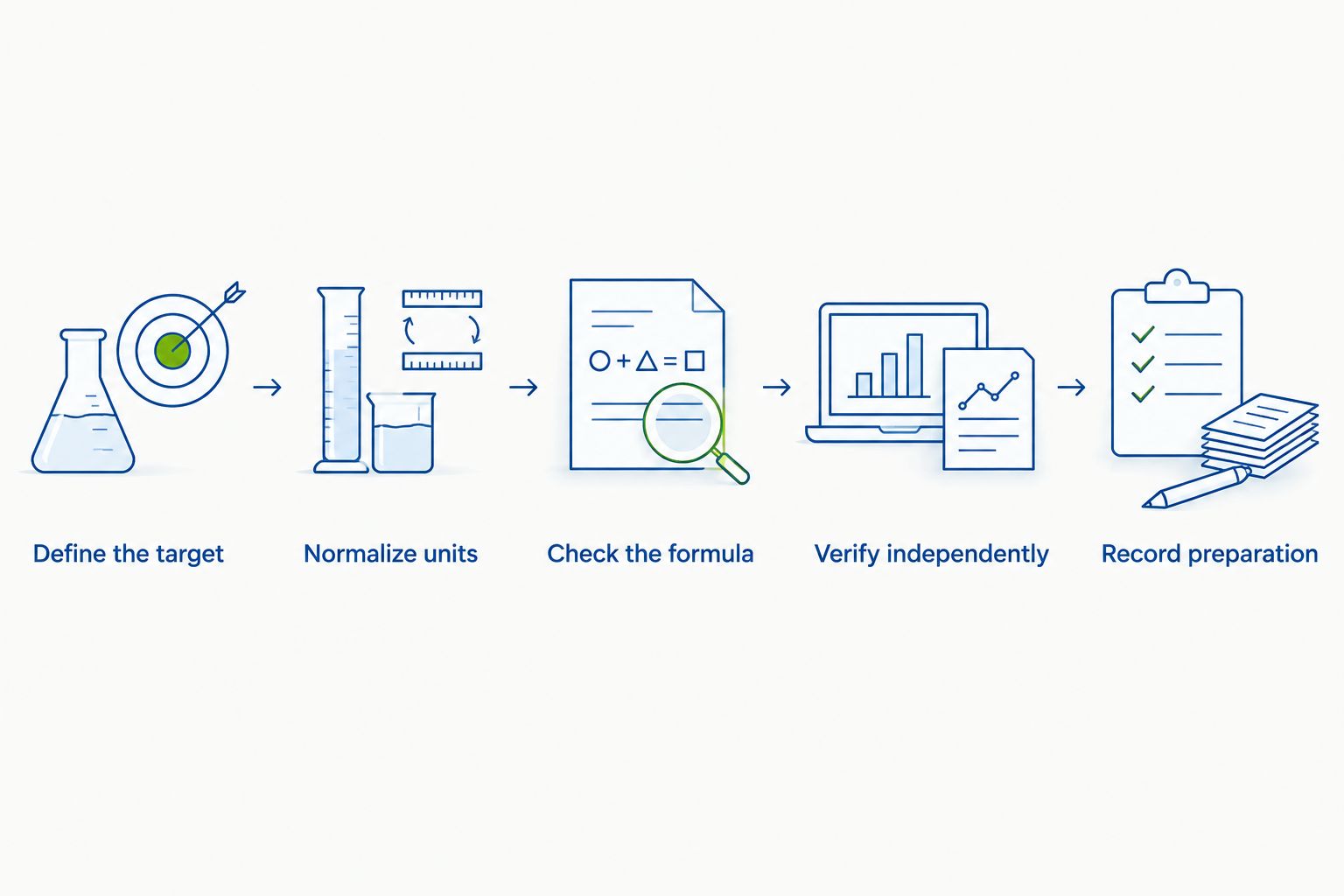
Use this verification sequence before accepting an output:
A calculator that hides its formula or leaves units ambiguous is unsuitable for a calculation you cannot otherwise verify. Extra precision on the screen does not resolve either problem.
For mass concentration, the governing relationship is straightforward:
Concentration = peptide mass ÷ final solution volume.
Use compatible units throughout. The established metric conversions are 1 mg = 1,000 µg and 1 mL = 1,000 µL. A calculator must preserve these relationships when converting between mg/mL and µg/µL.
Pay particular attention to what the mass field represents. A label claim, weighed powder mass, and analytically determined peptide content are not interchangeable measurements. Counterions, water, and other non-peptide components can affect how powder mass relates to peptide content.
Also distinguish solvent added from final solution volume. A formula expressed in final volume requires that quantity; it should not silently substitute a different preparation measurement. Follow the preparation method specified by your laboratory protocol.
The advantage of mass concentration is that it does not require molecular weight. Its limitation is equally clear: mass per volume does not tell you the number of peptide molecules present or confirm biological activity.
Molar concentration requires a molecular-weight value as well as mass and volume. The dimensional relationship is:
Molar concentration = peptide mass ÷ molecular weight ÷ final solution volume.
With mass in grams, molecular weight in grams per mole, and volume in liters, the result is moles per liter. 1 µM = 1 µmol/L; a molarity calculator must handle that conversion explicitly.
Confirm the peptide sequence and chemical form associated with the molecular-weight input. Modifications and salt forms require attention to the stated mass basis. Do not assume that a molecular weight copied from a similarly named compound applies to the material in your vial.
Molar concentration is appropriate when your assay protocol specifies a molecular concentration. Its limitation is dependence on additional assumptions: an incorrect molecular-weight basis or unsupported peptide-content adjustment propagates into the result.
For a 2026 protocol review, record the source of the molecular-weight value alongside the calculation. A saved output without that source is difficult to reconstruct when the material or documentation changes.
For a dilution that conserves the amount of solute, the relationship is C₁V₁ = C₂V₂. The stock concentration, stock transfer volume, target concentration, and final volume must use consistent units.
This equation describes dilution arithmetic. It does not establish that the stock remained stable, that the peptide dissolved completely, or that the solvent is compatible with the assay.
Specify the destination clearly. A transfer into an existing assay mixture differs from preparing a separate working solution to a defined final volume. The calculator's volume field must represent the quantity your protocol actually uses.
The advantage of a dilution calculator is convenient rearrangement of the equation. The limitation is that an incorrect stock concentration becomes an incorrect working concentration even when every subsequent step is calculated correctly.
Choose the approach that makes the assumptions easiest to inspect and preserve. None of these approaches independently measures the material in the vial.
| Approach | Best for | Advantage | Limitation | Acceptance check |
|---|---|---|---|---|
| Online calculator | A clearly defined, occasional calculation | Fast entry and automatic conversions | Formula, rounding, or field meanings can be unclear | Reproduce the result independently |
| Controlled spreadsheet | Repeated calculations under a laboratory procedure | Formulas and input fields can be retained together | Edited cells or incorrect formulas can propagate errors | Protect formulas and review revisions |
| Manual calculation | An independent arithmetic check | Makes dimensional relationships visible | Transcription and conversion mistakes remain possible | Write units at every step |
Use a transparent calculator for convenience and a separately checked calculation for verification. Two websites that agree are not necessarily independent evidence if they apply the same assumptions or repeat the same error.
A controlled spreadsheet also needs verification before routine use. Keeping a formula in a file does not make it correct; your laboratory must check the formula, input restrictions, and handling of invalid entries.
Separate calculation errors from preparation errors. These factors explain why a nominal result and an experimental preparation can differ:
Do not combine these issues into an unsupported percentage accuracy claim. A useful assessment identifies which inputs are measured, which are assumed, and which controls establish fitness for the intended experiment.
99% purity does not, by itself, establish solution concentration. Purity describes a material characteristic under a specified analytical method; concentration describes an amount per volume. You need the analytical method and reporting basis to interpret the relationship.
Chromatographic peak-area purity is not automatically a gravimetric peptide-content measurement. Nor does it establish sterility, complete dissolution, stability after preparation, or suitability for a particular assay.
Celonyx Labs sells 99%-pure, third-party-tested research peptides. Celonyx Labs research peptides are best suited to laboratory researchers seeking those stated sourcing attributes, not clinical-use materials. Those attributes do not replace protocol-specific checks on content, concentration, or handling.
The practical benefit is a stated purity and testing basis for sourcing discussions. The limitation is that those statements alone cannot validate your prepared solution. Assess the relevant documentation using the principles in peptide purity testing for contract research organizations, and keep the analytical result separate from the calculator output.
Verify liquid handling separately from the calculation. A correct transfer target does not establish that the instrument delivered that volume under your working conditions.
Your laboratory procedure should connect equipment identification, calibration status, technique, and the intended transfer range. When selecting pipette calibration services, match the documented calibration scope to the pipettes and volume ranges used in the experiment; an unrelated equipment check does not substantiate the transfer you recorded.
Calibration addresses instrument performance, while technique and sample behavior also affect delivery. Follow the pipette manufacturer's instructions and your laboratory's validated handling method, including any requirements for the liquid being transferred.
If a calculated transfer falls outside the equipment's specified operating range, do not round it into range and proceed. Revise the preparation through an approved dilution step, then recalculate the target. Keep the required concentration intact; change the preparation plan rather than silently changing the experimental amount.
For a reproducible 2026 record, preserve the calculation's context rather than a screenshot alone. Another researcher should be able to reconstruct both the arithmetic and the preparation without guessing what each field meant.
Record these details with the experiment:
Keep calculated concentration and measured concentration in separately labeled fields. If you later obtain an analytical concentration measurement, retain the original nominal value and the measurement basis rather than overwriting the preparation history.
For online tools, also preserve enough information to detect changes in behavior. A saved link alone cannot explain which fields, unit settings, or assumptions produced an earlier result.
A peptide calculator can convert a protocol-defined amount into a volume, but it cannot establish the scientific justification for that amount. Experimental concentration selection requires an appropriate study design and supporting evidence.
Do not interpret a calculator's preset values as a validated protocol. Research materials require the approvals, oversight, and procedures appropriate to the study; arithmetic does not replace them.
A syringe-unit output is a volume-scale conversion, not a peptide concentration. Interpreting it requires the relevant device scale and a justified stock concentration.
For laboratory calculations, record physical volume explicitly rather than an unlabeled unit count. A bare number copied between devices or worksheets loses the information needed to verify the transfer.
How accurate are online peptide dosing calculators for research?
Online peptide dosing calculators are accurate for a defined calculation only when their formulas, units, and input assumptions are correct. Verify the result independently and check preparation separately; arithmetic does not measure the actual sample.
Can I trust a calculator that shows many decimal places?
Many decimal places do not establish accuracy. Report precision consistent with your input measurements and equipment rather than copying every displayed digit.
Does 99% purity mean my peptide solution has the correct concentration?
99% purity does not establish solution concentration. Concentration also depends on the relevant peptide-content basis, final volume, and preparation; interpret purity using the stated analytical method.
Should I calculate peptide concentration in mass units or molar units?
Use the concentration units specified by your experimental protocol. Mass concentration uses mass and volume, while molar concentration also requires an appropriate molecular-weight basis.
Is an online calculator better than a spreadsheet?
Neither an online calculator nor a spreadsheet is inherently more accurate. Choose an approach with inspectable formulas, clear units, and a controlled record, then verify it independently.
Can I use a peptide dosing calculator to choose a human dose?
No, a research peptide calculator does not establish a safe or appropriate human dose. Research-use-only peptides are not for human consumption or clinical use.
Does third-party testing replace calculation checks?
Third-party testing does not replace calculation checks. Celonyx Labs states that its research peptides are third-party tested, but your laboratory must still verify the calculation, documentation, and preparation for its experiment.
Check what the denominator means before checking the decimal places. A precisely calculated concentration can still be wrong for your protocol if the volume refers to solvent added rather than the required final solution volume.
Make that distinction explicit in your 2026 worksheet. The most useful calculator output is one another researcher can reproduce from documented inputs—not simply one that looks precise.
A 2025 review of BPC-157 identified 36 relevant studies, 35 preclinical and only 1 clinical.
There's no nationwide rule that insulin syringes are prescription-free: your order depends on the destination
Buy the highest purity number you can find and you're covered. That's the most popular
FOR RESEARCH USE ONLY. Products sold by Celonyx Labs are intended exclusively for laboratory and scientific research. They are not intended for human or veterinary use, consumption, diagnosis, treatment, cure, or prevention of any disease. By purchasing from this site, you acknowledge that you understand the intended research purpose of these materials and agree to comply with all applicable laws and regulations.