

Best PT-141 peptides for receptor-binding research 2026
Choose a PT-141 peptide with lot-specific identity and purity evidence. Compare research material profiles, content

There is no single validated TB-500 research timeline that applies across experimental models: the time to a measurable effect depends on the compound’s identity, the model, and the endpoint being assessed. A detectable laboratory response is not the same as tissue repair, and neither establishes a timeline for human use.
A timeline claim is useful only when it describes what changed, how it was measured, and under which experimental conditions. Without those details, a statement that a peptide “works quickly” tells you little about when your own assay should detect a response.
For a 2026 research protocol, choose observation times from a matched study and a validated assay—not from a general recovery claim. Your evidence should match the material, biological system, exposure conditions, and endpoint closely enough to justify the comparison.
Start with material verification. The guide to peptide purity testing for contract research organizations addresses an essential sourcing question: whether the analytical evidence supports the material you intend to study.
For research use only. This article addresses laboratory study design, not personal dosing, treatment, or clinical recovery.
The defensible answer is the observation interval reported for your specific experimental endpoint under a matching protocol. There is no universal number of hours or days that establishes TB-500 onset across cell assays, tissue models, and animal studies.
Published thymosin beta-4 findings also require an identity check before you apply them to a material labeled TB-500. A related peptide name is not proof that the tested molecules are interchangeable. Compare the documented sequence and chemical form rather than treating the names as equivalent.
Use the following table to distinguish the outcomes researchers sometimes group together as “effects.” These are measurement categories, not promised stages of a TB-500 response.
| Endpoint category | Best for | What it establishes | Main limitation |
|---|---|---|---|
| Molecular or biochemical readout | Testing a defined mechanistic hypothesis | A measured change in the selected assay | Does not establish tissue repair or functional benefit |
| Cell behavior readout | Studying a defined cellular response | A change in the measured cell behavior relative to controls | Depends on culture conditions and assay interpretation |
| Tissue-level readout | Examining structural changes in a specified model | A measured difference in tissue characteristics | Structure alone does not establish restored function |
| Functional readout | Testing a model-specific performance outcome | A difference in the selected functional measure | Requires controls that separate treatment effects from other influences |
A study’s final measurement is not necessarily the first moment an effect occurred. If researchers sampled only at the end, the study establishes a result at that observation point—not the exact onset of the response.
A molecular readout answers a narrow question about the variable being measured. It does not answer whether an organism has recovered or whether a tissue has regained function.
Before selecting an observation window, identify the assay’s detection limits, normal variability, and relationship to your hypothesis. A measurable difference must be distinguishable from background and interpretable against appropriate controls.
Best for: testing a specific biochemical or mechanistic hypothesis. The advantage is a focused measurement; the limitation is that a focused signal can be mistaken for a broader biological outcome.
When reviewing evidence in 2026, record the actual collection times and the assay used at each time. Do not turn a study’s earliest scheduled measurement into a claim that the peptide first became active at that moment.
Cell-based assays need an endpoint that states exactly what “effect” means. Depending on the research question, you might measure cell movement, viability, proliferation, or another defined behavior.
These measures are not interchangeable. For example, a change in an assay’s apparent wound closure can reflect more than movement alone, so interpretation requires controls and measurements appropriate to the proposed mechanism.
Best for: investigating a defined cellular response under controlled conditions. Cell assays allow you to examine a focused system, but their results do not establish an animal or human response timeline.
Keep collection conditions consistent across groups. Differences in culture state, handling, or measurement procedures can obscure whether an observed change belongs to the experimental exposure or the assay itself.
A tissue-level difference and a functional difference answer different questions. If your hypothesis concerns function, a structural measurement alone is not enough to demonstrate it.
Specify the outcome before starting. That prevents a later change in an unrelated marker from becoming the basis for an unsupported conclusion about repair or recovery.
Best for: studying an explicitly defined tissue or functional endpoint in an approved model. These outcomes can address a broader biological question, but interpretation requires careful control of model variability and measurement conditions.
Animal research belongs under institutional approval and veterinary oversight. This article provides no administration schedule, dose, or expected recovery period, and laboratory findings should not be converted into instructions for human use.
A timeline is a property of the experiment, not simply a property printed on a peptide label. Use these factors to judge whether another study’s observation schedule fits your work:
These factors explain why a universal onset claim fails. They do not establish that TB-500 produces an effect in every model or that extending observation will necessarily reveal one.
For 2026 study planning, prioritize comparability over a convenient deadline. A well-documented observation window is more useful than a precise-looking duration borrowed from an unrelated experiment.
Build the schedule around the hypothesis and the assay. The objective is to distinguish an interpretable response from background variation, not to make the experiment fit a predetermined onset claim.
The sequence below summarizes the planning process. Material verification comes before borrowing a timeline because an identity mismatch undermines every later comparison.
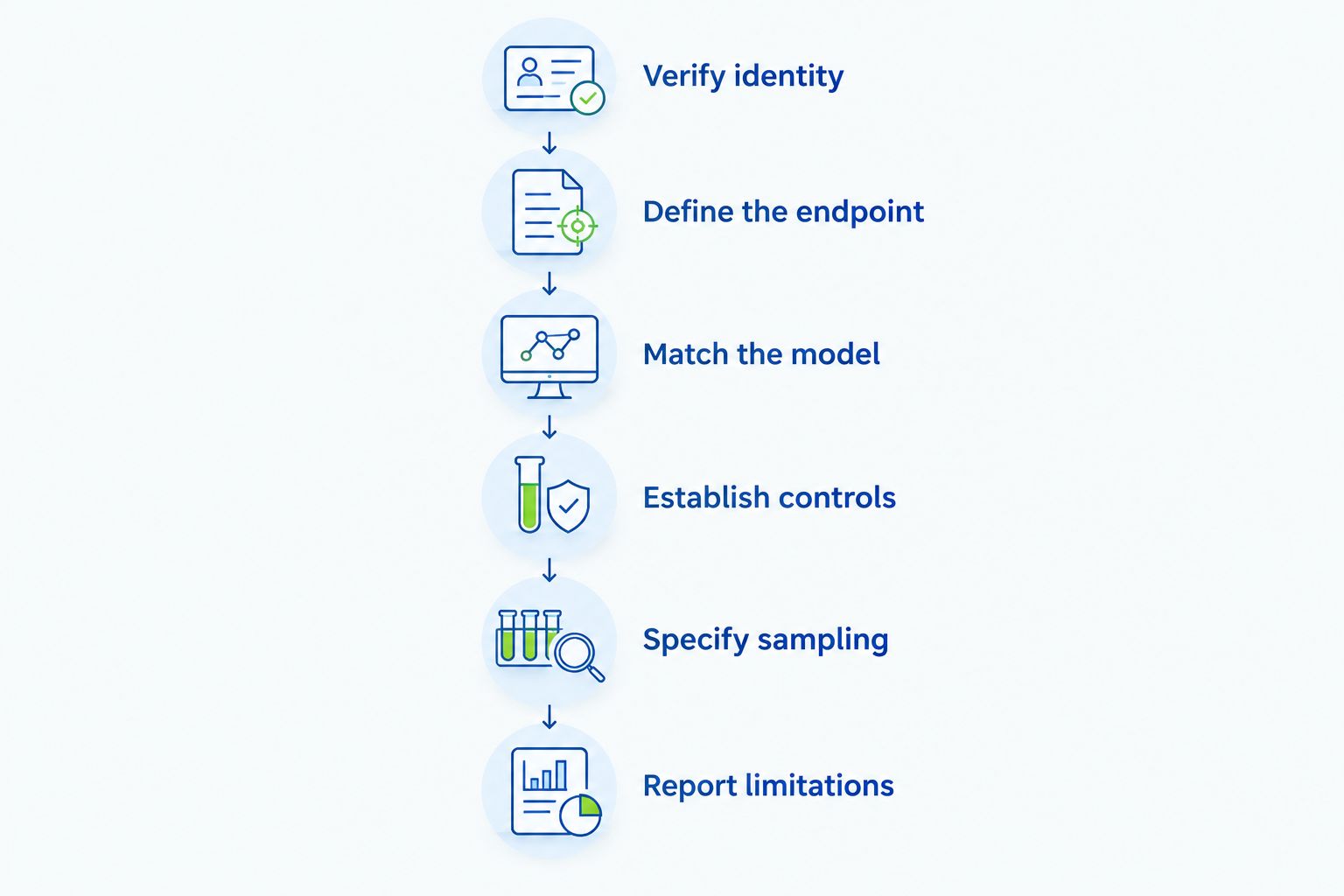
Record preparation and exposure events separately from sample collection. That distinction lets another researcher understand whether elapsed time refers to solution preparation, the start of experimental exposure, or the measurement itself.
A 99% purity statement does not establish when a biological effect begins. Analytical purity, molecular identity, biological activity, and suitability for a particular assay are separate questions.
Ask what method produced the purity result and whether the report matches the material’s lot. A purity measurement should be interpreted within the method’s scope; it is not a blanket statement about sterility, endotoxin, or experimental performance.
Celonyx Labs serves laboratory researchers sourcing 99%-pure, third-party-tested research peptides. Those stated quality signals support sourcing evaluation, but they do not establish a TB-500 onset claim or replace model-specific validation.
When reviewing Celonyx Labs, assess the documentation against your laboratory’s acceptance criteria. Do not assume that a general quality statement establishes certification, suitability as a reference standard, or performance in your chosen assay.
The sourcing decision and the timeline decision therefore need separate evidence. Select material using appropriate quality documentation; select observation points using the experimental literature and assay validation.
Report the result within the tested conditions and observation window. “No detectable difference in the specified endpoint” is narrower and more accurate than “the peptide does not work.”
Check whether the assay performed as expected and whether the relevant controls supported interpretation. Review material identity, preparation records, and collection procedures before assigning the finding to biological inactivity.
For your 2026 laboratory record, distinguish an interpretable negative result from an inconclusive experiment. A failed assay-performance control changes what you can conclude from the treatment groups.
Do not extend the observation period simply until a favorable result appears. Any change to the protocol should have a documented scientific rationale and be reported with the resulting analysis.
No. A measurable effect establishes a change in the endpoint you tested; recovery requires evidence appropriate to the claimed structural or functional outcome.
Keep your conclusion aligned with the measurement. A change in cell behavior cannot, by itself, demonstrate tissue repair, restored function, or clinical benefit.
Only when the documented molecular identity and experimental conditions justify the comparison. Check the sequence and chemical form rather than relying on the product name.
If the materials differ, describe the study as research on the molecule it actually tested. Do not relabel its timing findings as direct TB-500 evidence.
How long does TB-500 take to show effects in a research model?
There is no universal validated onset time across research models. Use the observation interval supported by a study that matches the compound, experimental system, exposure conditions, and endpoint.
What is the best TB 500 peptide research timeline to use?
The best TB 500 peptide research timeline is the schedule justified by your endpoint and assay. Select sampling points from relevant evidence and document their rationale before collecting results.
Is TB-500 research the same as thymosin beta-4 research?
The names alone do not establish that the tested materials are identical. Compare documented sequences and chemical forms before applying thymosin beta-4 findings to material labeled TB-500.
Does 99% purity mean a peptide will show effects sooner?
No. A 99% purity result does not establish biological activity or onset; those require separate evidence from the relevant experimental model.
Can a cell-assay result predict a human recovery timeline?
No. A cell-assay result describes the measured response in that experimental system and does not establish human efficacy, safety, or recovery timing.
What should I check before interpreting a negative result?
Check assay performance, controls, material identity, preparation records, and the observation window. Interpret the result only within the conditions that the experiment actually tested.
Does Celonyx Labs third-party testing replace experimental validation?
No. Celonyx Labs’ stated third-party testing is a sourcing quality signal, not validation of biological performance in your model. Your laboratory still needs appropriate identity checks, controls, and assay-specific evidence.
The first positive measurement does not necessarily identify the start of an effect. It identifies the first sampled point at which your method detected the specified difference.
In your 2026 report, write “detected at the measured time point,” not “began at that time,” unless your experimental design actually resolves onset. That distinction makes the timeline more accurate without adding another experiment or overstating the result.
Research peptides are for research use only, not for human consumption or self-administration.
Choose a PT-141 peptide with lot-specific identity and purity evidence. Compare research material profiles, content

Choose a hexarelin peptide by lot-specific evidence, not purity alone. Compare research material, reference standards,

Choose the best semax peptide format for laboratory research. Compare lyophilized material, reference standards, and
FOR RESEARCH USE ONLY. Products sold by Celonyx Labs are intended exclusively for laboratory and scientific research. They are not intended for human or veterinary use, consumption, diagnosis, treatment, cure, or prevention of any disease. By purchasing from this site, you acknowledge that you understand the intended research purpose of these materials and agree to comply with all applicable laws and regulations.