

Is bacteriostatic water the same as sterile water? No 2026
Is bacteriostatic water the same as sterile water? No. Compare preservatives, vial handling and peptide
What are you buying when a catalog says PP 332 peptide, and what happens if the problem in your experiment is not the compound at all, but the solvent, the batch paperwork, or the way you set the concentration window? If you are opening a vial, planning an ERR assay, or trying to explain the material to a lab mate, the useful question is not whether the label sounds familiar. The useful question is whether you can handle it in a way that gives reproducible data.
PP 332 is a research tool, not a therapeutic peptide in the usual sense. In the preclinical literature, the compound is known as SLU-PP-332, a small-molecule pan-agonist of estrogen-related receptors, ERRα, ERRβ, and ERRγ. The key point for a new graduate student is simple, the name on a vendor page can be a marketing label, but the chemistry and receptor biology are what drive the experiment.
A lot of confusion starts at the catalog level. A reader sees PP 332 peptide, assumes a peptide, and then tries to plan the work like a peptide project. That's the wrong mental model. The compound discussed in the preclinical literature is SLU-PP-332, a synthetic small molecule first reported in 2023 as an exercise-mimicking compound that acts through the estrogen-related receptor family, especially ERRα preclinical paper.
The phrase pp 332 peptide shows up in searches because people use it as a shorthand, but the working material is better understood as a mechanistic probe. In the foundational preclinical work, the compound induced the same metabolic gene programs that endurance exercise activates, which is why it shows up in metabolism and endurance discussions rather than peptide-therapy discussions preclinical paper.
That distinction matters at the bench. A peptide workflow often implies peptide solubility behavior, peptide cleavage concerns, or peptide storage assumptions. A small-molecule workflow pushes you to think about solvent choice, precipitation, and receptor-specific assay conditions instead.
Practical rule: before you write the protocol, write the mechanism in one sentence. If you can't say “ERR pan-agonist small molecule used as a preclinical probe,” you probably haven't sorted the material out yet.
The available evidence is animal-only, so the historical milestone is not a clinical approval. The milestone is the identification of a new exercise-linked pathway in 2023 that opened a new preclinical research category preclinical paper. That means you should treat the compound as a tool for metabolic research, endurance biology, and drug-discovery exploration, not as a human intervention.
If you need a vendor-facing example of how the product is presented in a research catalog, one listing is available at Celonyx Labs. Use that sort of page as an ordering reference, not as proof of clinical relevance.
The useful way to think about PP 332 is by receptor family, not by product category. It is a pan-agonist of ERRα, ERRβ, and ERRγ, with reported potency values of EC50 98 nM for ERRα, 230 nM for ERRβ, and 430 nM for ERRγ. It also does not affect classical estrogen receptors, which is exactly why it is attractive for mechanistic work where estrogenic confounding would muddy the readout receptor profile.
ERRα is the receptor mentioned first because it sits close to the metabolic core of the compound's story. The preclinical paper linked earlier showed that SLU-PP-332 can drive the gene programs associated with exercise, and ERRα is the best-known node in that network preclinical paper.
ERRβ and ERRγ matter because they remind you that the probe isn't a single-axis activator. A pan-agonist can support broader receptor engagement in metabolic models, which helps when you want a more integrated mitochondrial signal rather than a narrow isoform-only effect. That can be useful in cells that express more than one ERR family member.
Bench insight: if your collaborator expects a clean ER signal because the name looks hormone-adjacent, stop there. The point of this probe is that it gives ERR-linked signaling without direct classical estrogen receptor activity receptor profile.
The preclinical evidence ties the compound to mitochondrial biogenesis, fatty-acid oxidation, and shifts consistent with higher mitochondrial activity preclinical paper. That gives you a vocabulary for assays. If you measure only one downstream marker, you risk over-reading a partial signal. If you pair transcriptional markers with functional endpoints, you can tell whether the biology looks like receptor activation or like a solvent artifact.
In practice, that means your discussion with the team should stay grounded in receptor pharmacology. The compound is useful because it separates metabolic signaling from classical estrogen receptor biology, which is the main reason many labs prefer it over less selective probes.
Before a single cell plate or mouse cage is touched, the vial has to pass a basic identity check. Across reference and research-grade sources, PP 332 is consistently identified as C18H14N2O2, with a molecular weight of 290.32 g/mol and the chemical name (E)-4-Hydroxy-N′-(naphthalen-2-ylmethylene)benzohydrazide identity summary. If those fields don't match the Certificate of Analysis, stop and resolve the discrepancy before you start.
The purity claims matter, but only if they're paired with identity evidence. Major suppliers report ≥98% to ≥99% HPLC purity, and some provide MS/NMR confirmation plus low-impurity COAs identity summary. HPLC purity alone tells you the material is mostly one peak. MS and NMR tell you the major peak is the molecule you think you bought.
| Attribute | Reported Value | Why It Matters |
|---|---|---|
| Chemical name | (E)-4-Hydroxy-N′-(naphthalen-2-ylmethylene)benzohydrazide | Confirms you're matching the intended compound |
| Molecular formula | C18H14N2O2 | Helps detect mislabeling or a different salt/form |
| Molecular weight | 290.32 g/mol | Needed for stock calculations and identity cross-checks |
| Reported purity | ≥98% to ≥99% HPLC purity | High-purity material reduces confounding impurities |
| Identity confirmation | MS and/or NMR on some COAs | Strengthens confidence that the peak is real compound |
A strong COA ties the batch number, purity result, and identity evidence to the exact vial in your hand. A weak one gives a generic purity statement and leaves you guessing which lot you received. If the document doesn't let your institution trace the material from purchase to experiment, it's not enough for publication-grade work.
One practical resource for lab-level impurity thinking is Celonyx Labs' impurity profiling guide, especially if your group needs a clearer standard for batch documentation.
Working rule: if the supplier can't show you batch-tied identity and purity, don't assume the material is fit for a receptor study. In ERR work, the wrong impurity profile can be as misleading as the wrong compound.
Most first-pass failures with PP 332 happen because someone treats it like an easy aqueous reagent. It isn't. Supplier and reference descriptions note limited water solubility, with DMSO as the better handling vehicle for stock solutions identity summary. That means your solvent plan is part of the biology, not an afterthought.
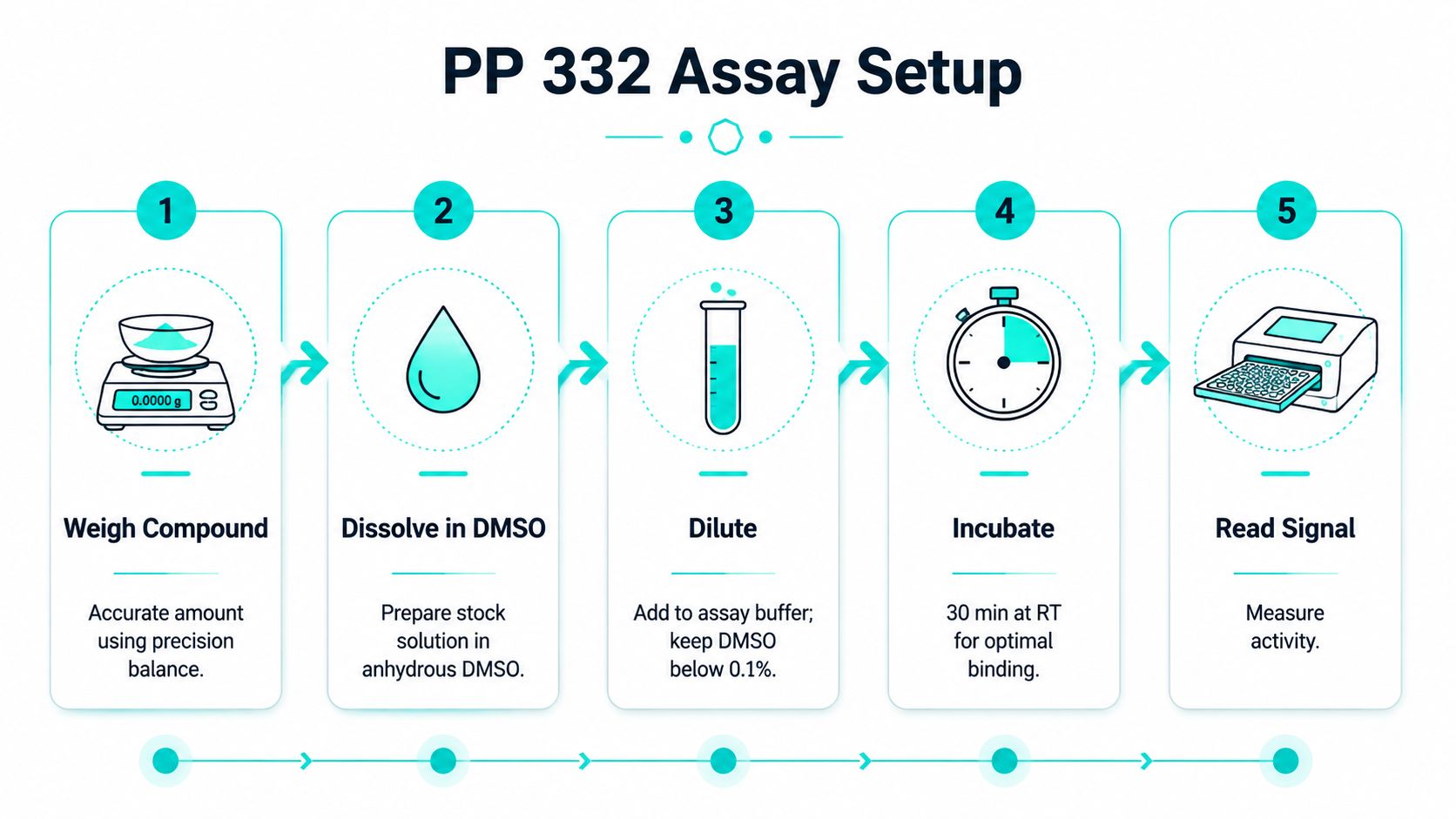
Start with a dry tube, a precision balance, and anhydrous DMSO. Make a concentrated stock, then aliquot it so you're not repeatedly thawing and refreezing the same tube. The point is to keep the compound in solution and keep the history of each aliquot simple enough to document.
The companion setup problem is the working dilution. In cell assays, you need matched DMSO controls for every condition, because solvent differences can move the readout by themselves. If the compound goes into an aqueous buffer and starts to cloud, you're no longer comparing receptor activity, you're comparing a soluble condition with a partially precipitated one.
For a new experiment, don't improvise the range. Start low enough that the vehicle doesn't dominate, then move upward only if the compound stays in solution and your assay system can tolerate the same solvent in every well. If your plate reader or cell line is sensitive to DMSO, that limitation belongs in the design phase, not in the discussion after the data look messy.
The common mistake is to interpret a flat curve as a biological negative when the compound fell out of solution. A second mistake is to push concentration until signal appears, then ignore the solvent burden that came with it.
A useful stepwise workflow is available in Celonyx Labs' reconstitution guide, but the core bench habit is the same no matter where you buy the material, control solvent exposure, document the aliquot history, and keep every comparison vehicle-matched.
The headline result around PP 332 is the mouse finding that a single daily dose increased running time by up to 70% preclinical paper. That number is real, but it only makes sense if you keep the assay context intact. It came from mouse experiments, not human performance testing, and it sits alongside metabolic readouts rather than standing alone as a magic endurance claim.
The same study reported improved fat oxidation and shifts consistent with higher mitochondrial activity preclinical paper. That pairing matters because endurance biology is not just “ran longer.” It's a linked phenotype, where behavior, substrate use, and mitochondrial signaling point in the same direction.
If you're planning a lab meeting around the result, keep your wording precise. Say the compound mimicked aspects of endurance exercise in mice, and say it activated metabolic gene programs associated with exercise preclinical paper. Don't inflate that into a claim about weight loss in people, improved athletic performance in humans, or a treatment for disease.
Group-meeting language that holds up: the best-supported claim is that SLU-PP-332 is a preclinical ERR-targeting tool that linked receptor activation to endurance-like metabolic signaling in mice.
A single daily dose can produce a striking behavioral readout, but that doesn't mean every downstream endpoint will move at the same pace. Receptor signaling can show up quickly in assay readouts, while tissue-level adaptation often takes longer and depends on how the model is built. If your lab is studying metabolic syndrome or endurance biology, separate the time scales before you compare datasets.
The safest interpretation is also the most accurate one. The compound belongs in the preclinical toolbox because it connects ERR activation to a recognizable exercise-linked phenotype. It does not justify clinical promises, and the evidence base still stops at animal work preclinical paper.
Treat PP 332 as a research-use-only material from the first moment it enters the lab. That sounds obvious, but people still blur the line when a compound has an exercise-mimetic reputation. The evidence you have is preclinical, the supplier context is research-oriented, and the published store policies exist to frame that use as laboratory work, not human or veterinary treatment supplier site.
For solid material, use the normal PPE your institution requires for hazardous powders, including gloves, eye protection, and a bench workflow that avoids aerosolizing dust. For DMSO stocks, remember that DMSO can carry dissolved material through skin more readily than plain water-based handling would suggest, so your spill discipline should be the same as for any bioactive small molecule.
Storage should prioritize dryness, limited light exposure, and minimizing repeated thaw cycles. If your lab has a chemical safety office, their disposal route should handle the waste stream, including contaminated tips, tubes, and leftover vehicle.
Any off-label human or veterinary use is outside current evidence. It's also outside the practical boundary that makes a clean experiment possible, because once a compound leaves the research setting, you've lost the discipline that ties it to a protocol, a lot, and a documented endpoint.
The right question is not whether the compound sounds promising. The right question is whether your lab can keep it inside a controlled, auditable workflow from storage through disposal.
Procurement breaks more projects than people admit. A lab can have a solid protocol and still lose a week because the paperwork doesn't match the vial, the purchase order lacks a COA, or the receiving team can't trace the lot. For a research material like PP 332, the vendor workflow should be as boring and auditable as the experiment itself.

Start with the catalog entry, then confirm that the item is identified as a research peptide category product in the site's online inventory structure. If the vendor highlights New Arrivals, Bestsellers, or stated third-party testing and 99% purity claims, treat those as procurement filters, not as substitutes for batch-specific documentation supplier overview.
A procurement officer should also look for published Terms and Conditions, Privacy, Refund and Return, and Shipping policies, because those pages tell the institution how the vendor handles receipt, dispute resolution, and delivery expectations. That matters just as much as the molecule when the lab needs an audit trail.
The supplier lists a business address at 1194 Twin Stacks Drive, Unit B, Dallas, PA 18612, a phone line at 570-761-6154, and customer support through phone and email supplier site. If your institution needs to confirm shipping status or request documentation, those are the details to hand to purchasing.
Use the vendor as a documentation source, not as a substitute for internal QC. The order should arrive with enough paperwork for your lab notebook, your purchasing office, and your compliance team to agree on what was received.
If your lab is setting up an ERR-targeting study, Celonyx Labs can supply research peptides, product documentation, and order support that fit a controlled procurement workflow. For teams comparing vendors, batch records, and catalog details around PP 332, visit Celonyx Labs and review the product pages against your own COA and assay requirements before you place the order.
Is bacteriostatic water the same as sterile water? No. Compare preservatives, vial handling and peptide

How do you know if a peptide vial has gone bad? Quarantine changes, check storage

Can too much bacteriostatic water ruin a peptide vial? Yes, if it overfills the vial
FOR RESEARCH USE ONLY. Products sold by Celonyx Labs are intended exclusively for laboratory and scientific research. They are not intended for human or veterinary use, consumption, diagnosis, treatment, cure, or prevention of any disease. By purchasing from this site, you acknowledge that you understand the intended research purpose of these materials and agree to comply with all applicable laws and regulations.