

Is bacteriostatic water the same as sterile water? No 2026
Is bacteriostatic water the same as sterile water? No. Compare preservatives, vial handling and peptide
A result shifts between two runs, and the first suspicion usually falls on the protocol. Reagents get checked, instrument settings get compared, and biological variables are reviewed. The peptide vial often receives less scrutiny, even though the supplier, batch, analytical record, transit history, and reconstitution process can all influence what reaches the assay.
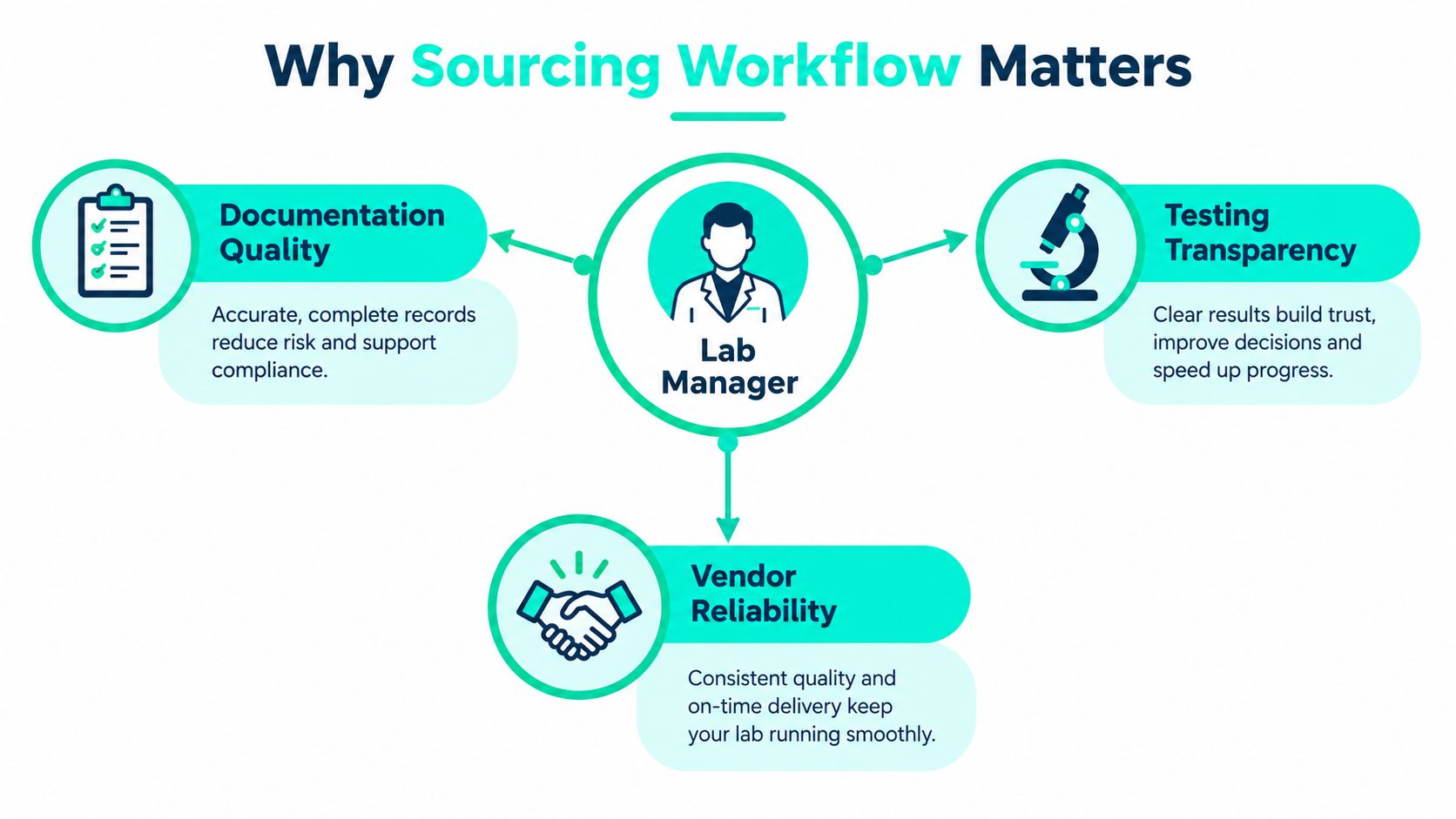
A reliable research peptides lab treats sourcing as part of experimental control. Every purchase should leave an audit trail that connects the approved vendor to the exact batch, its analytical evidence, shipping condition, storage location, and use in a defined experiment. Purity matters, but it's only one part of a defensible chain.
A run produces an unexpected result after two researchers order what appears to be the same peptide. One vial arrives with a batch-specific certificate of analysis, identity confirmation, storage instructions, and intact packaging. The other comes with a generic document, limited testing details, or no clear transit record. The powder may look identical, yet the records behind each vial support very different levels of confidence.
That difference creates experimental noise before the material reaches the bench. A supplier may report purity without establishing identity. Shipping conditions may vary between batches. An internal purchaser may retain the invoice but lose the certificate linked to the lot in question. If results later drift, the lab cannot reliably separate biological variation from procedural or material-related causes.
Practical rule: If a result cannot be linked to a specific peptide batch and its supporting records, troubleshooting remains incomplete.
Treat each purchase as an institutional procurement event, not a simple order. The investigator defines the sequence, modification, intended application, quantity, and required testing. Procurement verifies the vendor and purchasing terms. The receiving team checks the package, label, lot, and condition. The lab then records storage, reconstitution, and experimental use in a connected file.
Purity claims cover only the analytical question addressed by the test. A chromatographic result may estimate how much detected material appears in the principal peak, while mass spectrometry checks whether the molecular mass matches the intended sequence. These results answer different questions. HPLC combined with mass spectrometry gives the lab stronger evidence for material acceptance, consistent with this guidance on orthogonal peptide characterization.
The document trail needs the same level of attention. A file named “peptide COA” is insufficient if it omits the lot, test date, method, or product description. Preserve the original certificate and connect it to the purchase order, invoice, vial label, receiving record, and storage location. That chain allows another investigator to reconstruct what entered the experiment and under which conditions.
A controlled process does not require unnecessary paperwork. It requires records at the points where material identity and condition can change:
The broader peptide therapeutics market adds operational pressure to this process. One report places the market at USD 43.80 billion in 2025 and projects USD 83.80 billion by 2035 (market outlook). Those figures describe peptide therapeutics rather than the research-peptide supply chain, but they indicate a field where demand, manufacturing capacity, and purchasing complexity can affect supplier evaluation. A documented workflow helps the lab judge each batch on evidence it can retrieve, verify, and associate with the resulting data.
A purity percentage on a certificate of analysis (COA) is useful only when the lab records what the test measured. In reversed-phase HPLC, the reported value usually represents the area of the main chromatographic peak divided by the total area of detected peaks. It is therefore an analytical proportion, not proof that every molecule in the vial is the requested sequence.
For general research, 95% or greater is commonly used as a baseline, while 98–99% may be selected for quantitative assays, binding studies, structural work, or cell-based research. The appropriate threshold depends on the experiment. A preliminary screen may accept material that would compromise a sensitive receptor-binding comparison.
A 99% HPLC purity result leaves roughly 1% of detectable peptide-related material as non-target species. That fraction can include truncated sequences, deletion products, oxidation products, residual synthesis byproducts, or compounds that are poorly separated under the selected method. A small impurity fraction can still affect results if one component is biologically active, co-elutes with the target, or changes the effective concentration.
HPLC addresses separation. Mass spectrometry addresses identity by comparing measured molecular weight with the expected mass. Together, these methods provide stronger evidence that the dominant chromatographic material matches the requested peptide and can expose unexpected synthesis products.
A routine HPLC and MS panel may require only 1–5 mg of peptide, making analytical checks practical for many procurement workflows. The supporting record should identify the submitted sample, method, result, and batch. A polished PDF that cannot be connected to the vial or lot provides limited evidence.
For contamination-sensitive work, purity and identity do not cover the full quality assessment. Independent verification can examine endotoxins, heavy metals, and residual solvents. Review our third-party tested peptides overview to see how external testing is documented. The audit trail should show who performed the test, which batch was examined, and whether the method addressed the risk relevant to the experiment.
Set the evidence requirement from the application:
Purity supports a purchasing decision, but it cannot carry the decision alone. Before approving a batch, confirm that the method can detect the failure modes most likely to affect the experiment, and retain that reasoning with the procurement record.
Price is easy to compare because every catalog displays it. Documentation quality is harder to compare, but it's more useful for a laboratory that needs reproducible material and defensible purchasing records.
Start by creating a vendor file for each supplier under consideration. Record the legal business details, product documentation, testing policy, shipping terms, returns process, support contacts, and any restrictions relevant to your institution. For a broader governance perspective, resources for biotech executive leaders can help connect laboratory purchasing decisions with organizational accountability.
First, inspect the product record. Can the supplier identify the sequence, modification, physical form, intended research use, and available quantity? Avoid treating a polished catalog as proof of quality. The product page should lead to evidence, not replace it.
Next, request batch-specific documentation. A COA should identify the actual lot supplied to your lab. Check whether it reports HPLC purity, mass spectrometry identity, test methods, and relevant contaminant testing. If the document is generic, undated, or disconnected from the vial, record that limitation before approval.
Then, test the support process. Ask a technical question that requires a substantive answer, such as whether the stated purity is based on area percentage or whether third-party testing is available for the intended batch. The response reveals more than a marketing statement. A vendor that can't answer basic documentation questions before the sale is unlikely to resolve a discrepancy efficiently afterward.
The vendor qualification process can serve as a useful comparison point when building your own approval checklist. The aim isn't to copy another organization's workflow. It's to ensure your checklist covers evidence, responsibility, and follow-up.
Refund and return terms show how a supplier handles damaged, mismatched, or questionable material. Shipping policies reveal whether the vendor explains packaging, transit expectations, and responsibility for delivery problems. Fast shipping is useful when a study is scheduled, but speed doesn't compensate for missing analytical records.
A simple decision matrix keeps the review consistent:
| Criterion | What to verify | Warning sign |
|---|---|---|
| Batch evidence | COA tied to the supplied lot | Generic file with no lot link |
| Identity | Mass spectrometry or equivalent identity record | Purity only |
| Communication | Accessible support with technical answers | Benefits-focused responses |
| Policies | Clear shipping, returns, and terms | Ambiguous responsibility |
| Traceability | Invoice, lot, and product records connect | Records scattered across email |
Celonyx Labs is one catalog-based supplier that presents research peptides with stated purity attributes, independent third-party testing references, ordering information, and customer support. Treat those published claims as records to evaluate against your institutional requirements, not as a substitute for your own qualification process.
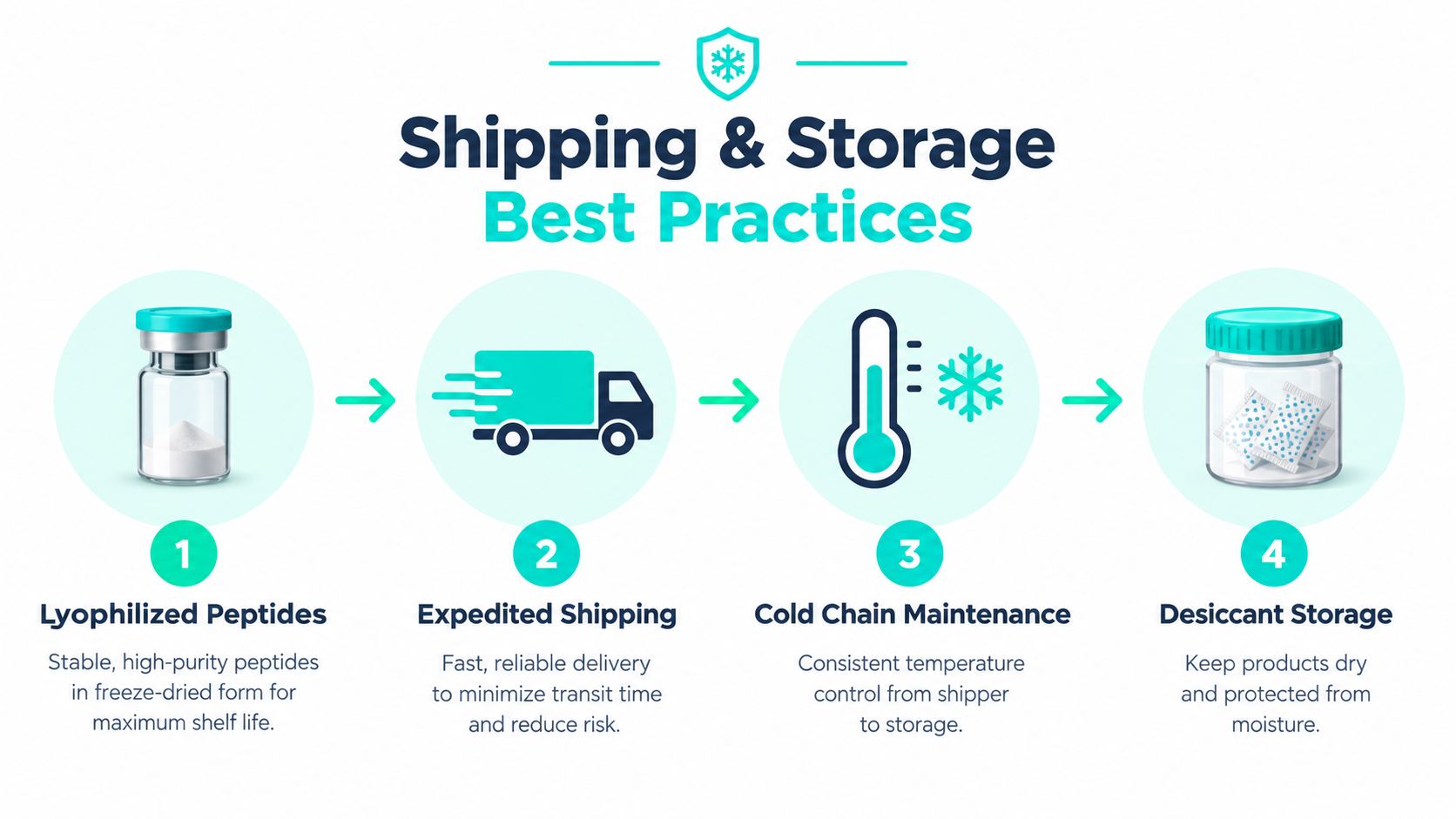
Shipping decisions should reflect the material's physical state and the lab's schedule. Lyophilized peptides are generally more stable in transit than reconstituted solutions because the dried form contains little residual moisture and travels in a sealed vial. Properly dried material with intact seals typically tolerates days at room temperature, and many sequences remain usable for weeks at 20–25°C without measurable purity loss, according to logistics guidance for research peptides (shipping and cold-chain guidance).
That doesn't make every shipping method equivalent. A delay may not immediately destroy the peptide, but it can interrupt a scheduled assay, increase handling, and expose the package to repeated temperature changes. Fast shipping often protects workflow continuity more than it protects against immediate chemical degradation.
| Choice | Where it helps | What it doesn't solve |
|---|---|---|
| Lyophilized shipment | Reduces sensitivity compared with a solution during ordinary transit | Doesn't correct a damaged seal or poor documentation |
| Expedited delivery | Limits delay and cumulative handling | Doesn't prove the vial preserved its documented quality |
| Cold-chain packaging | Adds protection during seasonal heat exposure | Adds cost and handling requirements |
| Standard packaging | May be adequate for stable, dried material and a controlled route | Offers less protection during exceptional conditions |
Short shipping excursions to 30–40°C may be acceptable over brief periods for many peptides, but the receiving decision should be based on the supplier's documented expectations, the actual condition of the package, and the intended experiment. Don't infer quality from delivery speed alone. Check the vial, seal, label, and paperwork when the parcel arrives.
For labs comparing packaging formats, it's useful to compare bulk shipping supplies by insulation, cushioning, moisture control, and handling requirements. The same principle applies to peptide shipments: evaluate the packaging system against the risk it is meant to control.
A video can help new staff visualize the handling sequence, but it shouldn't replace the supplier's written storage instructions:
At receipt, document the arrival condition before putting the vial away. Store the dried material according to the product record, protect it from unnecessary moisture, and avoid repeated removal from controlled storage. Once reconstituted, treat the solution as a different material with its own stability and handling considerations.
The peptide order-to-freezer workflow is a useful model for assigning responsibility across receiving, verification, labeling, and storage. Your local procedure should state who checks the parcel, who approves release for use, and where the associated records live.
A peptide purchase becomes institutionally defensible when another person can reconstruct what happened without relying on memory. That reconstruction should connect the request, approval, order, shipment, analytical record, receipt, storage location, and experiment.
The purchase order establishes what the lab intended to buy. The invoice shows what the supplier charged and supplied. The COA supports the quality record for the batch. The safety data sheet and product documentation help staff understand handling and hazards. Shipping and return policies define the operational terms under which the transaction occurred.
Store related files under a controlled naming convention that includes the product identifier and lot. Keep the original supplier documents rather than copying only the purity result into a spreadsheet. If a revised COA arrives, preserve the previous version and record why the replacement was accepted.
A useful procurement packet contains:
The sequence matters. A COA downloaded after an experiment may document a product family, but it doesn't necessarily prove that the tested batch was the one used. Make the batch link at receipt, while the vial and packaging are still available for inspection.
Institutional compliance works best when the lab assigns ownership. Procurement shouldn't be expected to interpret every analytical result, and researchers shouldn't have to reconstruct shipping details months later. Define handoffs in the standard operating procedure, then make the record easy enough that staff will complete it.
Audit test: Give a colleague the purchase order, COA, inventory entry, and experiment record. If they can't identify the exact material used, the workflow has a traceability gap.
Research-use-only status also needs to remain clear in the record. It defines the intended laboratory lane, not a quality grade or evidence of human or veterinary safety. Purchasing language, product documentation, storage labels, and internal forms should all preserve that distinction.
When a peptide-linked result changes, don't immediately redesign the assay. First determine whether the material, documentation, and handling remained consistent. A controlled investigation starts with the batch used, not the product name remembered by the researcher.
Place the current and prior records side by side. Compare the sequence and modifications, lot identifiers, HPLC method, reported purity, identity evidence, physical form, vial condition, and storage history. If the supplier changed manufacturing or documentation between lots, record that difference even when the catalog description looks unchanged.
Then examine the preparation record:
A purity label doesn't explain every variability event. HPLC area percentage can't establish all biological behavior, and a matching identity result doesn't guarantee that preparation was consistent. The investigation should therefore compare the full sourcing chain with the experimental timeline.
If the record is incomplete, quarantine the affected data for review and improve the receiving form. If the vial and COA don't match, stop using the material until procurement or quality staff resolve the discrepancy. If reconstitution records are inconsistent, standardize the preparation worksheet and train every operator against the same procedure.
For recurring problems, introduce a retained sample or batch comparison plan appropriate to the study. Use the same vendor, defined documentation requirements, and controlled storage process when the experiment depends on comparison across time. Don't change supplier, formulation, and assay conditions simultaneously, because that removes your ability to identify the cause.
A reliable research peptides lab makes sourcing visible in the final dataset. Record the supplier, product identifier, lot, COA location, storage history, preparation details, and operator with the experiment. That small discipline turns a vague result discrepancy into a solvable investigation.
Celonyx Labs supplies research peptides through an online catalog and presents product documentation, stated purity attributes, independent third-party testing references, shipping information, and customer support for laboratory buyers. Visit Celonyx Labs to review the available research materials and align your purchase records with a documented sourcing workflow.
Is bacteriostatic water the same as sterile water? No. Compare preservatives, vial handling and peptide

How do you know if a peptide vial has gone bad? Quarantine changes, check storage

Can too much bacteriostatic water ruin a peptide vial? Yes, if it overfills the vial
FOR RESEARCH USE ONLY. Products sold by Celonyx Labs are intended exclusively for laboratory and scientific research. They are not intended for human or veterinary use, consumption, diagnosis, treatment, cure, or prevention of any disease. By purchasing from this site, you acknowledge that you understand the intended research purpose of these materials and agree to comply with all applicable laws and regulations.