

Is bacteriostatic water the same as sterile water? No 2026
Is bacteriostatic water the same as sterile water? No. Compare preservatives, vial handling and peptide
You're probably in one of two situations right now. Either a semaglutide vial just arrived and you need to decide whether it's fit to enter a study, or you're still at the vendor-screening stage and trying to avoid building a long experiment on weak material. In both cases, the same problem shows up fast. With research peptides semaglutide, the science is only half the job. The other half is operational discipline.
Semaglutide matters because it's a strong tool for metabolic research, but it also exposes every soft spot in a lab workflow. Poor documentation, casual reconstitution, unclear salt forms, and vendor claims that don't hold up under scrutiny can all distort downstream data. A clean readout starts long before the first assay plate.
This guide stays on the preclinical side. It doesn't offer clinical advice. It focuses on what researchers need at the bench and in procurement: how the molecule is built, why that matters experimentally, what handling practices preserve integrity, and how to think clearly about vendor quality. If you need a broader orientation to peptide materials before getting into semaglutide specifically, this overview of research peptides is a useful starting point.
Semaglutide has become a central tool in metabolic research because it gives investigators a durable, pharmacologically relevant way to interrogate GLP-1 signaling. In practical terms, that means one molecule can support work on insulin secretion, appetite regulation, glucagon biology, gastric emptying, and broader metabolic adaptation without the short-lived behavior that limits native GLP-1.
That usefulness is why so many labs move toward it quickly. It's also why sloppiness around material quality becomes expensive. If the peptide identity is uncertain, if the concentration calculation is based on nominal vial weight instead of net peptide mass, or if the reconstituted stock has already aggregated, the study starts with hidden error.
For new team members, the right mindset is simple. Treat research peptides semaglutide like a high-value reagent that demands chain-of-custody thinking. You need batch documentation, an explicit handling SOP, and a repeatable plan for stock preparation.
Practical rule: If you can't reconstruct what lot was used, how it was dissolved, and how many freeze-thaw events occurred, you can't confidently interpret a surprising result.
The labs that get reliable data usually aren't doing anything flashy. They're controlling variables that other groups leave vague.
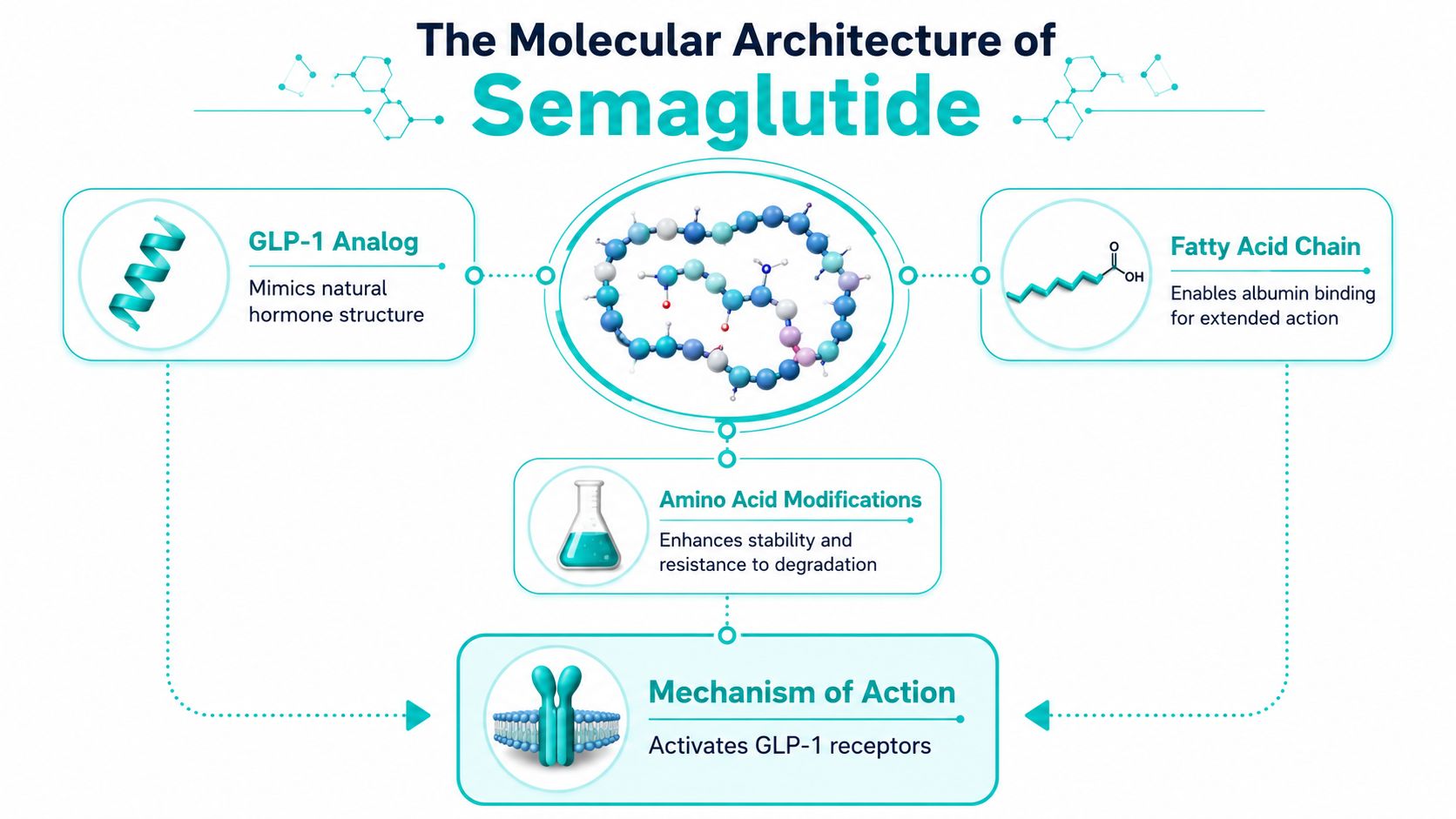
Semaglutide isn't just “another GLP-1 analog.” Its design is the reason it behaves so differently from native GLP-1 in experimental systems. According to the FDA document describing semaglutide's structure, synthetic semaglutide is a 31-amino acid GLP-1 receptor agonist with the molecular formula C187H291N45O59 and a molecular weight of 4,113.58 g/mol.
Two structural choices matter most.
First, semaglutide includes an Aib substitution at position 8. That change improves resistance to proteolytic degradation. Native GLP-1 is short-lived. The semaglutide scaffold is engineered to avoid disappearing almost immediately after exposure in vivo.
Second, a C18 diacid fatty side chain is attached to lysine at position 20. That side chain promotes albumin binding. In practice, albumin binding acts like a buffering system that slows clearance and extends exposure. The same FDA-linked source notes that these modifications extend semaglutide's half-life to approximately 7 days in vivo, compared with native GLP-1's 2-minute half-life.
A simple way to think about it is this. Native GLP-1 behaves like a signal written on a whiteboard in a busy room. It gets erased almost at once. Semaglutide behaves more like a laminated protocol card clipped to the bench. The signal persists.
Those molecular features affect more than pharmacology. They influence how you should think about formulation, assay timing, and stock management.
A few practical consequences show up repeatedly:
Don't treat semaglutide like a generic powder that only needs to be “mixed and used.” Its structure is doing real work, and your handling protocol has to respect that.
Researchers who understand the architecture usually make better decisions downstream. They choose more appropriate assay intervals, ask better questions about vendor documentation, and recognize why concentration accuracy and storage discipline are indispensable.
Semaglutide is most valuable when a study needs sustained GLP-1 receptor engagement rather than a brief pulse. That distinction changes which biological questions it can answer well. The compound's relevance isn't limited to weight-related readouts. It's useful wherever durable modulation of glucose handling, feeding behavior, and endocrine signaling helps clarify mechanism.
According to this semaglutide market and clinical summary, semaglutide has 94% structural homology to human GLP-1, demonstrated 14.9% body weight reduction in obesity trials versus 8.0% for liraglutide, and oral semaglutide achieved 16.6% body weight loss in Phase 3 trials. The same source states that semaglutide enhances glucose-dependent insulin secretion, slows gastric emptying, and reduces glucagon release. It also notes 89% bioavailability for subcutaneous formulations, an elimination half-life of approximately one week, steady-state exposure after 4 to 5 weeks of weekly administration up to 2.4 mg, and clinical efficacy including HbA1c reduction of 1.8% and body weight reduction of 6.1 kg. The source further says metabolic disorders accounted for nearly two-thirds of the global peptide market in 2025 as a projection.

In preclinical settings, semaglutide is often a strong fit for studies such as:
| Research area | Why semaglutide fits |
|---|---|
| Metabolic syndrome models | Sustained receptor activity helps reveal cumulative effects on body weight, glycemic control, and feeding behavior |
| Beta-cell and insulin studies | Glucose-dependent insulin secretion makes it useful for studying regulated endocrine response rather than blunt stimulation |
| Appetite and CNS pathway work | Reduced food intake and satiety-related biology can be studied over longer windows without constant redosing |
| Glucagon and hepatic signaling | Lower glucagon output helps investigate downstream metabolic coordination |
| Integrated physiology studies | Gastric emptying effects allow researchers to observe whole-system responses, not just isolated receptor activation |
Research peptides semaglutide often outperform earlier compounds in practical use. The molecule gives enough persistence to support repeated observation across a meaningful window, which reduces the need to force the model with frequent intervention.
Long action is useful, but it also introduces trade-offs.
If a protocol needs a sharp on-off signal, semaglutide may not be the best tool. Carryover effects can blur interval-based comparisons. Washout planning matters more. Vehicle controls need to be tighter. So does scheduling around feeding and sample collection.
Researchers also need to distinguish mechanism from convenience. It's tempting to choose a long-acting peptide because it simplifies dosing. That's not a good enough reason on its own. Choose it when the biology of sustained GLP-1 receptor activation is part of the experimental question.
A good design usually asks one of these things clearly:
When those questions are explicit, semaglutide becomes a precise tool rather than a fashionable reagent.
Bad peptide handling can subtly ruin a study. The stock may still look usable, and the assay may still produce signal, but the data become harder to trust. With semaglutide, most preventable failures happen during reconstitution and post-reconstitution storage.
Start with the handling logic before the first pipette movement. You're trying to preserve peptide integrity, avoid localized aggregation, and ensure that every aliquot used later reflects the concentration you think it does.
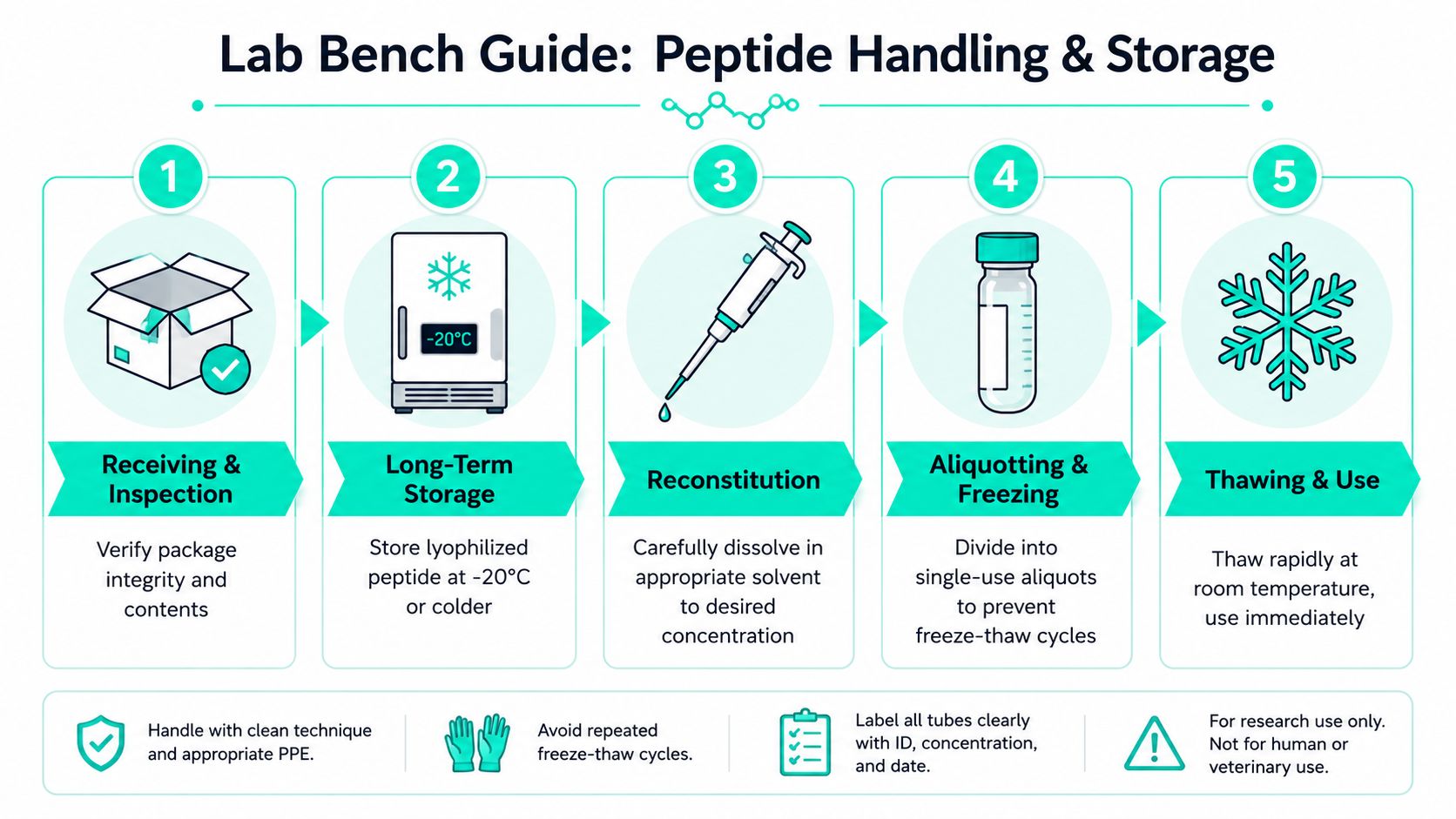
The most useful operational guidance comes from the laboratory reconstitution protocol for semaglutide research peptide. That source states that researchers should use 0.5–1% acetic acid in sterile water or 0.9% saline as the diluent. It also specifies that the liquid should be added dropwise while directing the stream along the vial wall, and that the vial should be gently rolled without vortexing to reduce foam formation and denaturation.
Use this as a bench sequence:
A cloudy stock is not a minor cosmetic issue. It's a warning that your starting material may no longer be behaving predictably.
Here's the YouTube walkthrough specified for this topic:
The same reconstitution source states that reconstituted semaglutide should be immediately aliquoted into single-use portions and stored at -80°C for any duration beyond one week, because mishandled or warmer-stored solutions can degrade and aggregate rapidly. That point deserves emphasis. The main enemy isn't only time. It's repeated handling.
A sound storage routine usually includes:
If your group needs a companion SOP for post-reconstitution workflow, this guide on storing reconstituted peptides is a practical reference.
What doesn't work is the casual method many labs apply to low-risk reagents. Reconstituting a vial, using part of it, putting the rest back, and relying on memory later is how concentration drift and degradation end up hidden inside “biological variability.”
Most semaglutide problems begin before the box reaches the freezer. They start in procurement, when a lab accepts a purity claim without checking what it proves. With research peptides semaglutide, quality assurance isn't a paperwork exercise. It's the gate that determines whether your assay is measuring biology or supplier variance.
The most important distinction is between material that has documented identity and sterility controls, and material that mainly has persuasive labeling. According to this analysis of compounded and nonregulated semaglutide products, there is a major gap between FDA-regulated semaglutide salts and unapproved research or compounded semaglutide in terms of impurity profiles and sterility. The same source reports that non-FDA-approved compounded semaglutide salts contain high levels of known and unknown impurities, while pharmaceutical-grade versions undergo mandatory sterility and purity testing.
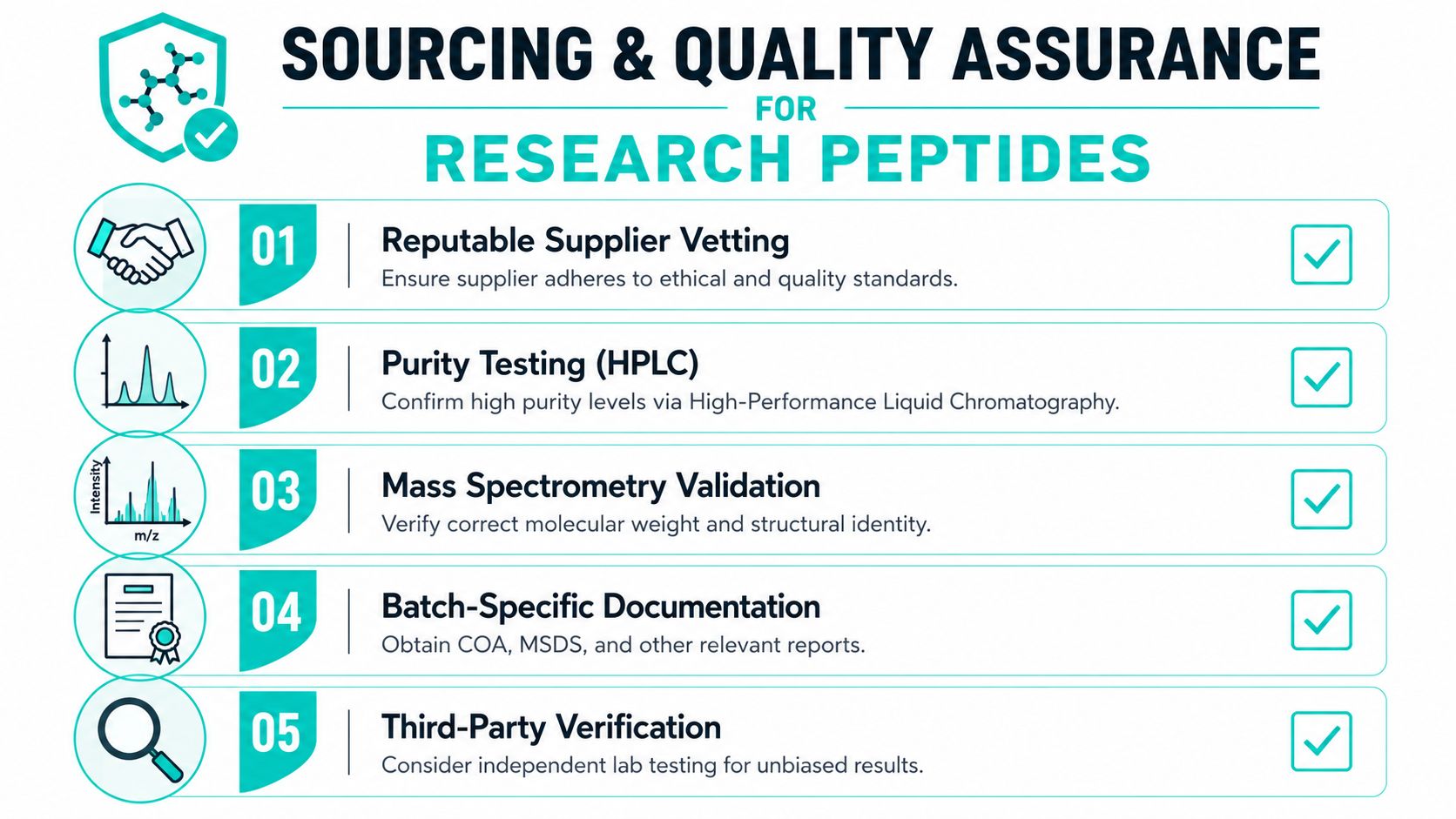
A vendor should be able to provide more than a headline purity number. At minimum, inspect the documentation as if you may need to defend that reagent choice in a lab meeting, an internal audit, or a manuscript methods section.
Use this checklist:
For labs building a more formal incoming-material review, this peptide reference standard guide offers a useful framework for thinking about reference materials and documentation standards.
“Research use only” is a label, not a performance guarantee. It doesn't establish assay suitability, contamination limits, or consistency across lots. It often just limits the seller's stated intended use.
That ambiguity matters especially with semaglutide salts. Different forms can affect impurity burden, handling assumptions, and confidence in reproducibility. If a vendor can't explain the form supplied, the associated analytical data, and how that batch was verified, the burden shifts to your lab.
Procurement should ask one question first: what evidence would convince us this vial is not suitable? If the answer is unclear, the acceptance process is too loose.
What works in practice is a layered standard. Review the CoA. Review the identity data. Ask direct questions. Compare documents across batches. If the project matters, treat independent confirmation as part of the study budget, not an optional extra.
What doesn't work is relying on website copy, generic PDFs, or a single purity number divorced from batch-level evidence.
Treat different semaglutide forms as analytically distinct until documentation proves equivalence for your intended use. Don't assume that a sodium or acetate form sold for research behaves like a regulated finished pharmaceutical product just because the name “semaglutide” appears on the label.
The practical issue is not only nomenclature. It's whether the supplied form has clear identity confirmation, impurity characterization, and handling guidance that match your study design. If those details are missing, reproducibility suffers first.
Most labs can still improve their screening process without an in-house analytical chemistry platform.
Start with a structured intake review:
That process won't replace formal verification, but it does reduce avoidable risk.
No. It addresses one question, and often only partially.
According to this reporting on online GLP-1 research vendors and FDA warning activity, vendors often claim 99% purity, yet only 4 out of 38 online vendors selling GLP-1s for research required buyers to verify researcher status, and none verified it. The same source says recent FDA warning letters described such products as unapproved and misbranded because the labeling and website presentation diverged from true research-only intent.
That tells you something important. A market can use the language of research while applying very little real gatekeeping.
If a supplier makes it easy for anyone to buy and hard for a qualified lab to verify documentation, the problem isn't marketing tone. The problem is quality culture.
A CoA is necessary, but it isn't self-authenticating. Read it as a claim package that still needs context.
The strongest CoAs are specific, current, and technically coherent. Weak ones tend to be generic, hard to tie to a lot, or built around one attractive purity figure with little supporting detail. If a study is high value, assume a vendor-issued CoA is the start of validation, not the end.
In many labs, the culprit is process drift rather than a dramatic reagent failure. A new batch may arrive with slightly different paperwork quality. A different staff member may reconstitute the stock using a faster but rougher method. Aliquots may be stored less carefully because “the assay worked last time.”
That's why semaglutide programs need written controls. Good lots can still produce bad data when bench handling becomes informal.
Semaglutide can be an excellent research tool when the lab treats it as both a biological probe and a controlled material. The molecule's design makes it powerful for sustained GLP-1 pathway work. That same design also makes weak handling and weak sourcing more costly.
The labs that get credible data usually do four things well. They understand the structure well enough to predict experimental behavior. They choose semaglutide for questions that benefit from durable receptor engagement. They reconstitute and store the material with strict consistency. And they refuse to outsource quality judgment to a product page.
Research peptides semaglutide don't reward casual workflows. They reward documentation, repeatable bench technique, and skeptical procurement habits. If you build those controls into the program early, semaglutide becomes far easier to use well and far less likely to introduce hidden variability.
Reliable peptide research rarely depends on one heroic decision. It depends on many small correct ones, repeated every time.
If your lab needs a supplier that understands those documentation and handling standards, Celonyx Labs is worth reviewing. Their catalog is built for research buyers, with published quality commitments, third-party testing references, and customer support that fits laboratory procurement workflows.
Is bacteriostatic water the same as sterile water? No. Compare preservatives, vial handling and peptide

How do you know if a peptide vial has gone bad? Quarantine changes, check storage

Can too much bacteriostatic water ruin a peptide vial? Yes, if it overfills the vial
FOR RESEARCH USE ONLY. Products sold by Celonyx Labs are intended exclusively for laboratory and scientific research. They are not intended for human or veterinary use, consumption, diagnosis, treatment, cure, or prevention of any disease. By purchasing from this site, you acknowledge that you understand the intended research purpose of these materials and agree to comply with all applicable laws and regulations.