

Is bacteriostatic water the same as sterile water? No 2026
Is bacteriostatic water the same as sterile water? No. Compare preservatives, vial handling and peptide
You've found two Selank listings that look nearly identical. One is cheaper, ships quickly, and includes a polished PDF. The other costs more and comes with a lot-specific chromatogram, mass-spectrometry result, and a traceable label. The first vial fails identity testing after it reaches your lab. The price difference has now become the least important part of the purchase.
That's the risk behind every search for Selank peptide for sale. You aren't choosing between ordinary retail products. You're procuring a research reagent whose usefulness depends on identity, purity, handling, and documentation that all point to the same batch. A defensible purchase starts before checkout and ends only after the vial passes receiving inspection.
Selank is a synthetic heptapeptide derived from the immune peptide tuftsin. It was developed in Russia in the 1990s and received Russian Ministry of Health approval in 2009 as a prescription anxiolytic nasal spray for generalized anxiety disorder, according to the clinical and regulatory summary from PeptidePedia's Selank overview. Reports summarizing the Russian clinical record describe a program involving roughly 800 patients across trials, with a well-known comparative study published in 2008. Those historical facts explain why Selank has a regulatory identity in Russia that many research buyers in other countries won't find elsewhere.
That status doesn't transfer automatically across borders. Selank hasn't received FDA, EMA, or MHRA approval, so buyers in major Western markets generally encounter it as a research or non-Western clinical compound, not as a routinely dispensed medicine. Current procurement summaries describe a 0.15% nasal spray in Russia, while also noting that no major Western trial has reproduced the Russian findings. See the Selank frequently asked questions and evidence summary for that distinction.
Procurement rule: If local approval doesn't establish the product's identity for your experiment, the vendor's batch documentation has to do that job.
In practice, the buyer must evaluate purity, identity, traceability, and handling rather than treating a marketplace listing as proof of quality. A peptide can carry an attractive purity headline and still raise questions about truncated sequences, synthesis-related variants, residual solvents, counterion identity, or contamination. The documentation chain is what lets you connect the material in the vial to the material described on paper.
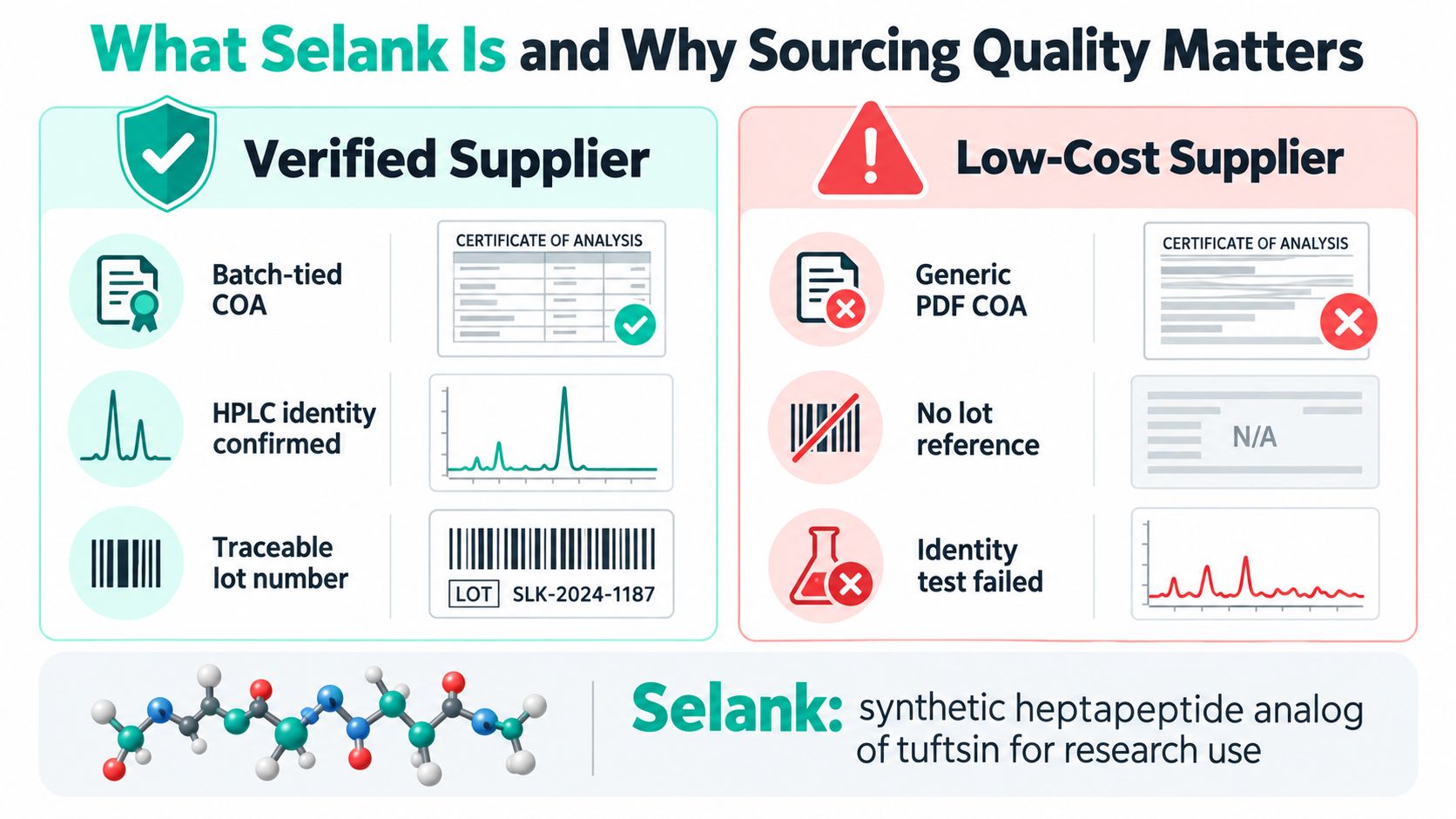
A buyer should therefore define acceptance criteria before contacting suppliers. Require a lot number, analytical method, identity result, and clear research-use labeling. If a vendor can't provide those items before payment, the low price isn't a bargain. It's an unresolved experimental variable.
Start with the supplier, not the vial. A vendor that can't identify the legal business behind the storefront won't become more accountable after receiving payment.
Ask for the company's legal name, physical address, reachable support contact, and a history that connects the business to research chemicals or laboratory supplies. A domain alone proves very little. Public policies, consistent contact details, and a response that directly answers technical questions are more useful signals.
Next, request the COA for the exact lot you'll receive. A generic certificate bearing only the product name is not enough. The practical benchmark for research material is lot-level reverse-phase HPLC with mass-spectrometric identity confirmation. Independent COA guidance includes an example showing 99.3% purity by HPLC-UV, a ≥98.0% specification, and USP <621> RP-C18 conditions at 220 nm, but the value lies in the matched trace and identity data, not in the headline percentage alone. Review the Selank COA example and analytical guidance.
Use this priority order:
The supplier should also state net peptide content, not just gross vial weight. “5 mg vial” can be ambiguous if the seller doesn't explain whether the figure describes active peptide or total contents.
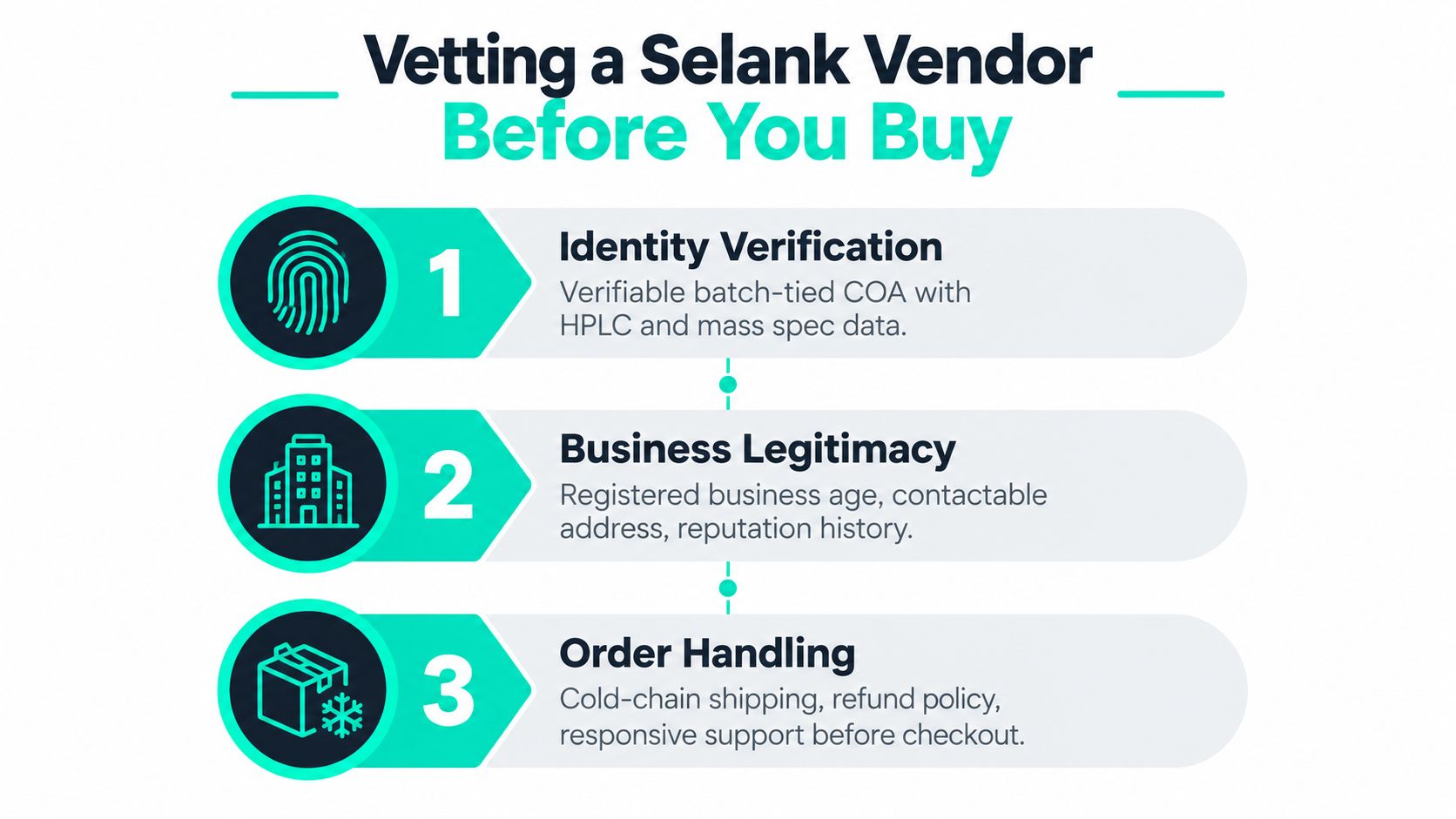
Ask whether the package will carry For Research Use Only or Not for Human Consumption labeling. Confirm that temperature-sensitive shipments use appropriate insulation and tracking, and ask what happens if the parcel arrives warm, damaged, or mismatched.
For a broader purchasing framework, use this vendor due diligence checklist to verify suppliers before contracting. You can also compare your internal approval sequence with a documented vendor qualification process before issuing a purchase order.
Don't release payment until the vendor has answered the technical and operational questions in writing. A responsive supplier isn't automatically qualified, but an evasive supplier has already failed a basic procurement test.
A COA is useful only when it lets you reject a questionable lot. Read it as a chain of linked records, not as a decorative PDF.
Begin with the lot number. Compare it with every vial label, the invoice, packing slip, and any shipping insert. One mismatch is enough to quarantine the material. A certificate for the right product but the wrong lot doesn't support the vial in your possession.
Then inspect the HPLC result. The main peak area is the headline purity measurement, and your written specification should state the minimum you'll accept. The cited Selank analytical example reports 99.3% HPLC-UV purity against a ≥98.0% specification using USP <621> RP-C18 at 220 nm in the referenced COA. Don't stop at the number. Request the chromatogram, method conditions, integration approach, and visible secondary peaks.
Mass spectrometry answers a different question. HPLC indicates chromatographic composition, while MS helps confirm molecular identity. For Selank acetate, compare the observed molecular ion with the calculated monoisotopic mass, reported in the buyer brief as near 751.9 Da. The stated acceptance window in that brief is within 0.5 Da of the calculated value. Treat missing mass data as an identity gap, not as an administrative omission.
Net peptide content also deserves scrutiny. Gross vial weight can include salts, residual moisture, counterions, or other non-peptide material. If the vendor provides only a gross weight and no active-content basis, you can't reliably calculate the amount entering your assay.
| COA Field | Acceptable Result | Red Flag to Reject |
|---|---|---|
| Lot number | Matches vial, invoice, and shipping records | Any lot mismatch |
| HPLC method | Named reverse-phase method with trace | Purity number without chromatogram |
| HPLC purity | Meets your written specification | Unexplained secondary peaks or below-spec result |
| Mass spectrometry | Observed mass aligns with expected identity | No MS result or unclear analyte |
| Peptide content | Net active peptide stated | Gross weight presented as active content |
| Laboratory details | Named testing laboratory and report date | Anonymous PDF or unverifiable issuer |
| Traceability | Complete lot and sample references | Product name only |
For a purchasing team comparing documentation across suppliers, this third-party-tested peptide resource provides a useful reference point. Reject the order if the supplier refuses to provide the underlying report, changes the lot after payment, or sends an image that can't be matched to the physical label.
A research-use label doesn't replace institutional approval. Before checkout, confirm that your laboratory permits procurement of synthetic peptides and that the planned work fits an approved in-vitro or controlled preclinical research program.
Document the research purpose in the purchase request. The record should identify the responsible principal investigator, protocol or project reference, intended model, and handling group. Keep the purpose factual. Don't describe Selank as a treatment, supplement, or personal-use product.
The vendor should label both the vial and outer packaging for research use. If the seller won't provide For Research Use Only or Not for Human Consumption labeling, stop the order. That omission creates avoidable confusion during receiving, storage, audits, and disposal.
Country rules require separate attention. Selank is approved as a prescription anxiolytic nasal spray in Russia, but it remains unapproved by the FDA, EMA, and MHRA, as summarized in the Selank regulatory overview. Researchers in Australia, Canada, and the United Kingdom may also face national rules affecting peptide analogs, while U.S. institutional policies still control how a laboratory may purchase and use research chemicals.
Audit standard: The purchase record should explain who approved the material, why the lab needs it, and which study will use it.
| Document | Purpose |
|---|---|
| Invoice or purchase order | Establishes supplier, product, lot, quantity, and cost |
| Lot-specific COA | Supports purity and identity review |
| Shipping record | Documents custody and delivery condition |
| Protocol or study reference | Connects the material to an approved research purpose |
| Receiving log | Records inspection, quarantine, and release decision |
| Complaint or deviation record | Preserves evidence if the shipment fails acceptance |
Don't store sensitive personal or institutional information casually in supplier systems. If your procurement workflow raises data-protection questions, you can contact DilicheckRep for GDPR help. The immediate compliance priority remains simple: retain the records that connect the order to the lab, the lot, and the authorized research activity.
Treat the lyophilized vial as a temperature-sensitive reagent as soon as it leaves the supplier. The label and the project's written stability procedure should control final storage, but a practical receiving plan separates short-term use from archival retention.
If you expect to reconstitute the vial within days, place it at 2–8°C. For a short-term archive, use -20°C. A vial held longer than 30 days should move to -80°C, with the desiccant intact, according to the handling plan in the brief. Protect the material from moisture, light, and avoidable temperature cycling.
Reconstitution is a calculation, not a guess. If the vial contains a known net peptide mass and you want a working concentration of 1 mg/mL, divide the peptide mass by the target concentration to determine the diluent volume. A vial containing 5 mg of net peptide would require a total volume of 5 mL for that target concentration, provided the product label confirms that 5 mg describes active peptide rather than gross contents.
Use an appropriate sterile laboratory diluent and follow your institution's aseptic procedure. The peptide reconstitution guide can serve as a general workflow reference, but it doesn't replace your validated protocol or compatibility review.
After reconstitution, prepare single-use aliquots sized for the assay schedule. Repeated freeze-thaw cycles create unnecessary uncertainty, especially when the experiment compares behavioral or biochemical endpoints across lots. Label each aliquot with lot, concentration, preparation date, analyst initials, and storage location.
Before accepting the parcel into inventory, check the insulation, coolant, and temperature indicator when used. For transit expected to exceed 48 hours, require insulated packaging, phase-change coolant, and a temperature indicator. A warm ice pack or thawed gel pack doesn't prove degradation, but it is a deviation that should trigger quarantine and a vendor discussion.
Record the arrival condition in the same file as the COA. The goal is continuity, from shipping container to freezer to assay, not merely a cold vial at the end of the process.
A delivered vial isn't ready for the working freezer. It first belongs in a clearly marked quarantine zone, physically separated from released inventory. This prevents a mislabeled or damaged lot from entering an experiment while procurement staff are still resolving paperwork.
Check the lyophilized cake under suitable lighting. It should be white to off-white, uniform, and free from obvious discoloration or collapse. Record what you see rather than relying on memory.
Inspect the rubber stopper and crimp seal for punctures, looseness, or damage. Confirm that the printed product name, vial size, lot number, and any research-use statement are legible. Compare the lot to the COA included in the parcel and to the invoice. Photograph discrepancies according to your institution's deviation procedure.
A vial can look normal and still fail identity testing, so visual inspection is only the first gate. It confirms packaging condition, not molecular authenticity.
A laboratory may use UV absorbance at 280 nm against a calculated extinction coefficient or compare the result with a vendor-supplied reference spectrum. This is a screening tool for a gross mismatch, not a replacement for HPLC and MS. It can flag a material that behaves unlike the expected peptide before the lab commits the lot to a full assay.
Keep the screen tied to the same lot number. Log sample preparation, dilution, instrument, analyst, and result. If the signal is inconsistent with expectations, leave the vial quarantined and request clarification or confirmatory testing.
Release the lot only when these records agree:
Receiving decision: No paperwork match, no bench release.
If the vial fails a gate, don't “test it anyway” because the project is urgent. Quarantine it, notify the supplier in writing, and preserve the shipment condition, photographs, and records. That response protects both the experiment and the lab's future purchasing decisions.
A first-time buyer should be able to run the same process without relying on personal judgment. Print this checklist, attach it to the purchase file, and require a completed record for every lot.
Vendor vetting: Confirm the business identity, contact details, operating history, research-use terms, and complaint policy. Ask for the lot-specific COA before approving the order.
Identity review: Check that the COA names the analytical methods, includes HPLC data, and provides mass-spectrometry confirmation. The lot number must match the proposed vial.
Quantity and purity review: Verify net peptide content, physical form, counterion information where relevant, and the laboratory's written purity requirement. Don't accept a gross-weight claim as active-content evidence.
Commercial terms: Record payment conditions, refund or replacement terms, order changes, and the person responsible for resolving a failed lot. A procurement file should show what happens after rejection.
Shipping verification: Confirm insulation, coolant, tracking, research-use labeling, and any temperature indicator required by the transit plan. Save the shipping instructions with the purchase order.
Arrival logging: On delivery, record package condition, coolant state, vial appearance, seal integrity, lot number, and receipt date. Match the physical vial to the COA before moving it into inventory.
Quarantine and storage: Hold the lot separately until document review and identity screening are complete. After release, record storage location, concentration, aliquot details, and the next review or retest decision.
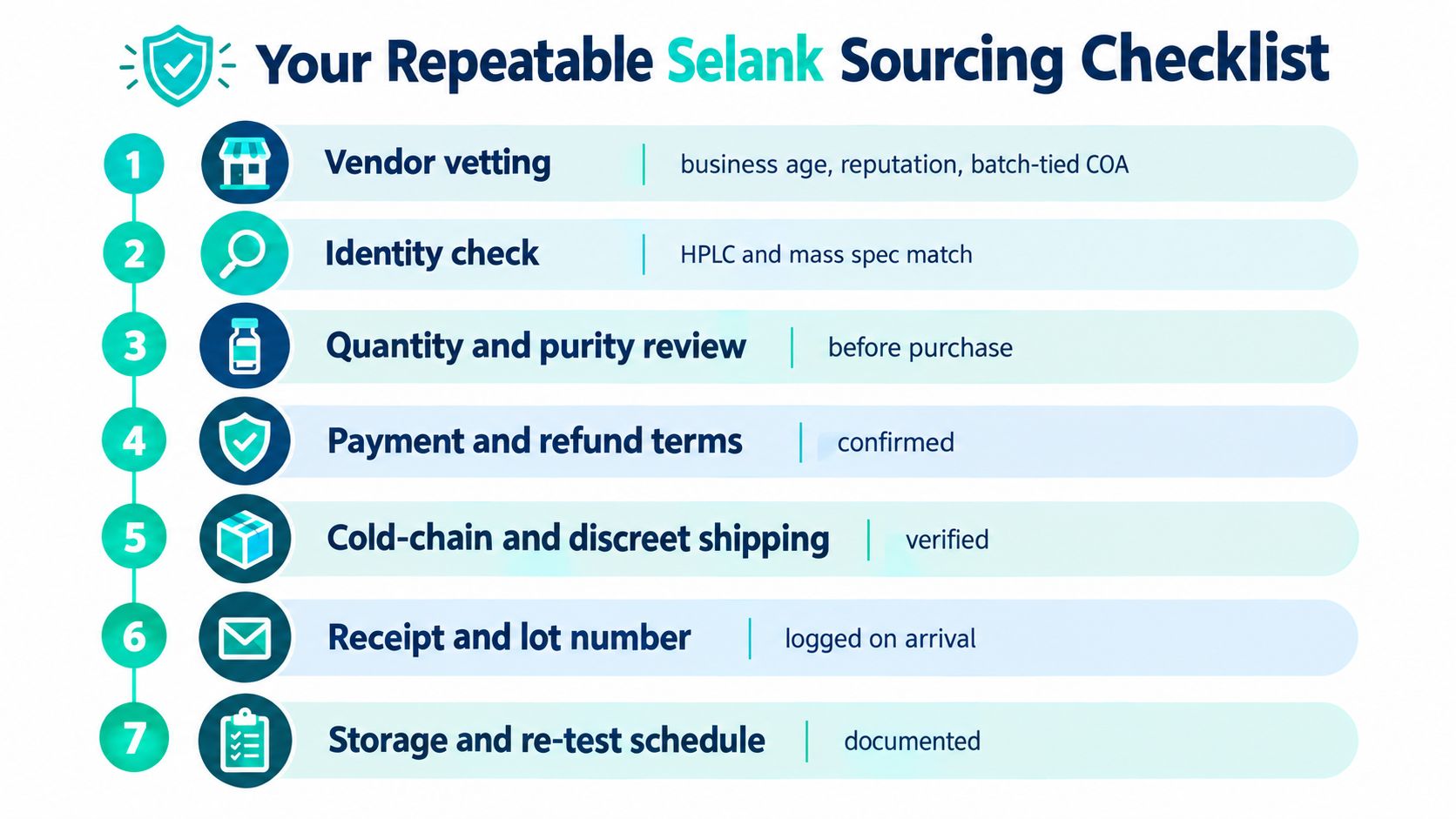
Archive the COA, invoice, packing slip, shipping record, receiving photographs, quarantine decision, and assay reference under the lot number. That filing convention lets a new buyer or auditor reconstruct the order without searching through disconnected email threads.
Celonyx Labs lists research peptides through an online catalog and describes 99% purity and independent third-party testing for its products. If its Selank listing fits your protocol, review the lot documentation, research-use terms, shipping policy, and acceptance process against this checklist before ordering through Celonyx Labs.
If your lab is sourcing Selank for controlled research, use Celonyx Labs as one supplier to evaluate, then request the batch-tied documentation needed for your acceptance criteria before money changes hands. Visit Celonyx Labs to review its research peptide catalog, product information, and purchasing policies.
Is bacteriostatic water the same as sterile water? No. Compare preservatives, vial handling and peptide

How do you know if a peptide vial has gone bad? Quarantine changes, check storage

Can too much bacteriostatic water ruin a peptide vial? Yes, if it overfills the vial
FOR RESEARCH USE ONLY. Products sold by Celonyx Labs are intended exclusively for laboratory and scientific research. They are not intended for human or veterinary use, consumption, diagnosis, treatment, cure, or prevention of any disease. By purchasing from this site, you acknowledge that you understand the intended research purpose of these materials and agree to comply with all applicable laws and regulations.